This article explores how the oracle mechanism works and how the system is structured. By understanding these foundations, you can develop a clearer view of decentralized data access, along with its security model and practical limitations.
Why Do Smart Contracts Need Oracles?
Blockchain systems are built on deterministic execution. Every node must reach the same result when given the same inputs. To preserve this property, smart contracts can only access data that already exists on-chain, such as account balances or transaction records. They cannot directly access internet data or real world information.
Yet many blockchain applications depend on off chain data. Financial protocols rely on asset prices for calculations. Insurance applications need confirmation that a real world event has occurred. Automated contracts may depend on timestamps or environmental data as trigger conditions. Without a reliable input mechanism, smart contracts would be confined to a closed system, severely limiting their use cases.
Oracle mechanisms bridge this information gap. They allow blockchains to connect with the real world without compromising decentralization or verifiability.
How Does the Chainlink Oracle Network Work?
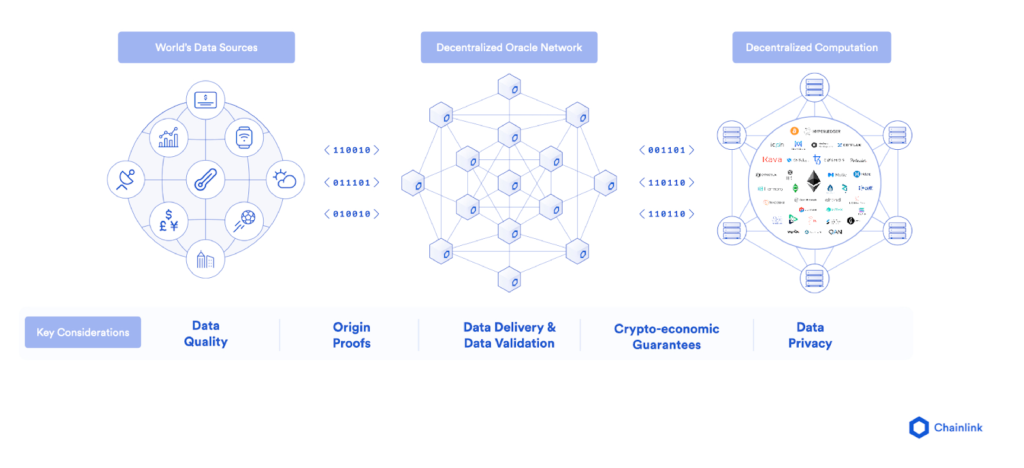
Chainlink introduces off chain data to blockchain through a structured process. When a smart contract requires external information, it sends a request to the oracle network, specifying the data type, precision, and return conditions.
Oracle nodes receive the request and execute tasks off chain. They retrieve information from designated or verifiable data sources and perform any necessary formatting or processing. Multiple nodes independently carry out the same task to reduce the impact of single point errors.
After completing their tasks, nodes submit their results to an on chain aggregation contract. The aggregation mechanism combines multiple responses according to predefined rules to produce a single output value. The smart contract then continues its execution using that result. This workflow keeps the data integration process transparent and reliable within a decentralized environment.
How Does Chainlink Reduce Trust Risk Through Multiple Nodes?
In a centralized data model, the system must rely on a single provider. If that provider makes an error or is manipulated, any application depending on its data can be seriously affected.
Chainlink reduces this risk through a multi node architecture. Multiple independent nodes process the same data request at the same time. Each node may retrieve information from different sources before submitting its result. The aggregation mechanism then applies statistical processing, such as filtering outliers, to reduce the influence of abnormal values.
This design shifts trust away from a single entity and distributes it across multiple independent participants. Structurally, it strengthens resistance to manipulation and reduces the risk of single point failure.
How Are Data Request, Aggregation, and Return Completed in the Chainlink Protocol?
The data handling process in Chainlink typically consists of three stages: request, aggregation, and return.
During the request stage, a smart contract defines the required data and triggers an oracle request. The request specifies parameters such as data type, precision, and output format.
During the aggregation stage, multiple oracle nodes submit their results. The aggregation contract processes these responses according to predefined rules, for example by removing outliers or calculating a median value to generate the final output.
During the return stage, the aggregated result is written to blockchain and read by the requesting contract. Because the entire process is recorded on-chain, it remains transparent and traceable.
How Do Chainlink’s On Chain and Off Chain Components Work Together?
Chainlink separates its architecture into on chain and off chain components to balance verifiability with flexibility.
The on chain components use smart contracts to manage requests, record node responses, and perform result aggregation. This ensures transparency and auditability.
The off chain components are operated by oracle nodes. They retrieve data, perform computational tasks, and return results. Off chain execution allows the system to access diverse data sources and support complex computation without being constrained by on-chain resource limits.
This collaborative structure allows Chainlink to maintain decentralized credibility while connecting to real world data.
What Problems Does Chainlink Solve, and What Limitations Remain?
Chainlink addresses a structural limitation of blockchains: the inability to directly access off chain data. By enabling smart contracts to execute based on real world conditions, it expands the scope of blockchain applications to support complex scenarios such as finance, insurance, and asset management.
However, oracle mechanisms cannot eliminate all risk. Data reliability still depends on the quality of data sources and the configuration of participating nodes. If a data source is flawed or manipulated, the system can still be affected.
In addition, while multi node and aggregation mechanisms enhance security, they also increase system complexity. Recognizing these limitations helps developers properly assess the role and boundaries of oracles in application design.
Why Does Chainlink Offer Strong Security Guarantees?
Chainlink’s security comes from a layered design.
Multi node architecture reduces the risk of single point failure or manipulation.
Diverse data sources help minimize the impact of errors from any one provider.
On-chain aggregation mechanisms improve transparency, allowing results to be audited and verified.
Economic incentives and penalty mechanisms encourage nodes to provide reliable service and discourage malicious behavior over the long term.
Together, these mechanisms enable Chainlink to provide relatively reliable data access within a decentralized environment.
What Role Does the LINK Token Play in the Chainlink Ecosystem?
In a decentralized oracle network, technical architecture alone is not enough to ensure that participants consistently provide reliable service. Economic incentives and constraints are also required to maintain stable network operation.
LINK is the functional token within the Chainlink network. It facilitates value transfer between data requesters and oracle service providers, while reinforcing reliable behavior through incentives and penalties. When a smart contract requests off chain information, the requester typically pays service fees in LINK. Oracle nodes receive compensation after completing tasks and submitting results. In some configurations, nodes must stake LINK as a performance guarantee. If they provide incorrect data or violate protocol rules, they may face financial penalties. This design ties node behavior directly to economic outcomes. It helps sustain network stability without centralized oversight and enhances the overall credibility of the data services provided.
Differences Between Chainlink and Centralized Oracles
| Dimension | Chainlink (Decentralized Oracle) | Centralized Oracle |
| Data Sources | Multiple nodes, multiple data sources | Single source |
| Trust Model | Distributed trust | Reliance on a single entity |
| Resistance to Manipulation | Relatively strong | Relatively weak |
| Transparency | Verifiable on chain | Usually not auditable |
| System Complexity | Higher | Lower |
| Suitable Scenarios | Applications with high security requirements | Simple data use cases |
Chainlink and centralized oracles differ fundamentally in how they introduce data and structure trust.
Centralized oracles usually depend on a single data provider or service node. The system must trust that entity’s accuracy and availability. By contrast, Chainlink relies on multiple independent nodes and diverse data sources, combined with an on chain aggregation mechanism to generate final results. This structural difference not only affects data reliability and resistance to manipulation, but also shapes tradeoffs between security requirements, system complexity, and suitable application scenarios.
Conclusion
Chainlink uses a decentralized oracle network to securely introduce off-chain data into blockchains, allowing smart contracts to execute logic based on real world conditions. Its multi node architecture, on-chain aggregation mechanisms, and off chain execution capabilities together create a technical pathway for integrating external data into decentralized systems. Understanding how it works provides a system level perspective on the critical role and practical boundaries of oracles within Web3 infrastructure.
FAQ
Why can’t smart contracts directly access internet data?
Because blockchain nodes must execute contracts based on identical inputs, and external data cannot be independently verified on chain.
Does Chainlink provide the data itself?
Chainlink coordinates the data retrieval and validation process rather than generating the data directly.
Why is a multi node mechanism more secure?
When multiple independent nodes provide data collectively, the risk of single point errors or manipulation is reduced.
What is the purpose of Chainlink’s off chain components?
Off chain execution allows the system to access real world data and perform complex computation.
Can oracles completely eliminate data risk?
No, but through structural design they can significantly reduce the likelihood of errors and manipulation.