Unlike Bitcoin’s Nakamoto Consensus, which relies on computational power competition, Ouroboros utilizes a stake-weighted randomized algorithm to assign bookkeeping rights. While eliminating massive energy consumption, it ensures a level of security equivalent to Proof-of-Work (PoW) through mathematical proofs, serving as the trusted foundation for securing Cardano’s trillion-dollar asset class.
From a macro perspective, the value of Ouroboros lies in its ultimate exploration of “dynamic availability” and “self-healing capabilities.” Not only does the Praos iteration solve the challenge of adaptive attacks, but it also demonstrates how to extract maximum network bandwidth performance through an ingenious pipelining architecture—all without sacrificing decentralization or increasing hardware requirements.
The Consensus Design of Cardano
Cardano is a third generation public blockchain project co-founded by Ethereum co-founder Charles Hoskinson. It emphasizes research driven development and formal verification, with many core protocols first published in peer reviewed academic papers before implementation. Functionally, Cardano supports value transfer, smart contracts, and decentralized applications, aiming to balance security, scalability, and decentralization.
Ouroboros is the name of the Proof of Stake consensus protocol used by Cardano. Unlike blockchains such as Bitcoin that rely on Proof of Work, Ouroboros determines who can produce new blocks based on stake ownership rather than computational power. This significantly reduces energy consumption and improves network efficiency.
As the core design responsible for block production, transaction validation, and network consensus, Ouroboros distributes control across stake pools. Stakeholders participate by delegating ADA to these pools, sharing in governance and reward distribution.
Core Components: The Epoch and Slot Time Structure
Ouroboros operates on a rigorously defined time structure. Instead of relying on physical clocks, it divides time into discrete units to organize block production. Based on stake distribution, the system randomly selects a Slot Leader for each Slot.
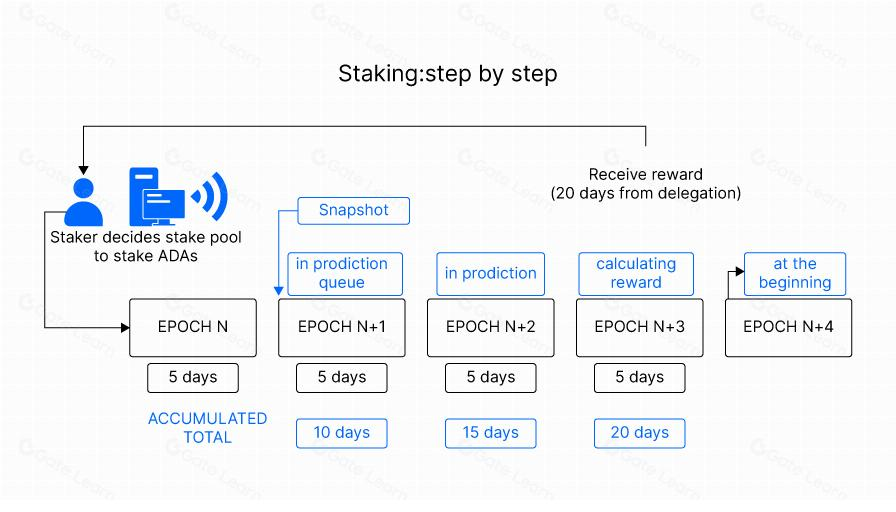
- Epoch: Cardano divides time into periods called epochs. Each epoch typically lasts about five days. Before a new epoch begins, the system calculates block production rights for the next epoch based on current staking data.
- Slot: Each epoch is further divided into slots, with each slot lasting approximately one second. In theory, each slot can produce one block.
This structure can be compared to a scheduling system: an epoch is a scheduling cycle, and each slot represents a one second opportunity to produce a block.
Block Production Process: How Is a New Block Created?
Block production in Ouroboros is a highly decentralized process, governed by the following steps:
- Selection: For each slot, the system uses a Verifiable Random Function (VRF) to randomly select a Slot Leader based on stake proportion. The more ADA a participant controls or is delegated, the higher the probability of being selected.
- Block Creation: The selected Slot Leader collects pending transactions, packages them into a new block, signs it with their private key, and broadcasts it to the network.
- Verification: Other nodes receive the block and verify the signature and transaction validity. If valid, the block is appended to the end of the local ledger.
- Reward Distribution: At the end of each epoch, the system calculates rewards based on actual block production and distributes ADA rewards in the following epoch.
The Evolution of Ouroboros: From Theory to Scalable Deployment
Ouroboros is the core Proof of Stake consensus protocol of Cardano. Through multiple iterations, it has continuously improved in security, scalability, and practicality.
Ouroboros Classic: The Academic Foundation
This was the earliest version, establishing a formally proven secure PoS foundation. It introduced epoch and slot based leader selection using stake proportional randomness, but was more vulnerable to adaptive attacks.
Ouroboros BFT: Transitional Protocol
Ouroboros BFT (Byzantine Fault Tolerant) was used during the Byron reboot phase as a transitional protocol between Cardano’s legacy codebase and the Shelley era. It helped prepare the network for decentralization.
This protocol assumed a federated set of servers with synchronized communication and did not require nodes to be continuously online. Its simplicity and determinism made it suitable for the transition phase.
Ouroboros Praos: Enhanced Privacy and Attack Resistance
Ouroboros Praos builds on Ouroboros Classic with significant improvements in security and scalability.
It introduced Verifiable Random Functions (VRF) to privately select Slot Leaders. Only the selected node knows it is the leader until it produces a block, effectively mitigating targeted denial of service attacks against validators.
This version improved resilience in dynamic network environments, ensuring stable consensus even when some nodes are under attack.
Ouroboros Genesis: Permissionless Network Bootstrapping
Earlier PoS protocols often required trusted checkpoints for new nodes to join securely, to prevent long range attacks. Ouroboros Genesis addressed this limitation.
Genesis allows new nodes to securely bootstrap from the genesis block without relying on trusted checkpoints. It introduces a new chain selection rule and proves protocol composability, enhancing resilience without sacrificing security.
Ouroboros Hydra: Scaling Toward Millions of TPS
To support global scale transaction demand, Ouroboros Hydra was introduced as an off chain scalability solution.
Hydra creates multiple isomorphic state channels, called Heads, outside the main chain. Each Head can process thousands of transactions per second, with theoretical aggregate throughput reaching millions of TPS. Hydra remains coupled to the main chain and supports native assets and scripts, significantly improving overall performance.
Security Model: How Does Ouroboros Prevent 51% Attacks?
Ouroboros relies on rigorous mathematical foundations to ensure security. It uses a dynamic availability model, allowing the system to continue operating even under partial network disruptions or adversarial conditions.
Protection against 51% attacks is rooted in its stake distribution model. In a PoS system, an attacker would need to control more than 51% of the circulating ADA supply to dominate consensus. This would require extremely high economic cost, and any successful attack would directly reduce the value of the attacker’s own holdings. This economic disincentive lowers the motivation for attacks.
Summary
Ouroboros is the core consensus protocol of Cardano. Through its Proof of Stake design, epoch and slot time structure, Verifiable Random Functions, and continuous multi version evolution, it delivers an energy efficient, scalable, and mathematically provable secure consensus system suitable for long term governance.
Overall, Ouroboros combines academic rigor with practical deployment. By using an epoch slot architecture and formally proven PoS mechanisms, it significantly reduces energy consumption while maintaining decentralization. Understanding how Ouroboros works helps users better assess the security and stability of the Cardano network when participating in staking or ecosystem activities.
FAQs
How is Ouroboros different from Bitcoin mining?
Bitcoin relies on computational competition through Proof of Work, while Ouroboros relies on stake ownership through Proof of Stake. The latter is more energy efficient and does not require specialized hardware.
Can all ADA holders become Slot Leaders?
In theory, yes. In practice, most users delegate their stake to stake pools that operate nodes continuously on their behalf.
What happens if two Slot Leaders produce blocks at the same time?
This results in a temporary fork. Ouroboros applies a defined longest chain rule to determine the valid chain.
How does Ouroboros ensure fair leader selection?
By using Verifiable Random Functions (VRF) to provide unpredictable yet publicly verifiable randomness, ensuring the selection process cannot be manipulated.