The Real Barrier to DEX Adoption: User Experience Gaps
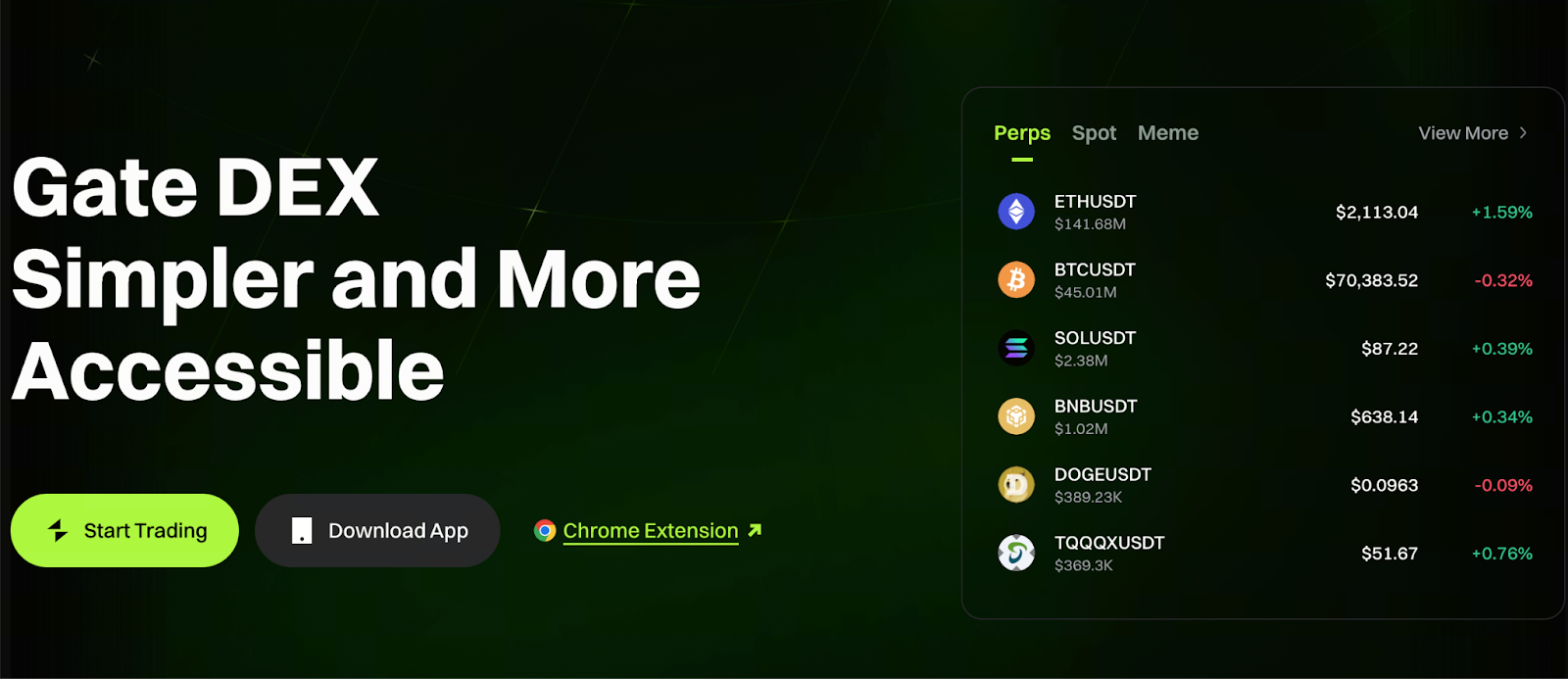
Decentralized trading has always been seen as a core pillar of Web3, yet most users haven’t developed the habit of consistently trading on DEXs. The problem isn’t with the underlying philosophy—it’s the experience: wallet processes are tedious, workflows are fragmented, and information is scattered across multiple tools, making the trading process feel disjointed and full of interruptions.
For most users, returning to a centralized platform after their first DEX experience isn’t a rejection of decentralization—it’s simply that the process is far from intuitive.
Gate DEX: A New Approach
Gate DEX isn’t just another swap interface. Its design rethinks the trading process from the ground up: What steps are truly essential for a complete on-chain transaction? Which can be integrated or streamlined?
Gate DEX unifies previously fragmented on-chain operations into a seamless system, covering:
- On-chain spot trading
- On-chain contract trading
- Cross-chain asset swaps
It also integrates token launch scenarios from Gate Fun and market analysis and strategy tools from Meme Go, enabling users to discover assets, analyze, place orders, and manage portfolios—all within a single interface, eliminating the need to jump between multiple DApps.
Lowering the Entry Barrier Is Essential for Broader Adoption
For most users who aren’t native to Web3, the real challenge often comes before they even begin. Gate DEX deliberately lowers technical barriers with flexible login options, supporting Gate accounts, Google accounts, and wallet-based sign-ins. Users can access the trading environment directly—no need to first master private keys or seed phrases.
With clear prompts and familiar trading logic, even first-time on-chain traders can gradually learn advanced features like limit orders and sniping trades, instead of being discouraged at the outset by complex processes.
Non-Custodial by Design—Without the Complexity of Engineering Tools
Gate DEX uses a non-custodial architecture, so users always retain full control of their assets—there’s no need to entrust funds to the platform. At the same time, the platform leverages a wallet architecture built on TEE (Trusted Execution Environment) technology, maintaining robust security while delivering a trading experience nearly as smooth as a centralized exchange.
Spot trades execute entirely on-chain, giving users direct ownership of their assets. The platform supports a broad range of leading cryptocurrencies and select tokenized US equities. Because there’s no leverage or liquidation mechanism, the structure remains straightforward—ideal for those seeking long-term holdings or stable portfolio allocations.
Turning CEX Expertise into DEX Advantages
Gate’s years of experience as a centralized exchange haven’t been left behind with Gate DEX—they’ve been adapted to fit the on-chain environment. Clear information hierarchies, reliable liquidity, and a responsive interface ensure users don’t have to relearn everything when trading on-chain.
The platform’s built-in invitation and sharing features also help on-chain trading develop into a social network, turning it from a solitary activity into a potentially viral trading ecosystem.
Beyond a Product: The Gateway to Web3 Trading
Gate DEX isn’t just a one-time feature upgrade—it’s a cornerstone of Gate’s “All in Web3” strategy. By lowering entry barriers, reengineering the trading process, and integrating with foundational platforms like Gate Layer, Gate DEX aims to build a truly scalable user base for decentralized trading.
In an era where CeFi and DeFi experiences remain highly fragmented, Gate DEX stands out as a practical entry point—not just a theoretical bridge.
Explore Gate DEX: https://web3.gate.com/
Conclusion
Gate DEX’s value isn’t about how many features it offers, but whether it makes on-chain trading a routine activity. With a process-driven design, a non-custodial yet efficient security framework, and an experience aligned with established exchange standards, Gate DEX is redefining expectations for decentralized exchanges. Only when decentralization becomes a tool that’s naturally accessible to the majority will DEXs truly have the potential to go mainstream.