On February 3, 2026, Vitalik Buterin made a statement on X.
This remark sent shockwaves through the Ethereum community, rivaling the impact of his 2020 push for a “rollup-centric” roadmap. In that post, Vitalik candidly admitted: “Layer 2 as ‘branded sharding’ to solve Ethereum’s scalability vision is no longer valid.”
With one sentence, he nearly declared the end of Ethereum’s mainstream narrative over the past five years. The Layer 2 ecosystem—once regarded as Ethereum’s lifeline and greatest hope—is now facing its most significant legitimacy crisis since its inception. Direct criticism followed, with Vitalik writing bluntly: “If you create an EVM that processes 10,000 transactions per second, but it connects to L1 via a multisig bridge, you are not scaling Ethereum.”
How did what was once a lifeline become a burden to be discarded? This is not just a technical shift—it’s a harsh contest of power, interests, and ideals. The story begins five years ago.
How Did Layer 2 Become Ethereum’s Lifeline?
The answer is straightforward: it was not a technical choice, but a survival strategy. Back in 2021, Ethereum was mired in the “noble chain” dilemma.
The numbers tell the story: On May 10, 2021, Ethereum’s average transaction fee reached a record high of $53.16. During the peak of the NFT craze, gas prices soared above 500 gwei. What did this mean? A basic ERC-20 token transfer could cost tens of dollars, while a single token swap on Uniswap could run up to $150 or more.
The DeFi Summer of 2020 brought unprecedented growth to Ethereum, with total value locked (TVL) skyrocketing from $700 million at the start of the year to $15 billion by year-end—a surge of over 2,100%. But this boom came at the cost of severe network congestion. By 2021, the NFT wave hit, and blue-chip projects like Bored Ape Yacht Club made the network even more strained, with single NFT transaction gas fees often running into hundreds of dollars. In 2021, some collectors were offered over 1,000 ETH for a Bored Ape but ultimately gave up due to high gas fees and complex transaction processes.
Meanwhile, Solana emerged as a challenger. Its metrics were staggering: tens of thousands of transactions per second and fees as low as $0.00025. The Solana community mocked Ethereum’s performance and directly criticized its bloated, inefficient architecture. “Ethereum is dead” became a popular refrain, fueling anxiety within the community.
Against this backdrop, in October 2020, Vitalik formally introduced a new concept in his post “A Rollup-Centric Ethereum Roadmap”: positioning Layer 2 as Ethereum’s “branded sharding.” The core idea was that Layer 2 would process massive transactions off-chain, then package and compress results back to the mainnet, theoretically enabling infinite scalability while inheriting Ethereum’s security and censorship resistance.
At that moment, the entire Ethereum ecosystem’s future hinged on Layer 2’s success. From the Dencun upgrade in March 2024 introducing EIP-4844 (Proto-Danksharding) to provide cheaper data availability for Layer 2, to countless core developer meetings, everything was paving the way for Layer 2. After Dencun, Layer 2 data publishing costs dropped by at least 90%, with Arbitrum’s transaction fees plunging from about $0.37 to $0.012. Ethereum sought to push L1 into the background, quietly serving as a “settlement layer.”
But why didn’t this bet pay off?
The “Centralized Databases” Valued at $1.2 Billion
If Layer 2 had truly fulfilled its original vision, it wouldn’t have fallen out of favor. So, what went wrong?
Vitalik identified the fatal flaw: decentralization is progressing too slowly. Most Layer 2 solutions have yet to reach Stage 2—having fully decentralized fraud or validity proof systems and allowing users to withdraw assets permissionlessly in emergencies. They are still controlled by centralized sequencers that handle transaction packaging and ordering, making them more akin to centralized databases wrapped in blockchain branding.
The conflict between commercial reality and technical ideals is stark. Take Arbitrum, for example: its developer, Offchain Labs, raised $120 million in a Series B round in 2021, reaching a $1.2 billion valuation with backing from top firms like Lightspeed Venture Partners. Yet, despite holding over $15 billion in locked funds and commanding about 41% of the Layer 2 market, Arbitrum remains stuck at Stage 1.
Optimism’s story is equally compelling. Led by Paradigm and Andreessen Horowitz (a16z), it completed a $150 million Series B round in March 2022, bringing total funding to $268.5 million. In April 2024, a16z privately purchased $90 million worth of OP tokens. But even with such strong capital support, Optimism remains at Stage 1.
Base’s rise reveals another dimension. Launched by Coinbase, Base quickly became a market favorite after its mainnet went live in August 2023. By the end of 2025, Base’s TVL reached $4.63 billion, capturing 46% of the Layer 2 market and surpassing Arbitrum as the Layer 2 with the highest DeFi TVL. But Base is even less decentralized, as Coinbase retains full control, making it technically closer to a centralized sidechain.
Starknet’s story is even more ironic. Developed by Matter Labs using ZK-Rollup technology, it has raised $458 million, including a $200 million Series C led by Blockchain Capital and Dragonfly in November 2022. Yet its STRK token price has dropped 98% from its peak, with a market cap of about $283 million. On-chain data shows its daily protocol revenue can’t even cover a few servers’ operating costs, and its core nodes remained highly centralized until mid-2025 when it finally reached Stage 1.
Some project teams privately admit they may never fully decentralize. Vitalik cited a case in his post: a project argued it would never further decentralize because “client regulatory requirements demand ultimate control.” This statement infuriated Vitalik, who responded bluntly:
“Perhaps you are doing the right thing for your clients. But clearly, if you do this, you are not ‘scaling Ethereum.’”
This comment essentially condemned all projects branded as Ethereum L2 but refusing to decentralize. Ethereum wants an extension that expands decentralization and security, not a group of centralized satellites cloaked in Ethereum branding.
The deeper issue is the irreconcilable conflict between decentralization and commercial interests. Centralized sequencers let project teams control MEV (maximal extractable value) revenue, respond flexibly to regulatory demands, and iterate products quickly. Full decentralization means relinquishing control to the community and validator network. For projects backed by venture capital and pressured for growth, this is a tough choice.
If Layer 2 achieved full decentralization, would it still fall out of favor? The answer may still be yes—because Ethereum itself has changed.
When the Mainnet Is Faster and Cheaper Than Sidechains
Why does Ethereum no longer need Layer 2 for scaling?
As early as February 14, 2025, Vitalik signaled a key shift. He published an article titled “Why Even in an L2-Centric Ethereum There Are Reasons to Have a Higher L1 Gas Limit,” clearly stating, “L1 is scaling.” At the time, this sounded like reassurance for mainnet purists, but in retrospect, it was the rallying cry for Ethereum’s mainnet to compete with Layer 2.
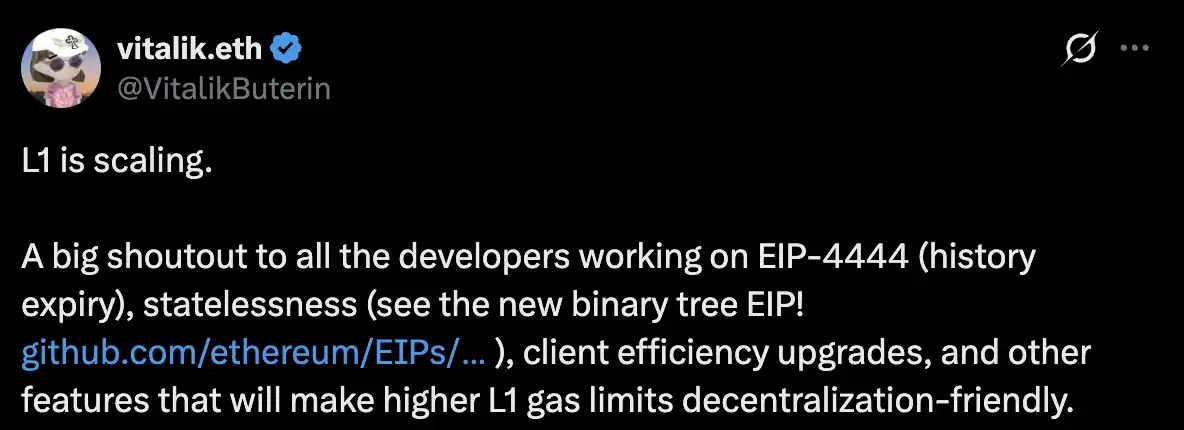
Over the past year, Ethereum L1 has scaled far faster than anyone expected. Multiple technical breakthroughs contributed: EIP-4444 reduced historical data storage needs; stateless client technology made node operation more lightweight; and, most importantly, the gas limit kept rising. In early 2025, Ethereum’s gas limit was 30 million; by mid-year, it was 36 million—a 20% jump, marking the first major increase since 2021.
But this was just the beginning. According to Ethereum core developers, two major hard fork upgrades are planned for 2026. The Glamsterdam upgrade will introduce parallel processing, pushing the gas limit from 60 million to 200 million—a more than threefold increase. The Heze-Bogota fork will add FOCIL (Fork-Choice Enforced Inclusion Lists), further boosting block construction efficiency and censorship resistance.
The Fusaka upgrade, completed on December 3, 2025, showcased L1’s scaling power. After the upgrade, daily transaction volume rose about 50%, active addresses increased about 60%, and the seven-day moving average for daily transactions hit a record 1.87 million—surpassing the 2021 DeFi peak.
The results are striking: Ethereum mainnet transaction fees have dropped to extremely low levels. In January 2026, the average transaction fee fell to $0.44—a more than 99% drop from the $53.16 peak in May 2021. In off-peak hours, transaction costs often fall below $0.10, and sometimes as low as $0.01, with gas prices down to 0.119 gwei. These numbers rival Solana, erasing Layer 2’s biggest cost advantage.
In his February article, Vitalik ran the numbers. Assuming ETH at $2,500, gas at 15 gwei (long-term average), and demand elasticity near 1 (doubling gas limit halves price):
Censorship resistance: Forcing an L1 transaction censored by L2 currently requires about 120,000 gas, costing $4.50. To cut costs below $1, L1 needs to scale 4.5x.
Cross-L2 asset transfers: Withdrawing from one L2 to L1 takes about 250,000 gas, depositing into another L2 takes 120,000 gas, totaling $13.87. With optimal design, only 7,500 gas and $0.28 are needed. To hit $0.05, L1 must scale 5.5x.
Mass exit scenarios: Take Sony’s Soneium—PlayStation has about 116 million monthly active users. With an efficient exit protocol (7,500 gas per user), Ethereum can now support emergency exits for 121 million users in a week. To support multiple such apps, L1 must scale about 9x.
These scaling goals are being achieved in 2026. Technology has changed the game. When L1 is fast and cheap on its own, why would users tolerate Layer 2’s complex bridging, convoluted interactions, and security risks?
Bridge security risks are real. In 2022, bridges were prime targets for hackers. In February, Wormhole lost $325 million; in March, Ronin suffered DeFi’s largest attack, losing $540 million; Meter, Qubit, and others were also breached. Chainalysis reported that in 2022, total crypto stolen from bridges reached $2 billion—most of all DeFi attack losses that year.
Liquidity fragmentation is another pain point. As Layer 2s proliferate, DeFi liquidity is split across dozens of chains, increasing slippage, lowering capital efficiency, and degrading user experience. To move assets between Layer 2s, users endure complex bridging, long waits, and extra costs and risks.
This leads to the next, harshest question: What happens to the Layer 2 projects that raised huge sums and issued tokens?
Valuation Bubbles and Ghost Towns
Where did all the Layer 2 money go?
In recent years, the Layer 2 space has resembled a massive financial game more than a technical revolution. VCs waved their checkbooks, pushing L2 valuations to jaw-dropping heights: zkSync raised $458 million, Offchain Labs behind Arbitrum is valued at $1.2 billion, Optimism raised $268.5 million, Starknet raised $458 million. Behind these figures are top VCs like Paradigm, a16z, Lightspeed, Blockchain Capital, and more.
Developers flocked to build “nested” DeFi Lego across L2s, chasing liquidity and airdrop hunters. But real users were worn down by repeated complex bridging and high hidden costs.
The harsh reality is that the market is becoming highly concentrated at the top. According to crypto research firm 21Shares, Base, Arbitrum, and Optimism now handle about 90% of all transactions. Base, leveraging Coinbase’s traffic and user base, exploded in 2025—its TVL surged from $1 billion at the start of the year to $4.63 billion by year-end, with quarterly transaction volume hitting $59 billion, up 37% quarter-over-quarter. Arbitrum holds steady at about $19 billion TVL, with Optimism close behind.
Outside the top tier, most L2 projects saw their real user numbers plummet to near zero after airdrop hype faded, becoming true “ghost towns.” Starknet is the prime example. Despite its token price dropping 98% from the peak, its extremely low daily active users and fee income leave its price-to-earnings ratio in a massive bubble. This means the market’s future expectations far exceed its current ability to generate real value.
Ironically, when Layer 2 fees dropped sharply due to EIP-4844, their payments to L1 for data availability also plunged, reducing Ethereum L1’s fee income. In January 2026, analysts noted that the Dencun upgrade shifted many transactions from L1 to cheaper L2s, helping push Ethereum network fees to their lowest since 2017. As Layer 2s cut their own costs, they also drain L1’s economic value.
In its 2026 Layer 2 outlook, 21Shares predicted most Ethereum Layer 2s may not survive the year, with brutal consolidation ahead—only high-performance, truly decentralized projects with unique value propositions will endure.
This is Vitalik’s true aim: to puncture the self-congratulatory infrastructure bubble and deliver a dose of reality to a sick market. If a Layer 2 can’t offer more compelling features than L1, it will become just an expensive transitional relic in Ethereum’s history.
Ethereum Is Reclaiming Its Sovereignty
Vitalik’s latest advice points Layer 2 toward a new path: abandon scaling as the sole selling point and pursue functional value that L1 cannot or will not provide in the short term. He listed several directions: privacy protection (on-chain private transactions via zero-knowledge proofs), efficiency optimization for specific applications (gaming, social networks, AI computation), ultra-fast transaction confirmation (milliseconds rather than seconds), and exploration of non-financial use cases.
In other words, Layer 2’s role will shift from being Ethereum’s extension to serving as specialized plugins. They are no longer the only savior for scaling, but a functional extension layer within the Ethereum ecosystem. This is a fundamental repositioning and a return of power—Ethereum’s core value and sovereignty will re-anchor in L1.
Vitalik also proposed a new framework: view Layer 2 as a spectrum, not a binary. Different L2s can make trade-offs in decentralization, security, and features; the key is to clearly communicate their guarantees to users, rather than all claiming to “scale Ethereum.”
The reckoning has begun. Layer 2s sustained by high valuations but with no real active users now face final judgment. Those that find unique value and achieve true decentralization may survive in the new landscape. Base may continue to lead thanks to Coinbase’s traffic and Web2 user onboarding, but it must address decentralization concerns. Arbitrum and Optimism need to accelerate progress to Stage 2 and prove they are more than centralized databases. zkSync and Starknet, as ZK-Rollup projects, must demonstrate the unique value of zero-knowledge proofs while dramatically improving user experience and ecosystem vibrancy.
Layer 2 hasn’t disappeared, but its era as Ethereum’s sole hope is over. Five years ago, cornered by rivals like Solana, Ethereum pinned its scaling hopes on Layer 2 and rebuilt its technical roadmap. Five years later, it found the best scaling solution is to make itself stronger.
This isn’t betrayal—it’s growth. Those Layer 2s unable to adapt will pay the price. When the gas limit hits 200 million by the end of 2026, when Ethereum L1 transaction fees settle at a few cents or less, and when users realize they no longer need to endure complex and risky cross-chain bridges, the market will vote with its feet. Projects with sky-high valuations but no real user value will be swept away by history.
Statement:
- This article is republished from [BlockBeats]. Copyright belongs to the original author [BlockBeats]. If you have objections to the republication, please contact the Gate Learn team, who will handle it promptly according to relevant procedures.
- Disclaimer: The views and opinions expressed in this article are solely those of the author and do not constitute investment advice.
- Other language versions of this article are translated by the Gate Learn team and may not be copied, distributed, or plagiarized unless Gate is explicitly cited.