Ethereum State Definition and Network Storage Overview
Within the Ethereum network, “state” refers to the comprehensive set of all verifiable on-chain information at any given time. This includes account balances, contract storage data, smart contract bytecode, and other essential data structures. Unlike a ledger that simply records transaction history, the state directly represents the network’s current operational outcome. It serves as the foundation for nodes to execute transactions, validate blocks, and maintain consensus.
As the Ethereum ecosystem expands and the number of smart contracts and decentralized applications grows, the on-chain state also increases in size. As a result, each full node must store, synchronize, and maintain a larger volume of data, driving up hardware requirements and system overhead for node operators.
Why “State Bloat” Is a Core Bottleneck for Nodes
“State bloat” describes the ongoing accumulation of on-chain state data over time, with little to no natural reclamation. Since the Ethereum protocol does not automatically clean up long-inactive state, large volumes of historical data—rarely accessed—must still be retained by all full nodes.
Research indicates that roughly 80% of on-chain state data goes unaccessed for a year or more. Nonetheless, this data imposes mandatory storage and synchronization burdens on every node. Such unchecked growth not only drives up storage costs but also raises the barrier for average users to run full nodes.
If, in the future, only a few large service providers can afford to maintain the full state, Ethereum’s decentralization will erode, introducing new trust and censorship risks.
Detailed Analysis of Three Main Technical Solutions
State Expiry
State Expiry centers on marking data that has not been accessed for an extended period and removing it from the “active state set.” Only data that is recently and frequently used is considered core operational data, while “cold” state must be reactivated through specific proof mechanisms.
This approach resembles a caching system, where only hot data remains in the high-frequency access layer. In principle, it can significantly shrink the active state size and substantially reduce node storage and synchronization costs.
State Archive
The State Archive approach segments on-chain data into distinct tiers:
- Hot State: Data frequently accessed and directly affecting block execution
- Cold State: Historical data primarily used for verification and queries
Through tiered storage, nodes can sustain stable performance without sacrificing historical verifiability. This method prioritizes “performance stability” over wholesale deletion of historical data, making it a sound long-term strategy that balances security and usability.
Partial Statelessness
The Partial Statelessness approach suggests that nodes only need to maintain the subset of on-chain state relevant to their operations. Other state data can be retrieved as needed via light nodes, wallets, caching layers, or external proof mechanisms.
This model has the potential to lower the operational threshold for running nodes, increase overall node participation, and reduce dependence on large RPC service providers—thereby structurally enhancing network decentralization.
Implications for Node Decentralization and Ecosystem Structure
All of these solutions aim to lower the hardware and operational barriers for running nodes without compromising security, thereby preventing the centralization of network state storage.
If state maintenance becomes concentrated among a handful of large nodes or service providers, it would not only undermine decentralization but also increase risks of censorship and systemic vulnerabilities. As such, state optimization is a critical pillar of Ethereum’s long-term security model.
Additionally, these mechanisms could have cascading effects on Layer 2 scaling solutions, RPC service models, and the on-chain data indexing ecosystem. For instance, partial statelessness may drive the evolution of caching services, light nodes, and modular data access architectures.
Future Research Directions and Roadmap
The Ethereum Foundation has emphasized that these proposals remain in the research and experimental phase and have not yet been fully integrated into the protocol. Future R&D priorities include:
- Design and testing of protocol-level state management rules
- Performance and compatibility optimization for node clients
- Community collaboration with developers and node operators
Researchers widely agree that these solutions must strike a balance between real-world usability, security, and backward compatibility. They are unlikely to launch all at once and will likely be adopted incrementally.
Market Implications from a Technical Challenge Perspective
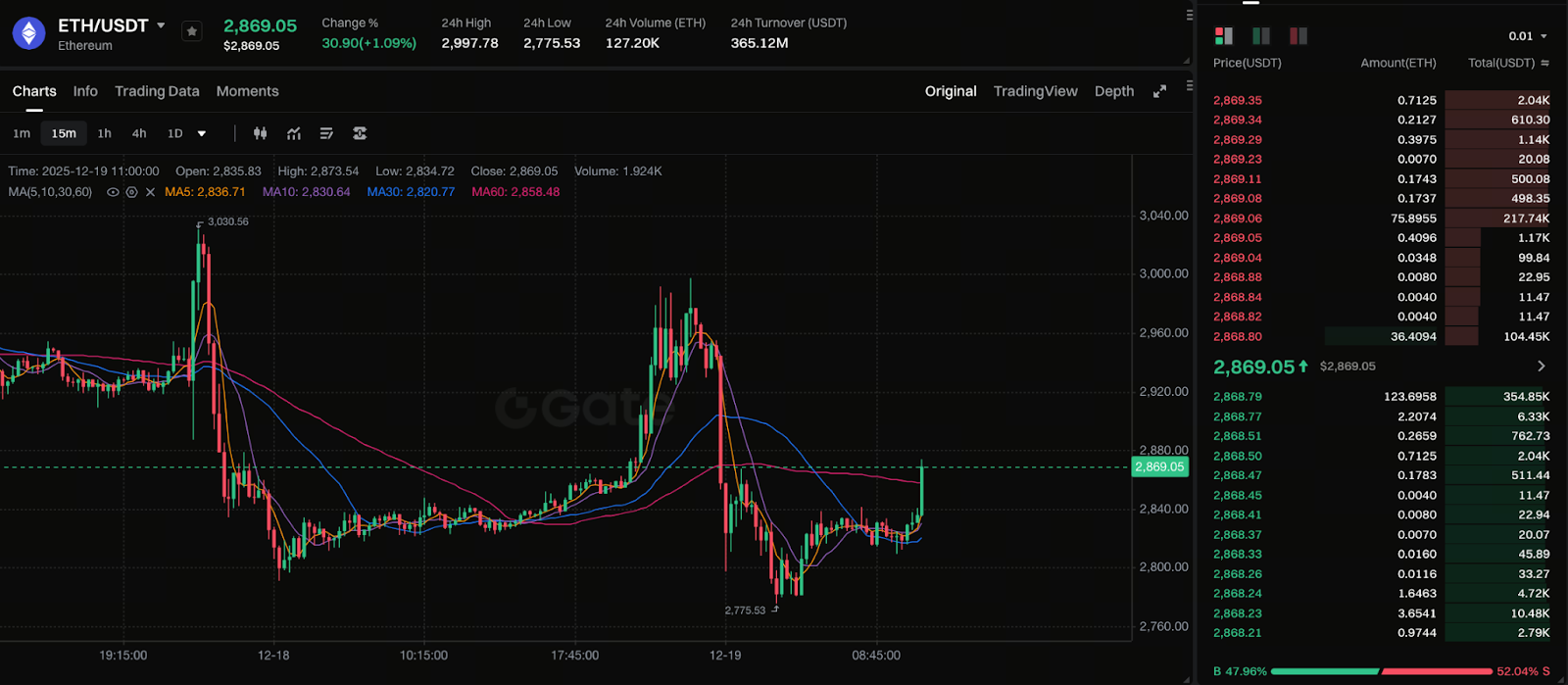
Image: https://www.gate.com/trade/ETH_USDT
From a market standpoint, foundational technical challenges often create short-term uncertainty and can impact sentiment. However, in the medium and long term, addressing state bloat will have a distinctly positive effect on Ethereum’s ecosystem health.
As of December 19, 2025, ETH continues to fluctuate around the $2,900 mark. As state management optimizations mature and see widespread adoption, they will enhance network efficiency, node distribution, and system sustainability, providing a more resilient technical foundation for Ethereum’s long-term value.
Conclusion
State bloat is not a short-term issue—it is a core challenge Ethereum must confront as a general-purpose computing platform at scale. Whether through state expiry, state archiving, or partial statelessness, the essential task is to find a new equilibrium among performance, decentralization, and security.
Looking ahead, the clarity and progress of state management solutions will be key indicators of Ethereum’s long-term technical competitiveness.