ENA derives its value from the expansion of the Ethena stablecoin USDe ecosystem。As USDe adoption grows across more use cases, ENA’s role in governance and incentives also becomes more important. This creates a strong link between ENA and the broader development of the protocol.
In addition, Ethena has introduced sENA as a tokenized staking receipt. Users who stake ENA receive sENA, which allows them to participate in governance and rewards mechanisms. This design strengthens incentives for long-term holders while also helping reduce sell pressure in the market.
By combining governance, incentives, and ecosystem development, Ethena has built a relatively comprehensive tokenomics model in which ENA serves multiple functions across the protocol.
Overview of Ethena (ENA)
ENA is the native governance token of the Ethena protocol, and its core role is to support protocol governance and ecosystem growth. Like traditional governance tokens, ENA holders can take part in major protocol decisions, including risk management and ecosystem expansion.
Ethena’s governance structure uses a committee model. ENA holders can vote to elect members of the risk committee, which is responsible for managing key protocol parameters and overseeing risk controls. This structure delegates day-to-day decisions to specialist groups while maintaining transparency in community governance.
At present, members of the Ethena risk committee include several research and risk management organizations, such as Kairos Research, Llama Risk, and Ethena Labs Research. These groups provide professional risk assessment and governance recommendations for the protocol.
In addition, ENA supports governance voting through Snapshot. Community members can participate in proposals and votes on matters such as adding new collateral assets, forming ecosystem partnerships, and adjusting risk parameters. This governance model increases the protocol’s level of decentralization.
Source: ethena.fi
ENA’s Functions and Use Cases
One of ENA’s main functions is protocol governance. ENA holders can vote on the future direction of the protocol, including whether to add new collateral assets or adjust risk parameters. This governance model allows the community to participate in Ethena’s long-term development.
ENA is also used in the staking mechanism. Users can stake ENA to receive sENA and take part in reward distribution. As a liquid receipt token, sENA can be used across the DeFi ecosystem, improving both token liquidity and capital efficiency.
ENA also plays a role in ecosystem incentives. Projects within the Ethena ecosystem may distribute token rewards to sENA holders. This model is similar to an ecosystem airdrop structure and encourages users to hold ENA over the long term.
In addition, ENA supports network security mechanisms. For example, through restaking, staked ENA can be used for cross-chain message validation and network security, helping strengthen protocol security.
| Function Type |
How It Is Used |
Purpose |
| Governance |
Voting and proposals |
Protocol governance |
| Staking |
ENA → sENA |
Earn rewards |
| Ecosystem incentives |
Airdrops and rewards |
Drive ecosystem growth |
| Network security |
Restaking |
Provide security support |
This multifunctional design strengthens ENA’s ecosystem value and long-term growth potential.
ENA Token Allocation and Supply Structure
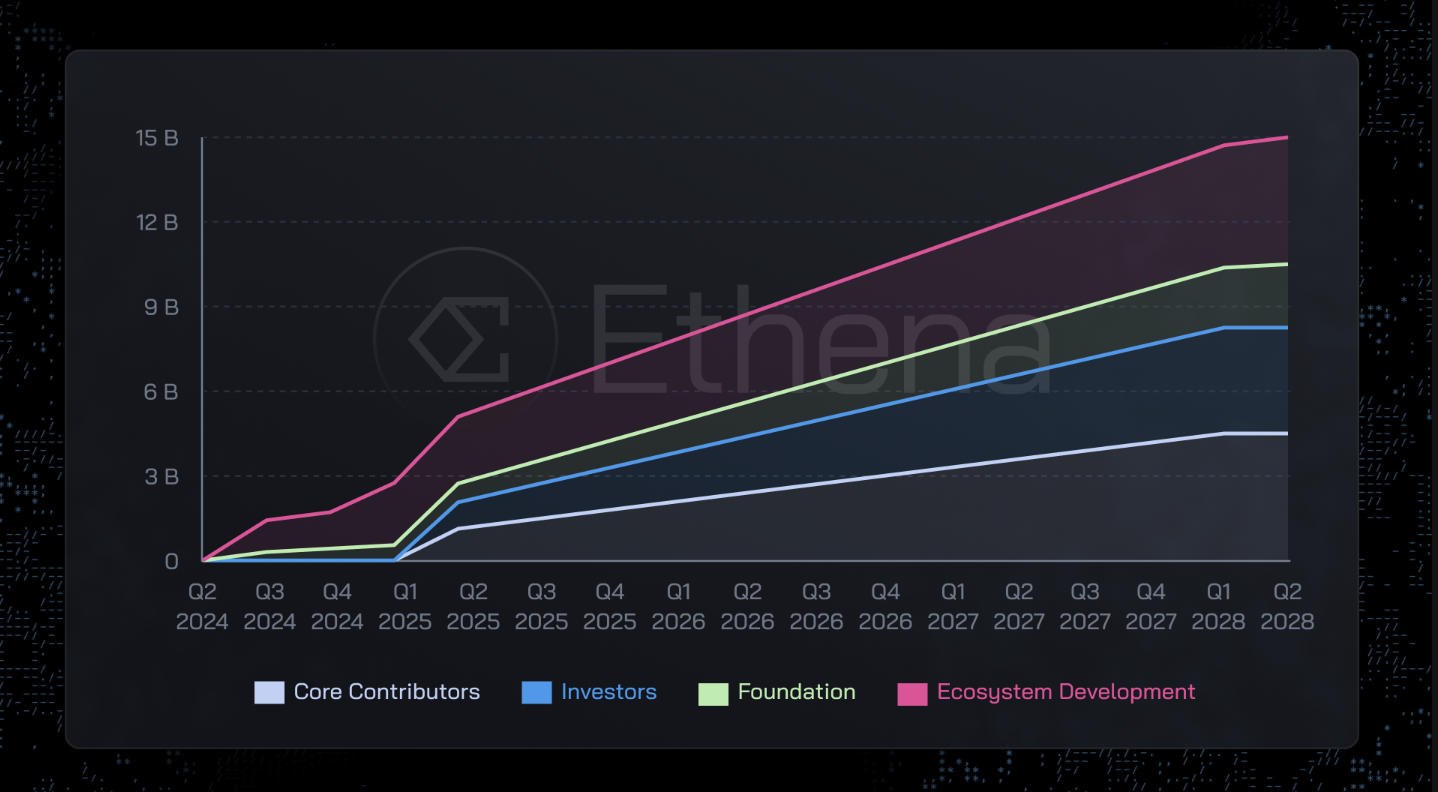
Ethena uses a multi-layered allocation structure to support long-term protocol growth and ecosystem development. ENA tokens are allocated across core contributors, investors, ecosystem development, and the foundation.
Core contributors receive about 30% of the supply, intended to reward the development team and advisors. These tokens are subject to a 1-year lock-up, followed by linear vesting over 3 years, helping ensure long-term team commitment to the protocol.
Investor allocations follow a similar vesting structure. Investor tokens are also locked for 1 year and then released gradually over 3 years. This design helps reduce market sell pressure and supports longer-term stability.
In addition, about 30% of the token supply is reserved for ecosystem development and airdrop incentives. These tokens are used to reward users, support ecosystem partnerships, and fund cross-chain expansion.
| Allocation Category |
Allocation Ratio |
Description |
| Core contributors |
30% |
Team and advisors |
| Investors |
25% |
Early funding support |
| Ecosystem development and airdrops |
30% |
User incentives |
| Foundation |
15% |
Ecosystem building and development |
This allocation structure is designed to support the long-term growth of the Ethena ecosystem.
ENA Incentive Design and Governance Model
Ethena’s incentive design is centered on the ENA staking system, with sENA serving as a core component. When users lock ENA, they receive sENA as a liquid receipt token. This design is similar to liquid staking models. Through sENA, users can earn rewards while continuing to use their assets across the DeFi ecosystem, improving capital efficiency.
sENA holders can receive rewards from the Ethena ecosystem. For example, some Ethena ecosystem projects may reserve token allocations for airdrops to sENA holders. This mechanism resembles an ecosystem dividend model, allowing long-term ENA holders to earn additional rewards while strengthening community engagement.
Ethena also introduces restaking to expand ENA’s utility further. Through partnerships with cross-chain infrastructure providers, staked ENA can be used for cross-chain message validation and network security, such as providing economic security for USDe cross-chain transfers. This makes ENA more than just a governance token, it also becomes part of the network’s security layer.
Ethena’s governance model uses a committee-based structure. ENA holders can regularly vote to elect members of the risk committee, and those members manage key protocol parameters such as collateral assets, risk limits, and yield distribution. This approach preserves decentralized governance while bringing in specialized institutions to improve risk management and protocol stability.
The Relationship Between ENA and the USDe Ecosystem
ENA and USDe form a closely connected ecosystem. USDe is Ethena’s core stablecoin product, while ENA is used to govern and incentivize the broader ecosystem. This structure is similar to the relationship between a protocol layer and a governance layer.
As USDe adoption expands, the Ethena ecosystem can attract more users into lending, trading, and staking use cases. As the ecosystem grows, governance needs increase, and ENA holders become more important to the protocol’s operation.
In addition, USDe’s yield mechanism may indirectly support the ENA ecosystem. When the protocol generates revenue, some incentive activities may be distributed through ENA or sENA. This design helps connect stablecoin-generated value with token-based incentives.
As the Ethena network develops, ENA may also play a role in more scenarios, including cross-chain governance, ecosystem incentives, and network security. This expansion creates a long-term synergistic relationship between ENA and USDe.
| Ecosystem Component |
Role |
Relationship to ENA |
| USDe |
Core stablecoin asset |
Drives ecosystem growth |
| sUSDe |
Yield-bearing stable asset |
Increases user participation |
| ENA |
Governance token |
Manages the ecosystem |
| sENA |
Staking receipt token |
Supports incentives and rewards |
This structure gives Ethena a complete token-based ecosystem.
Strengths and Risks of the Ethena (ENA) Token Model
Ethena’s token model has several strengths. First, ENA combines governance and incentive functions, giving the token a clear role within the protocol. This design may help reduce purely speculative behavior and strengthen long-term holding incentives.
Second, the sENA mechanism encourages users to lock ENA, reducing circulating supply and supporting ecosystem stability. At the same time, rewards distributed by ecosystem projects to sENA holders strengthen incentives for long-term participation.
In addition, restaking and cross-chain security mechanisms create new use cases for ENA, expanding it from a governance token into more of an infrastructure token. This broader utility may support ENA’s long-term value.
However, the model still carries risks. For example, concentrated governance power could affect decentralization, and market volatility could affect token value. In addition, if ecosystem growth falls short of expectations, the effectiveness of the incentive model may weaken. As a result, ENA’s long-term performance still depends heavily on the development of the Ethena ecosystem.
Summary
ENA is the core governance and incentive token of the Ethena protocol and plays an important role across the entire ecosystem. Through governance voting, staking rewards, and network security functions, ENA has become a key part of how Ethena operates.
At the same time, ENA works in close coordination with USDe. As stablecoin adoption expands, the governance demand and incentive value of ENA are also likely to grow. This gives Ethena a dual-core structure built around both a stablecoin and a governance token.
As the Ethena network continues to develop, ENA’s use cases may expand further, allowing it to play a larger role in cross-chain finance and the broader stablecoin ecosystem.
FAQ
- What is ENA?
ENA is the governance token of the Ethena protocol, used for governance voting, ecosystem incentives, and network security mechanisms.
- What is sENA?
sENA is the receipt token users receive after locking ENA. Holders can earn rewards and participate in governance.
- What is ENA used for?
ENA is mainly used for governance voting, staking rewards, ecosystem incentives, and cross-chain security.
- Where do ENA rewards come from?
ENA rewards mainly come from ecosystem rewards, project airdrops, and Ethena network incentive mechanisms.