What Is USDC Bridge?
 (Source: USDC)
Circle, the issuer of the stablecoin USDC, recently introduced a new tool called USDC Bridge. Its main goal is to make transferring USDC between different blockchains more accessible for users. Rather than being an entirely new technology, USDC Bridge builds on existing cross-chain transfer systems, lowering the barrier to entry with a more user-friendly interface.
Underlying Technology: CCTP Cross-Chain Protocol
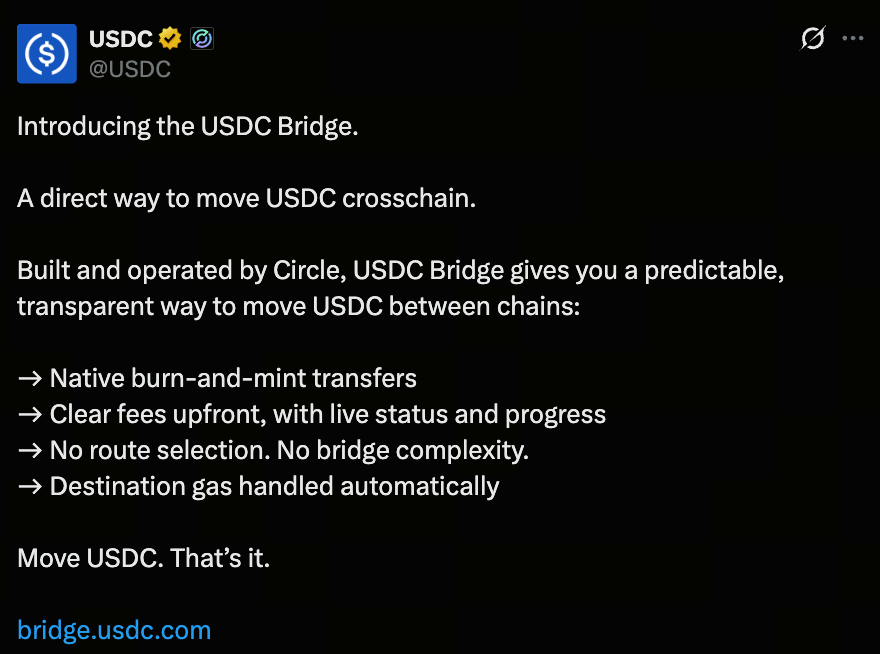
USDC Bridge is powered by Circle’s Cross-Chain Transfer Protocol (CCTP), launched in 2023. This protocol utilizes a burn-and-mint mechanism, eliminating the need for wrapped or synthetic versions of USDC. It supports transfers worth hundreds of millions of dollars each day, enabling assets to move natively across chains without relying on traditional bridging models.
(Source: USDC)
Enhanced User Experience
Previously, cross-chain operations were complex for many users. USDC Bridge aims to solve these challenges by providing a more intuitive process:
-
Auto trading fee processing
The system automatically calculates and handles Gas fees, reducing operational steps.
-
Transparent fees
All fees are clearly displayed before initiating a transfer, eliminating hidden costs.
-
Real-time status updates
Users can monitor transaction progress in real time, gaining full visibility into the process.
The overall objective is to make cross-chain transfers as seamless as standard payment transactions.
Supported Blockchain Networks
USDC Bridge now supports multiple blockchains, with a focus on EVM (Ethereum Virtual Machine) compatible chains such as Ethereum, Avalanche, Arbitrum, Optimism, Polygon, Base, Monad, Sonic, and World Network. In total, more than a dozen chains are supported, significantly enhancing liquidity across ecosystems.
The Importance of Cross-Chain Technology
In the blockchain ecosystem, different chains typically operate as independent systems. Bridges enable assets and data to flow between networks.
Ideally, cross-chain technology helps unify the crypto ecosystem, preventing fragmentation. However, previous cross-chain tools have faced several challenges:
- Complicated processes
- Multiple transactions required
- Trading fees that are difficult to estimate
These issues have, to some extent, limited the broader adoption of crypto products.
Expansion to More Non-EVM Ecosystems
Beyond EVM-compatible chains, CCTP also supports blockchains like Solana, Sui, and Aptos. This means USDC’s cross-chain applications have significant room for future growth.
Legal Challenges
As Circle launches new products, it also faces legal scrutiny. A recent class action lawsuit alleges that Circle failed to freeze approximately $230 million in USDC funds tied to a protocol vulnerability. The case is ongoing, and the final compensation amount will be determined by the courts.
Conclusion
The introduction of USDC Bridge signals a shift toward simpler, more accessible cross-chain technology. By optimizing the user experience and reducing technical barriers, tools like this can help onboard more users into the blockchain ecosystem and accelerate integration and interoperability across multiple chains.







