Recent BTC Market Overview: Structural Shifts Behind Strong Volatility
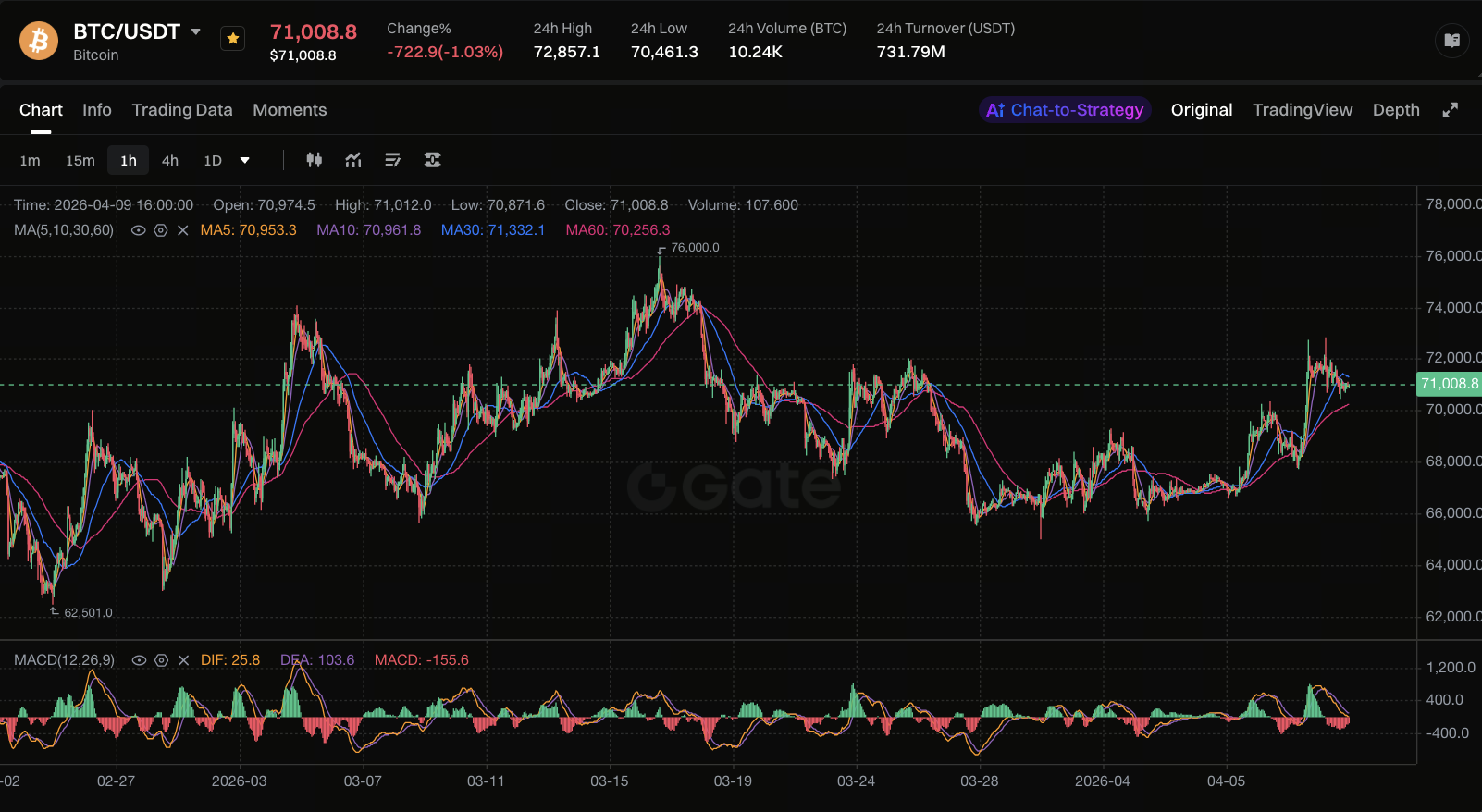
Image source: Gate BTC Market Page
BTC has demonstrated resilience in recent price action, maintaining key ranges despite escalating geopolitical tensions and multiple risk events.
As of early April 2026, three key market features stand out:
- Price: BTC remains near $70,000, experiencing short-term drawdowns but avoiding any decisive trend reversals.
- Market Rhythm: Volatility has increased, with event-driven moves becoming more pronounced. Intraday rallies and pullbacks are occurring at a faster pace than usual.
- Structure: Capital flows are not fully risk-on; instead, allocations are selectively made around "macro expectations + institutional channels."
This dynamic means the current BTC market can no longer be explained by a single narrative. It is neither purely a safe-haven trade nor simply a bull run continuation. Instead, it’s a "hybrid market" shaped by multi-factor pricing.
Geopolitical Conflicts Do Not Directly Benefit BTC—True Drivers Come From Three Transmission Chains
The question "Why is Bitcoin rising during war?" is often oversimplified.
A more accurate view: Geopolitical conflict first impacts macro variables, which then affect BTC pricing.
The primary transmission chains are:
- Chain A: Conflict → Changes in inflation and growth expectations → Reassessment of interest rate paths → Repricing of risk assets
- Chain B: Conflict → Rising concerns over sovereign credit and capital controls → Increased demand for non-sovereign asset allocation
- Chain C: Conflict → Amplified volatility in energy and financial markets → Institutional portfolio rebalancing → BTC, as a highly liquid asset, passively benefits or comes under pressure
In other words, conflict itself isn’t the reason for price appreciation—market expectations regarding post-conflict policy and liquidity are the core variables.
When the market believes "the shock is controllable and policy may turn accommodative," BTC tends to strengthen. When sentiment shifts to "the shock is uncontrollable and liquidity tightens," BTC typically comes under pressure along with other high-beta assets.
How Middle East and Russia-Ukraine Conflicts Affect Bitcoin: From Oil Prices to Liquidity to Risk Assets
Two main geopolitical threads currently warrant close attention:
- The Middle East situation oscillates between expectations of a temporary ceasefire and risks of renewed escalation. At one point, improved prospects for passage through the Strait of Hormuz triggered a rapid pullback in oil risk premiums.
- The Russia-Ukraine conflict continues to disrupt energy infrastructure, and supply-side uncertainty persists.
The combined effect is a market characterized by "high uncertainty + rapid repricing." The impact on BTC unfolds in two steps:
Step 1: Traditional Assets Are Affected First, Then the Impact Is Transmitted to Crypto Assets
- Sharp swings in oil prices alter inflation expectations.
- Changes in inflation expectations affect US Treasury yields and the US dollar.
- Shifts in the dollar and real interest rates ultimately impact valuations of global risk assets.
Step 2: Then Affect Capital Behavior Within the Crypto Market
- If the dollar weakens and interest rate expectations are revised downward, BTC valuation elasticity typically rises.
- If the dollar surges and global deleveraging occurs, BTC faces synchronized drawdown pressure.
- If policy uncertainty rises but systemic liquidity remains ample, BTC may show "relative strength amid high volatility."
In summary, the direction of geopolitical events' impact on BTC depends on which macro policy and liquidity equilibrium the market ultimately reaches.
Funding Evidence for This Rally: ETF Inflows, On-Chain Divergence, and Derivatives Signals
Headline news alone can easily mislead market judgment. What matters more is whether capital flows confirm the trend.
At least three pieces of evidence recently support the view that "BTC's resilience is driven by real capital flows":
Spot ETF Capital Inflows
US spot BTC ETFs saw significant single-day net inflows in early April, indicating that institutional channels remain open despite geopolitical risks.
This capital matters because it:
- Provides sustainable bids, not just short-term sentiment-driven flows
- Anchors market expectations for downside absorption
- Reinforces BTC’s role as a macro asset, not just a crypto trading vehicle
Divergence Between On-Chain and Spot Market Indicators
The market is exhibiting "stable price, weak on-chain demand," indicating that the current rally is not broad-based.
This typically means:
- Leading capital is more institutional.
- Narrative-driven moves outweigh those based on fundamentals.
- Without new catalysts, the market is more likely to enter a range-bound phase.
Derivatives Market Amplifies Short-Term Volatility
During periods of frequent events, leveraged capital accelerates price reactions to news.
When funding rates, basis, and open interest rise together, prices climb faster—but pullbacks are also steeper.
Therefore, this rally is best described as a "high-volatility phase within a bullish structure," not a one-way trend.
BTC Price Forecast for the Next 3–6 Months
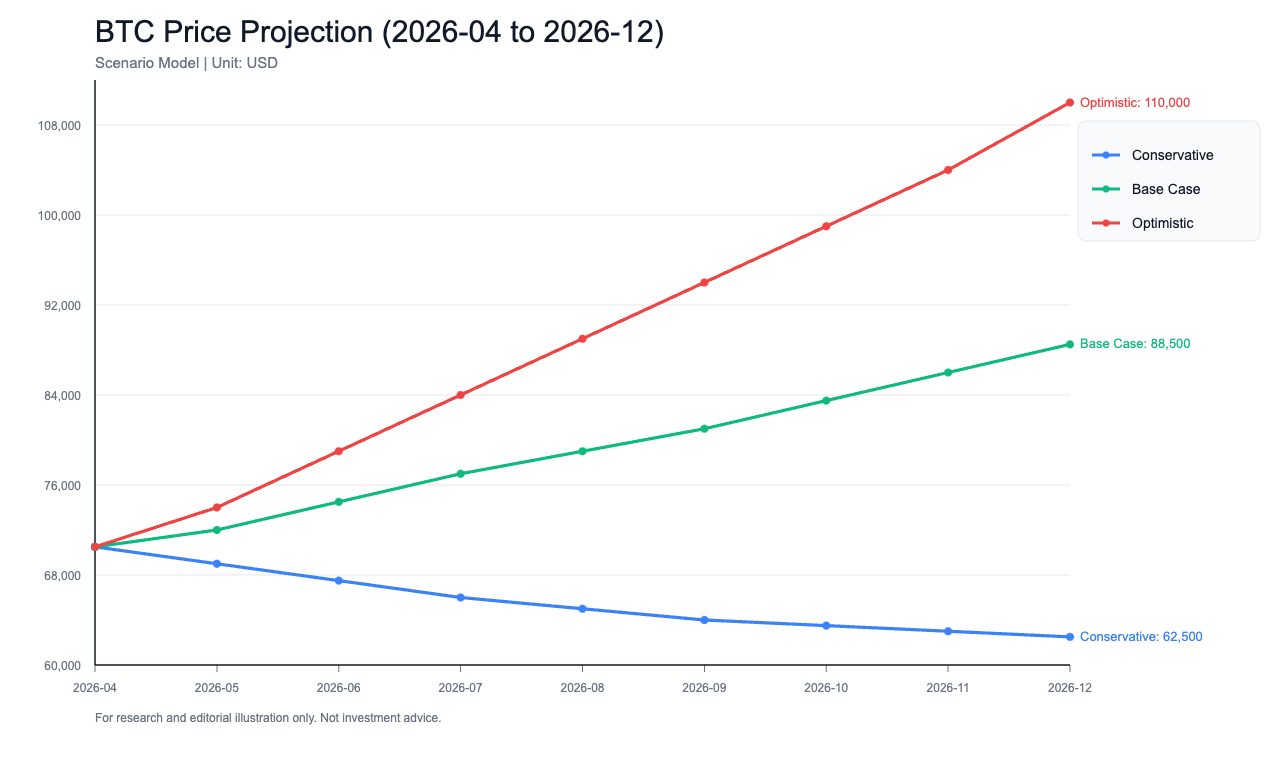
These forecasts are based on current public information and macro assumptions and do not constitute investment advice.
Scenario ranges are more practical than single price targets:
Conservative Scenario (Medium Probability)
- Conditions: Geopolitical conflicts escalate repeatedly, the dollar strengthens, and risk assets deleverage.
- Projection: BTC falls back and repeatedly tests the $62,000–$68,000 range.
- Triggers: Another sharp oil price surge, higher real US Treasury yields, sustained ETF net outflows.
Base Scenario (Higher Probability)
- Conditions: Conflicts remain controllable, policy expectations are neutral to slightly accommodative, and ETF net inflows persist for a period.
- Projection: BTC rises with high volatility within the $68,000–$82,000 range.
- Triggers: Dollar index fluctuates, oil prices stay under control, institutional allocation remains steady.
Optimistic Scenario (Medium-Low Probability)
- Conditions: Geopolitical risks ease at the margin, liquidity expectations improve significantly, and risk appetite recovers.
- Projection: BTC has a chance to challenge the $88,000–$98,000 range.
- Triggers: Sustained large ETF net inflows, macro data supports rate cut expectations, volatility remains contained.
From a trading execution perspective, the current environment calls for a "range + trigger" approach rather than linear extrapolation.
-
Trading and Risk Control Framework: How to Avoid "Right View, Wrong Execution" in Event-Driven Markets
In geopolitically driven markets, the greatest risk is often not market direction, but poor position management.
A practical framework includes:
- Position Layering: Separate core positions from trading positions to avoid mixing short-term views with long-term holdings.
- Triggered Trading: Only increase positions after key data or events are confirmed—avoid chasing rallies or sell-offs on initial headlines.
- Volatility First: Prioritize drawdown control before seeking returns, especially in high leverage environments.
- Cross-Market Confirmation: Monitor the dollar, US Treasuries, oil prices, and ETF flows simultaneously—do not rely solely on BTC charts.
- Predefined Plans: Define in advance "when to reduce/increase/close positions" to avoid emotional decisions.
A practical checklist:
- Track ETF net inflows and US Treasury yield direction daily.
- Assess weekly whether geopolitical events have changed the macro narrative.
- After large swings, review position exposure—not just profit and loss.
-
Conclusion: Bitcoin Is Transitioning from "High Beta Asset" to "Macro-Priced Asset"
BTC's recent relative strength reflects not just a single theme, but a shift in its role within the global asset framework:
It is evolving from an "internal crypto risk asset" to a "globally traded asset driven by macro variables."
This means that assessing BTC’s market requires answering three questions:
- Is capital continuously entering (especially through ETFs and institutional channels)?
- Do macro conditions support valuation expansion (interest rates, the dollar, liquidity)?
- Are geopolitical conflicts spiraling out of control, or being absorbed by policy?
If "controllable conflict + no liquidity tightening + ongoing institutional allocation" persists in the coming months, BTC still has medium-term upside potential. If "conflict escalation triggers systemic deleveraging," the price will first pull back before seeking a new equilibrium.
The most professional approach is not to bet on a single narrative, but to dynamically adjust positions and risk exposure within a multi-scenario framework. At this stage, building a repeatable decision-making system matters more than predicting price points.