Recently, BIO has seen a notable surge in trading volume and attention, with short-term price elasticity significantly increasing. As market activity heats up, it often attracts new capital but can shift discussions toward “price movements,” overshadowing the underlying mechanisms. The true determinant of BIO’s mid- and long-term value is whether its token structure can consistently attract high-quality research projects into the ecosystem and convert their results into verifiable on-chain value feedback.
From a digital asset methodology perspective, evaluating this type of token involves three steps: first, assess the supply structure; second, examine demand quality; and finally, analyze value feedback. The following sections address issuance and circulation, veBIO, BioXP, Ignition Sales, value closed loop, and risk indicators in sequence.
BIO Token Model Core Positioning: More Than a Trading Asset
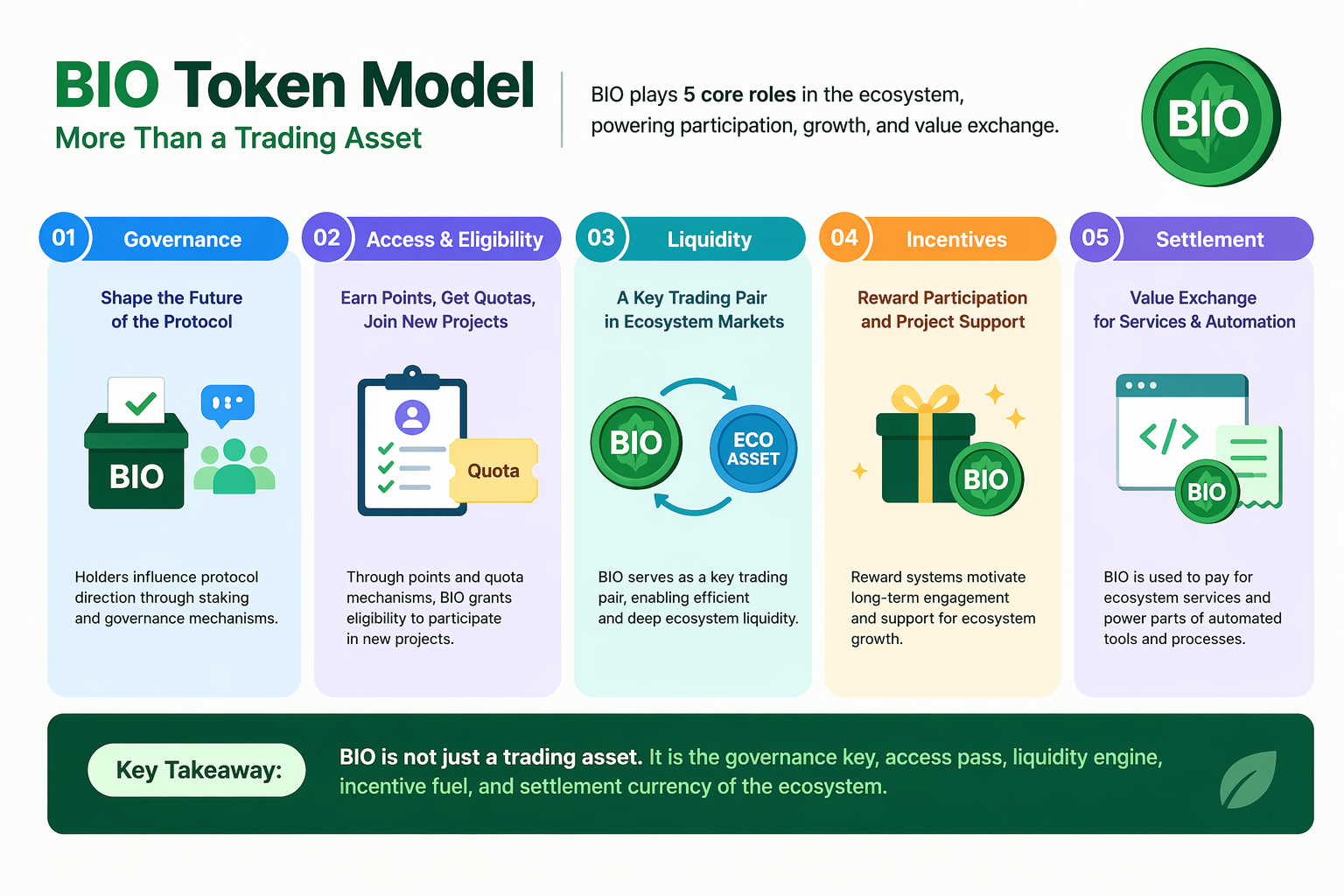
BIO’s ecosystem functions are divided into five modules:
- Governance module: Holders influence protocol direction through staking and governance mechanisms.
- Admission module: Eligibility for new project participation via credit and quota systems.
- Liquidity module: BIO serves as a key trading pair in ecosystem asset transactions.
- Incentive module: Rewards systems encourage long-term participation and project support.
- Settlement module: Facilitates value exchange for ecosystem services and certain automated tools.
This structure means BIO’s demand is multifaceted.
Ideally, demand should be composed of three layers:
- Basic trading demand
- Governance and staking demand
- Ecosystem project admission and service demand
When the latter two layers’ percentage increases, the token becomes less vulnerable to short-term market volatility. Conversely, if demand relies heavily on trading sentiment, price is more susceptible to macro risk preference shifts.
BIO Issuance Structure, Circulation Status, and Unlock Schedule
Public data indicates BIO’s total supply is approximately 3,320,000,000 tokens. For current market analysis, the focus should be on “circulating supply” and “future release schedule” rather than the total number.
BIO has already reached substantial circulation, with considerable tradable assets in the market. This enhances liquidity but also means valuation must account for upcoming unlock pressure. Investors should analyze supply over time:
- Short term (1–3 months): Monitor whether new circulation aligns with trading depth.
- Medium term (3–12 months): Track price and net flows around key unlock events.
- Long term (over 1 year): Assess whether ecosystem growth can absorb additional supply.
A practical principle: If demand growth rate < effective supply growth rate, valuation faces downward pressure; if demand growth rate > effective supply growth rate, the token is more likely to establish a stable upward trend.
veBIO Mechanism: Governance Weight and Long-Term Participation
veBIO is a central feature of BIO’s staking system. Users stake BIO to receive veBIO, which carries governance weight and ecosystem participation return.
This mechanism’s core objective is to integrate the “time dimension” into token dynamics, encouraging long-term holders to have greater influence in governance and resource allocation. Key benefits include:
- Mitigating short-term capital’s impact on governance outcomes
- Strengthening alignment between governance participation and asset locking
- Providing a stable basis for ecosystem incentive distribution
The ve model also faces inherent challenges:
- High learning curve for new users
- If governance topics are weakly linked to returns, staking motivation declines
- If top addresses remain concentrated, decentralized governance quality may be questioned
Effectiveness of veBIO depends not only on locked volume, but also on governance participation rate, proposal execution rate, and engagement depth among smaller holders.
BioXP Mechanism: Quota Competition, Credit Timeliness, and Incentive Design
BioXP is a key behavioral incentive system in Bio Protocol V2, primarily used for quota competition in Ignition Sales. The more users actively participate in the ecosystem, the greater their chances of early project allocation.
Sources of BioXP include:
- Staking BIO (automatic accumulation)
- Staking ecosystem assets (claim per rules)
- Ecosystem interaction and task participation (per official rule updates)
Key design points:
BioXP is time-sensitive, encouraging sustained activity over one-time accumulation- Different
veBIO levels offer varying multiplier returns, reinforcing long-term holding incentives
- Early-stage new assets may offer additional multipliers to boost liquidity
From a tokenomics perspective, the BioXP mechanism couples “attention” and “capital.” The advantage is higher ecosystem activity; the downside is that excessive complexity may cause user attrition due to high comprehension costs.
Ignition Sales: From USDC Submission to Final Allocation
Ignition Sales is a core mechanism for new project launches in Bio Protocol.
Rather than traditional primary market auctions, Ignition Sales use a “fund submission + credit weight + percentage allocation” model.
Typical participation steps:
- Prepare
USDC (sales are denominated in USDC)
- Acquire and accumulate
BioXP
- Submit funds and make credit commitments during the sales window
- Receive final allocation based on commitment percentage
- Claim assets or handle remaining funds after the sale ends
Advantages:
- Enhances early-stage project financing efficiency
- Shifts quota competition from “speed” to “long-term participation”
- Enables users to participate in research asset growth early
Potential issues:
- Oversubscription increases allocation uncertainty
- Frequent rule changes affect user expectation stability
- Hot projects may drive short-term speculation
When participating in Ignition Sales, project quality assessment should take priority over quota competition.
Value Closed Loop: How BIO Captures Ecosystem Value
BIO’s sustainability hinges on establishing a robust value closed loop.
A simplified path:
BIO staking -> veBIO and BioXP -> project launch participation -> ecosystem asset growth -> trading and service fees -> protocol and ecosystem feedback
For stable operation, the closed loop must meet at least four criteria:
- Continuous influx of high-quality research projects
- Active community capital and research participation
- Observable fee and value feedback mechanisms
- Effective governance and risk control framework
Recent public progress shows Bio Protocol has achieved milestones in financing, project launches, and ecosystem expansion, indicating the closed loop is taking shape. However, long-term viability depends on research milestone fulfillment and commercialization quality.
Risks and Key Indicators: What Investors Should Track
BIO is a “high potential + high uncertainty” asset, requiring proactive risk management.
Key risks:
- Supply and unlock risk: Changes in circulation may impact valuation
- Mechanism complexity: High learning cost for
veBIO + BioXP + Ignition Sales
- Project quality: Early-stage research projects have a high failure rate
- Compliance: Biological data and cross-border financing face multiple regulatory hurdles
- Market volatility: Prices are heavily influenced by sentiment in high-turnover environments
Establish a regular tracking panel for weekly or monthly review:
MC / FDV and changes in circulation percentage- Staking scale,
veBIO distribution, and governance activity
- Ignition Sales participation, oversubscription ratio, and retention
- Ecosystem project milestone achievement and fund transparency
- Protocol fees, liquidity depth, and net flow changes
Focusing only on price yields noise; focusing only on narrative yields bias. Only “mechanism data + execution results” deliver reliable insights.
Summary
The BIO tokenomics model aims to integrate decentralized science capital, governance, and innovation incentives into a reusable growth system. veBIO delivers long-term weight, BioXP drives behavioral incentives, and Ignition Sales enhances project admission and financing efficiency—together forming BIO’s core mechanism framework.
In the short term, BIO is influenced by market sentiment and liquidity fluctuations; in the long term, its value depends on research achievement conversion, governance quality, and value feedback strength.
If Bio Protocol continues to improve project quality screening, lower participation barriers, and increase transparency, BIO could evolve from a “narrative token” to a “DeSci infrastructure token.”
FAQs
Q1: What is the relationship between BIO and veBIO? BIO is the base token; staking BIO grants veBIO, which enhances governance weight and ecosystem participation.
Q2: What is the main purpose of BioXP?
BioXP is primarily used for quota competition in Ignition Sales, enabling active participants to gain early allocation in new projects.
Q3: Why do Ignition Sales require USDC and BioXP?
USDC is for fund submission, while BioXP determines allocation weight. Together, they balance capital strength and long-term participation.
Q4: What are the main factors for BIO’s long-term value?
Focus on three aspects: research project quality, token supply-demand balance, and protocol value feedback strength.
Q5: What is the most commonly overlooked risk when participating in the BIO ecosystem?
The most overlooked risks are mechanism complexity and unlock schedule. Many risks stem from insufficient understanding of the rules, not from project direction.