Image: https://base-batches-robotics-track.devfolio.co/overview
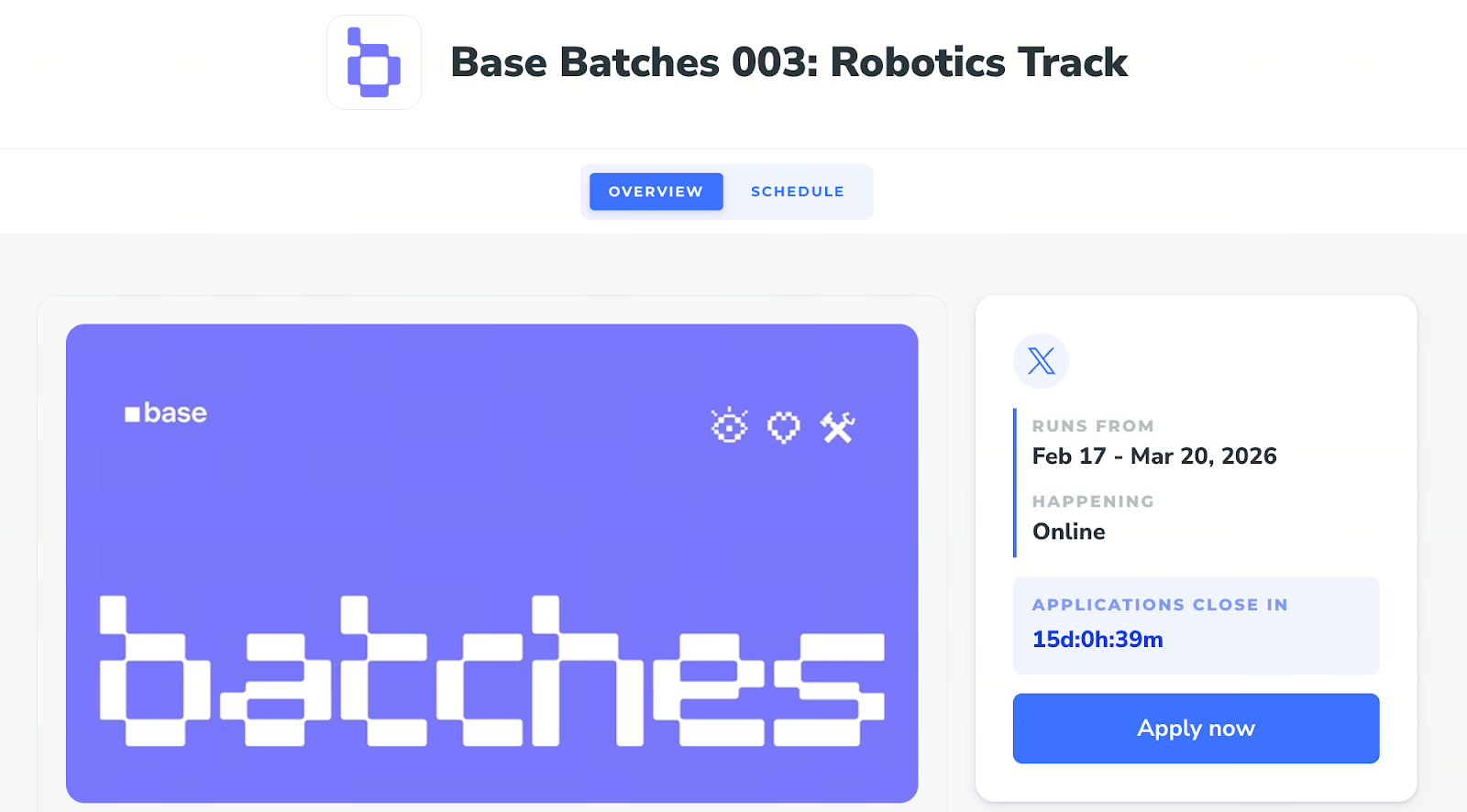
In March 2026, the Base ecosystem signaled a pivotal shift: AI agents and robotics are rapidly emerging as the next frontier in blockchain innovation. Led by Virtuals Protocol, the Base Batches 003: Robotics project is now open for applications. This initiative aims to accelerate the adoption of AI agents in the robotics sector, empowering developers to build robot agents, fleet management systems, robotics data pipelines, and seamless workflows between robots and AI agents.
Selected projects receive mentorship and up to $50,000 in funding, culminating in a Demo Day in San Francisco. Base’s official channels underscored the announcement, emphasizing that the convergence of robotics and autonomous agents is among today’s most promising technology frontiers.
This is not just a developer support program—it’s a clear signal: Crypto, AI agents, and robotics are intersecting to form a new, transformative narrative for technology.
AI Agents and Robotics: The Dawn of Embodied Intelligence
Artificial intelligence has advanced through several major phases in recent years—from early machine learning, to deep learning, and now to the era of large-scale models. While AI capabilities have grown immensely, one key limitation remains: most AI still operates primarily in virtual environments.
Consider these examples:
- Intelligent assistants
- Chatbots
- AI coding tools
- Content generation models
These systems possess advanced cognitive abilities, yet they rarely participate directly in real-world production or services.
This has led the tech industry to introduce a new concept: embodied artificial intelligence (Embodied AI). Embodied AI is artificial intelligence that goes beyond software, taking action in the physical world through robots, autonomous devices, or smart hardware. In other words, AI can now both “think” and “act.”
Within this framework, the AI agent serves as the robot’s digital brain. Robots execute physical tasks, while the AI agent handles decision-making, planning, and orchestration.
For example:
- Autonomous delivery robots
- Self-driving fleets
- Smart warehouse robots
- Factory automation equipment
In the future, these systems could collaborate through AI agents, creating highly automated networks for production and services.
Why Is Blockchain Entering the Robotics Industry?
The Base Batches 003 project overview from Virtuals highlights a critical gap: despite major advances in robotics, the industry still lacks a foundational infrastructure for identity, permissions, and payments. In short, robots do not yet possess independent economic agency in the real world.
Blockchain technology is uniquely positioned to close this gap.
Robot Identity Systems
On blockchain networks, each robot can have its own on-chain identity, such as:
- Wallet addresses
- NFT device credentials
- Decentralized identifiers (DIDs)
These identity systems allow robots to be recognized as independent digital entities. Robots thus become more than devices—they become participants in the on-chain economy.
Permission and Governance Mechanisms
Robots require precise permission management to perform tasks, including:
- Who can access the robot
- Which tasks it is allowed to execute
- Which data it can access
Smart contracts can automate these rules. For example, a logistics company can use smart contracts to ensure its delivery robots operate only within authorized zones.
This approach boosts efficiency and reduces manual management costs.
Automated Payments and Settlement
One of blockchain’s core strengths is enabling trustless payment systems.
When a robot completes a task, it can automatically receive payment. For example:
- Delivery robots completing orders
- Autonomous vehicles finishing rides
- Factory robots completing production assignments
After task completion, stablecoins or tokens are transferred directly to the robot’s wallet.
This mechanism lays the groundwork for the future robot economy.
AI Agents: The Robot Operating System
Within this architecture, AI agents are essential. They are autonomous software entities capable of making decisions, executing instructions, and adapting to environmental changes.
In robotics systems, AI agents can handle:
- Task planning
- Resource allocation
- Data analysis
- Collaboration and coordination
When robots and AI agents are integrated, a new paradigm emerges: AI agents make decisions, robots carry out execution.
Consider an autonomous delivery network:
- Users submit delivery requests on the platform
- The AI agent orchestrates scheduling based on location, traffic, and robot status
- The most suitable robot accepts and completes the delivery
- Payments are settled automatically
The entire process is fully automated, requiring no human intervention.
Potential Forms of the Robot Economy Network
If AI agents, robotics, and blockchain technology truly converge, a new kind of economic system could emerge.
Robot Task Marketplaces
Think of a sharing economy platform—but with robots as the participants.
Users can post tasks such as:
- Item delivery
- Cleaning services
- Equipment inspections
AI agents automatically match the most suitable robot to each task and handle payment settlement. This model could become the robot equivalent of Uber or DoorDash.
Automated Fleet Operations
Autonomous vehicle fleets are another major application.
In these systems:
- AI agents manage fleet scheduling
- Vehicles autonomously complete ride assignments
- Revenue is automatically deposited into on-chain accounts
This enables highly automated fleet management. In the future, fully autonomous robot fleet companies could operate without any human involvement.
Robot Data Marketplaces
Robots generate vast amounts of data during operation, including:
- Camera imagery
- Sensor data
- Environmental maps
This data is highly valuable for AI model training.
If data ownership and trading can be managed on-chain, robot data marketplaces could emerge. AI companies would purchase this data for model training, while robot operators could earn additional revenue streams.
Base’s Ecosystem Strategy
Base, the Layer 2 network launched by Coinbase, is focused on more than just supporting DeFi—it aims to build the Onchain Internet.
In the past two years, Base’s ecosystem has centered on several key areas:
- Social applications (SocialFi)
- Onchain apps
- AI agents
- Automation systems
With the addition of robotics, Base is now exploring the convergence of AI, crypto, and real-world infrastructure.
Unlike traditional blockchain projects, Base is embedding blockchain technology directly into real-world systems.
Web3 and the Long-Term Potential of Embodied AI
Looking ahead, the integration of AI agents and robotics could become a key driver for Web3’s evolution.
Imagine a future with:
- Millions of robots
- Billions of automated tasks
- Globally distributed automation
These systems would require:
- Automated identity frameworks
- Automated payment networks
- Decentralized data marketplaces
Blockchain technology is ideally suited to fulfill these roles.
In this vision, blockchain becomes more than a financial tool—it is the settlement and coordination layer for the emerging machine economy.
Challenges Ahead
Of course, this vision faces significant challenges.
- Technical complexity: Robotics systems involve hardware, software, networking, and advanced AI algorithms, making development far more demanding than standard blockchain applications.
- Security risks: Faulty decisions by AI agents or robots could pose real-world dangers, such as accidents or equipment failures.
- Regulatory and societal issues: Robotics intersects with urban management, data privacy, and regulatory policy—all requiring sustained exploration and adaptation.
Conclusion
The launch of Base Batches 003: Robotics marks a deeper integration of AI and real-world applications within the blockchain ecosystem. As this trend accelerates, AI agents may become the core control layer for robotic systems, while blockchain provides the foundation for identity, payments, and data exchange.
If this model succeeds, future economic networks will feature not only human participants but also a vast number of machine entities with wallets and autonomous task capabilities.
In this new world, robots are no longer mere tools—they become integral players in the digital economy.







