Risk Aversion and Inflation Expectations Boost Metals Market Attention
Global market sentiment has recently been oscillating between risk appetite and safe-haven demand. While some economic data remains strong, growth in certain regions is slowing, prompting cautious outlooks for the economy’s future. At the same time, shifting inflation expectations and evolving policy paths continue to reshape asset price structures.
In this environment, metals have returned to the spotlight among investors. Gold and silver are in focus due to their historic safe-haven roles, while industrial metals are gaining new trading momentum driven by expectations for industrial upgrades and rising demand from the new energy sector.
This combined dynamic is significantly increasing overall activity in the metals market.
Metals Market Structure Is Undergoing Transformation
Unlike previous periods dominated by single trends, the current metals market is displaying more complex structural features. Prices often surge rapidly in the short term, then consolidate, and subsequently shift direction based on new data or changing expectations.
This “event-driven plus expectation trading” structure makes the market more dependent on information flow and timing. Price responses to macroeconomic data, policy signals, and industry news have become noticeably faster.
At the same time, increasing participation from institutions and quantitative strategies is making price swings more frequent and accelerating trading pace.
New Patterns in Capital Behavior Amid Volatility
During heightened volatility, capital behavior typically shows three distinct traits:
- First, holding periods are shorter. Many traders prefer phased participation over long-term holding.
- Second, asset rotation speeds up. Funds move frequently among metals, stocks, and digital assets.
- Third, risk management becomes a priority. Investors focus more on position sizing and managing drawdowns.
In this environment, platform flexibility and execution efficiency are crucial. Platforms that offer convenient operations and a stable trading experience are more likely to attract users.
How Gate’s Metals Section Addresses Diverse Needs
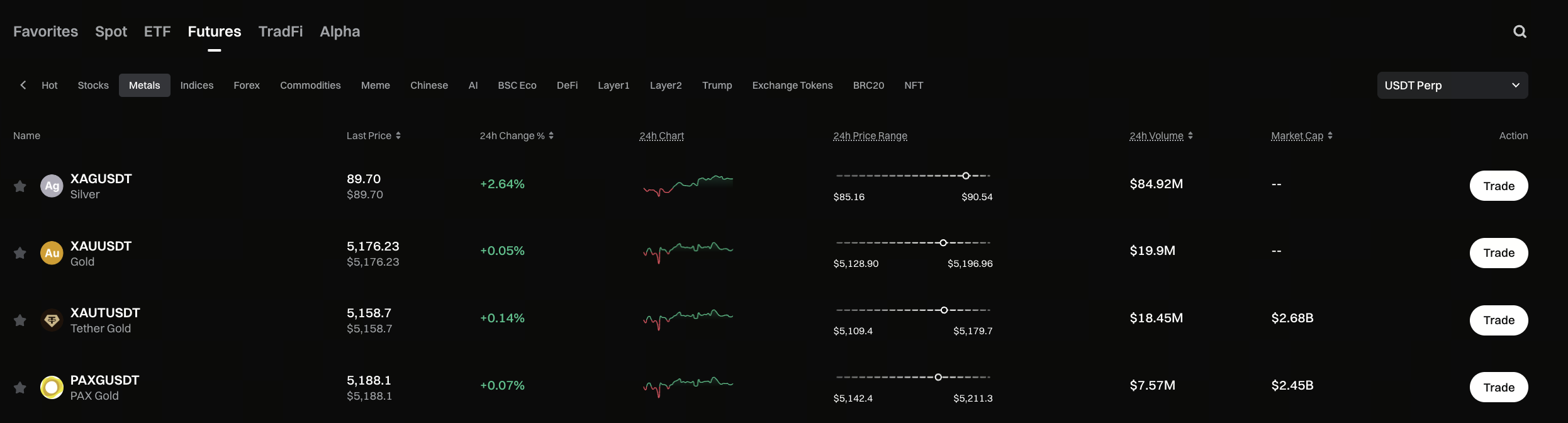
Figure: https://www.gate.com/price/futures/category-metals/usdt
Gate’s dedicated metals section gives users a centralized gateway for metals trading, allowing investors to monitor multiple metal assets within a unified trading environment. By integrating the trading interface and account system, users can execute strategies more efficiently and streamline their operations. In fast-moving markets, this centralized approach reduces operational steps and speeds up decision-making.
Additionally, the digital trading environment removes traditional time restrictions, so investors can participate flexibly in response to global market dynamics. For users already accustomed to digital asset trading, the metals section is an important addition for broadening asset classes.
Integration of Metals Trading and Multi-Asset Strategies
As traditional and digital assets increasingly merge, investors are no longer confined to a single market when building portfolios. Metals and other asset classes perform differently across economic cycles, creating more opportunities for portfolio diversification.
Multi-asset trading on a single platform enhances capital allocation efficiency and smooths strategy execution. For users aiming to build diversified investment structures, this integrated environment offers clear advantages.
Rational Participation in Complex Market Conditions
While metals market trading activity is rising, high volatility also brings higher risk. Rationally assessing market structure, allocating positions wisely, and avoiding emotional trading are essential for successful participation.
With risk aversion and inflation expectations shifting, metals are likely to remain highly active. Choosing a stable and convenient trading environment helps maintain pace and efficiency in uncertain markets.
Gate’s metals section gives investors greater flexibility and opens new possibilities for multi-asset trading trends.