Why Is the Metals Market Experiencing High Volatility?
Since 2026, the global metals market has entered a period of heightened volatility. Precious metals like gold and silver are attracting sustained capital flows due to ongoing safe-haven demand. Industrial metals such as copper and aluminum, meanwhile, are impacted by shifts in global economic recovery and supply chain restructuring, leading to more frequent price breakouts and rapid corrections.
With persistent uncertainty in the macroeconomic environment, capital is moving between risk and safe-haven assets, positioning the metals market as a key venue for portfolio rebalancing. Compared to previous stable periods, today’s market features a much broader price fluctuation range and a faster trading rhythm.
This transformation signals that the metals market is evolving from a “stable allocation asset” into a “high-activity trading asset,” drawing in a growing number of short-term and medium-term traders.
Multiple Factors Fueling Frequent Metals Market Volatility
Current metals market volatility stems from the interplay of several factors.
1. Changing expectations for global economic growth continue to reshape industrial metals demand. Manufacturing is rebounding strongly in some regions, while growth slows elsewhere, causing market forecasts for future demand to fluctuate.
2. Geopolitical dynamics and energy cost shifts are affecting metal production and transportation expenses, which in turn impact prices. When supply becomes temporarily constrained, prices often surge quickly; as supply normalizes, prices tend to retreat just as rapidly.
3. Evolving financial market capital structures are also driving metals price volatility. Increasingly, institutions and quantitative funds are integrating metals assets into their trading models, resulting in more frequent price swings, clearer trend movements, and faster reversals.
Trading Opportunities and Challenges Amid High Volatility
Expanded price swings present both opportunities and challenges for traders.
In trending markets, prices can move sharply upward or downward in a short span, offering substantial gains for trend traders. However, market reversals are also accelerating, and inadequate risk controls can magnify losses.
Given today’s environment, investors are focusing more on position management, trading discipline, and execution efficiency. Platforms and tools that support rapid market entry and exit, as well as flexible position adjustments, are increasingly vital. As a result, more traders are engaging in metals markets through digital asset trading platforms, gaining longer trading windows and greater flexibility for strategy execution.
How Gate Metals Zone Boosts Trading Efficiency
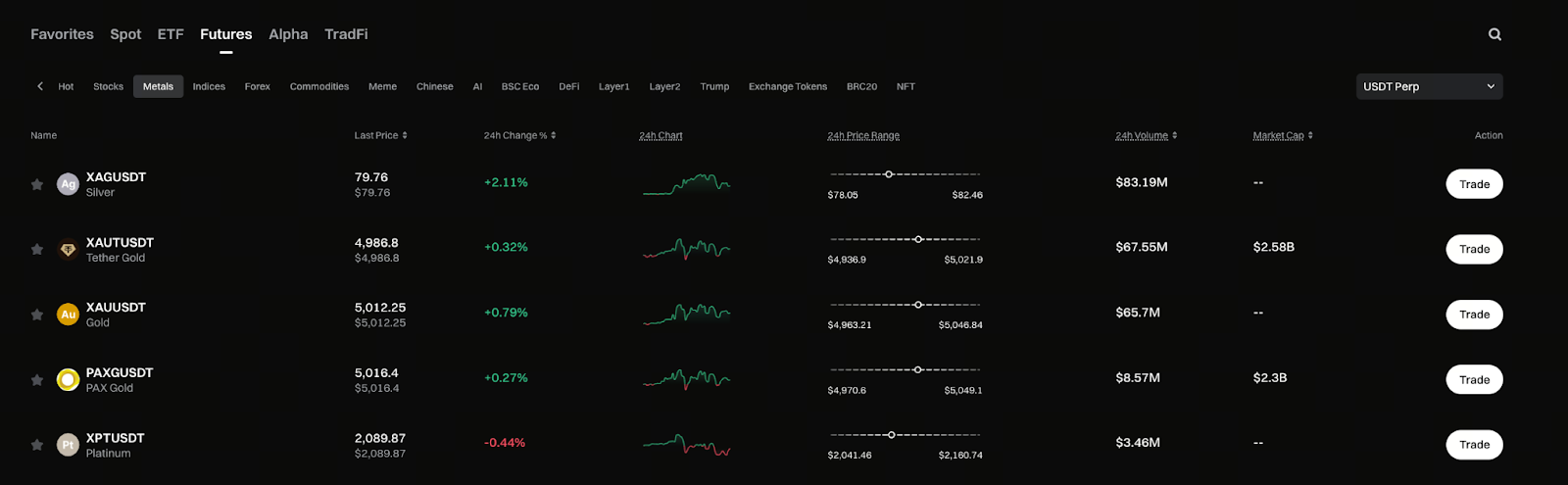
Figure: https://www.gate.com/price/futures/category-metals/usdt
In response, Gate has introduced the Metals Zone, offering users a centralized and streamlined gateway for metals trading.
This dedicated section allows users to view and trade leading metals within a unified trading environment, eliminating the need to frequently switch markets or accounts. The integrated account system and stable matching engine ensure smooth execution, particularly during rapid market shifts, effectively minimizing operational risks from system latency. Additionally, the digital contract trading mechanism provides flexible trading hours, freeing users from traditional market constraints and enabling around-the-clock trading in line with their strategies.
For users accustomed to crypto asset trading, the Metals Zone presents a new avenue for diversified asset allocation, enhancing portfolio risk management flexibility.
Metals Trading Strategies Are Becoming More Diverse
As participation in metals trading grows, market strategies are becoming increasingly sophisticated. Some traders pursue short-term swings to capture intraday or periodic moves, while others employ metals assets as stable allocations within their portfolios to hedge against rising market risk.
Cross-market strategies are also on the rise, such as leveraging differences in capital flows between crypto and traditional assets to pursue arbitrage or rotation opportunities.
The launch of Gate Metals Zone enables these strategies to be executed within a unified environment, reducing the complexity of switching between platforms and enhancing execution efficiency.
Metals Market Maintains Long-Term Strategic Value
Over the long term, metals assets remain an integral part of global asset allocation. Whether driven by safe-haven demand or sustained industrial needs in sectors like new energy and manufacturing, the market is poised to stay active. As traditional assets increasingly converge with digital trading systems, metals trading is likely to advance toward greater efficiency and convenience.
For investors seeking to seize market opportunities, choosing platforms with robust systems and a wide range of trading scenarios will be essential for future participation.