What Is the Constellation Protocol? A Ground-Up Redesign of Blockchain Architecture
As public blockchain competition shifts from a "performance race" to a contest over "market structure," transaction ordering mechanisms have become the new core variable. Constellation, introduced by Anza, represents a foundational architecture upgrade designed to address this challenge directly.
Unlike traditional approaches that focus on boosting TPS or reducing Gas fees, Constellation fundamentally reimagines "who decides transaction order." Its core innovation is the introduction of Multi-Proposer Concurrency (MCP), which expands transaction proposal rights from a single node to a network-wide collaborative process. This shift fundamentally changes the power dynamics of block production.
Core Issues in the Existing Solana Model: Leader Monopoly and MEV
In the current Solana architecture, each slot is managed by a single Leader responsible for transaction processing and block construction. While this design delivers high performance, it introduces structural challenges:
- Highly centralized ordering power: The Leader has absolute authority over transaction ordering and, by extension, value allocation.
- Acute MEV challenges: Practices like front-running, sandwich attacks, and liquidation sniping all rely on control over ordering to generate returns.
- Censorship risk: The Leader can selectively ignore certain transactions, enabling covert censorship.
All of these issues stem from a central logic: Centralized ordering power → Concentrated returns → Imbalanced incentives
How MCP Works: Multi-Proposer Concurrency in Action
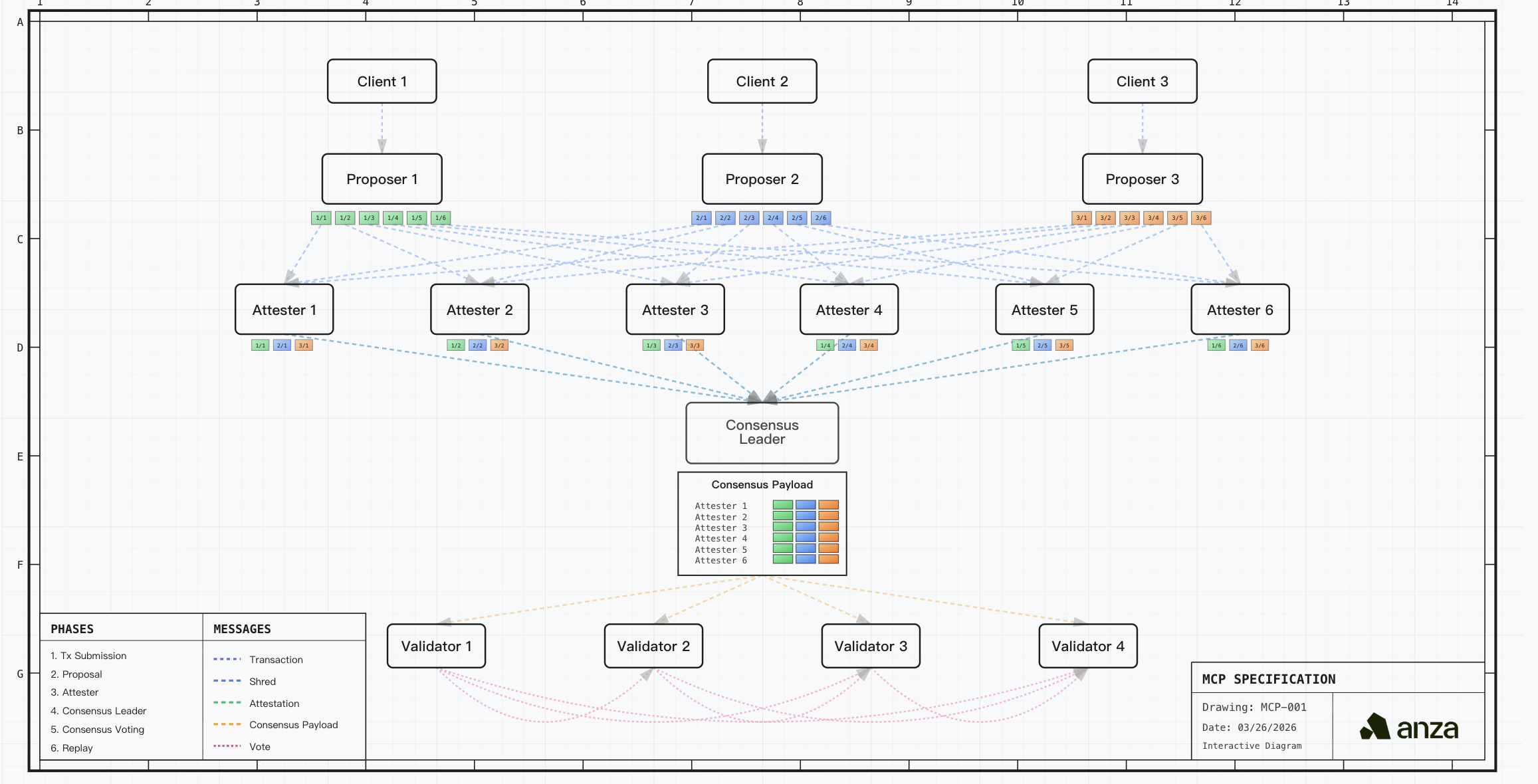 Image source: Anza Constellation Protocol Page
Constellation’s key breakthrough is splitting the transaction proposal process—once monopolized by the Leader—into parallel tasks executed by multiple participants, creating a "concurrent transaction marketplace." The process works as follows:
- Multiple proposers simultaneously collect transactions from the network.
- Roughly every 50ms, each submits transaction fragments.
- Attesters validate and timestamp transactions, then broadcast them across the network.
- In the final stage, the Leader aggregates all transaction fragments and produces the block.
This mechanism drives three fundamental changes:
- Transaction flow is no longer concentrated in a single node but instead propagates across the network.
- Proposers compete with one another, creating a marketplace dynamic.
- Block production shifts from "single-threaded execution" to "parallel processing."
In essence, Constellation transforms block generation from a "linear process" into a "concurrent system."
Censorship Resistance: From Trust in Individuals to Protocol-Level Guarantees
Traditionally, whether a transaction is included in a block depends largely on the Leader’s subjective judgment. Constellation, however, embeds censorship resistance directly into protocol rules:
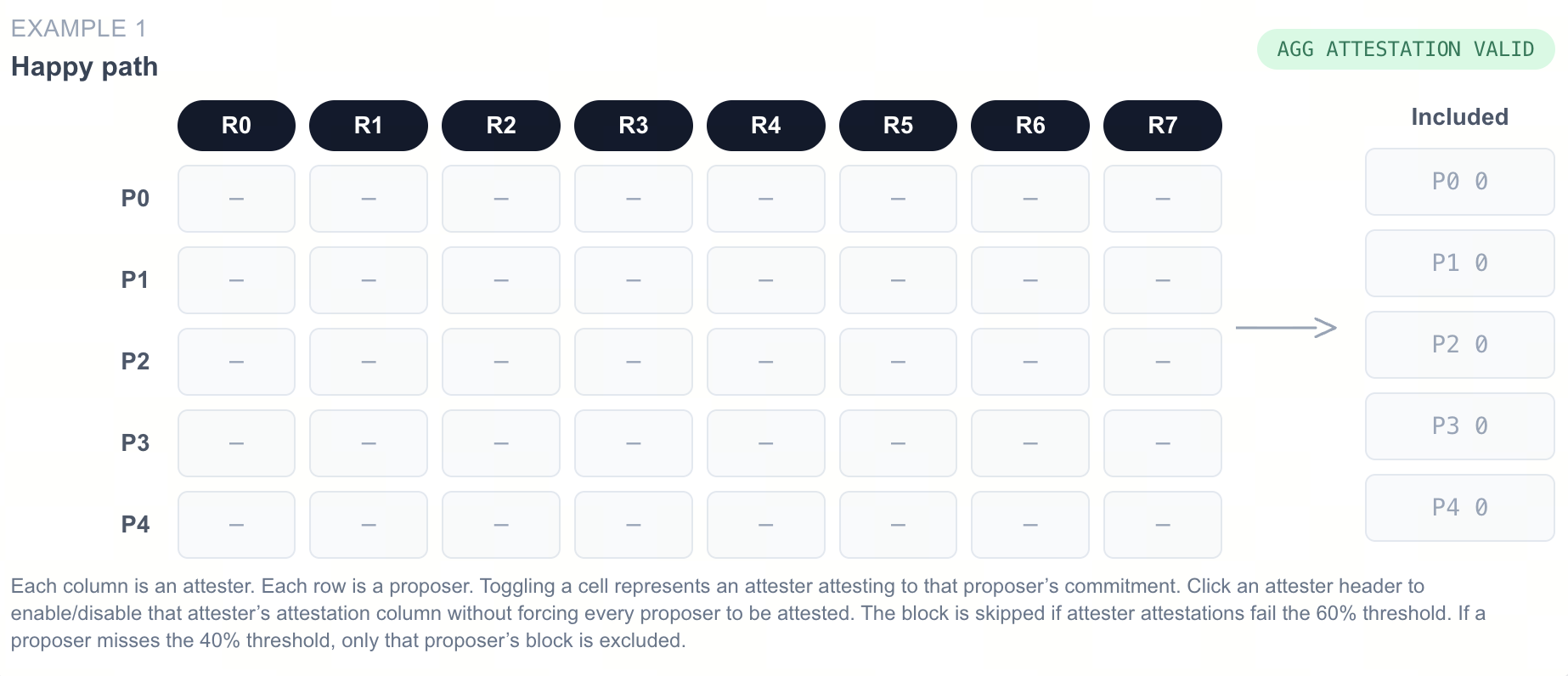
When at least 40% of attesters witness a transaction, the Leader is required to include it in the block.
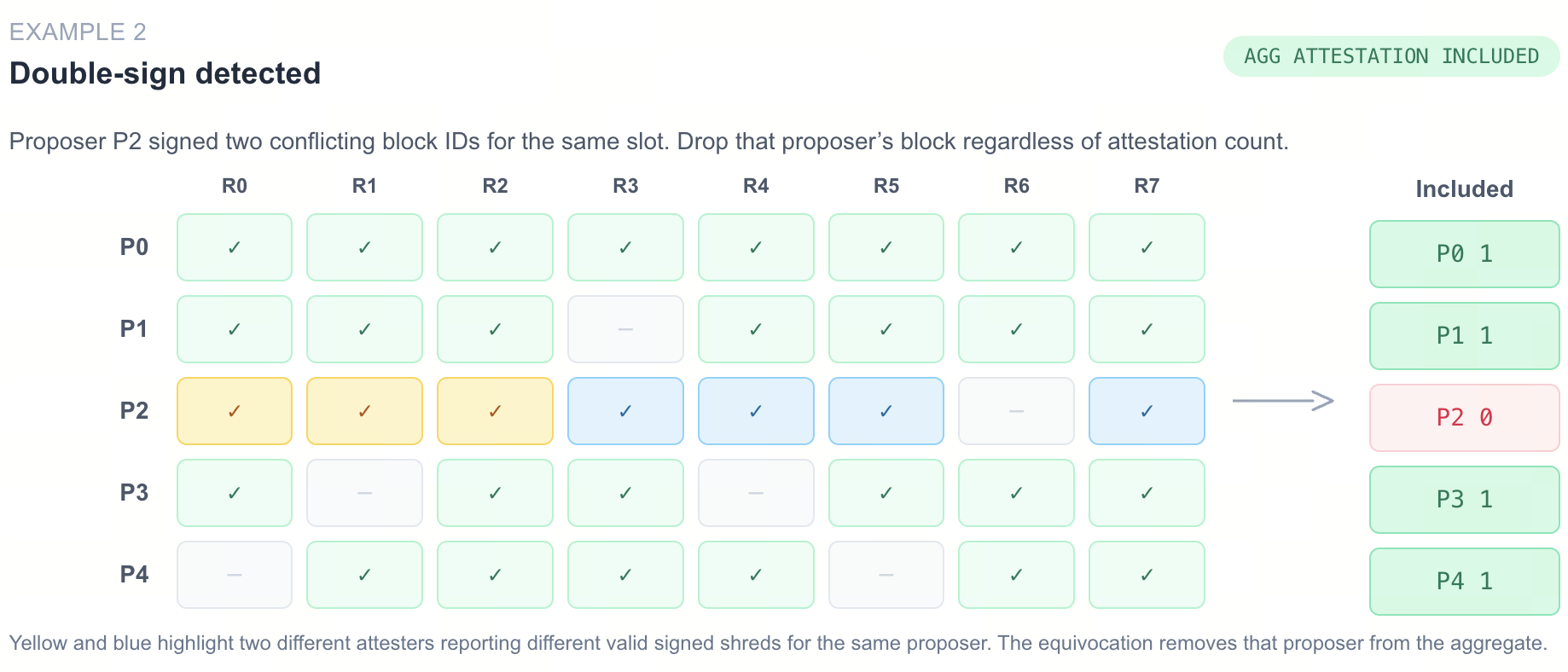
If a transaction is insufficiently confirmed (for example, it does not reach a higher threshold), the block may be skipped or deemed invalid.
This design has several direct effects:
- The Leader cannot censor by simply ignoring transactions.
- Attackers would need to control a large share of nodes to influence transaction outcomes.
- Transaction confirmation shifts from "single-point decision" to "collective consensus."
Fundamentally, this moves the system from "trusting nodes" to "trusting protocol rules."
Fees and Incentives: Redefining the Distribution of Ordering Power
Constellation not only changes the technical structure but also redesigns the economic incentive model. The fee structure is divided into two main types:
- Inclusion Fee (charged for a transaction to be included in a block)
- Ordering Fee (the value derived from transaction ordering)
The key innovation is in how ordering fees are distributed:
- Ordering fees are no longer monopolized by the Leader.
- Instead, they are distributed among the validator network according to stake.
The results of this design include:
- Preventing Leaders from extracting excessive returns through ordering power.
- Reducing the risk of power reconcentration.
- Converting ordering returns into a public good.
This is a critical step because it addresses the risk of "technical decentralization but economic centralization."
Constellation and MEV: Compression, Marketization, or Restructuring?
Constellation does not eliminate MEV; instead, it changes its nature. Structurally, three evolutionary outcomes are possible:
- MEV is compressed: Dispersed ordering power reduces arbitrage opportunities.
- MEV becomes market-driven: Proposers compete for transaction flow, creating an open marketplace.
- MEV is restructured: The focus shifts from on-chain front-running to competition for order flow.
In short, MEV shifts from "hidden returns" to "explicit competition."
Industry Comparison: Constellation vs. Flashbots—Divergent Paths
Currently, the industry is split between two main approaches to MEV:
- Off-chain approach (e.g., Flashbots):
- Resolves ordering via off-chain auctions.
- Does not modify the underlying protocol.
- Protocol approach (e.g., Constellation):
- Restructures transaction flow directly at the protocol layer.
- Integrates ordering mechanisms into consensus.
The core distinctions are:
- Control: Off-chain marketplaces vs. protocol-level rules.
- Source of risk: Relay centralization vs. protocol complexity.
- Scalability: External optimization vs. internal restructuring.
These approaches represent fundamentally different directions for ecosystem development.
Implications for DeFi and On-Chain Finance: Unlocking High-Frequency Trading
Constellation’s 50ms transaction cadence brings on-chain systems closer than ever to the matching speeds of traditional finance, resulting in structural changes:
- High-frequency trading (HFT) becomes viable, dramatically expanding the range of possible strategies.
- Order book models become more practical, reducing exclusive reliance on AMMs.
- Price discovery becomes more efficient, with less distortion from manual ordering.
These advances suggest DeFi may move from the "automated liquidity" phase into an era of "complex market structures."
Risks and Challenges: New Game Dynamics on the Horizon
While Constellation introduces advanced design, its new structure may also bring new challenges:
- Proposer cartels: Multiple proposers could collude to regain control over transaction flow.
- Increased system complexity: Multi-role architecture increases both the attack surface and maintenance costs.
- Network synchronization: Concurrency could introduce latency and consistency issues.
In other words, existing problems do not vanish—they shift to new layers and competitive dynamics.
Looking Ahead: Constellation’s Role in Solana’s Roadmap
Constellation is not a standalone upgrade; it is part of Solana’s long-term strategy. Potential future directions include:
- Integration with upcoming consensus upgrades (such as Alpenglow)
- Enhanced parallel execution and greater network throughput
- Support for institutional-grade finance and complex trading scenarios
Long term, the objective is not just higher performance, but to evolve blockchain into an infrastructure that closely mirrors real-world financial markets.
Conclusion
Constellation’s true significance lies in its redistribution of "transaction ordering power." Through its multi-proposer concurrency mechanism, it delivers three key transformations:
- From single-point control → multi-party competition
- From implicit ordering → explicit marketplaces
- From local optimization → architectural overhaul
If successfully implemented, this mechanism will usher public blockchains into a new era—where the competition is not just about speed, but about who can build a fairer, more efficient market structure.







