Far more than a mere medium of payment, ADA plays multiple roles within Cardano’s dual-layer architecture: it serves both as the staking collateral for maintaining Ouroboros consensus security and as the voting weight for participating in on-chain governance decisions. Through a unique “incentive-compatible” mechanism, ADA achieves a dynamic balance between network security, decentralization, and long-term sustainability.
From a macroeconomic perspective, the value logic of ADA lies in its precise control over the transition from inflation to deflation. It utilizes predictable “Reserve Emissions” to fill the early incentive space and, as transaction volumes surge, gradually shifts toward an endogenous growth model sustained by transaction fees.
Introduction to the ADA Token
Cardano is a layered smart contract blockchain that uses the Ouroboros Proof of Stake consensus mechanism. Its objective is to provide a secure, scalable, and formally verifiable infrastructure for decentralized applications and financial systems. ADA, as its native token, was introduced in 2017 through an initial coin offering, with a fixed maximum supply of 45 billion tokens.
Unlike Bitcoin’s Proof of Work (PoW) model or Ethereum’s early monetary structure, ADA emphasizes long term sustainability and community driven development. ADA is not only used for transaction fees, but also enables staking participation and decentralized governance.
- Staking: ADA holders can delegate tokens to Cardano validators to earn staking rewards
- Fees: Decentralized applications use ADA to pay transaction fees on the Cardano network
- Governance: ADA holders who stake their tokens can participate in on-chain governance and vote on development proposals
The Role of ADA Within the Cardano Ecosystem
Cardano’s development roadmap is divided into five eras: Byron, Shelley, Goguen, Basho, and Voltaire. Each era introduces a distinct set of functionalities delivered through multiple protocol upgrades
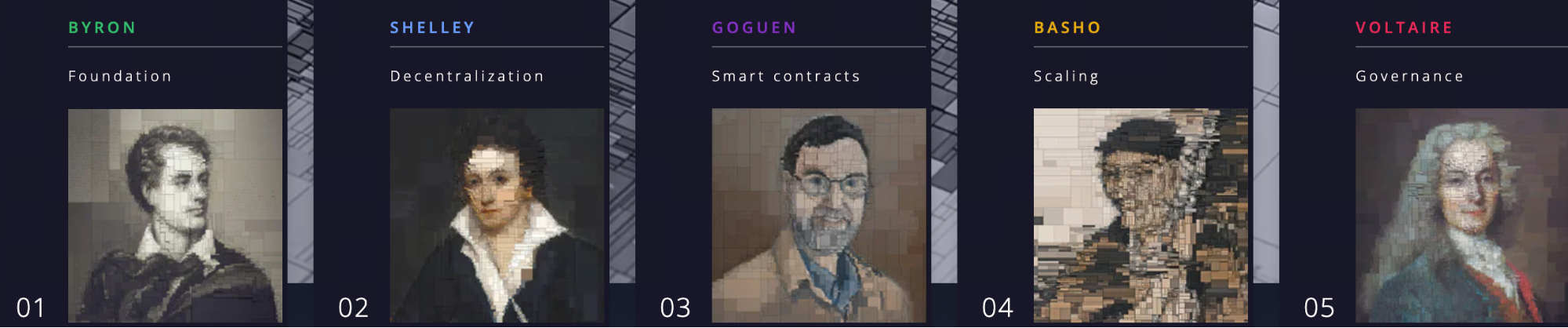
ADA functions not only as a medium of exchange, but also as the driving force that moves the network from the Shelley era of decentralization toward the Voltaire era of on-chain governance.
Within Cardano’s dual layer architecture, consisting of the Cardano Settlement Layer and the Cardano Computation Layer, ADA plays a critical role. At the settlement layer, ADA is used to process basic transactions under the UTXO model, paying minimal transaction fees that support efficient network propagation. At the computation layer, ADA functions as the fee unit for executing Plutus smart contracts, ensuring fair access to computation resources.
In decentralized finance, non fungible tokens, and identity verification applications, ADA is widely used. Lending platforms accept ADA as collateral, users earn rewards through staking while contributing to network security, and governance mechanisms introduced in the Voltaire era allow ADA holders to decide how treasury funds are allocated.
Compared with other smart contract platforms, ADA’s positioning places greater emphasis on formal verification and academic validation. The use of the Haskell programming language and functional design reduces software vulnerabilities and strengthens security guarantees. This approach has supported Cardano’s integration into real world use cases such as digital identity systems in emerging markets, while future sidechains and interoperability solutions are expected to expand ADA’s utility further.
Supply and Distribution: Inflation or Deflation
ADA has a fixed maximum supply of 45 billion tokens. During the initial presale phase, approximately 58% of the total supply was sold. Around 11.5% was allocated to the founding entities Cardano Foundation, IOHK now known as IOG, and Emurgo. The remaining 31% was placed into a reserve pool used to fund long term staking rewards.
- ICO sale: 25.9 billion ADA, approximately 57.6%
- Reserves: 13.9 billion ADA, approximately 30.9%
- IOHK: 2.46 billion ADA, approximately 5.5%
- Emurgo: 2.07 billion ADA, approximately 4.6%
- Cardano Foundation: 0.64 billion ADA, approximately 1.4%
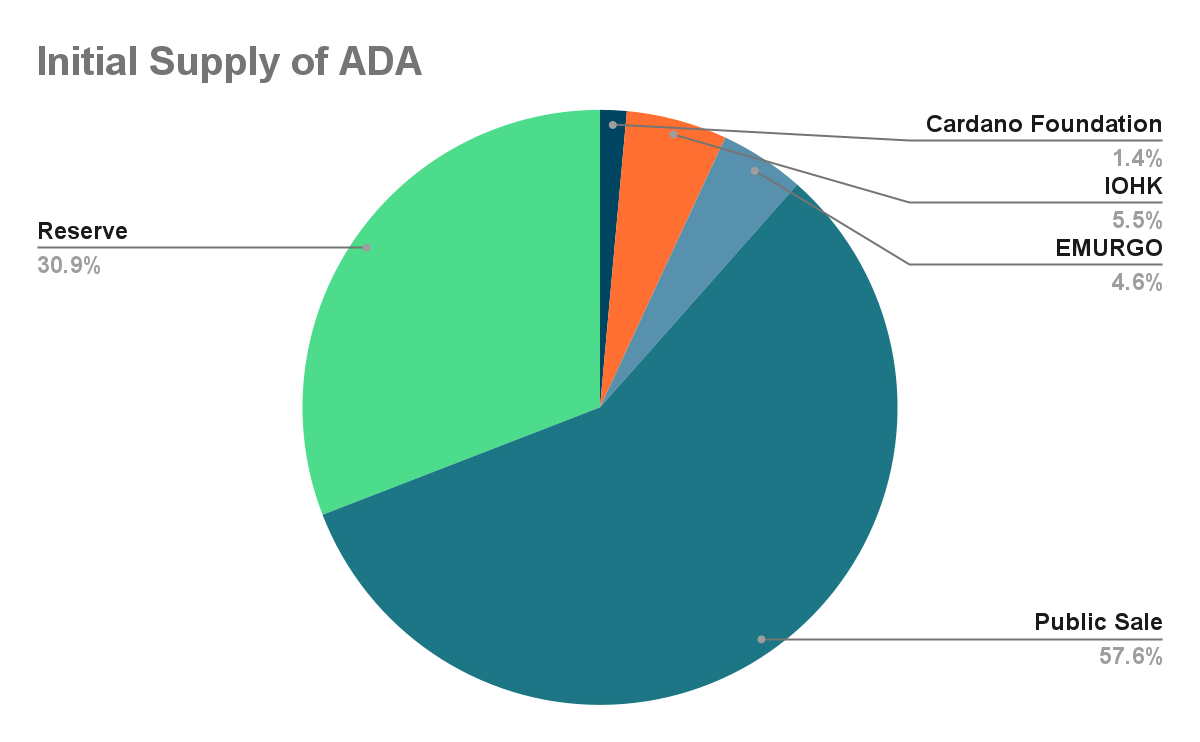
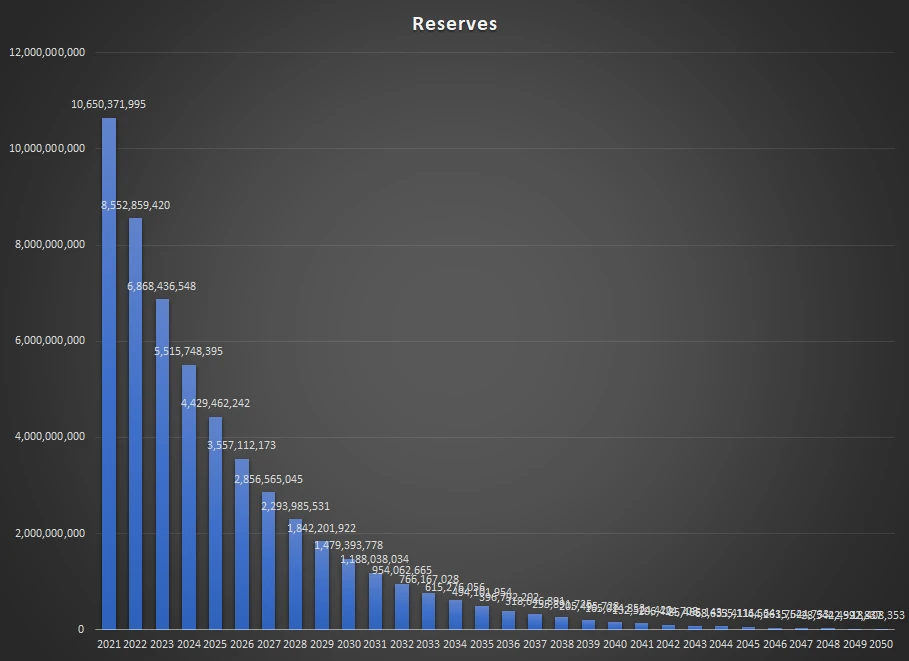
According to CoinMarketCap data, the current circulating supply of ADA is approximately 36.07 billion tokens, representing around 80% of the maximum supply. Because new ADA issuance decreases over time through epoch-based releases every five days, the long-term monetary model trends toward deflation. In the short term, however, reserve releases maintain moderate inflation to incentivize network participation.
How the Incentive Mechanism Works
Cardano’s incentive system is designed to balance efficiency and decentralization through a structured reward distribution process.
- Total reward calculation: At the end of each epoch, the protocol calculates total rewards. These rewards come from a predefined portion of the reserve pool and all transaction fees generated during the epoch
- Distribution logic: Approximately 20% of rewards are allocated directly to the treasury, while the remaining 80% is distributed to stake pool operators and delegators
- Saturation parameter: To prevent individual stake pools from becoming too large, the protocol defines a saturation threshold. Once a pool exceeds this threshold, its reward rate decreases, encouraging delegators to distribute ADA across smaller pools
This mechanism promotes decentralization while maintaining predictable and transparent incentives.
Monetary Policy and the Treasury System
Cardano’s monetary policy is highly systematic, with the treasury system serving as its central pillar.
A portion of each block reward and transaction fee is automatically directed into the on-chain treasury, rather than controlled by any centralized entity. This design ensures that even after all reserve ADA is fully distributed, the ecosystem retains a sustainable funding source for ongoing development and community initiatives.
As governance mechanisms mature, ADA holders will vote on how treasury funds are allocated. This process moves Cardano closer to a self-sustaining economic system governed by its participants.
Potential Risks in ADA Tokenomics
Despite the rigorous mathematical foundations of ADA’s economic design, several challenges remain in practice.
- Staking participation risk: If a significant portion of ADA holders stop staking, network security could weaken
- Governance concentration risk: Although saturation parameters exist, large institutions or exchanges operating multiple stake pools could still concentrate effective governance power
- Liquidity pressure: As treasury allocations grow, insufficient on-chain spending mechanisms could reduce circulating ADA and impact ecosystem activity
Understanding these risks is essential when evaluating ADA’s long term sustainability.
Summary
ADA’s tokenomics model features a fixed maximum supply, gradual token release, a sustainable staking incentive structure, an integrated on-chain treasury, and an evolving decentralized governance system.
Overall, ADA represents a crypto asset that combines a capped supply with decentralized incentive mechanisms. Through its carefully designed staking saturation model and self reinforcing treasury system, Cardano has established a sustainable economic framework that does not rely on centralized intervention.
FAQs
What is the maximum supply of ADA?
The maximum supply of ADA is fixed at 45 billion tokens, with more than 36 billion currently in circulation.
Is there a risk of slashing when staking ADA?
Unlike many Proof of Stake networks, Cardano currently does not implement slashing. Delegated ADA remains in the user’s wallet and does not face principal loss.
How can users earn ADA rewards?
Users can delegate ADA to stake pools or operate their own node. Rewards are distributed automatically every five days, which corresponds to one epoch.
What is an epoch in Cardano?
An epoch in Cardano lasts five days. Staking rewards are calculated and distributed on an epoch basis.
How are treasury funds used?
Through Project Catalyst, community members submit proposals and ADA holders vote on whether treasury funds should support those initiatives.







