Understanding aTokens and Aave Collateral Assets
To fully grasp this incident, it's important to first understand the core mechanics of Aave.
Within Aave, when users deposit assets into the protocol, they receive a type of voucher token known as an aToken. For example:
- Deposit USDT → Receive aEthUSDT
- Deposit AAVE → Receive aEthAAVE
These tokens represent the user's share of deposits in the Aave protocol and automatically accrue interest over time. As a result:
- The value of aEthUSDT generally remains close to that of USDT
- The value of aEthAAVE generally remains close to that of AAVE
Aave also offers a feature called Collateral Swap, which allows users to directly convert their collateral from one asset to another without withdrawing from the protocol.
For instance, USDT collateral can be directly swapped for AAVE collateral. This process is usually executed via an on-chain DEX or aggregator.
Incident Review: How a $50.43 Million Trade Became Just $36,000
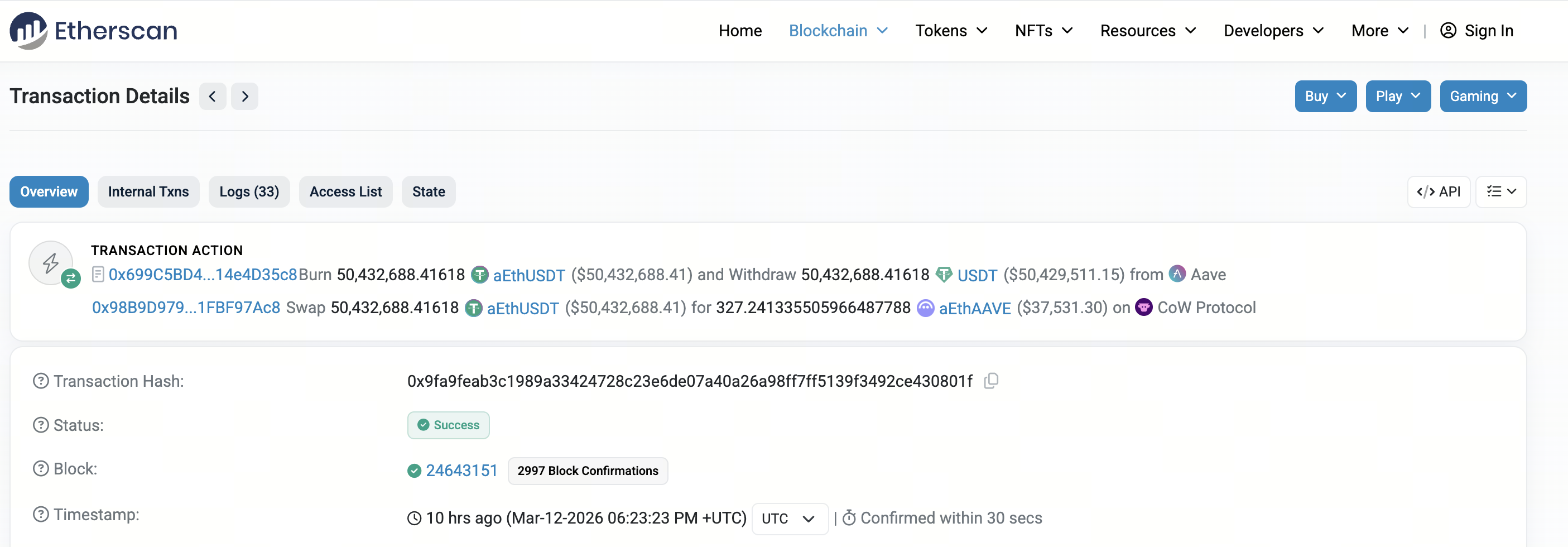 Image source: Etherscan
On-chain data indicates that a user executed a massive transaction through CoW Swap.
Transaction details:
- Asset traded: aEthUSDT → aEthAAVE
- Trade size: approximately $50.43 million
- Final amount received: approximately 327 aEthAAVE
- Final value: approximately $36,000
The actual slippage for this transaction exceeded 99%. After the incident, the on-chain analytics community quickly began analyzing and reconstructing the transaction path. Most believe the transaction was likely initiated through Aave’s collateral swap feature and ultimately executed via a DEX aggregator.
Because the transaction size was enormous and the relevant asset pool liquidity was extremely low, the price was instantly pushed to extreme levels.
CoW Swap’s Trading Path and Slippage Mechanism
CoW Swap is a decentralized trading aggregator designed to automatically route transactions and secure the best possible price across multiple DEXs.
Under normal circumstances, large trades are typically split across several pools, such as: USDT → ETH → AAVE.
In this case, the transaction may have attempted a direct swap within the aToken pair, such as: aEthUSDT → aEthAAVE.
Because aToken trading pools are extremely shallow, any order in the tens of millions of dollars can cause the price to move sharply to extreme levels.
This was the primary cause of the significant slippage in this incident.
Aave Founder Responds: User Confirmed Extreme Slippage Warning
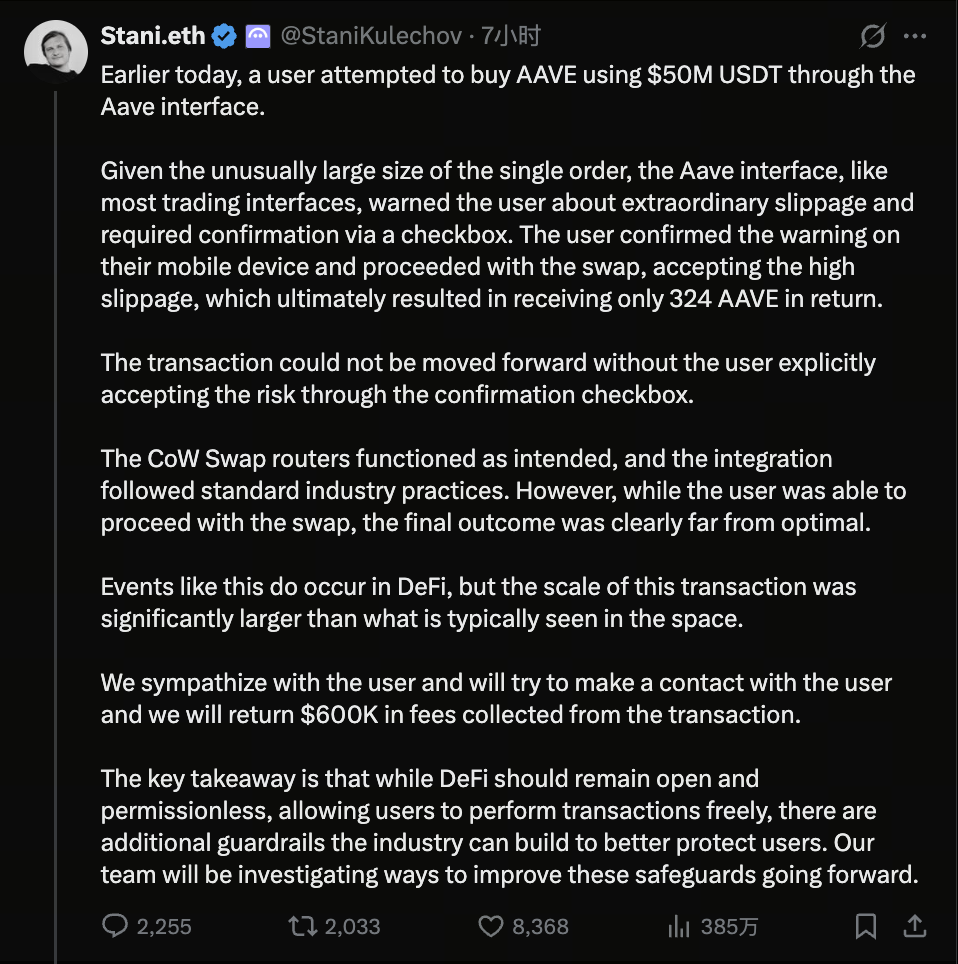 Image source: Stani Kulechov X Account
After the incident escalated, Stani Kulechov publicly responded, stating that the system had issued a clear warning to the user before executing the transaction.
According to his statement:
- The order size was exceptionally large
- The user interface displayed an extreme slippage warning
- The user needed to manually check a box to confirm before proceeding
The user acknowledged the warning and continued with the transaction on a mobile device.
From the protocol's perspective, the transaction process followed standard operational logic. After user signature confirmation, DEXs and aggregators typically do not block execution—this is a core aspect of DeFi’s permissionless design. However, Stani Kulechov also noted that the Aave team plans to contact the user and refund the approximately $600,000 protocol fee collected from the transaction, but not the entire loss.
Why DeFi Routing Strategies Can Fail
This incident once again highlights potential issues with DeFi trading aggregators under certain extreme conditions.
Most DEX aggregators currently rely on automated routing algorithms to identify the best trade path, but the following scenarios can cause problems:
- Insufficient Liquidity for Long-Tail Assets: Assets like aTokens, LSDs, and re-staked assets typically have much smaller pools than mainstream assets.
- Excessive Order Size: When a single transaction reaches tens of millions of dollars, even mainstream assets can experience significant slippage, let alone lower-liquidity derivatives.
- Limited Path Optimization Strategies: Some routing algorithms may fail to properly split trades or prioritize high-liquidity pools, amplifying price impact.
Lessons for DeFi: What the Extreme Slippage Incident Reveals
This event offers important warnings for both DeFi users and protocol developers.
- Large trades require careful execution: When conducting on-chain trades worth tens of millions of dollars, it is generally advisable to split the transaction into smaller batches to mitigate slippage risk.
- Users need to fully understand trade paths: While many DeFi interfaces are highly abstracted, actual transactions still depend on complex on-chain liquidity structures.
- Protocols should strengthen risk warnings: Future DeFi interfaces may need to provide clearer trade simulations, such as displaying price outcomes under extreme scenarios.
Additionally, some developers have suggested implementing trade size protection mechanisms at the UI level to prevent users from executing oversized orders in low-liquidity pools.
Conclusion
In summary, this incident—in which a $50 million trade resulted in only about $36,000 in assets—was not a typical hack or protocol vulnerability. Instead, it resulted from the combined effects of trade routing, liquidity structure, and user actions. As the DeFi ecosystem continues to grow and more derivative assets and complex trading mechanisms emerge, these extreme slippage events remind market participants that risk management remains a critical aspect of on-chain finance.
For everyday users, understanding liquidity structures, exercising caution with large trades, and carefully reviewing transaction warnings remain key to avoiding similar losses.







