As AI begins to enter automated decision-making, on-chain agents, and machine economy scenarios, the market no longer only needs powerful AI tools. It requires AI capabilities that can be scheduled, authorized, and settled. New architectures represented by AINFT transform AI from closed platform services into programmable on-chain resources through model aggregation, wallet-based identity, and pay-as-you-go mechanisms. By further integrating on-chain payments and financial modules, AI agents gain the ability not only to reason and generate content, but also to participate directly in value exchange and economic activity, becoming active participants in the Web3 economy.
This article begins by explaining why Web2 AI business models are increasingly strained. It then examines how model aggregation reshapes AI usage, analyzes the impact of wallet-based identity and usage-based pricing on access and cost structures, and introduces the AI financial infrastructure and three-layer architecture built by AINFT. Together, these elements help explain how AI evolves from a platform tool into a freely composable and autonomous core resource in the Web3 world.
Why Web2 AI Services Are Showing Structural Fatigue
Mainstream AI platforms offer powerful functionality, but their business models remain rooted in Web2 assumptions. Models are distributed across separate platforms, forcing users to repeatedly register accounts, bind credit cards, and pay fixed monthly fees. For low-frequency users and developers, this creates a clear barrier to entry.
Access to AI capabilities is entirely controlled by platform rules. Users cannot transfer, combine, or assetize their usage rights, which runs counter to Web3’s emphasis on sovereignty and composability.
Model Aggregation: Turning AI Capabilities into Schedulable Resources
(Source: AINFT)
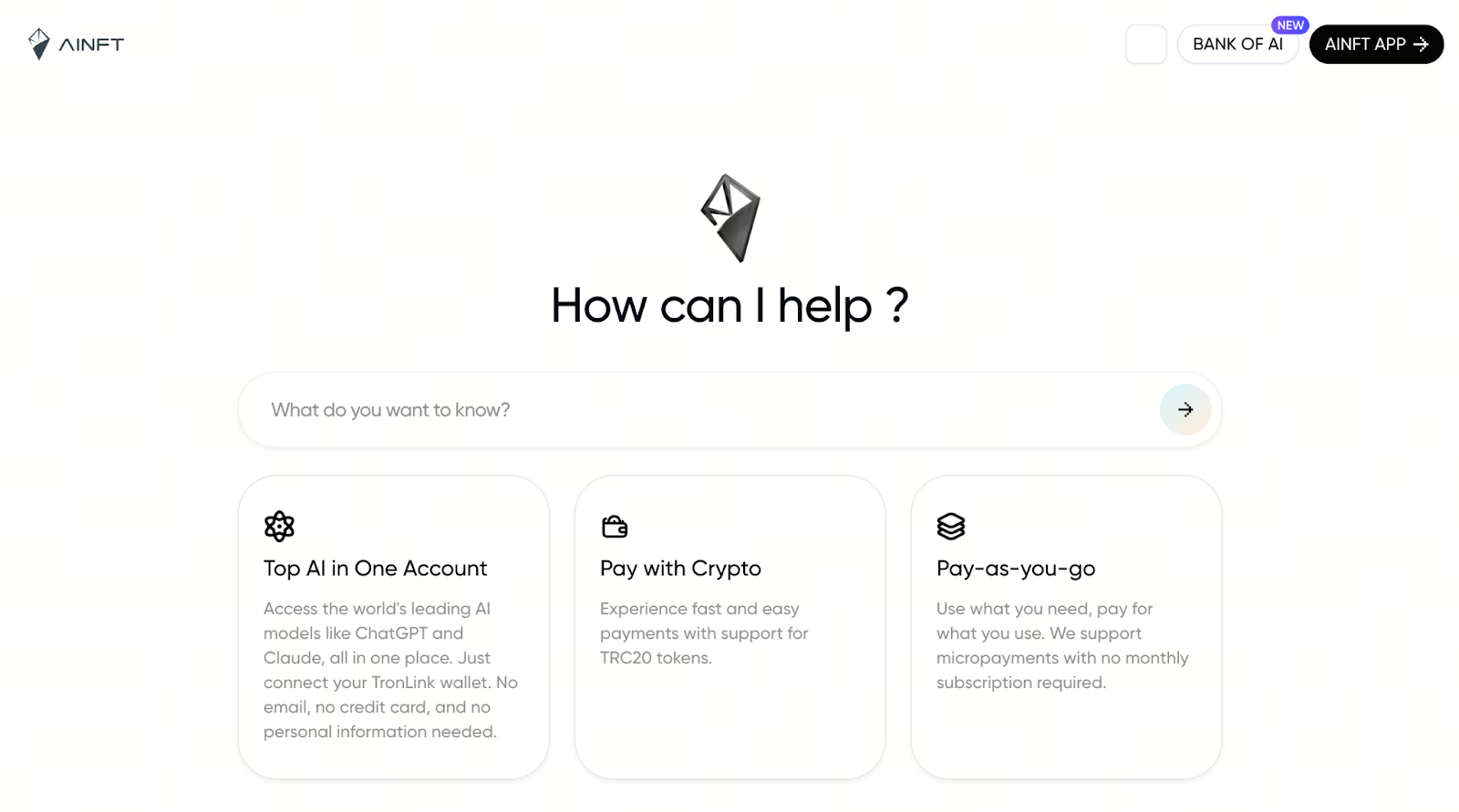
AINFT adopts a model aggregation architecture that integrates multiple AI models into a single access layer. Users do not need to consider the underlying model providers and instead select the most appropriate capability based on task requirements. This design transforms AI from a platform service into a foundational resource, introduces competition between models, and returns genuine choice to users.
Wallet as Account: Reconstructing Identity for AI Access
Within the AINFT architecture, the wallet itself serves as the user’s identity. Authentication is completed through on-chain signatures, allowing users to access AI capabilities directly without usernames, passwords, or KYC processes. This not only simplifies onboarding but also binds AI usage rights to on-chain identity for the first time, enabling future scenarios such as permission layering, assetization, and delegated access.
How Usage-Based Payments Reshape AI Cost Structures
Compared to traditional subscription models, AINFT uses a usage-based credit system that charges users only for the AI capabilities they actually consume. This aligns AI costs more closely with real value creation rather than fixed fees.
For developers, this creates more predictable and controllable cost structures, making it easier to integrate AI capabilities into early-stage or experimental products.
OpenClaw Extension: Equipping AI Agents with Full On-Chain Financial Capabilities

(Source: bankofai)
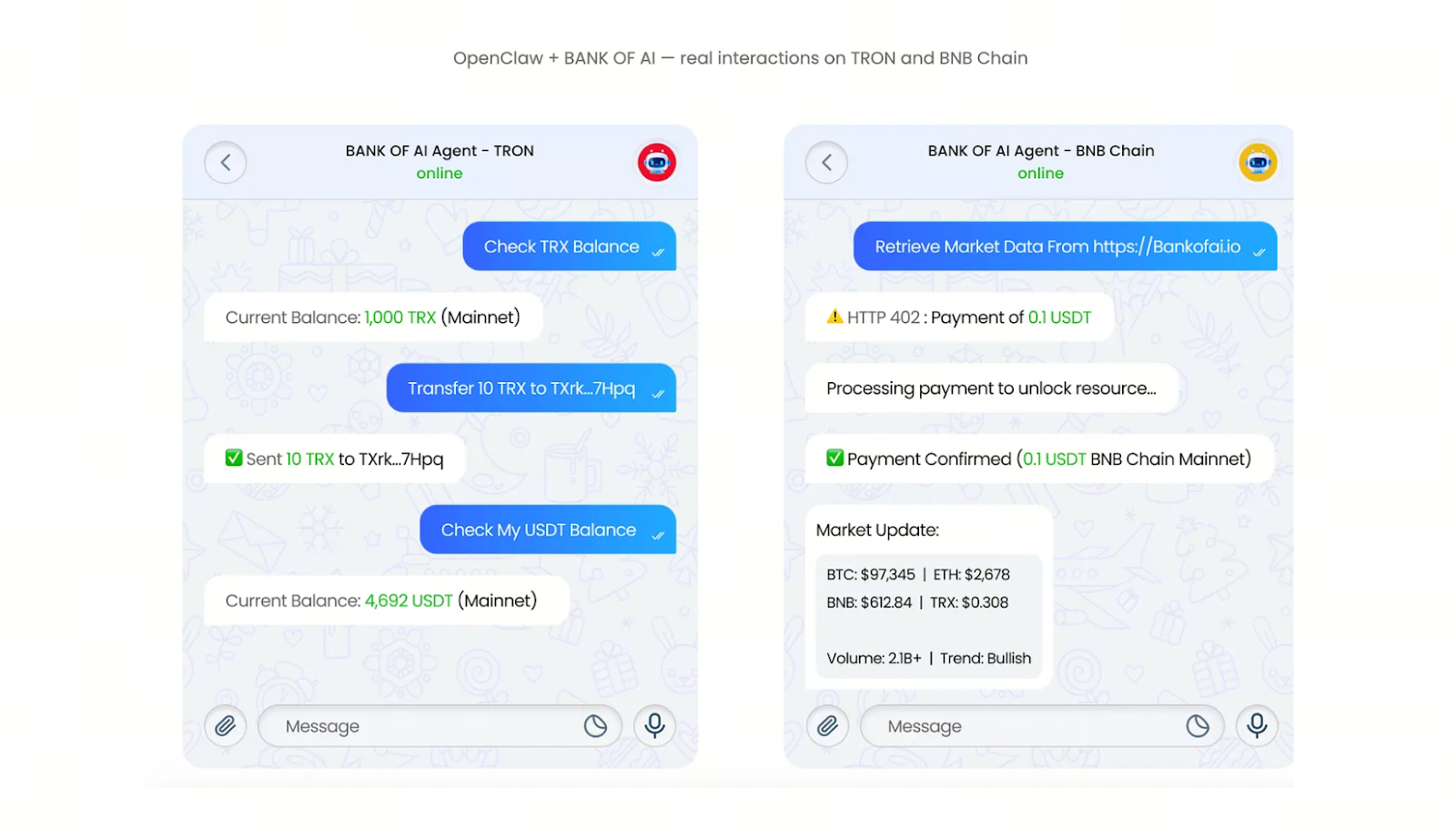
AINFT has officially introduced the “BANK OF AI” financial infrastructure layer, providing AI agents with seamless on-chain payment, identity verification, and DeFi interaction capabilities. The OpenClaw Extension serves as the core module of this system. By integrating the x402 payment protocol, multi-chain MCP (Model Context Protocol) servers, and a preconfigured Skills function library, AI agents gain bank-grade financial functionality immediately upon integration.
AI is no longer a passive tool that merely executes instructions. It becomes an on-chain economic participant capable of sending and receiving payments, verifying on-chain identities, and interacting directly with DeFi protocols. This shift transforms AI from a digital labor unit into a digital citizen with asset management and value exchange capabilities, redefining its collaborative role and value position within the Web3 economy.
A Three-Layer Architecture for AI Economic Autonomy
OpenClaw Extension is built on a three-layer structure that forms the foundation of AI economic autonomy.
- The first layer is the x402 payment protocol, which acts as a standardized value exchange language. It enables AI to conduct low-cost, automated micropayment settlements on-chain, significantly improving human–machine collaboration efficiency.
- The second layer consists of multi-chain MCP servers. By abstracting access to TRON and BNB Chain, AI agents can query balances, execute transfers, and call smart contracts directly, without needing to understand underlying RPC interfaces or gas mechanics.
- The third layer is the Skills function library, which includes built-in modules for payments, registration, and token exchange. This allows AI to complete complex financial operations through function calls, without writing smart contracts from scratch.
(Source: AINFT)
Together, this architecture combines programmable money, automated smart contract execution, and the verifiability of decentralized ledgers to deliver practical financial infrastructure for AI. It enables AI to evolve from a reasoning system into an economic actor capable of real-world execution.
Standardized APIs and the Web3 Developer Ecosystem
Through standardized APIs, AINFT packages complex AI capabilities into immediately callable modules. Developers do not need to understand underlying model mechanics to integrate intelligence into applications. This shifts AI from being the domain of large teams to a shared Web3 infrastructure component, accelerating innovation across the ecosystem.
Conclusion
AINFT’s model aggregation platform represents AI’s transition from closed platforms to decentralized services that can be accessed via wallets and paid for on demand. As AI capabilities integrate directly into the on-chain economy, AI ceases to be merely a tool and becomes a freely composable core resource within the Web3 world.







