Cardano’s Next Chapter: How x402 and Leios Consensus Usher in the Age of AI Payments

Beginner
Quick Reads
Last Updated 2026-03-28 06:07:32
Reading Time: 1m
Cardano (ADA) is steadily evolving from a traditional smart contract platform into an intelligent economic system that combines AI, payments, and decentralized collaboration. The integration of the x402 protocol and Masumi Network, along with the Leios consensus entering the engineering phase, is reinforcing Cardano’s technical foundation and establishing new infrastructure for the AI Agent economy.

Preface

Recently, Patrick Tobbler, founder of NMKR and architect of Masumi Network, announced the official launch of the x402 protocol within the Cardano ecosystem and its deep integration with Masumi Network. This development has drawn significant attention from both the community and the industry, with Cardano founder Charles Hoskinson even stating on X (formerly Twitter): “This is an important step for Cardano.” This update represents more than just a technical upgrade—it signals the beginning of Cardano’s transition toward an AI-driven economic network.
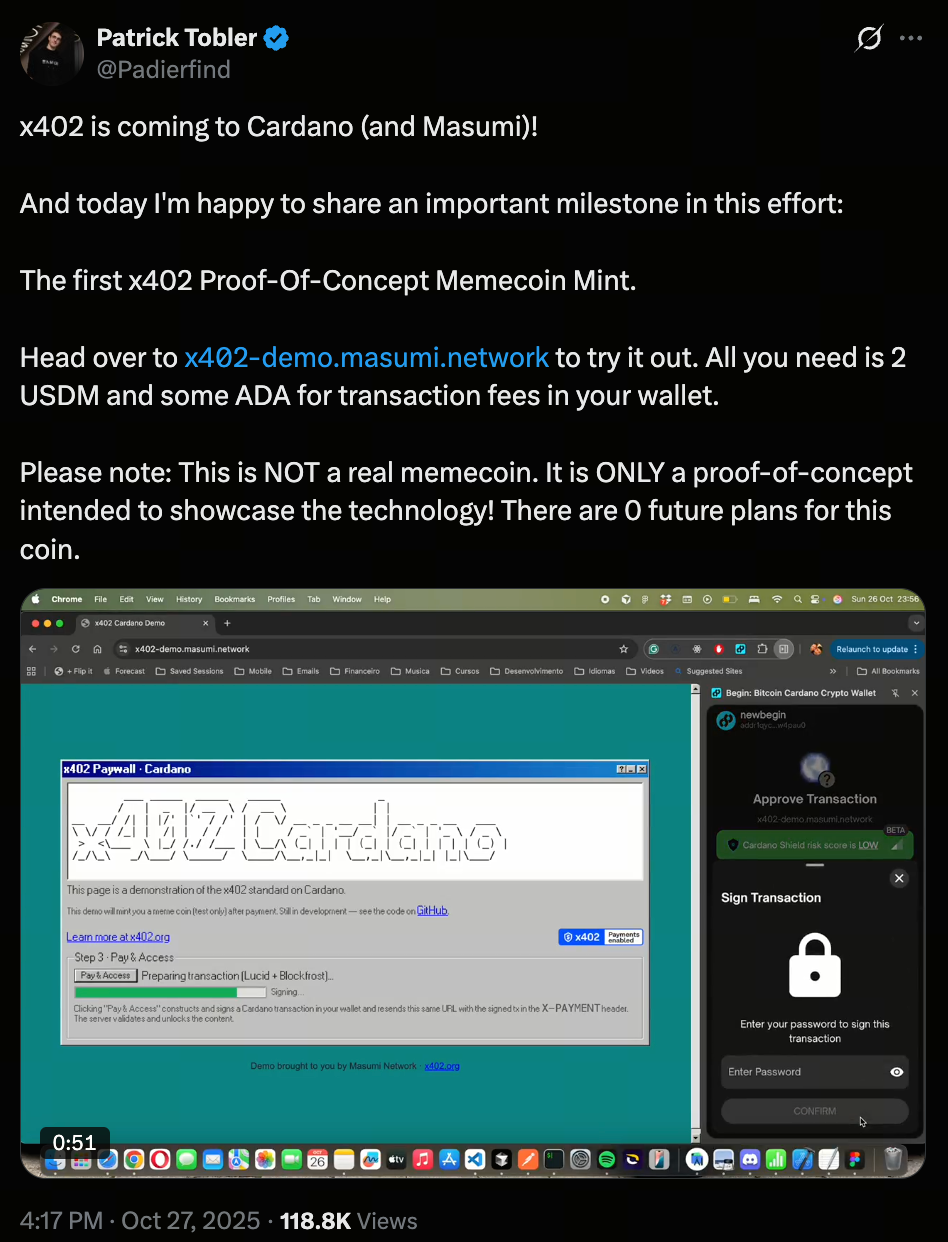

(Source: Padierfind)

x402 Protocol: Redefining On-Chain Payment Logic

The x402 protocol draws inspiration from the HTTP 402 status code (“Payment Required”), but in the Web3 context, it is reimagined as a decentralized payment protocol layer. Unlike traditional payment flows, x402 enables users to pay for digital resources directly via API—no registration, email verification, or OAuth authorization required. Originally conceptualized by Coinbase and compatible with Google’s Agent-Payment Protocol (AP2), this technology marks a step toward the automation and standardization of on-chain payments.

Tobbler notes that the adoption of x402 provides Cardano with a native, verifiable, and automatically executable payment mechanism, establishing a reliable foundation for transactions between AI Agents. In essence, x402 is more than a payment protocol—it’s a financial infrastructure enabling autonomous operation of AI and the Web3 economy.

Masumi Network: Where AI Meets Blockchain

Masumi Network is an AI protocol layer built on Cardano, designed to enable secure transactions, verification, and task execution among AI Agents. With the integration of x402, AI Agents can now complete automated payments and resource exchanges without human intervention or centralized intermediaries, creating a truly trustless intelligent economy.

This architecture transforms Cardano from a mere smart contract platform into a collaborative infrastructure supporting the AI ecosystem. In future use cases, we may see AI agents autonomously purchase computing power, subscribe to data feeds, and even settle payments based on task outcomes—this is the vision unlocked by the synergy between Masumi and x402.

Leios Consensus: Cardano Scaling Moves Toward Engineering Implementation

Beyond foundational protocols, Cardano’s core consensus is undergoing a major evolution. The Input Output (IOG) team has announced that Ouroboros Leios has transitioned from theoretical research to engineering implementation, officially moving from Input Output Research (IOR) to Input Output Engineering (IOE). Leios is an advanced iteration of the existing Ouroboros consensus mechanism, primarily aimed at increasing transaction throughput and network scalability. Cardano is moving from theoretical design to a truly commercial-grade, high-speed network—laying the technical groundwork for large-scale AI payments and real-time interactions.

Why Are These Advancements Critical for Cardano?

These three advancements interact to create a virtuous cycle for Cardano’s technology, application landscape, and market positioning:

  • Technical Advancement: x402 and Leios respectively reinforce Cardano’s payment and consensus layers, making it ideally suited for AI and Web3 applications.
  • Ecosystem Transformation: The introduction of Masumi Network marks Cardano’s evolution from a blockchain platform to an AI collaborative infrastructure.
  • Mainstream Adoption: The inclusion of ADA in US crypto ETFs demonstrates its emergence as a mainstream asset with enduring value.

If you want to explore more about Web3, click to register: https://www.gate.com/

Conclusion

From its origins as a smart contract platform to its current evolution into a multi-layered system integrating AI, payments, and consensus innovation, Cardano is entering a new era of openness and technical depth. With the deployment of the x402 protocol and Leios consensus, Cardano is advancing not only in on-chain finance but also in enabling the emergence of a self-operating AI economy. In the future, Cardano may transcend its role as just another public blockchain, becoming a smart economic network where humans and AI collaborate and participate together.

Author: Allen
Disclaimer
* The information is not intended to be and does not constitute financial advice or any other recommendation of any sort offered or endorsed by Gate.
* This article may not be reproduced, transmitted or copied without referencing Gate. Contravention is an infringement of Copyright Act and may be subject to legal action.

Related Articles

AI-Native Settlement Layers: How United Stables Is Building the Next Financial Rail
Beginner

AI-Native Settlement Layers: How United Stables Is Building the Next Financial Rail

Stablecoins were originally designed as dollar substitutes within exchanges, primarily used for asset pricing and trade settlement. As on-chain financial ecosystems have matured, their role has expanded beyond simple payments to include collateral assets, cross-chain liquidity mediums, and unified settlement units. In particular, as AI systems and automated agents begin to participate directly in economic activity, demand has risen sharply for programmable value units capable of instant settlement. This shift is pushing stablecoins toward the role of foundational financial infrastructure.
2026-03-25 03:16:17
The ve(3,3) Flywheel Explained: How AERO Tokenomics Powers Aerodrome’s DeFi Economy
Beginner

The ve(3,3) Flywheel Explained: How AERO Tokenomics Powers Aerodrome’s DeFi Economy

In the competition for DeFi liquidity, high-inflation mining alone is no longer enough to build lasting advantages. Aerodrome applies the ve(3,3) economic model to redesign token emissions, voting mechanisms, and revenue distribution, creating a liquidity flywheel centered on governance and cash flow. This article examines AERO tokenomics, the veAERO locking mechanism, and protocol revenue models to explain how Aerodrome builds a sustainable DeFi economic system.
2026-03-25 06:41:58
Aerodrome Tokenomics: How ve(3,3) Powers Base's Most Profitable DEX
Beginner

Aerodrome Tokenomics: How ve(3,3) Powers Base's Most Profitable DEX

AERO is the native token of Aerodrome Finance, a core decentralized exchange and liquidity protocol in the Base ecosystem. It is primarily used for liquidity incentives and ecosystem operations. veAERO is a governance NFT that users receive by locking AERO, representing both voting power and the right to share protocol revenue. Through a dual track structure of AERO as a utility token and veAERO as a governance credential, Aerodrome separates liquidity usage value from long term governance power, allowing participants to act as liquidity providers, governance decision makers, and revenue sharers within the same system.
2026-03-25 06:40:31
How Does PAXG Work? In-Depth Overview of the Physical Gold Tokenization Mechanism
Beginner

How Does PAXG Work? In-Depth Overview of the Physical Gold Tokenization Mechanism

PAXG (Pax Gold) is a tokenized asset backed by physical gold, issued by the fintech company Paxos and traded on the Ethereum blockchain as an ERC-20 token. The core concept is to tokenize physical gold on-chain, with each PAXG token representing ownership of a certain amount of gold. This structure enables investors to hold and trade gold in the form of a digital asset.
2026-03-24 19:12:51
How is the price of PAXG determined? Pegging mechanism, trading depth, and influencing factors
Beginner

How is the price of PAXG determined? Pegging mechanism, trading depth, and influencing factors

PAXG (Pax Gold) is a tokenized asset backed by physical gold reserves, launched by fintech firm Paxos and issued as an ERC-20 token on the Ethereum blockchain. The core concept is to digitally represent real-world gold assets, allowing investors to hold and trade gold via the blockchain network. Because each PAXG token corresponds to a specific quantity of physical gold, its price is theoretically expected to closely track the global gold market.
2026-03-24 19:11:40
Aster vs Hyperliquid: Which Perp DEX Will Prevail?
Beginner

Aster vs Hyperliquid: Which Perp DEX Will Prevail?

Aster and Hyperliquid are the two representative protocols of the "purpose-built L1 path" within the current decentralized perpetual exchange (Perp DEX) sector. As a pioneer in the field, Hyperliquid has built a deep liquidity moat through its highly mature order book architecture and strong community consensus. Conversely, Aster, as a rising challenger, seeks to leapfrog the competition in high-performance trading through more aggressive multi-chain aggregation logic, private transaction modules, and an underlying execution environment optimized for 2026 market demands.
2026-03-24 11:58:33





