Peacefulheart

vip
Age 0.8 Year
Peak Tier 5
No content yet
Pin
𝐏𝐨𝐥𝐲𝐦𝐚𝐫𝐤𝐞𝐭 $𝟏𝟎𝟎 Trading Champion 𝐂𝐡𝐚𝐥𝐥𝐞𝐧𝐠𝐞 Is Now Live _ Turn Your Judgment Into Real Profit
𝐓𝐡𝐞 𝐏𝐨𝐥𝐲𝐦𝐚𝐫𝐤𝐞𝐭 $𝟏𝟎𝟎 𝐖𝐚𝐫 𝐆𝐨𝐝 𝐂𝐡𝐚𝐥𝐥𝐞𝐧𝐠𝐞 highlights how 𝐩𝐫𝐞𝐝𝐢𝐜𝐭𝐢𝐨𝐧 𝐦𝐚𝐫𝐤𝐞𝐭𝐬 are transforming modern trading by combining macro analysis, probability, and real-time market sentiment. With rising volatility across crypto, inflation, AI, and global politics, traders who understand 𝐫𝐢𝐬𝐤 𝐦𝐚𝐧𝐚𝐠𝐞𝐦𝐞𝐧𝐭, institutional flows, and market psychology may gain major advantages. The challenge rewards both profitable trading and high-quality analytical co
BTC-3.19%
Expand All
  • Reward
  • 50
  • 4
  • Share
Vortex_King:
2026 GOGOGO 👊
View More
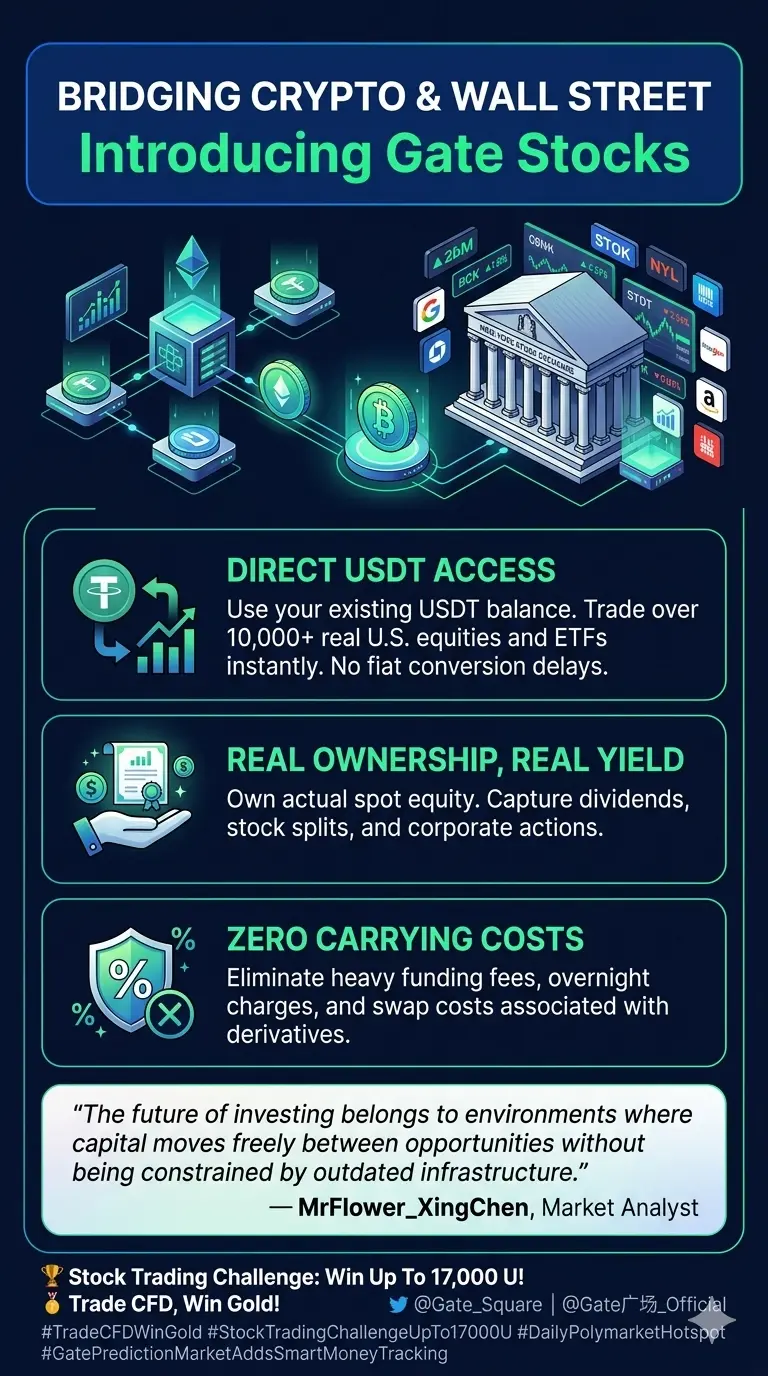
𝗚𝗮𝘁𝗲 𝗦𝘁𝗼𝗰𝗸𝘀 — 𝗧𝗵𝗲 𝗕𝗿𝗶𝗱𝗴𝗲 𝗕𝗲𝘁𝘄𝗲𝗲𝗻 𝗖𝗿𝘆𝗽𝘁𝗼 𝗖𝗮𝗽𝗶𝘁𝗮𝗹 𝗔𝗻𝗱 𝗪𝗮𝗹𝗹 𝗦𝘁𝗿𝗲𝗲𝘁
The financial world is undergoing one of the biggest transformations in modern history as the barriers separating cryptocurrency markets and traditional financial markets continue to disappear. For years, investors faced a complicated process whenever they wanted to move capital from digital assets into stocks. The journey often involved converting crypto into fiat currency, transferring funds through banks, opening brokerage accounts, completing additional verification procedure
MrFlower_XingChen
𝗚𝗮𝘁𝗲 𝗦𝘁𝗼𝗰𝗸𝘀 — 𝗧𝗵𝗲 𝗕𝗿𝗶𝗱𝗴𝗲 𝗕𝗲𝘁𝘄𝗲𝗲𝗻 𝗖𝗿𝘆𝗽𝘁𝗼 𝗖𝗮𝗽𝗶𝘁𝗮𝗹 𝗔𝗻𝗱 𝗪𝗮𝗹𝗹 𝗦𝘁𝗿𝗲𝗲𝘁
The financial world is undergoing one of the biggest transformations in modern history as the barriers separating cryptocurrency markets and traditional financial markets continue to disappear. For years, investors faced a complicated process whenever they wanted to move capital from digital assets into stocks. The journey often involved converting crypto into fiat currency, transferring funds through banks, opening brokerage accounts, completing additional verification procedures, and waiting for settlement before finally accessing the stock market. This process created friction that prevented many crypto-native investors from participating efficiently in traditional equity markets.
The launch of Gate Stocks represents a major step toward solving that problem. By allowing users to directly utilize their existing USDT balances to access thousands of U.S. stocks and ETFs, the platform creates a streamlined connection between digital assets and traditional investments. Instead of treating crypto and stocks as separate financial universes, the new model integrates them into a single ecosystem where capital can move more efficiently.
One of the most attractive features is the ability to gain exposure to major U.S. exchanges through a familiar trading environment. Investors can access companies listed on the NASDAQ and NYSE while continuing to operate within the same platform they already use for digital asset trading. This simplicity reduces operational complexity and lowers the barriers to portfolio diversification.
The concept of one-stop trading is becoming increasingly important in modern finance. Investors today expect convenience, speed, and flexibility. Managing multiple accounts across different institutions can be time-consuming and inefficient. A unified environment where users can buy, hold, and sell assets through a single interface significantly improves the overall investment experience.
Another important advantage is the treatment of corporate actions. Traditional stock ownership includes benefits that extend beyond simple price appreciation. Dividends, stock splits, mergers, and other corporate events play a critical role in long-term wealth creation. Having these actions reflected automatically helps ensure that investors receive the full economic benefits associated with their holdings.
The integration of dividend distributions is particularly significant for long-term investors. Many of the world's most successful companies generate substantial shareholder returns through recurring dividend payments. Access to these benefits creates additional opportunities for portfolio growth and income generation beyond capital appreciation alone.
Security and regulatory compliance remain fundamental pillars of financial participation. As the digital asset industry matures, investors increasingly prioritize platforms that operate within established regulatory frameworks. Services supported by licensed brokerage infrastructure help strengthen confidence while creating a more secure environment for market participation.
The broader significance extends beyond convenience. The convergence of cryptocurrency and traditional finance represents a structural shift in how capital markets function. Investors no longer want isolated ecosystems. They want seamless access to multiple asset classes, including cryptocurrencies, stocks, ETFs, commodities, and other financial instruments, all within a connected framework.
Global investment behavior is evolving accordingly. Younger generations of investors often begin their financial journey through digital assets before expanding into equities and traditional markets. Providing efficient pathways between these asset classes helps support broader financial participation and portfolio diversification.
According to 𝗠𝗿𝗙𝗹𝗼𝘄𝗲𝗿_𝗫𝗶𝗻𝗴𝗖𝗵𝗲𝗻, the most important aspect of Gate Stocks is not merely access to stocks themselves but the removal of friction between two previously disconnected financial ecosystems. He believes the future belongs to platforms capable of integrating digital and traditional assets into a unified user experience.
The timing is particularly relevant as global markets continue experiencing rapid innovation. Artificial intelligence, semiconductor expansion, cloud computing, biotechnology, and renewable energy are creating investment opportunities across traditional equities, while blockchain technology continues reshaping digital finance. Investors increasingly seek exposure to both worlds simultaneously.
Another advantage is improved capital efficiency. Rather than maintaining separate pools of capital across multiple institutions, users can manage resources more effectively within a single ecosystem. This flexibility may enhance portfolio management and reduce unnecessary operational delays.
The development also reflects a broader trend toward financial accessibility. Historically, participation in global equity markets was often restricted by geography, banking infrastructure, and administrative requirements. Technology-driven solutions are steadily reducing those limitations and expanding access to a wider audience.
According to 𝗠𝗿𝗙𝗹𝗼𝘄𝗲𝗿_𝗫𝗶𝗻𝗴𝗖𝗵𝗲𝗻, integrated financial ecosystems will become one of the defining themes of the next decade. Investors increasingly expect seamless transitions between asset classes, and platforms that successfully deliver this experience are likely to gain significant competitive advantages.
As traditional finance and digital assets continue converging, the distinction between the two sectors becomes less meaningful. The focus shifts toward creating efficient, secure, and accessible environments where users can allocate capital according to their investment objectives without unnecessary barriers.
Ultimately, Gate Stocks represents more than a new product launch. It reflects the ongoing evolution of global finance toward a future where cryptocurrencies and traditional equities coexist within interconnected ecosystems. By enabling direct access to U.S. stocks through USDT while preserving the benefits of real ownership, dividends, and corporate actions, the platform highlights how financial innovation continues expanding opportunities for investors around the world.
#TradeCFDWinGold #StockTradingChallengeUpTo17000U #DailyPolymarketHotspot #GatePredictionMarketAddsSmartMoneyTracking @Gate_Square @Gate广场_Official

repost-content-media
  • Reward
  • 2
  • Repost
  • Share
Vortex_King:
2026 GOGOGO 👊
View More
⚽ 2026 World Cup Top Scorer Prediction — Final Analysis (Golden Boot Outlook) 🏆
The 2026 World Cup Golden Boot race is shaping up as a battle between elite finishing efficiency, team depth, and tournament longevity. In expanded World Cups, the most important factor is not just scoring ability, but how far a player’s team advances, because more knockout matches directly translate into more goal opportunities.
At the top of the market, Kylian Mbappé (France) stands out as the most structurally complete candidate. France are consistently projected to reach the semi-finals or beyond, and Mbappé r
MrFlower_XingChen
⚽ 2026 World Cup Top Scorer Prediction — Final Analysis (Golden Boot Outlook) 🏆
The 2026 World Cup Golden Boot race is shaping up as a battle between elite finishing efficiency, team depth, and tournament longevity. In expanded World Cups, the most important factor is not just scoring ability, but how far a player’s team advances, because more knockout matches directly translate into more goal opportunities.
At the top of the market, Kylian Mbappé (France) stands out as the most structurally complete candidate. France are consistently projected to reach the semi-finals or beyond, and Mbappé remains the central attacking focal point with penalty duties and high shot volume. With strong team depth and a system built for fast transitions, France provide him with the most stable platform to accumulate goals across 6–7 matches or more. This combination of elite finishing and guaranteed game volume makes him the most reliable Golden Boot profile in the tournament.
Behind him, Harry Kane (England) remains the strongest challenger. England’s tactical setup creates consistent chances through high possession and structured chance creation, while Kane’s penalty responsibility significantly increases his scoring ceiling. However, England’s attack is slightly more distributed compared to France, meaning Kane’s output can be affected by goal sharing across multiple forwards. Even so, his consistency and experience in major tournaments keep him firmly in the top-tier prediction bracket.
The most dangerous upside wildcard is Erling Haaland (Norway). His scoring efficiency is unmatched, and he is capable of dominating games with minimal chances. However, his Golden Boot probability depends heavily on Norway’s ability to reach the knockout stages. If Norway exit early, his campaign shortens dramatically. If they progress, Haaland becomes the most explosive scoring threat in the entire tournament due to his pure finishing power and high conversion rate.
Spain, while structurally strong as a team, is less reliable in the Golden Boot race. Their possession-heavy system spreads goals across multiple attackers and midfielders, reducing the likelihood of a single dominant scorer. This makes Spain more of a tournament-winning profile than a top-scorer profile, unless a clear focal striker emerges during the competition.
🧠 Final Prediction (Golden Boot 2026)
🥇 1st Place: Kylian Mbappé (France) — Best combination of team depth, deep tournament run, and elite finishing volume
🥈 2nd Place: Harry Kane (England) — Strong penalty + consistency profile, slightly lower ceiling
🥉 3rd Place: Erling Haaland (Norway) — Highest upside, but dependent on team progression
4️⃣ Spain attacker pool — Strong system, but goal distribution limits individual dominance
📌 Final Verdict
The Golden Boot race is ultimately a “team progression + central striker dependency” contest, not just raw talent.
If France reach late stages → Mbappé is the most statistically supported winner
If England overperform → Kane becomes a serious threat
If Norway shock the tournament → Haaland dominates the upside scenario
👉 Final Model Edge: Mbappé remains the most balanced and high-probability Golden Boot pick for 2026.
repost-content-media
  • Reward
  • 2
  • Repost
  • Share
Vortex_King:
2026 GOGOGO 👊
View More
𝗜𝗻𝘁𝗿𝗼𝗱𝘂𝗰𝗶𝗻𝗴 𝗚𝗮𝘁𝗲 𝗦𝘁𝗼𝗰𝗸𝘀 — 𝗧𝗵𝗲 𝗡𝗲𝘄 𝗕𝗿𝗶𝗱𝗴𝗲 𝗕𝗲𝘁𝘄𝗲𝗲𝗻 𝗖𝗿𝘆𝗽𝘁𝗼 𝗔𝗻𝗱 𝗪𝗮𝗹𝗹 𝗦𝘁𝗿𝗲𝗲𝘁
For years, one of the biggest frustrations facing cryptocurrency investors has been the separation between digital assets and traditional financial markets. Many traders have watched some of the world's largest companies generate extraordinary returns while remaining trapped inside a different financial ecosystem. They saw technology giants expand, major stock indices climb to new highs, and global corporations continue creating shareholder value, yet gaining expos
MrFlower_XingChen
𝗜𝗻𝘁𝗿𝗼𝗱𝘂𝗰𝗶𝗻𝗴 𝗚𝗮𝘁𝗲 𝗦𝘁𝗼𝗰𝗸𝘀 — 𝗧𝗵𝗲 𝗡𝗲𝘄 𝗕𝗿𝗶𝗱𝗴𝗲 𝗕𝗲𝘁𝘄𝗲𝗲𝗻 𝗖𝗿𝘆𝗽𝘁𝗼 𝗔𝗻𝗱 𝗪𝗮𝗹𝗹 𝗦𝘁𝗿𝗲𝗲𝘁
For years, one of the biggest frustrations facing cryptocurrency investors has been the separation between digital assets and traditional financial markets. Many traders have watched some of the world's largest companies generate extraordinary returns while remaining trapped inside a different financial ecosystem. They saw technology giants expand, major stock indices climb to new highs, and global corporations continue creating shareholder value, yet gaining exposure often required leaving the crypto environment entirely. The process was slow, expensive, and filled with unnecessary barriers that discouraged participation.
A typical journey into U.S. equities often began with converting digital assets into fiat currency, transferring funds through banking networks, opening separate brokerage accounts, completing additional verification procedures, and waiting through settlement periods before finally gaining access to the market. By the time many investors completed these steps, opportunities they had been monitoring were often already moving higher. This friction became one of the biggest obstacles preventing seamless capital allocation between digital assets and traditional investments.
The introduction of Gate Stocks represents a significant shift in this relationship. Rather than forcing investors to navigate multiple financial systems, the platform creates a direct connection between cryptocurrency holdings and real U.S. equities. The concept is straightforward yet powerful: use the USDT already sitting in your account to access thousands of stocks and ETFs without leaving the ecosystem you already know.
What makes this development particularly important is the distinction between real ownership and synthetic exposure. For years, many investors seeking stock exposure through crypto-focused platforms relied on tokenized representations, derivatives, or products that did not provide actual ownership rights. Gate Stocks changes that dynamic by focusing on direct access to real equity assets. When investors purchase shares, they gain exposure to the actual securities rather than simply tracking their price movements through an intermediary structure.
This distinction becomes especially valuable when considering long-term investing. Real ownership brings benefits that extend beyond market appreciation. Dividends, stock splits, mergers, and other corporate actions form an essential part of shareholder returns. Access to these benefits creates a more authentic investment experience and aligns digital-native investors with traditional market opportunities that have historically been available primarily through conventional brokerage systems.
The convenience factor cannot be overstated. Imagine monitoring earnings announcements, economic data releases, or major market developments while holding digital assets. Instead of transferring funds across multiple platforms and waiting for processing times, investors can move capital within a unified environment and respond immediately to opportunities. This streamlined workflow dramatically improves efficiency while reducing operational complexity.
Another major advantage lies in cost structure. Many traders are familiar with the hidden expenses associated with leveraged products and certain derivatives. Funding fees, overnight charges, swap costs, and other recurring expenses can gradually reduce returns over time. Spot stock ownership eliminates many of these concerns, allowing investors to focus primarily on the underlying asset's performance rather than ongoing carrying costs.
The broader significance extends beyond convenience and cost savings. The integration of stocks and digital assets reflects a larger transformation occurring across global finance. Investors increasingly view financial markets as interconnected rather than isolated. Instead of maintaining separate strategies for cryptocurrencies and equities, many seek diversified portfolios that combine exposure to multiple asset classes within a unified framework.
This convergence is particularly relevant as technology continues reshaping global capital markets. Artificial intelligence, cloud computing, semiconductor manufacturing, biotechnology, and digital infrastructure are creating opportunities across traditional equities, while blockchain technology continues driving innovation within digital finance. Investors no longer want to choose between these themes; they want efficient access to both.
The ability to access more than 10,000 stocks and ETFs creates significant diversification opportunities. Investors can allocate capital across industries, regions, and investment styles while maintaining the flexibility associated with digital asset ecosystems. This broadens portfolio construction possibilities and helps reduce dependence on any single market segment.
According to 𝗠𝗿𝗙𝗹𝗼𝘄𝗲𝗿_𝗫𝗶𝗻𝗴𝗖𝗵𝗲𝗻, the most important innovation is not simply the addition of stock trading functionality but the removal of the traditional barriers separating crypto capital from global equity markets. He believes this development represents another step toward a future where financial markets operate as integrated ecosystems rather than disconnected networks.
Security and compliance also play a crucial role in supporting long-term adoption. Investors increasingly prioritize platforms that combine accessibility with strong regulatory frameworks and operational safeguards. Reliable infrastructure helps build confidence while creating a more stable environment for financial participation.
The simplicity of onboarding further highlights the platform's focus on accessibility. Rather than requiring entirely new account structures and separate application processes, existing users can transition into stock investing through a streamlined workflow. This reduces friction and encourages broader participation among individuals who may have previously viewed stock ownership as overly complicated.
The long-term implications could be substantial. As traditional finance and digital assets continue converging, platforms capable of offering seamless access across multiple asset classes may become increasingly influential. Investors are demanding flexibility, efficiency, and integration, and financial service providers are responding by building more comprehensive ecosystems.
According to 𝗠𝗿𝗙𝗹𝗼𝘄𝗲𝗿_𝗫𝗶𝗻𝗴𝗖𝗵𝗲𝗻, the future of investing belongs to environments where capital moves freely between opportunities without being constrained by outdated infrastructure. He sees the integration of stocks and digital assets as part of a broader evolution toward truly interconnected financial markets.
Ultimately, Gate Stocks represents more than a new feature. It symbolizes the gradual dismantling of the barriers that have historically separated cryptocurrency investors from traditional capital markets. By enabling direct access to real U.S. equities through existing digital asset infrastructure, the platform offers a glimpse into a future where investing is defined not by financial silos but by accessibility, efficiency, and freedom of choice. The wall between crypto and Wall Street is becoming smaller, and for many investors, a new path has finally opened.
#TradeCFDWinGold #StockTradingChallengeUpTo17000U #DailyPolymarketHotspot @Gate_Square @Gate广场_Official
#IntroducingGateStocks
repost-content-media
  • Reward
  • 2
  • Repost
  • Share
Vortex_King:
2026 GOGOGO 👊
View More
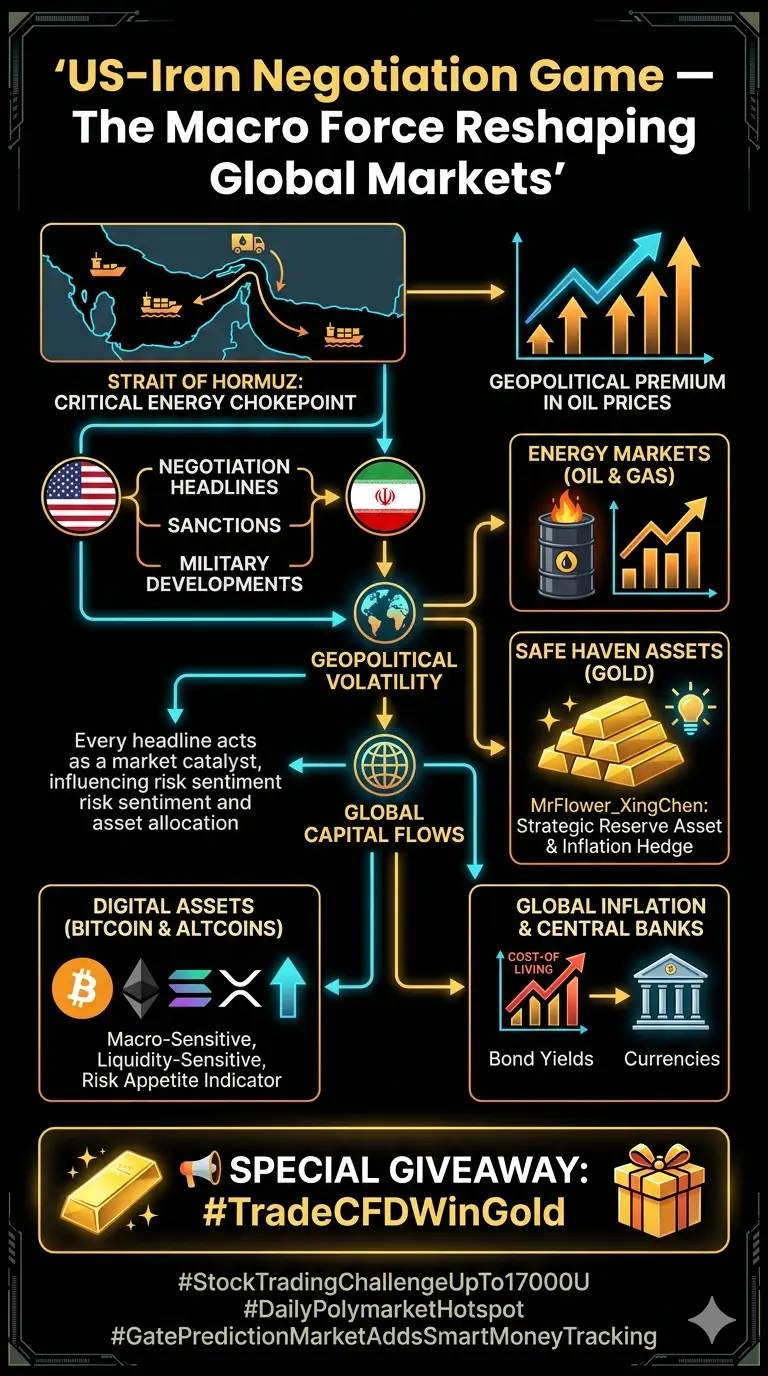
𝗨𝗦–𝗜𝗿𝗮𝗻 𝗡𝗲𝗴𝗼𝘁𝗶𝗮𝘁𝗶𝗼𝗻 𝗚𝗮𝗺𝗲 — 𝗧𝗵𝗲 𝗠𝗮𝗰𝗿𝗼 𝗙𝗼𝗿𝗰𝗲 𝗥𝗲𝘀𝗵𝗮𝗽𝗶𝗻𝗴 𝗚𝗹𝗼𝗯𝗮𝗹 𝗠𝗮𝗿𝗸𝗲𝘁𝘀
The geopolitical relationship between the United States and Iran has evolved far beyond a traditional diplomatic dispute. In today's financial environment, every negotiation headline, sanction announcement, military development, or diplomatic breakthrough has become a direct catalyst for capital movement across global markets. Investors are no longer focused solely on economic indicators, corporate earnings, or central bank policy decisions. Instead, geopolitical developm
MrFlower_XingChen
𝗨𝗦–𝗜𝗿𝗮𝗻 𝗡𝗲𝗴𝗼𝘁𝗶𝗮𝘁𝗶𝗼𝗻 𝗚𝗮𝗺𝗲 — 𝗧𝗵𝗲 𝗠𝗮𝗰𝗿𝗼 𝗙𝗼𝗿𝗰𝗲 𝗥𝗲𝘀𝗵𝗮𝗽𝗶𝗻𝗴 𝗚𝗹𝗼𝗯𝗮𝗹 𝗠𝗮𝗿𝗸𝗲𝘁𝘀
The geopolitical relationship between the United States and Iran has evolved far beyond a traditional diplomatic dispute. In today's financial environment, every negotiation headline, sanction announcement, military development, or diplomatic breakthrough has become a direct catalyst for capital movement across global markets. Investors are no longer focused solely on economic indicators, corporate earnings, or central bank policy decisions. Instead, geopolitical developments have become one of the most important variables influencing short-term market direction and long-term macro positioning.
The modern market environment operates as a highly interconnected system where geopolitical risk is transmitted almost instantly into commodities, currencies, equities, bonds, and digital assets. Every new development between Washington and Tehran creates immediate reactions among institutional investors, hedge funds, commodity traders, and algorithmic trading systems. As a result, markets increasingly function within a geopolitical volatility framework where uncertainty itself becomes a tradable asset.
At the center of this dynamic stands the strategic importance of energy markets. The Middle East continues to occupy a critical role within the global energy system, and the relationship between the United States and Iran remains one of the most significant determinants of risk premiums embedded within crude oil pricing. Market participants understand that even limited disruptions to regional stability can have substantial implications for global energy supply chains.
One of the most important factors remains the Strait of Hormuz, a maritime corridor responsible for facilitating a significant portion of global oil and liquefied natural gas transportation. The strategic importance of this route means that even the perception of disruption can trigger immediate repricing across energy markets. Traders are constantly evaluating not only actual supply conditions but also the probability of future disruptions that could affect transportation and distribution networks.
This reality has fundamentally altered the way oil markets operate. Crude oil is no longer driven exclusively by traditional supply and demand dynamics. Instead, it has evolved into a hybrid geopolitical asset where diplomatic negotiations, sanctions policies, military deployments, and regional stability often exert greater influence on short-term price action than production statistics alone. Geopolitical premiums have become a permanent component of market valuation.
The implications extend far beyond energy markets. Elevated oil prices create inflationary pressure throughout the global economy. Transportation costs rise, manufacturing expenses increase, logistics networks become more expensive to operate, and consumer prices face upward pressure. This creates additional challenges for central banks attempting to manage inflation while simultaneously supporting economic growth.
As inflation concerns intensify, investors frequently seek protection through traditional safe-haven assets. Gold continues to serve as one of the primary beneficiaries of geopolitical uncertainty because it offers both inflation protection and a perceived store of value during periods of instability. Central bank diversification programs, sovereign reserve management, and private investor demand have all contributed to maintaining strong structural support for precious metals.
According to 𝗠𝗿𝗙𝗹𝗼𝘄𝗲𝗿_𝗫𝗶𝗻𝗴𝗖𝗵𝗲𝗻, gold's strength during periods of geopolitical uncertainty reflects a broader shift in investor psychology. Rather than viewing gold solely as a commodity, many institutions increasingly regard it as a strategic reserve asset capable of preserving purchasing power during periods of systemic uncertainty. This perception continues to support long-term demand despite periodic market fluctuations.
Cryptocurrency markets have also become deeply intertwined with geopolitical developments. Bitcoin, in particular, increasingly behaves as a macro-sensitive asset influenced by liquidity conditions, institutional participation, and global risk sentiment. While some investors continue to view Bitcoin as a hedge against traditional financial risks, its market behavior often reflects broader liquidity trends and investor confidence levels.
Periods of heightened uncertainty frequently generate increased attention toward alternative financial systems and decentralized assets. However, cryptocurrencies remain highly sensitive to shifts in liquidity, making them vulnerable to both risk-on and risk-off transitions depending on the broader macroeconomic environment. This dual nature contributes to the sector's characteristic volatility.
Ethereum, Solana, XRP, and other major digital assets often amplify Bitcoin's movements due to their higher beta characteristics. During periods of optimism, these assets can outperform significantly. Conversely, during episodes of uncertainty or risk aversion, they may experience larger drawdowns than Bitcoin itself. This dynamic has become increasingly apparent as digital assets integrate more deeply into global capital markets.
The broader significance of the US–Iran negotiation framework lies in its influence over asset allocation decisions. Rising geopolitical tensions often encourage capital flows toward defensive assets such as gold, while simultaneously increasing energy prices and pressuring certain equity sectors. Conversely, signs of diplomatic progress can trigger renewed risk appetite, benefiting stocks, growth-oriented investments, and higher-risk digital assets.
Financial markets today operate within an environment where interconnectedness has reached unprecedented levels. Oil influences inflation expectations. Inflation expectations influence bond yields. Bond yields affect currency valuations. Currency movements impact international capital flows. Digital assets react to shifts in liquidity and investor sentiment. Every component influences the others, creating a highly synchronized global financial system.
Supply chain considerations add another layer of complexity. Higher shipping costs, insurance premiums, logistical inefficiencies, and transportation disruptions contribute to what many analysts describe as hidden inflation. These costs may not always appear immediately within headline economic data, but they significantly affect corporate profitability and consumer pricing structures over time.
From a strategic perspective, investors must increasingly account for geopolitical developments alongside traditional economic indicators. Market participants who focus exclusively on earnings reports, technical analysis, or monetary policy may overlook one of the most influential drivers of modern financial markets. Understanding geopolitical risk has become an essential component of comprehensive market analysis.
According to 𝗠𝗿𝗙𝗹𝗼𝘄𝗲𝗿_𝗫𝗶𝗻𝗴𝗖𝗵𝗲𝗻, the defining characteristic of the current cycle is not simply volatility but the speed at which information is transmitted across markets. A single geopolitical headline can influence oil, gold, currencies, equities, and cryptocurrencies within minutes, creating a level of interconnectedness rarely observed in previous market cycles.
Looking ahead, the outlook remains heavily dependent on the trajectory of diplomatic engagement between the United States and Iran. Escalation scenarios could reinforce existing risk premiums across energy markets and support defensive asset demand, while meaningful progress toward de-escalation could reduce geopolitical pressure and encourage broader risk-taking across financial markets.
Ultimately, the US–Iran Negotiation Game has evolved into one of the most powerful macroeconomic forces shaping global capital flows. Oil remains the central transmission mechanism, gold serves as the primary defensive hedge, and Bitcoin functions as a liquidity-sensitive indicator of risk appetite. Until lasting stability emerges, markets are likely to remain highly responsive to geopolitical developments, ensuring that every headline continues to influence financial flows across the global economy.
#TradeCFDWinGold #StockTradingChallengeUpTo17000U @Gate_Square @Gate广场_Official
#USIranNegotiationGame
repost-content-media
  • Reward
  • 2
  • Repost
  • Share
Vortex_King:
2026 GOGOGO 👊
View More
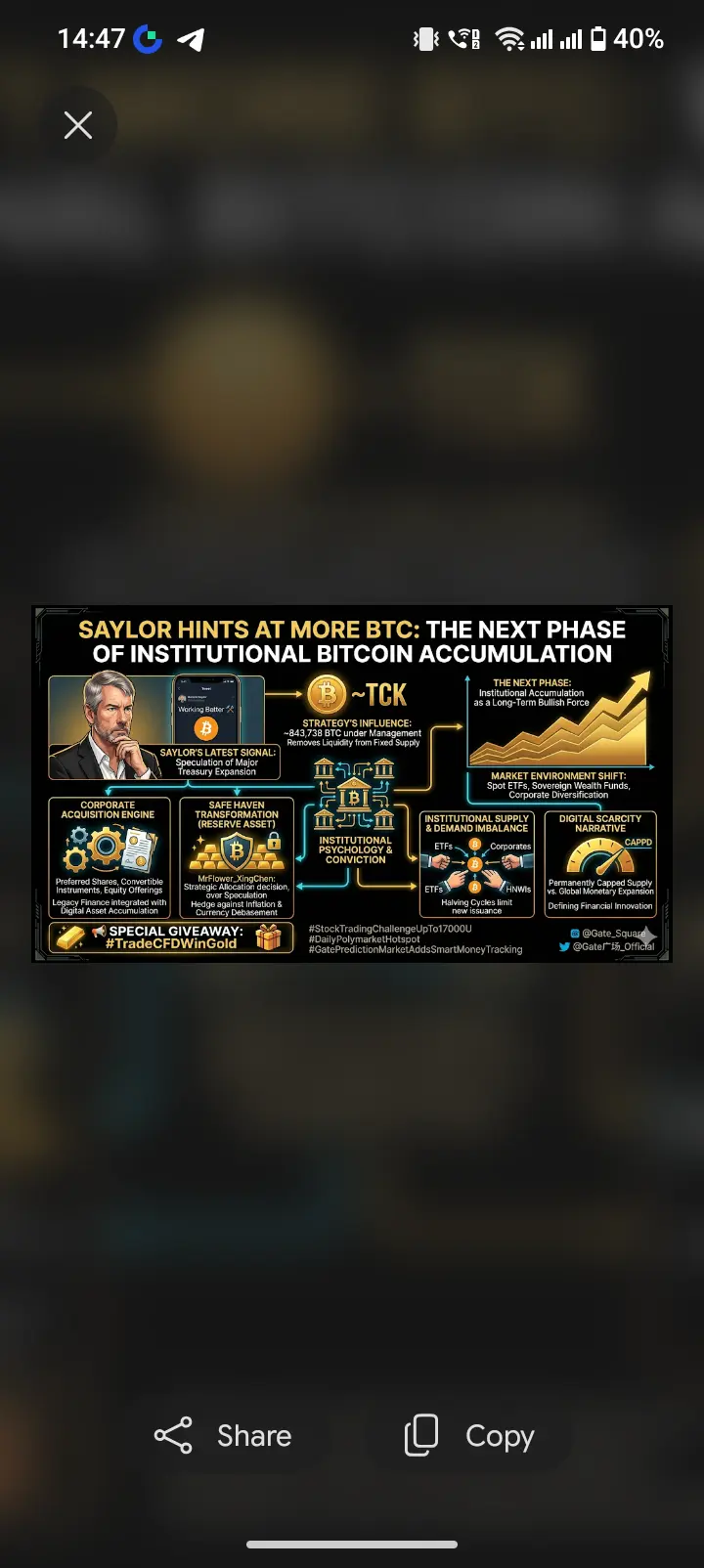
𝗦𝗮𝘆𝗹𝗼𝗿 𝗛𝗶𝗻𝘁𝘀 𝗔𝘁 𝗠𝗼𝗿𝗲 𝗕𝗧𝗖: 𝗧𝗵𝗲 𝗡𝗲𝘅𝘁 𝗣𝗵𝗮𝘀𝗲 𝗢𝗳 𝗜𝗻𝘀𝘁𝗶𝘁𝘂𝘁𝗶𝗼𝗻𝗮𝗹 𝗕𝗶𝘁𝗰𝗼𝗶𝗻 𝗔𝗰𝗰𝘂𝗺𝘂𝗹𝗮𝘁𝗶𝗼𝗻
The cryptocurrency market has become accustomed to a familiar pattern. Whenever 𝗠𝗶𝗰𝗵𝗮𝗲𝗹 𝗦𝗮𝘆𝗹𝗼𝗿 posts a short message accompanied by a 𝗕𝗶𝘁𝗰𝗼𝗶𝗻 𝗮𝗰𝗾𝘂𝗶𝘀𝗶𝘁𝗶𝗼𝗻 𝗰𝗵𝗮𝗿𝘁, investors immediately begin preparing for another 𝗺𝗮𝗷𝗼𝗿 𝘁𝗿𝗲𝗮𝘀𝘂𝗿𝘆 𝗮𝗻𝗻𝗼𝘂𝗻𝗰𝗲𝗺𝗲𝗻𝘁. What appears to be a simple social media update often evolves into one of the largest 𝗶𝗻𝘀𝘁𝗶𝘁𝘂𝘁𝗶𝗼𝗻𝗮𝗹 𝗕𝗶𝘁𝗰𝗼𝗶𝗻 𝗽𝘂𝗿𝗰𝗵𝗮𝘀𝗲𝘀 in the
BTC-3.19%
MrFlower_XingChen
𝗦𝗮𝘆𝗹𝗼𝗿 𝗛𝗶𝗻𝘁𝘀 𝗔𝘁 𝗠𝗼𝗿𝗲 𝗕𝗧𝗖: 𝗧𝗵𝗲 𝗡𝗲𝘅𝘁 𝗣𝗵𝗮𝘀𝗲 𝗢𝗳 𝗜𝗻𝘀𝘁𝗶𝘁𝘂𝘁𝗶𝗼𝗻𝗮𝗹 𝗕𝗶𝘁𝗰𝗼𝗶𝗻 𝗔𝗰𝗰𝘂𝗺𝘂𝗹𝗮𝘁𝗶𝗼𝗻
The cryptocurrency market has become accustomed to a familiar pattern. Whenever 𝗠𝗶𝗰𝗵𝗮𝗲𝗹 𝗦𝗮𝘆𝗹𝗼𝗿 posts a short message accompanied by a 𝗕𝗶𝘁𝗰𝗼𝗶𝗻 𝗮𝗰𝗾𝘂𝗶𝘀𝗶𝘁𝗶𝗼𝗻 𝗰𝗵𝗮𝗿𝘁, investors immediately begin preparing for another 𝗺𝗮𝗷𝗼𝗿 𝘁𝗿𝗲𝗮𝘀𝘂𝗿𝘆 𝗮𝗻𝗻𝗼𝘂𝗻𝗰𝗲𝗺𝗲𝗻𝘁. What appears to be a simple social media update often evolves into one of the largest 𝗶𝗻𝘀𝘁𝗶𝘁𝘂𝘁𝗶𝗼𝗻𝗮𝗹 𝗕𝗶𝘁𝗰𝗼𝗶𝗻 𝗽𝘂𝗿𝗰𝗵𝗮𝘀𝗲𝘀 in the market. The latest signal, “𝗪𝗼𝗿𝗸𝗶𝗻𝗴 𝗕𝗲𝘁𝘁𝗲𝗿,” has once again reignited speculation that 𝗦𝘁𝗿𝗮𝘁𝗲𝗴𝘆 is preparing for another aggressive expansion of its already historic 𝗕𝗶𝘁𝗰𝗼𝗶𝗻 𝗽𝗼𝘀𝗶𝘁𝗶𝗼𝗻.
What makes this situation particularly important is the sheer scale of 𝗦𝘁𝗿𝗮𝘁𝗲𝗴𝘆’𝘀 𝗶𝗻𝗳𝗹𝘂𝗲𝗻𝗰𝗲 within the Bitcoin ecosystem. With approximately 𝟴𝟰𝟯,𝟳𝟯𝟴 𝗕𝗧𝗖 already under management, the company controls a significant percentage of Bitcoin's 𝗳𝗶𝘅𝗲𝗱 𝘀𝘂𝗽𝗽𝗹𝘆. Every new purchase removes additional 𝗹𝗶𝗾𝘂𝗶𝗱𝗶𝘁𝘆 from the open market and reinforces the growing perception that 𝗶𝗻𝘀𝘁𝗶𝘁𝘂𝘁𝗶𝗼𝗻𝗮𝗹 𝗮𝗰𝗰𝘂𝗺𝘂𝗹𝗮𝘁𝗶𝗼𝗻 remains one of the strongest long-term bullish forces supporting Bitcoin's valuation. Unlike short-term traders who react to daily volatility, Strategy continues to operate with a 𝗺𝘂𝗹𝘁𝗶-𝗱𝗲𝗰𝗮𝗱𝗲 𝗶𝗻𝘃𝗲𝘀𝘁𝗺𝗲𝗻𝘁 𝗵𝗼𝗿𝗶𝘇𝗼𝗻.
The broader market environment also looks very different from previous accumulation cycles. 𝗦𝗽𝗼𝘁 𝗕𝗶𝘁𝗰𝗼𝗶𝗻 𝗘𝗧𝗙𝘀 have fundamentally changed 𝗶𝗻𝘀𝘁𝗶𝘁𝘂𝘁𝗶𝗼𝗻𝗮𝗹 𝗮𝗰𝗰𝗲𝘀𝘀 to digital assets, 𝘀𝗼𝘃𝗲𝗿𝗲𝗶𝗴𝗻 𝘄𝗲𝗮𝗹𝘁𝗵 𝗳𝘂𝗻𝗱𝘀 are increasingly researching blockchain-based reserve strategies, and 𝗰𝗼𝗿𝗽𝗼𝗿𝗮𝘁𝗲 𝘁𝗿𝗲𝗮𝘀𝘂𝗿𝘆 𝗱𝗶𝘃𝗲𝗿𝘀𝗶𝗳𝗶𝗰𝗮𝘁𝗶𝗼𝗻 has become a mainstream discussion among global executives. In this environment, Strategy is no longer viewed as an isolated experiment. Instead, it has become the 𝗯𝗹𝘂𝗲𝗽𝗿𝗶𝗻𝘁 many institutions study when evaluating Bitcoin as a 𝗿𝗲𝘀𝗲𝗿𝘃𝗲 𝗮𝘀𝘀𝗲𝘁.
One of the most fascinating developments is how Strategy has transformed 𝘁𝗿𝗮𝗱𝗶𝘁𝗶𝗼𝗻𝗮𝗹 𝗰𝗮𝗽𝗶𝘁𝗮𝗹 𝗺𝗮𝗿𝗸𝗲𝘁𝘀 into a Bitcoin acquisition engine. Through 𝗽𝗿𝗲𝗳𝗲𝗿𝗿𝗲𝗱 𝘀𝗵𝗮𝗿𝗲𝘀, 𝗰𝗼𝗻𝘃𝗲𝗿𝘁𝗶𝗯𝗹𝗲 𝗶𝗻𝘀𝘁𝗿𝘂𝗺𝗲𝗻𝘁𝘀, and 𝗲𝗾𝘂𝗶𝘁𝘆 𝗼𝗳𝗳𝗲𝗿𝗶𝗻𝗴𝘀, the company has effectively built a mechanism capable of converting conventional financial capital into long-term Bitcoin ownership. This model continues attracting attention because it demonstrates how 𝗹𝗲𝗴𝗮𝗰𝘆 𝗳𝗶𝗻𝗮𝗻𝗰𝗶𝗮𝗹 𝘀𝘁𝗿𝘂𝗰𝘁𝘂𝗿𝗲𝘀 can be integrated with digital asset accumulation strategies.
The market is also watching an important shift in 𝗶𝗻𝘀𝘁𝗶𝘁𝘂𝘁𝗶𝗼𝗻𝗮𝗹 𝗽𝘀𝘆𝗰𝗵𝗼𝗹𝗼𝗴𝘆. A few years ago, Bitcoin ownership by public companies was considered highly controversial. Today, large-scale 𝗕𝗶𝘁𝗰𝗼𝗶𝗻 𝘁𝗿𝗲𝗮𝘀𝘂𝗿𝘆 𝗵𝗼𝗹𝗱𝗶𝗻𝗴𝘀 are increasingly viewed as a 𝘀𝘁𝗿𝗮𝘁𝗲𝗴𝗶𝗰 𝗮𝗹𝗹𝗼𝗰𝗮𝘁𝗶𝗼𝗻 decision rather than a speculative gamble. As 𝗶𝗻𝗳𝗹𝗮𝘁𝗶𝗼𝗻 𝗰𝗼𝗻𝗰𝗲𝗿𝗻𝘀, 𝘀𝗼𝘃𝗲𝗿𝗲𝗶𝗴𝗻 𝗱𝗲𝗯𝘁 𝗴𝗿𝗼𝘄𝘁𝗵, and 𝗰𝘂𝗿𝗿𝗲𝗻𝗰𝘆 𝗱𝗲𝗯𝗮𝘀𝗲𝗺𝗲𝗻𝘁 discussions continue globally, Bitcoin's fixed supply narrative remains attractive.
Another critical factor supporting Strategy's thesis is the growing imbalance between 𝗮𝘃𝗮𝗶𝗹𝗮𝗯𝗹𝗲 𝘀𝘂𝗽𝗽𝗹𝘆 and 𝗶𝗻𝘀𝘁𝗶𝘁𝘂𝘁𝗶𝗼𝗻𝗮𝗹 𝗱𝗲𝗺𝗮𝗻𝗱. New Bitcoin issuance remains limited following previous 𝗵𝗮𝗹𝘃𝗶𝗻𝗴 𝗰𝘆𝗰𝗹𝗲𝘀, while ETFs, corporate treasuries, family offices, and 𝗵𝗶𝗴𝗵-𝗻𝗲𝘁-𝘄𝗼𝗿𝘁𝗵 𝗶𝗻𝘃𝗲𝘀𝘁𝗼𝗿𝘀 continue competing for available liquidity. This 𝘀𝘂𝗽𝗽𝗹𝘆-𝗱𝗲𝗺𝗮𝗻𝗱 𝗱𝘆𝗻𝗮𝗺𝗶𝗰 creates structural pressure that many analysts believe will remain a dominant force throughout the next market cycle.
The importance of 𝗕𝗶𝘁𝗰𝗼𝗶𝗻’𝘀 𝘀𝗰𝗮𝗿𝗰𝗶𝘁𝘆 becomes even more apparent when viewed against 𝗴𝗹𝗼𝗯𝗮𝗹 𝗺𝗼𝗻𝗲𝘁𝗮𝗿𝘆 𝗲𝘅𝗽𝗮𝗻𝘀𝗶𝗼𝗻. Central banks can increase currency supply when necessary, governments can issue additional debt, and corporations can create new shares. Bitcoin remains unique because its supply is 𝗽𝗲𝗿𝗺𝗮𝗻𝗲𝗻𝘁𝗹𝘆 𝗰𝗮𝗽𝗽𝗲𝗱. This characteristic continues attracting investors who view 𝗱𝗶𝗴𝗶𝘁𝗮𝗹 𝘀𝗰𝗮𝗿𝗰𝗶𝘁𝘆 as one of the defining financial innovations of the modern era.
According to 𝗠𝗿𝗙𝗹𝗼𝘄𝗲𝗿_𝗫𝗶𝗻𝗴𝗖𝗵𝗲𝗻, the most important takeaway from Saylor's latest signal is not simply whether another purchase announcement arrives. The deeper story is that 𝗶𝗻𝘀𝘁𝗶𝘁𝘂𝘁𝗶𝗼𝗻𝗮𝗹 𝗰𝗼𝗻𝘃𝗶𝗰𝘁𝗶𝗼𝗻 continues strengthening despite market volatility. Every acquisition reinforces the idea that major players increasingly view Bitcoin as a 𝗹𝗼𝗻𝗴-𝘁𝗲𝗿𝗺 𝘀𝘁𝗿𝗮𝘁𝗲𝗴𝗶𝗰 𝗮𝘀𝘀𝗲𝘁 rather than a short-term speculative trade.
Looking ahead, the next phase of 𝗕𝗶𝘁𝗰𝗼𝗶𝗻 𝗮𝗱𝗼𝗽𝘁𝗶𝗼𝗻 may be driven less by retail enthusiasm and more by 𝗶𝗻𝘀𝘁𝗶𝘁𝘂𝘁𝗶𝗼𝗻𝗮𝗹 𝗰𝗼𝗺𝗽𝗲𝘁𝗶𝘁𝗶𝗼𝗻. As more organizations evaluate 𝗿𝗲𝘀𝗲𝗿𝘃𝗲 𝗱𝗶𝘃𝗲𝗿𝘀𝗶𝗳𝗶𝗰𝗮𝘁𝗶𝗼𝗻 𝘀𝘁𝗿𝗮𝘁𝗲𝗴𝗶𝗲𝘀, the pressure to secure scarce Bitcoin supply could intensify dramatically. Companies that establish positions early may gain advantages that become increasingly difficult for late entrants to replicate.
If Strategy announces another 𝗺𝗮𝗷𝗼𝗿 𝗮𝗰𝗾𝘂𝗶𝘀𝗶𝘁𝗶𝗼𝗻 in the coming weeks, it would further reinforce the narrative that 𝗶𝗻𝘀𝘁𝗶𝘁𝘂𝘁𝗶𝗼𝗻𝗮𝗹 𝗮𝗰𝗰𝘂𝗺𝘂𝗹𝗮𝘁𝗶𝗼𝗻 remains active despite macroeconomic uncertainty. Such a development could strengthen 𝗺𝗮𝗿𝗸𝗲𝘁 𝗰𝗼𝗻𝗳𝗶𝗱𝗲𝗻𝗰𝗲, encourage additional corporate participation, and accelerate discussions around Bitcoin's role within modern treasury management frameworks.
Ultimately, the significance of Saylor's latest message extends far beyond a social media post. It represents another chapter in the ongoing transformation of Bitcoin from an 𝗮𝗹𝘁𝗲𝗿𝗻𝗮𝘁𝗶𝘃𝗲 𝗱𝗶𝗴𝗶𝘁𝗮𝗹 𝗮𝘀𝘀𝗲𝘁 into a 𝗴𝗹𝗼𝗯𝗮𝗹𝗹𝘆 𝗿𝗲𝗰𝗼𝗴𝗻𝗶𝘇𝗲𝗱 𝗶𝗻𝘀𝘁𝗶𝘁𝘂𝘁𝗶𝗼𝗻𝗮𝗹 𝗿𝗲𝘀𝗲𝗿𝘃𝗲 𝗶𝗻𝘀𝘁𝗿𝘂𝗺𝗲𝗻𝘁. Whether the next purchase is measured in thousands or tens of thousands of BTC, the broader trend remains clear: 𝗶𝗻𝘀𝘁𝗶𝘁𝘂𝘁𝗶𝗼𝗻𝗮𝗹 𝗱𝗲𝗺𝗮𝗻𝗱 continues evolving, supply remains limited, and Bitcoin's role within global finance appears to be expanding rather than contracting.
The signal has been delivered. The market is watching. And if history is any guide, the next major announcement may once again demonstrate why 𝗶𝗻𝘀𝘁𝗶𝘁𝘂𝘁𝗶𝗼𝗻𝗮𝗹 𝗕𝗶𝘁𝗰𝗼𝗶𝗻 𝗮𝗰𝗰𝘂𝗺𝘂𝗹𝗮𝘁𝗶𝗼𝗻 remains one of the most closely followed narratives in the entire 𝗱𝗶𝗴𝗶𝘁𝗮𝗹 𝗮𝘀𝘀𝗲𝘁 𝗶𝗻𝗱𝘂𝘀𝘁𝗿𝘆.
#TradeCFDWinGold #StockTradingChallengeUpTo17000U #DailyPolymarketHotspot #GatePredictionMarketAddsSmartMoneyTracking @Gate_Square @Gate广场_Official

#SaylorHintsAtMoreBTC
repost-content-media
  • Reward
  • Comment
  • Repost
  • Share
#ETHSeesawsAround2000Level
𝗘𝗧𝗛 𝗔𝘁 𝗧𝗵𝗲 𝗖𝗿𝗶𝘁𝗶𝗰𝗮𝗹 $𝟮,𝟬𝟬𝟬 𝗕𝗮𝘁𝘁𝗹𝗲𝘇𝗼𝗻𝗲 — 𝗪𝗵𝘆 𝗧𝗵𝗶𝘀 𝗟𝗲𝘃𝗲𝗹 𝗠𝗮𝘆 𝗗𝗲𝗳𝗶𝗻𝗲 𝗘𝘁𝗵𝗲𝗿𝗲𝘂𝗺’𝘀 𝗡𝗲𝘅𝘁 𝗠𝗮𝗷𝗼𝗿 𝗠𝗼𝘃𝗲
Ethereum continues to trade in one of the most important 𝗧𝗘𝗖𝗛𝗡𝗜𝗖𝗔𝗟 𝗭𝗢𝗡𝗘𝗦 of the current market cycle as price action fluctuates around the $𝟮,𝟬𝟬𝟬 𝗣𝗦𝗬𝗖𝗛𝗢𝗟𝗢𝗚𝗜𝗖𝗔𝗟 𝗟𝗘𝗩𝗘𝗟. While Bitcoin remains the dominant force driving overall market sentiment, Ethereum has entered a period of 𝗨𝗡𝗖𝗘𝗥𝗧𝗔𝗜𝗡𝗧𝗬 where buyers and sellers are aggressively competing for control of the n
ETH-1.5%
BTC-3.19%
MrFlower_XingChen
#ETHSeesawsAround2000Level
𝗘𝗧𝗛 𝗔𝘁 𝗧𝗵𝗲 𝗖𝗿𝗶𝘁𝗶𝗰𝗮𝗹 $𝟮,𝟬𝟬𝟬 𝗕𝗮𝘁𝘁𝗹𝗲𝘇𝗼𝗻𝗲 — 𝗪𝗵𝘆 𝗧𝗵𝗶𝘀 𝗟𝗲𝘃𝗲𝗹 𝗠𝗮𝘆 𝗗𝗲𝗳𝗶𝗻𝗲 𝗘𝘁𝗵𝗲𝗿𝗲𝘂𝗺’𝘀 𝗡𝗲𝘅𝘁 𝗠𝗮𝗷𝗼𝗿 𝗠𝗼𝘃𝗲
Ethereum continues to trade in one of the most important 𝗧𝗘𝗖𝗛𝗡𝗜𝗖𝗔𝗟 𝗭𝗢𝗡𝗘𝗦 of the current market cycle as price action fluctuates around the $𝟮,𝟬𝟬𝟬 𝗣𝗦𝗬𝗖𝗛𝗢𝗟𝗢𝗚𝗜𝗖𝗔𝗟 𝗟𝗘𝗩𝗘𝗟. While Bitcoin remains the dominant force driving overall market sentiment, Ethereum has entered a period of 𝗨𝗡𝗖𝗘𝗥𝗧𝗔𝗜𝗡𝗧𝗬 where buyers and sellers are aggressively competing for control of the next major trend. The result is a highly 𝗖𝗢𝗠𝗣𝗥𝗘𝗦𝗦𝗘𝗗 𝗠𝗔𝗥𝗞𝗘𝗧 𝗦𝗧𝗥𝗨𝗖𝗧𝗨𝗥𝗘 that could eventually lead to a significant breakout or breakdown.
The importance of the $𝟮,𝟬𝟬𝟬 𝗭𝗢𝗡𝗘 extends far beyond simple price action. 𝗣𝗦𝗬𝗖𝗛𝗢𝗟𝗢𝗚𝗜𝗖𝗔𝗟 𝗟𝗘𝗩𝗘𝗟𝗦 often become major battlegrounds because they attract increased attention from retail traders, institutions, derivatives participants, and algorithmic trading systems. When an asset spends an extended period consolidating around such a level, it usually indicates that the market is preparing for a larger 𝗗𝗜𝗥𝗘𝗖𝗧𝗜𝗢𝗡𝗔𝗟 𝗠𝗢𝗩𝗘.
Over recent weeks, Ethereum has struggled to establish sustained 𝗕𝗨𝗟𝗟𝗜𝗦𝗛 𝗠𝗢𝗠𝗘𝗡𝗧𝗨𝗠 despite occasional recovery attempts. Every rally has encountered resistance from 𝗢𝗩𝗘𝗥𝗛𝗘𝗔𝗗 𝗦𝗨𝗣𝗣𝗟𝗬, while every decline has attracted buyers searching for long-term value. This ongoing conflict has created a 𝗥𝗔𝗡𝗚𝗘-𝗕𝗢𝗨𝗡𝗗 𝗘𝗡𝗩𝗜𝗥𝗢𝗡𝗠𝗘𝗡𝗧 where volatility remains elevated but conviction remains limited.
One of the primary factors influencing Ethereum's performance is its relationship with 𝗕𝗜𝗧𝗖𝗢𝗜𝗡. Historically, Ethereum performs best when Bitcoin stabilizes after a strong rally and capital begins rotating into 𝗔𝗟𝗧𝗖𝗢𝗜𝗡𝗦. However, when Bitcoin remains the center of institutional attention, Ethereum often experiences 𝗥𝗘𝗟𝗔𝗧𝗜𝗩𝗘 𝗨𝗡𝗗𝗘𝗥𝗣𝗘𝗥𝗙𝗢𝗥𝗠𝗔𝗡𝗖𝗘 as liquidity concentrates in the market leader.
From a technical perspective, the immediate 𝗦𝗨𝗣𝗣𝗢𝗥𝗧 𝗥𝗘𝗚𝗜𝗢𝗡 remains near $𝟭,𝟵𝟴𝟬–$𝟮,𝟬𝟬𝟬. This area has repeatedly attracted demand and continues functioning as the first line of defense for bullish participants. A decisive breakdown below this range could significantly alter 𝗠𝗔𝗥𝗞𝗘𝗧 𝗦𝗘𝗡𝗧𝗜𝗠𝗘𝗡𝗧 and potentially trigger increased selling pressure from leveraged traders.
On the upside, the most important 𝗥𝗘𝗦𝗜𝗦𝗧𝗔𝗡𝗖𝗘 𝗭𝗢𝗡𝗘 remains around $𝟮,𝟬𝟴𝟬–$𝟮,𝟭𝟬𝟬. This supply corridor has consistently limited bullish momentum and prevented Ethereum from establishing a sustainable recovery trend. Until buyers successfully reclaim this area, the market remains vulnerable to additional 𝗖𝗢𝗡𝗦𝗢𝗟𝗜𝗗𝗔𝗧𝗜𝗢𝗡 and downside volatility.
Current 𝗠𝗔𝗥𝗞𝗘𝗧 𝗦𝗧𝗥𝗨𝗖𝗧𝗨𝗥𝗘 suggests Ethereum is trapped between competing macro forces. On one side, long-term adoption continues expanding through 𝗗𝗘𝗙𝗜, staking infrastructure, tokenization initiatives, and institutional blockchain experimentation. On the other side, short-term 𝗟𝗜𝗤𝗨𝗜𝗗𝗜𝗧𝗬 𝗖𝗢𝗡𝗗𝗜𝗧𝗜𝗢𝗡𝗦 remain challenging as investors carefully evaluate risk across global markets.
Another important factor is Ethereum's 𝗦𝗧𝗔𝗞𝗜𝗡𝗚 𝗘𝗖𝗢𝗦𝗬𝗦𝗧𝗘𝗠. The proof-of-stake model has created a unique supply environment where a substantial percentage of circulating ETH remains locked within validator networks. This reduces available supply while introducing new dynamics related to 𝗬𝗜𝗘𝗟𝗗 𝗚𝗘𝗡𝗘𝗥𝗔𝗧𝗜𝗢𝗡, liquidity management, and long-term holder behavior.
𝗜𝗡𝗦𝗧𝗜𝗧𝗨𝗧𝗜𝗢𝗡𝗔𝗟 𝗣𝗔𝗥𝗧𝗜𝗖𝗜𝗣𝗔𝗧𝗜𝗢𝗡 remains one of the most closely monitored variables. As traditional financial institutions continue exploring blockchain technology and digital asset exposure, Ethereum benefits from its status as the dominant 𝗦𝗠𝗔𝗥𝗧 𝗖𝗢𝗡𝗧𝗥𝗔𝗖𝗧 𝗘𝗖𝗢𝗦𝗬𝗦𝗧𝗘𝗠. However, institutional flows remain sensitive to broader macroeconomic and regulatory developments.
The 𝗗𝗘𝗥𝗜𝗩𝗔𝗧𝗜𝗩𝗘𝗦 𝗠𝗔𝗥𝗞𝗘𝗧 also provides important signals. Open interest, funding rates, and liquidation clusters indicate that traders remain cautious despite persistent volatility. Market participants appear unwilling to commit aggressively in either direction until a clear breakout from the current trading range emerges.
According to 𝗠𝗿𝗙𝗹𝗼𝘄𝗲𝗿_𝗫𝗶𝗻𝗴𝗖𝗵𝗲𝗻, Ethereum's current behavior reflects a market attempting to establish a fair-value zone after months of conflicting macro signals. He believes the longer ETH remains above 𝗖𝗥𝗜𝗧𝗜𝗖𝗔𝗟 𝗦𝗨𝗣𝗣𝗢𝗥𝗧, the stronger the probability becomes that quiet 𝗔𝗖𝗖𝗨𝗠𝗨𝗟𝗔𝗧𝗜𝗢𝗡 is taking place beneath the surface.
The broader 𝗖𝗥𝗬𝗣𝗧𝗢𝗖𝗨𝗥𝗥𝗘𝗡𝗖𝗬 𝗘𝗡𝗩𝗜𝗥𝗢𝗡𝗠𝗘𝗡𝗧 also plays a crucial role. Global liquidity conditions, monetary policy expectations, geopolitical developments, and institutional asset allocation decisions all influence investor appetite for digital assets. Ethereum remains highly sensitive to these external variables because of its central position within the blockchain economy.
Beyond price action, Ethereum continues maintaining one of the industry's strongest 𝗗𝗘𝗩𝗘𝗟𝗢𝗣𝗘𝗥 𝗘𝗖𝗢𝗦𝗬𝗦𝗧𝗘𝗠𝗦. Thousands of decentralized applications, protocols, and blockchain projects rely on Ethereum infrastructure, reinforcing its role as a foundational layer for 𝗪𝗘𝗕𝟯 𝗜𝗡𝗡𝗢𝗩𝗔𝗧𝗜𝗢𝗡 and decentralized finance.
For long-term investors, the current 𝗖𝗢𝗡𝗦𝗢𝗟𝗜𝗗𝗔𝗧𝗜𝗢𝗡 𝗣𝗛𝗔𝗦𝗘 may represent market preparation rather than weakness. Historically, Ethereum has often experienced extended accumulation periods before major expansion cycles. While past performance never guarantees future results, prolonged compression frequently precedes periods of increased volatility and opportunity.
If buyers successfully reclaim the $𝟮,𝟬𝟴𝟬–$𝟮,𝟭𝟬𝟬 𝗥𝗘𝗦𝗜𝗦𝗧𝗔𝗡𝗖𝗘 𝗖𝗢𝗥𝗥𝗜𝗗𝗢𝗥, market sentiment could improve significantly and open a pathway toward higher valuation zones. Conversely, a decisive break below $𝟭,𝟵𝟴𝟬 would likely shift attention toward deeper support levels and increase short-term caution across the market.
According to 𝗠𝗿𝗙𝗹𝗼𝘄𝗲𝗿_𝗫𝗶𝗻𝗴𝗖𝗵𝗲𝗻, the key lesson for investors is 𝗣𝗔𝗧𝗜𝗘𝗡𝗖𝗘. Ethereum remains one of the most influential digital assets in the industry, but major opportunities often emerge after periods of uncertainty rather than during moments of excitement. Understanding 𝗥𝗜𝗦𝗞 𝗠𝗔𝗡𝗔𝗚𝗘𝗠𝗘𝗡𝗧 and market structure remains more important than attempting to predict every short-term fluctuation.
Ultimately, Ethereum's battle around the $𝟮,𝟬𝟬𝟬 𝗧𝗛𝗥𝗘𝗦𝗛𝗢𝗟𝗗 represents more than a technical event. It symbolizes the ongoing struggle between 𝗟𝗢𝗡𝗚-𝗧𝗘𝗥𝗠 𝗔𝗗𝗢𝗣𝗧𝗜𝗢𝗡, institutional growth, and cautious short-term market conditions. Whichever side ultimately gains control may determine Ethereum's next major trend and potentially influence the broader cryptocurrency market throughout the remainder of 2026.
#TradeCFDWinGold #StockTradingChallengeUpTo17000U @Gate_Square @Gate广场_Official
repost-content-media
  • Reward
  • Comment
  • Repost
  • Share
#CBOEIntroducesExtendedTradingForStockOptions
𝗪𝗵𝘆 𝗘𝘅𝘁𝗲𝗻𝗱𝗲𝗱-𝗛𝗼𝘂𝗿𝘀 𝗢𝗽𝘁𝗶𝗼𝗻𝘀 𝗧𝗿𝗮𝗱𝗶𝗻𝗴 𝗖𝗼𝘂𝗹𝗱 𝗕𝗲𝗰𝗼𝗺𝗲 𝗧𝗵𝗲 𝗡𝗲𝘅𝘁 𝗦𝘁𝗿𝘂𝗰𝘁𝘂𝗿𝗮𝗹 𝗦𝗵𝗶𝗳𝘁 𝗜𝗻 𝗚𝗹𝗼𝗯𝗮𝗹 𝗙𝗶𝗻𝗮𝗻𝗰𝗲
The expansion of 𝗲𝘅𝘁𝗲𝗻𝗱𝗲𝗱-𝗵𝗼𝘂𝗿𝘀 𝗼𝗽𝘁𝗶𝗼𝗻𝘀 𝘁𝗿𝗮𝗱𝗶𝗻𝗴 is not just an incremental improvement in market access. It reflects a deeper structural transition in how global financial systems are evolving toward a 𝗰𝗼𝗻𝘁𝗶𝗻𝘂𝗼𝘂𝘀 𝗹𝗶𝗾𝘂𝗶𝗱𝗶𝘁𝘆 𝗲𝗰𝗼𝘀𝘆𝘀𝘁𝗲𝗺 where risk, pricing, and hedging no longer pause based on geography or time zones.
For decades,
MrFlower_XingChen
#CBOEIntroducesExtendedTradingForStockOptions
𝗪𝗵𝘆 𝗘𝘅𝘁𝗲𝗻𝗱𝗲𝗱-𝗛𝗼𝘂𝗿𝘀 𝗢𝗽𝘁𝗶𝗼𝗻𝘀 𝗧𝗿𝗮𝗱𝗶𝗻𝗴 𝗖𝗼𝘂𝗹𝗱 𝗕𝗲𝗰𝗼𝗺𝗲 𝗧𝗵𝗲 𝗡𝗲𝘅𝘁 𝗦𝘁𝗿𝘂𝗰𝘁𝘂𝗿𝗮𝗹 𝗦𝗵𝗶𝗳𝘁 𝗜𝗻 𝗚𝗹𝗼𝗯𝗮𝗹 𝗙𝗶𝗻𝗮𝗻𝗰𝗲
The expansion of 𝗲𝘅𝘁𝗲𝗻𝗱𝗲𝗱-𝗵𝗼𝘂𝗿𝘀 𝗼𝗽𝘁𝗶𝗼𝗻𝘀 𝘁𝗿𝗮𝗱𝗶𝗻𝗴 is not just an incremental improvement in market access. It reflects a deeper structural transition in how global financial systems are evolving toward a 𝗰𝗼𝗻𝘁𝗶𝗻𝘂𝗼𝘂𝘀 𝗹𝗶𝗾𝘂𝗶𝗱𝗶𝘁𝘆 𝗲𝗰𝗼𝘀𝘆𝘀𝘁𝗲𝗺 where risk, pricing, and hedging no longer pause based on geography or time zones.
For decades, traditional markets operated under a rigid framework:
• fixed trading sessions
• regional liquidity windows
• delayed price discovery outside market hours
• fragmented global participation
But modern financial reality has fundamentally changed.
Today, capital markets are shaped by:
🔹 𝗴𝗹𝗼𝗯𝗮𝗹 𝗶𝗻𝗳𝗼𝗿𝗺𝗮𝘁𝗶𝗼𝗻 𝗳𝗹𝗼𝘄 𝗶𝗻 𝗿𝗲𝗮𝗹 𝘁𝗶𝗺𝗲
🔹 𝗔𝗜-𝗱𝗿𝗶𝘃𝗲𝗻 𝘁𝗿𝗮𝗱𝗶𝗻𝗴 𝘀𝘆𝘀𝘁𝗲𝗺𝘀
🔹 𝗺𝗮𝗰𝗿𝗼 𝗲𝘃𝗲𝗻𝘁𝘀 𝗼𝗰𝗰𝘂𝗿𝗿𝗶𝗻𝗴 𝗮𝗻𝘆𝘁𝗶𝗺𝗲
🔹 𝗰𝗿𝗼𝘀𝘀-𝗺𝗮𝗿𝗸𝗲𝘁 𝗮𝗿𝗯𝗶𝘁𝗿𝗮𝗴𝗲 𝗳𝗹𝗼𝘄𝘀
🔹 𝗶𝗻𝘀𝘁𝗶𝘁𝘂𝘁𝗶𝗼𝗻𝗮𝗹 𝗿𝗶𝘀𝗸 𝗵𝗲𝗱𝗴𝗶𝗻𝗴 𝗻𝗲𝗲𝗱𝘀
This creates constant demand for instruments that remain accessible beyond traditional hours.
Options markets sit at the center of this transformation because they are the primary tools institutions use to manage:
🔹 𝗲𝘅𝗽𝗼𝘀𝘂𝗿𝗲 𝗿𝗶𝘀𝗸
🔹 𝗺𝗮𝗿𝗸𝗲𝘁 𝘃𝗼𝗹𝗮𝘁𝗶𝗹𝗶𝘁𝘆
🔹 𝗹𝗲𝘃𝗲𝗿𝗮𝗴𝗲𝗱 𝗽𝗼𝘀𝗶𝘁𝗶𝗼𝗻𝗶𝗻𝗴
🔹 𝗲𝗮𝗿𝗻𝗶𝗻𝗴𝘀 𝗲𝘃𝗲𝗻𝘁 𝗵𝗲𝗱𝗴𝗶𝗻𝗴
🔹 𝗴𝗹𝗼𝗯𝗮𝗹 𝗽𝗼𝗿𝘁𝗳𝗼𝗹𝗶𝗼 𝗮𝗹𝗹𝗼𝗰𝗮𝘁𝗶𝗼𝗻
When markets are closed, risk does not stop. It only becomes invisible until the next session opens.
Extended-hours trading is essentially an attempt to eliminate that blind gap.
---
𝗧𝗵𝗲 𝗡𝗲𝘄 𝗣𝗿𝗶𝗰𝗲 𝗗𝗶𝘀𝗰𝗼𝘃𝗲𝗿𝘆 𝗥𝗲𝗮𝗹𝗶𝘁𝘆
One of the most important structural effects of extended trading is the evolution of 𝗽𝗿𝗶𝗰𝗲 𝗱𝗶𝘀𝗰𝗼𝘃𝗲𝗿𝘆.
Previously:
• news occurred after market close
• derivatives adjusted with delay
• gaps formed at opening bell
Now:
• pricing adjusts continuously
• volatility is distributed across longer timeframes
• institutional hedging occurs instantly
• global traders participate simultaneously
This reduces “overnight shock gaps,” but increases the importance of continuous liquidity monitoring.
In practice, markets shift from:
📉 “opening-driven volatility”
to
📊 “continuous micro-volatility regimes”
𝗜𝗻𝘀𝘁𝗶𝘁𝘂𝘁𝗶𝗼𝗻𝗮𝗹 𝗥𝗲𝗮𝘀𝗼𝗻 𝗕𝗲𝗵𝗶𝗻𝗱 𝗘𝘅𝘁𝗲𝗻𝗱𝗲𝗱 𝗛𝗼𝘂𝗿𝘀
Large funds and market makers are increasingly exposed to global risks that do not align with US market hours:
🔹 Asia macro releases
🔹 Europe central bank decisions
🔹 geopolitical overnight developments
🔹 commodity price shocks
🔹 currency volatility spikes
Without extended access, institutions face:
• delayed hedging execution
• increased portfolio gap risk
• inefficient risk adjustment cycles
Extended-hours options trading helps solve this by enabling:
✔ faster hedging response
✔ continuous delta management
✔ better volatility pricing
✔ reduced overnight exposure risk
This is especially critical in high-volatility environments where global events can reprice entire sectors within minutes.
---
𝗔𝗹𝗴𝗼𝗿𝗶𝘁𝗵𝗺𝗶𝗰 𝗧𝗿𝗮𝗱𝗶𝗻𝗴 𝗔𝗻𝗱 𝗧𝗵𝗲 𝟮𝟰/𝟳 𝗙𝗿𝗮𝗺𝗲𝘄𝗼𝗿𝗸
Another driving force is the rise of 𝗔𝗜-𝗱𝗿𝗶𝘃𝗲𝗻 𝗮𝗹𝗴𝗼𝗿𝗶𝘁𝗵𝗺𝗶𝗰 𝘀𝘆𝘀𝘁𝗲𝗺𝘀.
These systems:
• monitor global markets simultaneously
• execute hedges in milliseconds
• adjust exposure based on macro signals
• operate without human timing constraints
For algorithms, “market hours” are an artificial limitation.
As a result, exchanges are gradually adapting to align with machine-driven liquidity cycles rather than human trading schedules.
This is one of the most underappreciated structural shifts in modern finance.
𝗧𝗵𝗲 𝗥𝗶𝘀𝗸 𝗢𝗳 𝗟𝗶𝗾𝘂𝗶𝗱𝗶𝘁𝘆 𝗙𝗿𝗮𝗴𝗺𝗲𝗻𝘁𝗮𝘁𝗶𝗼𝗻
While extended trading brings efficiency, it also introduces structural risks:
🔻 thinner overnight liquidity
🔻 wider bid-ask spreads
🔻 uneven institutional participation
🔻 increased algorithm dominance
🔻 potential flash volatility events
In simpler terms, markets may become:
✔ more continuous
but also
⚠ more fragile during low-volume windows
This creates a dual-speed market structure:
• high liquidity during peak hours
• fragmented liquidity during extended hours
Understanding this structure will become essential for risk management.
---
𝗧𝗵𝗲 𝗕𝗿𝗼𝗮𝗱𝗲𝗿 𝗙𝘂𝘁𝘂𝗿𝗲 𝗢𝗳 𝗙𝗶𝗻𝗮𝗻𝗰𝗲
The expansion of extended-hours trading is part of a larger convergence trend:
🔹 𝘁𝗿𝗮𝗱𝗶𝘁𝗶𝗼𝗻𝗮𝗹 𝗺𝗮𝗿𝗸𝗲𝘁𝘀
🔹 𝗱𝗶𝗴𝗶𝘁𝗮𝗹 𝗮𝘀𝘀𝗲𝘁 𝗺𝗮𝗿𝗸𝗲𝘁𝘀
🔹 𝗔𝗜 𝘁𝗿𝗮𝗱𝗶𝗻𝗴 𝗶𝗻𝗳𝗿𝗮𝘀𝘁𝗿𝘂𝗰𝘁𝘂𝗿𝗲
🔹 𝗴𝗹𝗼𝗯𝗮𝗹 𝗹𝗶𝗾𝘂𝗶𝗱𝗶𝘁𝘆 𝗳𝗹𝗼𝘄𝘀
All are gradually moving toward a unified system where:
• price discovery is continuous
• liquidity is global
• hedging is instant
• markets operate without downtime
This is not just an upgrade — it is a structural redesign of financial markets.
𝗔𝘀 𝗠𝘆 𝗩𝗶𝗲𝘄 — 𝗠𝗿𝗙𝗹𝗼𝘄𝗲𝗿_𝗫𝗶𝗻𝗴𝗖𝗵𝗲𝗻
In my opinion, extended-hours options trading represents another step toward a fully integrated global financial system where risk and liquidity never truly stop moving.
The biggest winners in this transition will likely be participants who understand:
🔹 continuous liquidity behavior
🔹 macro event timing outside US hours
🔹 algorithmic volatility patterns
🔹 cross-market hedging dynamics
Personally, I believe finance is entering a phase where the distinction between “market open” and “market closed” will gradually lose its importance.
Instead, the future will be defined by one continuous system of global price discovery — always active, always adjusting, and always interconnected.
#TradeCFDWinGold #StockTradingChallengeUpTo17000U #DailyPolymarketHotspot #GatePredictionMarketAddsSmartMoneyTracking @Gate_Square @Gate广场_Official
  • Reward
  • Comment
  • Repost
  • Share
#ESPORTSPriceCrashesAfterWalletDump
The collapse of the ESPORTS token on May 25 is another brutal reminder that in crypto markets, liquidity structure and token distribution often matter far more than narratives, partnerships, or community hype. Within just four hours, ESPORTS collapsed more than 92%, crashing from approximately $0.75 to nearly $0.05 and wiping out over $110 million in market capitalization almost instantly. What initially appeared to be a normal correction rapidly turned into a full-scale liquidity event that exposed one of the most dangerous structural weaknesses inside low
ESPORTS12.8%
MrFlower_XingChen
#ESPORTSPriceCrashesAfterWalletDump
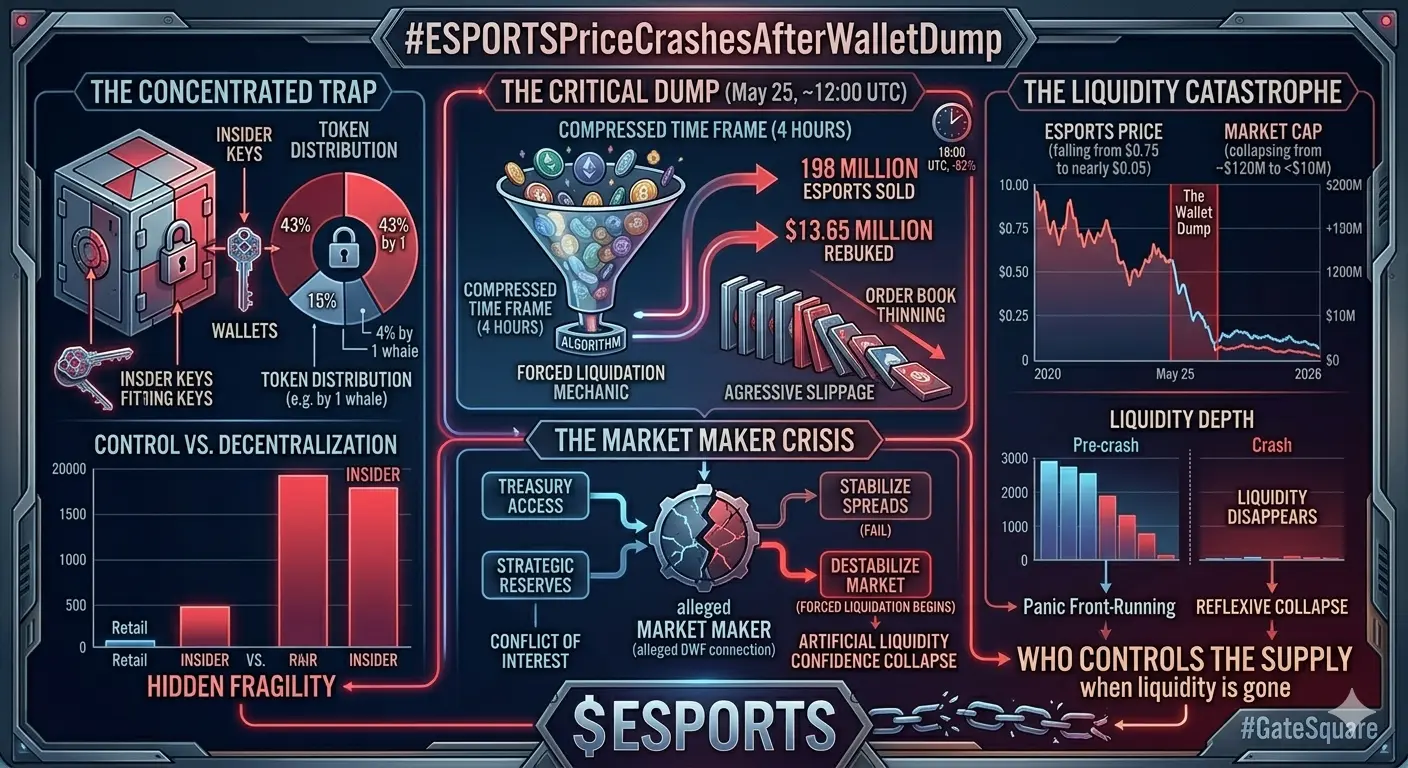
The collapse of the ESPORTS token on May 25 is another brutal reminder that in crypto markets, liquidity structure and token distribution often matter far more than narratives, partnerships, or community hype. Within just four hours, ESPORTS collapsed more than 92%, crashing from approximately $0.75 to nearly $0.05 and wiping out over $110 million in market capitalization almost instantly. What initially appeared to be a normal correction rapidly turned into a full-scale liquidity event that exposed one of the most dangerous structural weaknesses inside low- and mid-cap crypto markets: concentrated token control.
According to on-chain tracking data, approximately 198 million ESPORTS tokens — representing nearly 43% of the circulating supply — were suddenly sold into the market for an estimated $13.65 million. That number alone explains why the collapse became so violent. When nearly half of a token’s actively circulating supply hits the market in a compressed timeframe, liquidity depth disappears extremely quickly. Order books become thin, slippage expands aggressively, panic selling accelerates, and cascading liquidations amplify the downward move even further.
The most controversial part of the situation is the alleged connection between the selling wallets and DWF Labs, which market participants widely suspect was acting as the project’s market maker. Whether officially confirmed or not, the perception itself immediately intensified panic because it revived one of crypto’s longest-running concerns: the hidden power market makers and treasury-controlled wallets can have over price action in smaller-cap ecosystems.
This incident highlights a reality many retail traders still underestimate.
In traditional finance, publicly traded companies operate under strict disclosure rules regarding insider holdings, institutional ownership, lockups, and major shareholder transactions. Crypto markets often operate under far looser transparency standards. A project may appear decentralized publicly while a very small number of wallets quietly control massive portions of supply behind the scenes.
That creates a fragile market structure.
As long as buying pressure remains strong, concentrated ownership may stay hidden beneath rising prices. But once a major holder decides to exit aggressively, the illusion of liquidity can disappear almost instantly. Prices then stop reflecting organic market demand and instead become dominated by forced selling mechanics.
The ESPORTS collapse also exposes how dangerous market maker dependency can become for smaller tokens.
Market makers are supposed to improve liquidity, stabilize spreads, and support orderly trading environments. However, if a market maker simultaneously controls large inventory allocations, treasury access, or strategic token reserves, conflicts of interest can emerge very quickly. In extreme cases, the same entity responsible for supporting liquidity may also possess enough supply to destabilize the market entirely if liquidation begins.
This is especially dangerous in ecosystems with:
• low organic spot demand
• thin exchange liquidity
• highly concentrated wallets
• weak long-term holder distribution
• limited institutional participation
In those environments, price stability often depends less on real adoption and more on controlled liquidity management behind the scenes.
Another important factor is psychological contagion.
Once traders recognize that a major insider or whale may be exiting, fear spreads much faster than fundamentals can stabilize. Holders begin front-running each other trying to escape liquidity before it disappears completely. That transforms a normal selloff into a reflexive collapse where panic itself becomes the dominant market force.
The event also raises broader questions about tokenomics sustainability across the crypto industry.
Many smaller projects still launch with:
• highly concentrated treasury allocations
• oversized insider distributions
• opaque market maker agreements
• weak circulating supply structures
• artificial liquidity support mechanisms
During bullish periods, these weaknesses often remain hidden because momentum overshadows structural risk. But during stress events, token concentration becomes one of the single biggest determinants of survival.
The comparison to previous crypto collapses is unavoidable.
Again and again, the same pattern appears:
Narrative growth → concentrated ownership → artificial liquidity confidence → sudden large-wallet exit → liquidity collapse → panic cascade.
The problem is not limited to one project. It reflects a recurring structural vulnerability across large sections of the altcoin market.
For traders, the ESPORTS incident reinforces several important lessons.
First, market capitalization alone does not equal real liquidity. A token may appear valuable on paper while still remaining extremely fragile underneath.
Second, wallet concentration matters enormously. If a small number of addresses control large portions of supply, price stability becomes heavily dependent on those holders maintaining confidence.
Third, market maker relationships should never be ignored. Liquidity providers can significantly influence short-term market behavior, especially in smaller ecosystems where organic trading volume remains limited.
And finally, on-chain transparency is both crypto’s greatest advantage and its harshest warning system. Blockchain data often reveals structural risk long before price fully reacts — but only for traders paying close attention to wallet behavior, token flows, and liquidity movements.
The ESPORTS crash may eventually recover partially, or it may become another long-term example of how fragile concentrated token ecosystems can be. But regardless of what happens next, the event already delivered one clear message to the market:
In crypto, the biggest risk is often not volatility itself.
It is who controls the supply when liquidity disappears.
repost-content-media
  • Reward
  • 8
  • Repost
  • Share
Leeessa:
Ape In 🚀
View More
#EthereumPrivacyUpgradeRoadmap
Ethereum may now be entering one of the most important philosophical and technical transformations in its entire history. For years, blockchain privacy existed as a fragmented, controversial, and often isolated sector of crypto infrastructure. Privacy tools were treated as optional add-ons rather than foundational components of decentralized finance itself. Users who wanted stronger privacy protections were forced to rely on third-party mixers, external protocols, complicated wallet setups, or specialized chains that frequently faced regulatory pressure, liquidi
ETH-1.5%
MrFlower_XingChen
#EthereumPrivacyUpgradeRoadmap
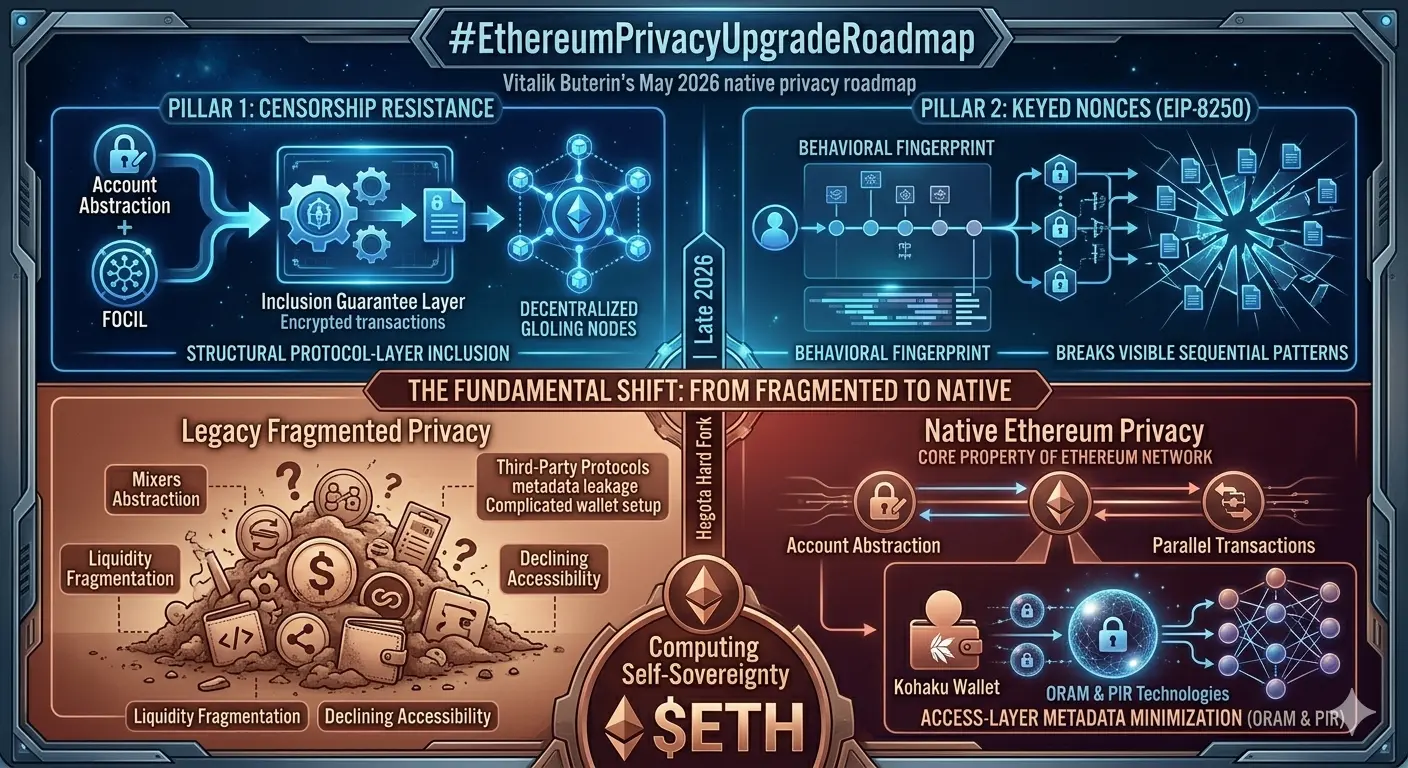
Ethereum may now be entering one of the most important philosophical and technical transformations in its entire history. For years, blockchain privacy existed as a fragmented, controversial, and often isolated sector of crypto infrastructure. Privacy tools were treated as optional add-ons rather than foundational components of decentralized finance itself. Users who wanted stronger privacy protections were forced to rely on third-party mixers, external protocols, complicated wallet setups, or specialized chains that frequently faced regulatory pressure, liquidity fragmentation, censorship risks, and declining accessibility.
Vitalik Buterin’s May 2026 native privacy roadmap changes that direction completely.
Instead of treating privacy as a niche feature for advanced users, Ethereum is now moving toward integrating privacy directly into the protocol and access infrastructure itself. That distinction is critical because it fundamentally changes how privacy is positioned within the Ethereum ecosystem. Privacy is no longer being framed as a separate product layered on top of Ethereum. It is increasingly being treated as a core property required for digital self-sovereignty, censorship resistance, and long-term fungibility.
The roadmap connected to the upcoming Hegota hard fork in late 2026 represents a structural attempt to solve two of the biggest weaknesses in public blockchain systems:
• transaction censorship
• metadata leakage
Both problems have quietly become much larger threats than most users fully realize.
Public blockchains created radical transparency, but extreme transparency also introduced a new form of vulnerability. Wallet histories became permanently traceable. User behavior became profileable. Balances became publicly visible. Transaction relationships became analyzable by governments, corporations, analytics firms, competitors, and malicious actors simultaneously. Over time, blockchain transparency unintentionally created financial surveillance systems more visible than traditional banking itself.
Vitalik’s roadmap appears designed to reverse that trajectory before Ethereum’s long-term decentralization properties become compromised.
The first major pillar of the framework focuses on censorship resistance through the combination of Account Abstraction and FOCIL.
This addresses one of the most overlooked problems in crypto privacy: getting private transactions included on-chain at all.
Most people assume encryption alone creates privacy. But even perfectly encrypted transactions can still be censored before confirmation if block builders or validators decide to exclude them. Large infrastructure participants increasingly control transaction ordering across modern blockchain systems, creating the risk that private activity becomes selectively filtered out of the network entirely.
The proposed solution combines Account Abstraction with Forward Inclusion Lists, allowing private transactions to receive protocol-level inclusion guarantees. This effectively treats privacy-preserving transactions as first-class citizens within Ethereum itself rather than suspicious external activity vulnerable to silent exclusion.
That changes the power balance significantly.
Instead of relying on validators voluntarily accepting privacy transactions, Ethereum would structurally enforce their inclusion at the protocol layer. This is extremely important because censorship resistance is meaningless if certain categories of transactions can quietly disappear before reaching the chain.
The second pillar introduces EIP-8250 and keyed nonces, which target one of Ethereum’s biggest hidden privacy leaks: transaction sequencing.
Currently, Ethereum accounts use sequential nonces to prevent double-spending. While technically efficient, this creates a perfect behavioral fingerprint. Every outgoing transaction leaves a visible linear pattern that analytics firms can use to map wallet activity, behavioral timing, DeFi interactions, and spending habits across months or years.
This system effectively turns every Ethereum wallet into a publicly traceable behavioral timeline.
EIP-8250 attempts to break that structure entirely.
By introducing keyed nonces and parallel transaction processing, Ethereum transactions would no longer need to follow rigid sequential ordering. Multiple interactions could occur simultaneously using randomized key structures and nullifiers, dramatically reducing the ability of external observers to reconstruct user activity patterns.
That is a massive shift.
It moves Ethereum away from transparent account-chain identity mapping toward a much more privacy-preserving transaction architecture where behavioral reconstruction becomes significantly harder.
The third pillar may actually be the most important long term because it addresses something most crypto users never think about: access-layer surveillance.
Even before a transaction reaches Ethereum, massive amounts of user metadata are already exposed.
Every time users open a wallet, check balances, interact with DeFi protocols, or load smart contract data, their wallet communicates with RPC nodes. Those node providers can potentially observe:
• IP addresses
• wallet queries
• contract interactions
• balance lookups
• browsing behavior
• timing patterns
This means privacy can fail long before a transaction is even broadcast to the blockchain.
Vitalik’s roadmap directly targets this problem through the Kohaku wallet framework combined with ORAM and PIR technologies.
ORAM (Oblivious Random Access Machine) and PIR (Private Information Retrieval) are designed to allow users to query blockchain data and interact with smart contracts without revealing exactly what information they are requesting. Instead of exposing search patterns directly to infrastructure providers, requests become cryptographically obscured.
This is extraordinarily important because modern surveillance increasingly depends on metadata rather than transaction contents alone.
In many cases, knowing who accessed which information, at what time, from which location, can reveal just as much as the transaction itself.
The broader philosophical implications of this roadmap extend far beyond Ethereum alone.
Vitalik’s repeated emphasis on “computing self-sovereignty” signals a recognition that decentralization without privacy may ultimately become incomplete. If wallets can be profiled, screened, censored, scored, blacklisted, or behaviorally analyzed based on fully transparent histories, then digital assets lose an essential property of fungibility.
Money that carries visible historical baggage behaves differently from truly neutral money.
This becomes especially dangerous in a future where AI-driven analytics, regulatory monitoring systems, and chain surveillance tools continue growing more sophisticated. Without stronger native privacy protections, blockchain ecosystems risk evolving into hyper-transparent financial environments where users permanently sacrifice economic anonymity in exchange for decentralization.
Ethereum’s 2026 roadmap attempts to prevent that future before it becomes irreversible.
Importantly, this is not a return to total anonymity. The roadmap instead appears focused on selective privacy, metadata minimization, and censorship-resistant access while still preserving Ethereum’s broader programmability and compliance flexibility.
That balance may become one of the defining technological battles of the next crypto era:
How to preserve openness, decentralization, and financial sovereignty without turning blockchain systems into permanent public surveillance networks.
The Hegota upgrade may ultimately be remembered as the moment Ethereum stopped treating privacy as optional infrastructure and started treating it as a fundamental requirement for digital freedom itself.
$ETH
repost-content-media
  • Reward
  • 6
  • Repost
  • Share
Leeessa:
LFG 🔥
View More
#DailyPolymarketHotspot #DailyPolymarketHotspot
Gate Square | Polymarket 5/25 Prediction: What will the HYPE price reach by the end of May?
The market is no longer watching HYPE only as another fast-rising altcoin. What is happening now around Hyperliquid is becoming one of the most important live case studies in crypto market structure, whale positioning, and revenue-backed token valuation. The newest development surrounding Loracle’s massive short position is intensifying that debate even further.
On May 25, the whale known as Loracle reportedly placed another enormous short around the $64
HYPE5.78%
MrFlower_XingChen
#DailyPolymarketHotspot
Gate Square | Polymarket 5/25 Prediction: What will the HYPE price reach by the end of May?
The market is no longer watching HYPE only as another fast-rising altcoin. What is happening now around Hyperliquid is becoming one of the most important live case studies in crypto market structure, whale positioning, and revenue-backed token valuation. The newest development surrounding Loracle’s massive short position is intensifying that debate even further.
On May 25, the whale known as Loracle reportedly placed another enormous short around the $64 region, with total bearish exposure climbing toward extremely aggressive levels. Market discussions indicate the position expanded from roughly $10 million earlier this year to well above $140 million after continuous averaging during the rally.
What makes this situation especially important is that the short was not opened against a weak asset. It was opened against one of the strongest momentum structures currently existing in crypto.
HYPE recently pushed into new all-time highs above $64 while whale activity exploded across the ecosystem. At the same time, institutional narratives around Hyperliquid have been accelerating rapidly. ETF-related demand, rising perpetual futures dominance, and protocol revenue growth created a market environment where bearish positioning became increasingly dangerous.
The most fascinating part is that Loracle did not simply enter one isolated short trade. The whale repeatedly added exposure as price moved higher, effectively averaging into the position while HYPE continued strengthening. That transforms the trade from a short-term directional bet into something much larger — a high-conviction thesis that HYPE’s valuation has expanded too quickly relative to the sustainability of its current growth cycle.
The market now appears divided into two completely different camps.
The bullish side argues that Hyperliquid is no longer behaving like a speculative token and instead resembles high-growth trading infrastructure. The protocol’s Assistance Fund continuously redirects trading revenue toward open-market HYPE purchases, creating automatic structural demand tied directly to ecosystem activity. Combined with ETF inflows, institutional attention, reserve recycling, and growing derivatives dominance, bulls believe the market is still underpricing Hyperliquid’s future role in crypto trading infrastructure.
The bearish side focuses on sustainability risk.
HYPE’s valuation expansion has been extraordinarily fast. Market capitalization growth, all-time highs, and aggressive leverage expansion all happened within a relatively compressed time frame. Critics argue that perpetual trading activity cannot expand infinitely, and if trading volume slows materially, the buyback engine supporting HYPE may weaken much faster than current market participants expect.
This is where Loracle’s influence becomes extremely important psychologically.
Massive whale positions often affect market sentiment even before liquidation levels are reached. Traders begin positioning emotionally around the whale itself. Some attempt to front-run a potential squeeze higher. Others interpret the whale’s persistence as evidence that sophisticated capital expects an eventual correction. In highly leveraged environments, perception itself becomes part of the market structure.
Ironically, the short may also be contributing to HYPE’s strength.
Large visible shorts can create fuel for aggressive squeezes because market makers and momentum traders recognize liquidation clusters above resistance zones. If price keeps grinding higher, short covering itself can become additional buy pressure. This dynamic may partially explain why HYPE continued climbing despite weakening buyback intensity in recent quarters.
The broader market context matters too.
Hyperliquid is increasingly becoming one of the central liquidity hubs in crypto derivatives trading. Whale positioning, ETF narratives, perpetual futures growth, and institutional speculation are all converging around one ecosystem simultaneously. That combination creates unusually high volatility because every major participant group is now active inside the same trade.
For the remainder of May, several scenarios become possible.
If HYPE successfully holds above the psychological $60 region while trading volume remains elevated, momentum traders may continue pushing toward the $68–$72 range, especially if short squeeze pressure intensifies further. If ETF inflows and ecosystem activity accelerate simultaneously, temporary overshoots beyond that range become possible as leveraged shorts get forced out progressively.
However, if market-wide risk sentiment weakens or perpetual trading activity begins slowing, volatility could reverse aggressively. A rapid unwind below key support zones may trigger cascading liquidations on both long and short sides because leverage concentration across the ecosystem is already extremely elevated.
The most important thing traders should understand is that this is no longer a normal altcoin chart.
HYPE is now trading as a complex interaction between:
• perpetual trading volume
• protocol revenue
• ETF narratives
• whale positioning
• liquidity depth
• leverage concentration
• institutional participation
• buyback mechanics
That makes every large whale position far more influential than it would normally be in a standard speculative market.
Loracle’s short is not simply a bet against price.
It is effectively a bet against the durability of Hyperliquid’s entire economic flywheel.
And right now, the market is aggressively testing which side of that equation is stronger.
#Hyperliquid #GateSquare
repost-content-media
  • Reward
  • 6
  • Repost
  • Share
Leeessa:
LFG 🔥
View More
#PlatinumCardCreatorExclusive
If I had a Gate Platinum Card, I would not use it only as a payment card — I would use it as a complete bridge between the digital financial world and everyday real-life spending. What makes this card interesting is not simply the cashback, spending limit, or premium features. The real importance is that it represents how crypto is slowly evolving from a speculative asset class into something capable of functioning inside normal daily economic activity.
For years, one of the biggest limitations in crypto adoption was the gap between holding digital assets and act
BTC-3.19%
GT-3.59%
MrFlower_XingChen
#PlatinumCardCreatorExclusive
If I had a Gate Platinum Card, I would not use it only as a payment card — I would use it as a complete bridge between the digital financial world and everyday real-life spending. What makes this card interesting is not simply the cashback, spending limit, or premium features. The real importance is that it represents how crypto is slowly evolving from a speculative asset class into something capable of functioning inside normal daily economic activity.
For years, one of the biggest limitations in crypto adoption was the gap between holding digital assets and actually using them conveniently in real life. Traders could hold Bitcoin, stablecoins, GT, or other digital assets on exchanges, but spending those assets smoothly in daily situations still felt disconnected from the real economy. Traditional banking systems and crypto ecosystems operated almost like two separate financial universes. Products like the Gate Platinum Card begin collapsing that separation completely.
If I had the card, I would primarily use it as my main spending card for both online and offline transactions. Travel would probably become one of the biggest use cases. Booking flights, hotels, transportation, restaurants, and international purchases through a single globally accepted payment system while staying connected to crypto rewards would completely change the experience of managing finances while traveling. Instead of constantly transferring funds between banks and exchanges, the process becomes much more unified and efficient.
I would also use it heavily through Google Pay for everyday purchases. The idea of walking into a store, buying coffee, paying for groceries, handling subscriptions, or managing entertainment expenses while remaining integrated into the crypto ecosystem reflects exactly where modern finance appears to be heading. Digital assets are gradually becoming less about isolated speculation and more about practical utility.
Another reason the Gate Platinum Card stands out is flexibility. Traditional banking systems often create friction through currency limitations, regional restrictions, slow settlement systems, and rigid financial structures. A card that supports freely selectable currencies while connecting to a global crypto infrastructure introduces a much more modern financial experience. In a world where digital work, online businesses, international payments, and borderless commerce continue expanding rapidly, financial tools capable of operating globally become increasingly valuable.
The cashback feature is also more important than many people realize. Cashback systems effectively create a financial feedback loop where normal spending activity can continuously generate additional value. Instead of spending becoming purely consumptive, users receive rewards while participating in everyday economic activity. Over time, this changes how people psychologically interact with digital finance products because the ecosystem itself begins rewarding active participation rather than simply holding assets passively.
I would also use the card strategically for managing recurring monthly expenses. Subscription platforms, utility payments, online services, and digital business tools increasingly dominate modern lifestyles. Being able to centralize those payments into one ecosystem while potentially accumulating GT or other ecosystem benefits creates a much more streamlined financial structure. Instead of separating crypto investments from traditional spending behavior, the two systems begin operating together.
What excites me most, however, is the broader direction this represents for the industry itself. The crypto market has spent years building infrastructure around trading, speculation, DeFi, and tokenized assets. But the next major phase of adoption may depend less on speculation and more on integration into ordinary economic life. The platforms that successfully connect crypto liquidity with real-world usability could become some of the most important financial ecosystems of the next decade.
The Gate Platinum Card feels like part of that transition. It combines elements of traditional finance convenience with blockchain-era flexibility. High daily spending limits, Google Pay integration, cashback systems, global usability, and crypto-connected infrastructure together create something that feels much closer to the future of digital banking rather than just another exchange product.
As crypto adoption continues expanding globally, the line separating traditional finance from blockchain finance becomes weaker every year. Cards like this may eventually become normal financial tools for millions of users who want seamless access between digital assets and real-world spending. The future may no longer involve choosing between crypto and traditional finance. Instead, both systems may merge into one connected financial environment where users move between them effortlessly.
If I had a Gate Platinum Card, I would use it not only for convenience, but as part of participating in that larger financial transformation already unfolding across the world.
#PlatinumCardExclusiveForCreators
repost-content-media
  • Reward
  • 6
  • Repost
  • Share
Leeessa:
LFG 🔥
View More
#InstitutionalCapitalRotatesFromBTCToHYPEAndXRP
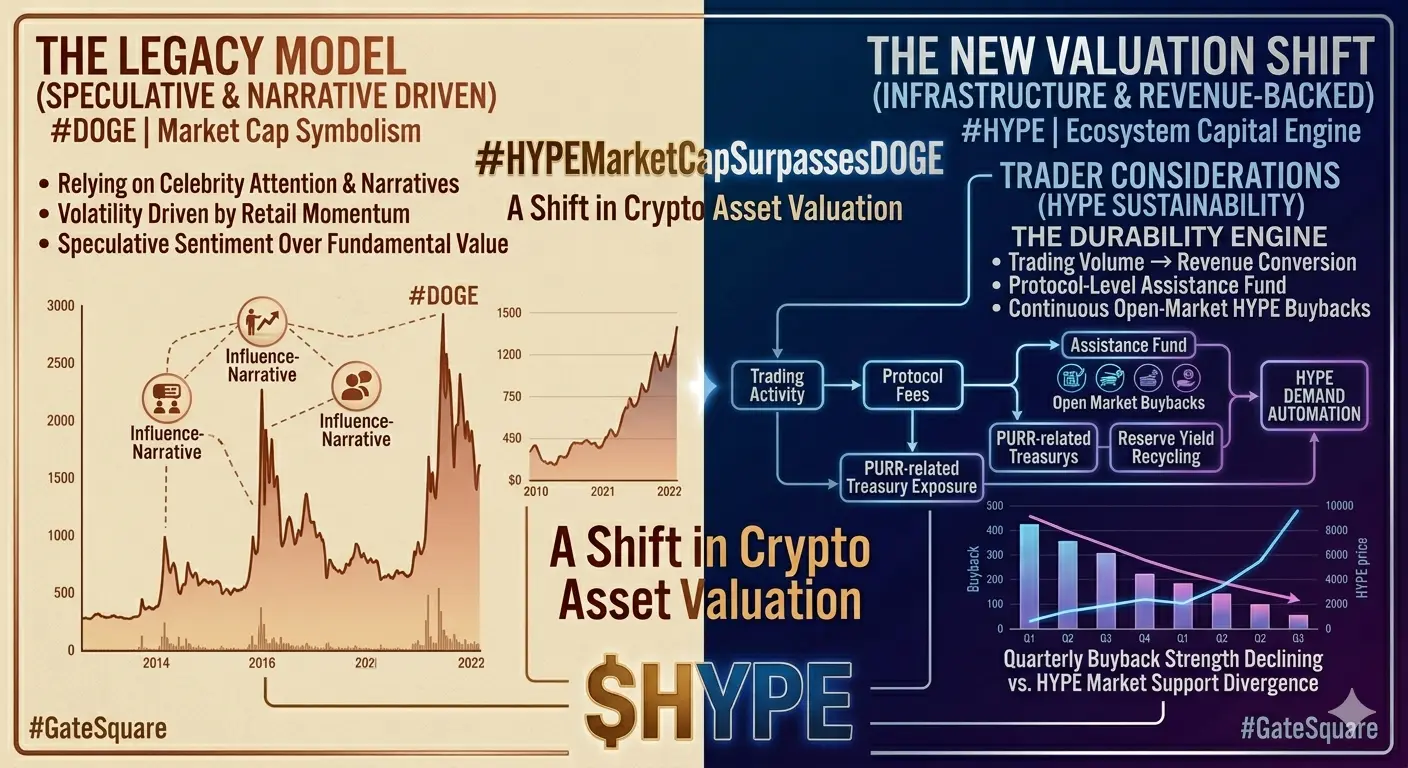
HYPE surpassing DOGE in market capitalization is far more important than a simple leaderboard reshuffle inside crypto rankings. This moment represents a major transition in how digital assets are being valued by the market. For years, large-cap crypto rallies were dominated primarily by speculation, memes, celebrity influence, social media momentum, and retail hype cycles. Hyperliquid’s rise introduces a very different framework — one where infrastructure efficiency, protocol revenue, liquidity dominance, and automated capital flows increasingly
HYPE5.82%
DOGE-0.52%
PURR-3.61%
MrFlower_XingChen
#InstitutionalCapitalRotatesFromBTCToHYPEAndXRP
HYPE surpassing DOGE in market capitalization is far more important than a simple leaderboard reshuffle inside crypto rankings. This moment represents a major transition in how digital assets are being valued by the market. For years, large-cap crypto rallies were dominated primarily by speculation, memes, celebrity influence, social media momentum, and retail hype cycles. Hyperliquid’s rise introduces a very different framework — one where infrastructure efficiency, protocol revenue, liquidity dominance, and automated capital flows increasingly determine valuation strength.
Hyperliquid officially pushed into the global Top 10 digital assets with a valuation exceeding $16 billion after overtaking DOGE. On the surface, many traders are calling it another momentum breakout driven by ETF speculation and market enthusiasm. But beneath the headlines, the mechanics supporting HYPE are structurally different from the majority of previous altcoin expansions.
This is not behaving like a classic speculative meme cycle.
The most important distinction is that Hyperliquid continuously generates internal demand directly from trading activity itself. Instead of relying solely on narratives, influencer promotion, retail excitement, or external hype injections, the protocol has built a self-reinforcing economic engine where ecosystem usage automatically converts into buy pressure.
At the center of this structure is the Assistance Fund.
Nearly all trading fees generated across Hyperliquid’s ecosystem are redirected toward purchasing HYPE directly from the open market. This is not a temporary treasury strategy or a governance proposal that may change later. It is embedded into the protocol’s operating design itself. Every increase in perpetual futures trading activity expands revenue generation, and that revenue mechanically strengthens HYPE demand.
That changes the valuation model entirely.
Traditional meme assets often depend on attention cycles to sustain momentum. Hyperliquid’s valuation increasingly behaves more like a high-growth financial infrastructure network where exchange activity, liquidity depth, and transaction flow directly reinforce token demand. The market is no longer pricing HYPE as just another speculative asset. It is increasingly pricing it as revenue-producing infrastructure.
The scale of the ecosystem helps explain why.
Hyperliquid has already generated more than $1 billion in cumulative protocol revenue since launch, placing it among the highest-performing revenue-generating systems in crypto. Very few blockchain ecosystems have reached that level of capital efficiency in such a short time period. But one of the most important signals is hidden beneath the headline numbers.
Quarterly buyback intensity has actually been declining:
• Q3 2025 buybacks approached approximately $316 million
• Q4 2025 buybacks declined toward roughly $255 million
• Q1 2026 buybacks weakened further near $192 million
Under normal market conditions, weakening structural buy support would create downward pressure on price. Instead, HYPE continued climbing aggressively toward new all-time highs above $62.
That divergence is extremely important.
It suggests the market is no longer relying on only one demand mechanism. Multiple independent accumulation pipelines are now supporting the ecosystem simultaneously.
The first remains the Assistance Fund itself, creating continuous baseline buy pressure tied directly to perpetual trading volume.
The second comes from PURR-related treasury exposure. Market participants increasingly believe Nasdaq-linked treasury structures connected to the ecosystem accumulated significant HYPE exposure and continue acting as major buyers across the market. Whether fully confirmed or not, the perception alone strengthened institutional confidence surrounding the ecosystem.
The third source involves reserve yield recycling. Stablecoin reserves, ecosystem yields, and internal treasury profits are increasingly being redirected back into HYPE accumulation, further reinforcing demand even as buyback intensity moderates.
Together, these mechanisms created one of the strongest structural bid systems currently operating inside crypto markets.
This is exactly why comparisons between HYPE and traditional meme rallies are becoming increasingly inaccurate.
DOGE historically relied on narrative acceleration, viral attention, retail psychology, and celebrity-driven momentum. Its value expanded primarily through social amplification.
HYPE expands through liquidity infrastructure, derivatives dominance, exchange revenue, and automated capital recycling.
That does not mean risk disappears.
In fact, the largest long-term vulnerability becomes even clearer precisely because the system is so dependent on trading activity itself.
The entire flywheel depends on perpetual volume remaining elevated:
Trading Volume → Revenue → Buybacks → Structural Market Support
If perpetual trading activity slows materially:
• protocol revenue weakens
• Assistance Fund purchases decline
• buyback support contracts
• external market demand becomes increasingly important
Unlike traditional equities, token holders do not possess direct redemption claims on treasury reserves or protocol assets. Market price remains the only realization mechanism for valuation. That means if trading volume contracts while market capitalization continues accelerating higher, the system could eventually face serious stress between valuation expectations and declining structural support.
This is where sustainability becomes the central question.
The market is now rewarding Hyperliquid not as a speculative experiment, but as revenue-generating digital infrastructure. Flipping DOGE is symbolic because it signals a broader transition happening across crypto itself. Capital is beginning to prioritize systems that generate measurable cash flow, internal demand loops, and liquidity dominance rather than relying purely on speculative attention cycles.
That shift may become one of the defining themes of the next crypto era.
But sustainability will ultimately determine whether HYPE’s expansion continues or whether valuation eventually outruns the strength of the underlying engine supporting it.
The most important chart is no longer simply HYPE/USD.
It is the health of the entire flywheel:
Trading Activity → Revenue Generation → Buybacks → Market Confidence → Liquidity Expansion
As long as that cycle keeps strengthening, HYPE remains structurally powerful.
If the cycle begins weakening while valuations continue rising aggressively, risk may increase much faster than most traders currently expect.
The DOGE flip changed the narrative.
Now the market will decide whether Hyperliquid’s economic engine is durable enough to redefine how crypto assets themselves are valued going forward.
#HYPE #DOGE #GateSquare
repost-content-media
  • Reward
  • 8
  • Repost
  • Share
Leeessa:
LFG 🔥
View More
#TradeCFDWinGold
The fusion between crypto and traditional finance is accelerating fast, and Gate is now pushing that evolution into the spotlight with the official launch of the Gate Square TradFi Trading Sharing Challenge. Designed to connect digital asset traders with global financial markets, the campaign introduces a massive $30,000 reward pool while encouraging users to publicly share market analysis, CFD strategies, and real-time trading perspectives directly through the Gate ecosystem.
This event arrives at a crucial moment for the industry as platforms increasingly compete to build m
XIAOMI2.61%
ASTS-9.16%
CVX2.2%
UPS1.11%
post-image
  • Reward
  • 5
  • Repost
  • Share
Leeessa:
LFG 🔥
View More
#USStrikesIran
Global markets may have just entered the most critical geopolitical transition phase of 2026. After months of escalating instability caused by the U.S.-Israeli military strikes on Iran and the resulting blockade of the Strait of Hormuz, financial markets are now rapidly repricing the possibility of a historic diplomatic breakthrough. Reports emerging from Doha and Islamabad suggest that Washington and Tehran are approaching a conditional memorandum of understanding that could dramatically reshape energy markets, inflation expectations, and global risk sentiment.
The impact on c
BTC-3.19%
ETH-1.5%
post-image
post-image
  • Reward
  • 12
  • Repost
  • Share
Leeessa:
LFG 🔥
View More
#StockTradingChallengeUpTo17000U
The lines separating traditional stock markets and the blockchain space have officially blurred. As the Gate Stock Trading Challenge kicks off its high-stakes run from May 25, 2026, through June 15, 2026, the event is highlighting a massive shift toward fully tokenized finance. This multi-track event allows aggressive, strategic traders to stack independent rewards across spot, futures, CFDs, ETFs, and staking products, driving potential individual earnings up to 17,000 USDT. More than just a flash campaign, this initiative directly reflects Gate’s expanding T
ONDO-1.99%
NVDA4.51%
TSLA-3.25%
post-image
post-image
  • Reward
  • 5
  • Repost
  • Share
Leeessa:
LFG 🔥
View More
#Nikkei225RecordHigh
Nikkei 225 Shatters 65,000 Milestone in Historic Surge 🇯🇵🚀
The Japanese stock market has written a brand-new chapter in global financial history. In a spectacular display of market momentum, the benchmark Nikkei 225 surged past the historic 65,000 milestone for the first time ever, closing at a record-breaking 65,158.19. This represents a staggering 2.87% single-day jump, capping off an extraordinary 8.95% advance over just three trading sessions—the steepest three-day rally Tokyo has witnessed in over six years. The broader TOPIX index similarly mirrored this euphoria
JPN2252.47%
post-image
post-image
  • Reward
  • 7
  • Repost
  • Share
Leeessa:
LFG 🔥
View More
#JaneStreetReducesBitcoinETFHoldings
A major institutional signal has just emerged from Jane Street, and it’s reshaping how traders are interpreting the next phase of the crypto cycle. Fresh Q1 2026 filings confirm that the firm significantly reduced its exposure to spot Bitcoin ETF products, including a nearly 71% cut in iShares Bitcoin Trust ETF and around a 60% reduction in Fidelity Wise Origin Bitcoin Fund.
At first glance, this looks like a bearish signal—but the underlying shift tells a much more strategic story.
Capital Rotation, Not Exit
Rather than exiting crypto, Jane Street appears
BTC-3.19%
ETH-1.5%
IBIT-2.81%
post-image
post-image
  • Reward
  • 11
  • Repost
  • Share
Leeessa:
LFG 🔥
View More
#GateSquareMayTradingShare
The Next Phase of the 10-Year Asset War: Bitcoin, Gold, and the Institutional Rotation Era
The last decade already delivered a clear hierarchy of asset performance, but the current market structure in 2026 suggests we may be entering a different regime entirely—one driven less by retail speculation and more by institutional allocation models, sovereign demand, and regulated crypto integration.
Bitcoin is still dominating the long-term scoreboard, but the conversation is no longer just about historical returns. It is now about how capital allocators are re-pricing Bi
BTC-3.19%
XAUUSD-1.35%
post-image
post-image
  • Reward
  • 10
  • Repost
  • Share
MrFlower_XingChen:
I impressed your explanation
View More
#CLARITYActPassesSenateCommittee
CLARITY Act Momentum Continues as Bitcoin Enters Late-Stage Compression Phase
Regulatory Path Advances Beyond Committee Stage
Following the bipartisan passage of the CLARITY Act through the U.S. Senate Banking Committee, legislative momentum has now shifted into a more complex phase: full Senate floor negotiation and amendment structuring. Early indications suggest growing alignment between moderate lawmakers, with discussions focusing on refining jurisdictional boundaries between the U.S. Securities and Exchange Commission and the U.S. Commodity Futures Tradi
BTC-3.19%
post-image
post-image
  • Reward
  • 12
  • Repost
  • Share
ShainingMoon:
To The Moon 🌕
View More
  • Pinned