MyDiscover

vip
Age 0.1 Year
Peak Tier 0
No content yet
#美元指数跌破99关口 #TradFi交易分享挑战 The Middle East situation sees signs of easing, and the US Dollar Index weakens immediately
The Middle East situation sees signs of easing, and the US Dollar Index weakens immediately
Last week, the Federal Reserve released the minutes of its April monetary policy meeting. Some Fed officials generally believe that, with inflation running high and uncertainties surrounding the Middle East, the current interest-rate policy may need to be maintained for a longer period. However, the meeting minutes released a key signal: if inflation continues to stay above 2%, rate hi
USIDX0.33%
Ryakpanda
#美元指数跌破99关口 #TradFi交易分享挑战 The Middle East situation sees signs of easing, and the US Dollar Index weakens immediately
The Middle East situation sees signs of easing, and the US Dollar Index weakens immediately
Last week, the Federal Reserve released the minutes of its April monetary policy meeting. Some Fed officials generally believe that, with inflation running high and uncertainties surrounding the Middle East, the current interest-rate policy may need to be maintained for a longer period. However, the meeting minutes released a key signal: if inflation continues to stay above 2%, rate hikes will be considered.
Based on the CPI data released in April, inflation has already risen to 3.8%. The market expects inflation in May to rise to above 4%. Given the current trend, a significant rise in inflation seems all but certain. As expectations for rate hikes gradually heat up, this will inevitably provide support for an upward move in the US Dollar Index.
Last week, the US Dollar Index was mostly trading strongly in the 99.30–99.50 range. From the current fundamentals, although monetary-policy signals supporting rate hikes provide support for the US Dollar Index, Trump recently said that the US and Iran have basically reached an agreement, and that the final details will be announced soon. Iran has also indicated that the memorandum of understanding is about to be finalized. Affected by these factors, on Monday this week, the US Dollar Index in Asian markets saw a short-term pullback to around 99.00.
This week, attention will be on the final outcome of negotiations between the US and Iran. If the talks make substantive progress, the US Dollar Index still has room to decline in the short term.
Over the previous week, the US Dollar Index fluctuated between 98.93 and 99.51, showing a range-bound pattern. On Monday this week, Asian markets saw a short-term retreat, and at the time of writing it is temporarily fluctuating around 99.00. Looking at the weekly chart, after the US Dollar Index was supported for a sustained period by a medium- to long-term upward trend line, it triggered a rebound. In the short term, although the exchange rate shows a rally followed by a pullback, this does not mean that the rebound is over. If, after the US Dollar Index adjusts, it once again attempts to break higher and tests the technical resistance line at 100.15, and it successfully holds above that level, it is likely to produce a new round of upward movement. Conversely, it is important to note that if the pullback continues and effectively breaks below the support of the medium- to long-term trend line at 97.93, once this scenario occurs it would mean the end of the US Dollar Index’s upward trend.
Overall, regarding changes in the future trend, caution is needed because the US Dollar Index could choose a direction at any time. Support level: 97.93; Resistance level: 100.15

repost-content-media
  • Reward
  • Comment
  • Repost
  • Share
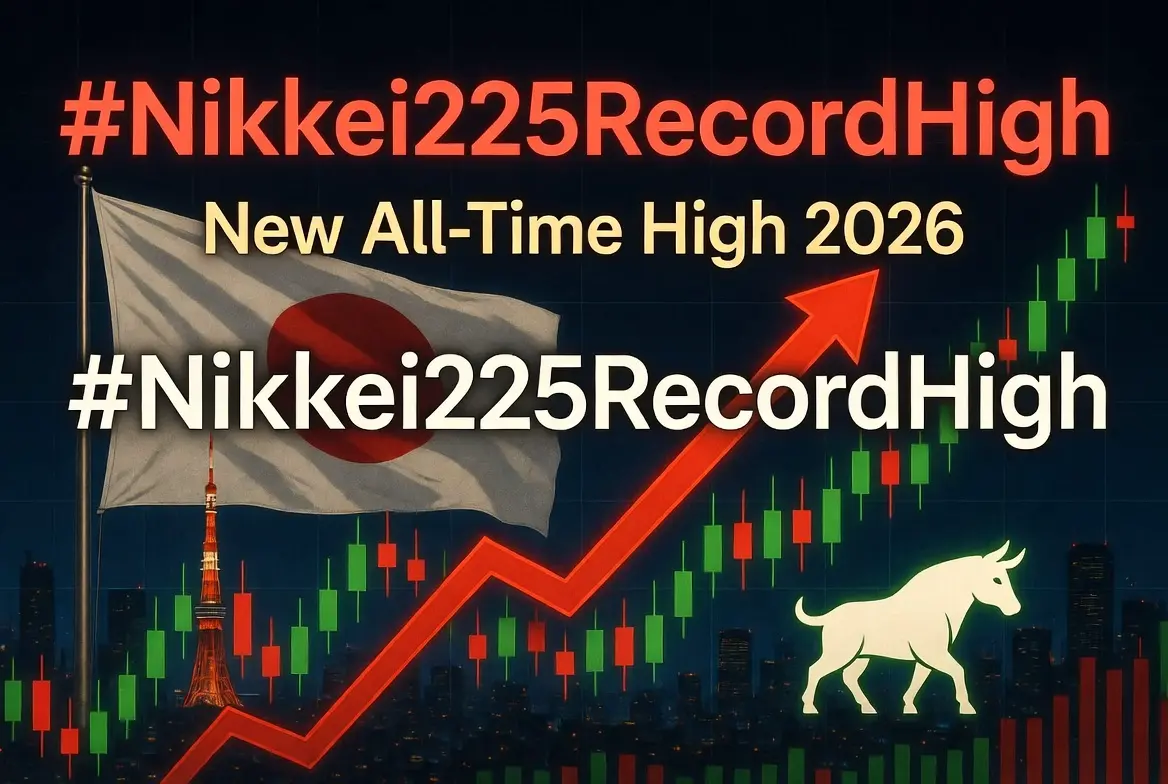
#Nikkei225RecordHigh Nikkei 225 Record High: ¥63,339 → ¥65,321 Drivers, TA & Hidden Risks
Japan's Nikkei just delivered an explosive rally. May 22 close: ¥63,339 (+2.68%). May 25 morning: ¥65,321 (+3.1%) on Iran deal optimism. ¥30T (~$200B) market cap added in one day. Index doubled since erasing its 1989 bubble peak.
Four Drivers
1️⃣ CPI at 4-year low 1.4% → BOJ stays loose → USDJPY ~159 boosts exporters
2️⃣ US-Iran deal optimism → oil collapse → risk-on. Risk: Iran disputes Trump, deal could collapse within days
3️⃣ Strong Q1 earnings + Nvidia AI tailwind → SoftBank, Tokyo Electron, Advant
JPN225-0.69%
USDJPY0.15%
NVDA-1.01%
Falcon_Official
#Nikkei225RecordHigh Nikkei 225 Record High: ¥63,339 → ¥65,321 Drivers, TA & Hidden Risks
Japan's Nikkei just delivered an explosive rally. May 22 close: ¥63,339 (+2.68%). May 25 morning: ¥65,321 (+3.1%) on Iran deal optimism. ¥30T (~$200B) market cap added in one day. Index doubled since erasing its 1989 bubble peak.
Four Drivers
1️⃣ CPI at 4-year low 1.4% → BOJ stays loose → USDJPY ~159 boosts exporters
2️⃣ US-Iran deal optimism → oil collapse → risk-on. Risk: Iran disputes Trump, deal could collapse within days
3️⃣ Strong Q1 earnings + Nvidia AI tailwind → SoftBank, Tokyo Electron, Advantest surge
4️⃣ Foreign net buying + corporate governance reform → global allocators increase Japan weightings
Technical Analysis Current ¥65,321 | Record close ¥63,339
Support: ¥61,900 | ¥60,000 (April breakout) | ¥54,000 (Jan ATH) Resistance: ¥65,300 | ¥66,000 | ¥70,000
StochRSI 14: ~75 → approaching overbought Trend: Strongly bullish all timeframes, all SMAs rising YTD: +70.45% extraordinary, highly extended
The ¥500B Carry Trade Shadow Rally foundation = yen weakness from global carry trade. ¥Hundreds of billions borrowed in cheap yen → invested in higher-yielding assets including Japanese equities. Self-reinforcing: carry weakens yen → Nikkei rises → foreign buying → yen weaker. August 2024 showed unwind: Nikkei crashed 4,000+ points in one day. If BOJ tightens again or risk sentiment reverses, ¥30T added in one day could vanish just as fast.
1989 Echo: Bubble peak ¥38,915. Now ¥65,000+ 70% above. Loose policy, yen weakness, foreign inflows mirror 1989. Difference: genuine earnings + reform. But yen dependence remains.
Watch Next
• BOJ policy signals — rate hikes threaten foundation • Iran deal outcome — failure = oil spike + risk-off
• USDJPY → yen at 140-150 compresses margins
• StochRSI overbought → ¥61,900-¥63,000 pullback zone
• Carry trade stability — credit events trigger rapid unwinds
Bottom line: Powerful trend, real earnings, genuine reform. But yen dependence + fragile Iran catalyst = more vulnerable to reversal than most recognize. Trade the trend, respect the speed at which ¥30 trillion vanishes.
#BOJ #USDJPY #AsianMarkets #JapaneseEquities
repost-content-media
  • Reward
  • Comment
  • Repost
  • Share
#Polymarket每日热点
The Hyperliquid ecosystem has emerged as one of the most compelling narratives in the decentralized finance space during 2026, with its native token HYPE experiencing unprecedented price appreciation that has caught the attention of both retail and institutional participants. As we approach the final days of May 2026, the market finds itself at a critical juncture where technical momentum, whale positioning, and fundamental protocol mechanics are converging to create a complex but fascinating price discovery environment.
Current Market Context and Whale Dynamics
The most signi
HighAmbition
#Polymarket每日热点
The Hyperliquid ecosystem has emerged as one of the most compelling narratives in the decentralized finance space during 2026, with its native token HYPE experiencing unprecedented price appreciation that has caught the attention of both retail and institutional participants. As we approach the final days of May 2026, the market finds itself at a critical juncture where technical momentum, whale positioning, and fundamental protocol mechanics are converging to create a complex but fascinating price discovery environment.
Current Market Context and Whale Dynamics
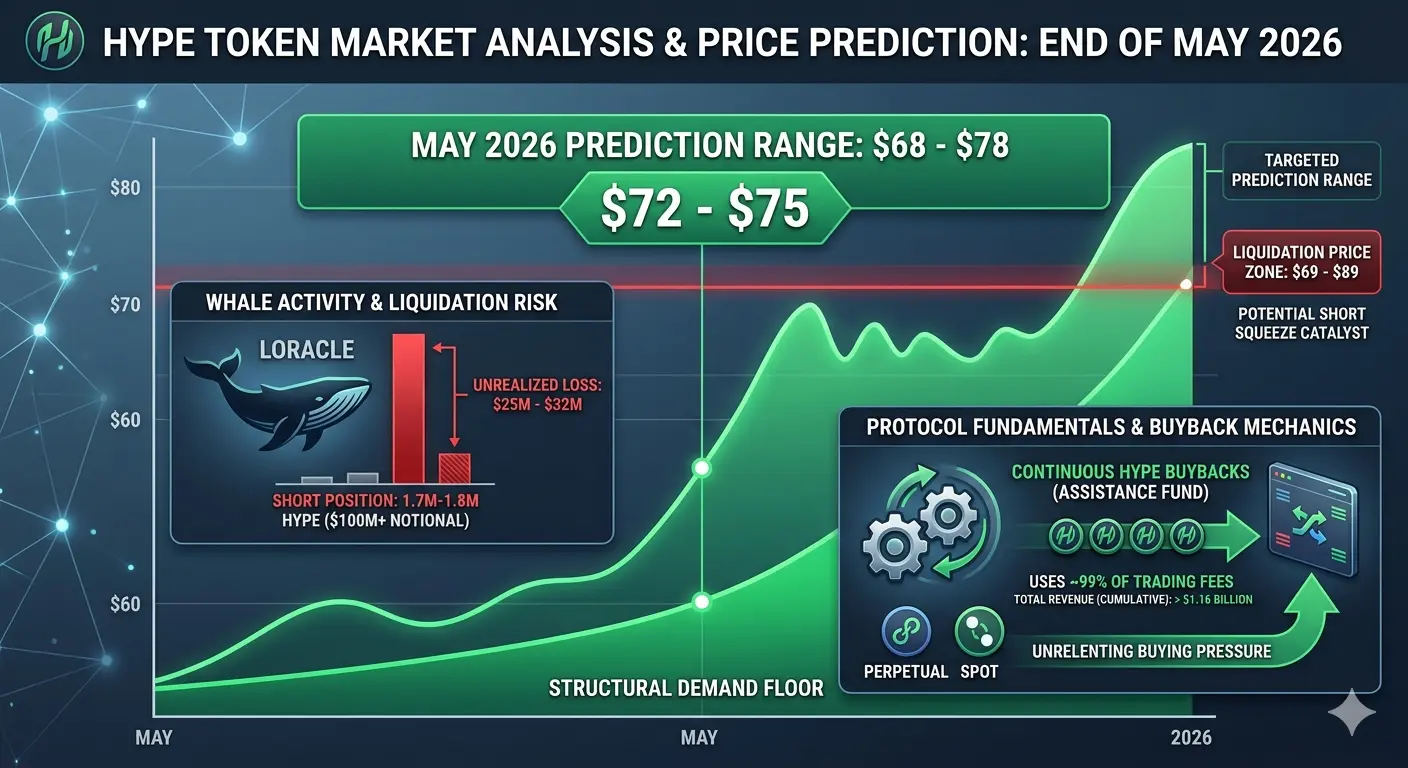
The most significant development affecting HYPE's price trajectory has been the massive short position maintained by the whale known as Loracle, who has become something of a legend within the Hyperliquid community. This trader currently holds approximately 1.7 to 1.8 million HYPE tokens in a short position, representing a notional value exceeding $100 million at current prices. What makes this position particularly noteworthy is that Loracle entered this short when HYPE was trading around $41, and has been systematically adding to the position as the price has climbed to current levels near $64.
The whale's strategy has involved selling spot HYPE tokens to fund margin requirements for the short position. On May 22, Loracle deposited and sold 616,675 HYPE tokens worth approximately $36.76 million, using these proceeds to add margin and defend the short position from liquidation. This behavior indicates a conviction trade that has become increasingly underwater as HYPE continues to print new all-time highs. Current estimates suggest Loracle is sitting on unrealized losses between $25 million to $32 million, making this one of the most visible losing positions in the Hyperliquid ecosystem.
The liquidation price for this massive short position has been adjusted upward multiple times and currently sits somewhere in the $69 to $89 range depending on additional margin deposits and partial position closures. This creates a fascinating dynamic where the higher HYPE's price climbs, the more precarious this whale's position becomes, potentially setting up a short squeeze scenario that could accelerate price appreciation if triggered.
Protocol Fundamentals and Buyback Mechanics
Beyond the whale dynamics, HYPE's price appreciation is underpinned by one of the most aggressive token buyback mechanisms in the cryptocurrency space. The Hyperliquid protocol operates an Assistance Fund that directs approximately 99% of all trading fees from perpetual and spot markets toward purchasing HYPE tokens on the open market. This buyback operates continuously, executing in every block regardless of market conditions.
Since its launch, Hyperliquid has generated cumulative revenue exceeding $1.16 billion, with effectively all of these earnings being deployed into token buybacks. This creates a persistent and predictable demand floor for HYPE that is independent of speculative interest or market sentiment. The protocol's revenue model represents one of the most direct and honest value accrual mechanisms in the industry, with genuine trading activity translating directly into token support.
This buyback mechanism has been cited by multiple analysts as the primary driver of HYPE's price appreciation, distinguishing it from other tokens that rely primarily on speculative flows. The continuous and programmatic nature of these purchases provides a structural tailwind that becomes increasingly significant as trading volumes grow.
Technical Analysis and Price Levels
From a technical perspective, HYPE has demonstrated remarkable strength throughout May 2026. The token has broken through multiple resistance levels that previously capped price appreciation, establishing new all-time highs above $64. Volume analysis confirms the authenticity of this breakout, with 24-hour trading volumes surging approximately 12% to reach $1.14 billion, indicating strong organic buying pressure rather than artificial price manipulation.
The critical support level to monitor is the $60 zone, which previously served as resistance and has now flipped to provide support. If HYPE maintains stability above this level, the path opens for a retest of higher resistance zones, potentially targeting $70 in the near term. Conversely, a breakdown below $60 could trigger a correction toward the $55 support level, though the strength of the underlying buyback mechanism makes such corrections likely to be shallow and short-lived.
Technical indicators across multiple timeframes suggest continued bullish momentum, with the token having defied earlier bearish projections that called for declines to the $20 range. Instead, HYPE has maintained its broader uptrend structure, climbing from the $35.5 support level to test and exceed the key $45 resistance, and subsequently pushing through the $50 and $60 psychological barriers.
Market Sentiment and Community Analysis
Community sentiment surrounding HYPE remains predominantly bullish, with discussions on social media platforms highlighting the token's strong fundamentals and the potential for continued appreciation. The whale Loracle's short position has become a focal point of community discussion, with many participants viewing the position as a potential catalyst for accelerated price movement if liquidation levels are approached.
Analysts and community members have shared various price targets for HYPE's end-of-2026 trajectory, with base case scenarios ranging from $90 to $140, and more optimistic bull cases projecting levels between $180 and $300. These projections are predicated on continued holder growth, the persistent buyback mechanism, protocol revenue expansion, and the development of new products within the Hyperliquid ecosystem.
The recent approval and launch of crypto-linked ETFs tracking HYPE has attracted over $11 million in inflows and generated $40 million in trading volume, reflecting growing institutional interest in gaining exposure to the token. This institutional participation adds another layer of demand that complements the protocol's native buyback program.
Risk Factors and Considerations
While the bullish case for HYPE is compelling, several risk factors warrant consideration. The concentration of short interest around the Loracle position creates potential for extreme volatility in both directions. If this whale were to unwind or be liquidated, the resulting price spike could be dramatic, but it could also lead to subsequent profit-taking and price consolidation.
Additionally, the rapid price appreciation has compressed risk-reward ratios for new entrants, with the token trading at levels that represent significant multiples from its launch price. While the buyback mechanism provides fundamental support, markets can remain irrational longer than participants can remain solvent, and corrections within the broader cryptocurrency market could impact HYPE regardless of its specific fundamentals.
The protocol's reliance on trading fee revenue means that any significant decline in trading activity could reduce the rate of buybacks, potentially removing a key support mechanism for the token price. However, Hyperliquid's position as a leading decentralized perpetual exchange suggests that trading volumes are likely to remain robust, particularly if the broader cryptocurrency market maintains its current trajectory.
Price Prediction for End of May 2026
Synthesizing the various factors discussed above, my prediction for HYPE's price by the end of May 2026 falls within a range of $68 to $78, with a most likely scenario around $72 to $75. This projection is based on several key assumptions:
First, the persistent buyback mechanism will continue to provide structural support for the token, with daily buying pressure from the Assistance Fund creating a floor that becomes more significant as the month progresses. The approximately $1 billion in annual revenue generated by the protocol translates to meaningful daily buyback volumes that compound over time.
Second, the Loracle short position creates a potential catalyst for accelerated price movement as the token approaches liquidation levels. Even if this whale manages to avoid liquidation through additional margin deposits, the mere existence of such a large underwater short creates a psychological dynamic that favors continued price appreciation.
Third, technical momentum suggests that the $70 psychological level is within reach, and breaking through this barrier could trigger additional buying interest from momentum traders and technical analysts who view round numbers as significant resistance levels.
Fourth, institutional interest as evidenced by ETF inflows and trading volumes suggests that sophisticated market participants are accumulating positions, providing additional demand that complements retail participation.
The bullish case would see HYPE reaching the upper end of this range or potentially exceeding $80 if the Loracle position approaches liquidation and triggers a short squeeze, or if additional positive catalysts emerge such as major protocol upgrades, new product launches, or broader cryptocurrency market strength.
The bearish case, while less likely given current momentum, would see HYPE consolidating in the $60 to $65 range if profit-taking accelerates or if broader market weakness impacts sentiment. However, even in this scenario, the buyback mechanism provides a significant cushion against severe declines.
Conclusion
HYPE represents one of the most fundamentally sound tokens in the current cryptocurrency market, with a revenue model that directly benefits token holders through programmatic buybacks. The whale dynamics surrounding the Loracle short position add a layer of speculative interest that could catalyze accelerated price movement, while the technical picture remains constructive with the token holding above key support levels.
My prediction of $72 to $75 by the end of May 2026 reflects a balanced assessment of these factors, acknowledging both the strong fundamental tailwinds and the potential for short-term volatility. Participants should remain aware of the risks inherent in any cryptocurrency investment, including the potential for sharp corrections and the uncertainty surrounding whale positioning.
The Hyperliquid ecosystem continues to demonstrate why it has become a focal point for decentralized finance innovation, and HYPE's price performance reflects the market's recognition of this value proposition. As the protocol continues to evolve and expand its product offerings, the long-term outlook for HYPE remains positive, though short-term price movements will inevitably be influenced by the complex interplay of technical, fundamental, and sentiment-driven factors described in this analysis.
@Gate_Square @Gate广场_Official #TradfiTradingChallenge #DailyPolymarketHotspot
repost-content-media
  • Reward
  • Comment
  • Repost
  • Share
#HYPEOutperformsAgain 📢 Gate Plaza | 5/22 Hot Topics: #HYPE再度领涨 🚀🔥
THE $HYPE MOMENTUM WAR — BULLS IN CONTROL OR BEARS SETTING TRAPS?
As of May 22, the market is witnessing one of the most aggressive momentum phases in recent memory. $HYPE has surged another +15% in a single day, pushing the price to $58.97, and marking a staggering +134% year-to-date performance. This is not just a rally anymore—it is a full-scale liquidity expansion phase where sentiment, leverage, and positioning are colliding at extreme levels.
But behind the green candles, something much more violent is happening under
HYPE-2.82%
MyDiscover
#WarshSwornInAsFedChair WHY KEVIN WARSH DIDN’T SAVE BITCOIN (YET) 🧠₿
On May 22, 2026, the crypto market witnessed what was supposed to be a historic turning point: Kevin Warsh officially took charge as the new Federal Reserve Chair. For months, speculation had built around this moment. A leader with a generally pro-market reputation, deep Wall Street roots, and personal exposure to digital assets was expected to ignite a major bullish wave across Bitcoin and risk markets.
But reality told a very different story.
Instead of a breakout above $80,000, Bitcoin remained trapped in a tight and frustrating range between $75,000 and $78,000. No breakout. No collapse. Just silence, hesitation, and repeated rejection at the same resistance zone. The market that was supposed to react with momentum instead chose indecision.
This is the most important question now: if Warsh was supposed to be bullish for crypto, why did nothing change?
---
📉 THE MARKET IS STUCK — AND THE CHARTS SHOW IT CLEARLY
The price action around the event tells the entire story without needing interpretation.
May 18: $77,347
May 20: $76,749
May 22 (Swearing-In): $77,546
Instead of a trend, we are seeing compression. Instead of direction, we are seeing equilibrium.
Every attempt to break above $78K is met with aggressive selling. Every dip toward $75K is immediately bought. This is not momentum trading anymore—it is a liquidity battle.
The result is a market forming repeated doji-style indecision candles, signaling one clear message:
The market is waiting for a real catalyst, not just headlines.
---
🌍 THE REAL DRIVER: GEOPOLITICS HAS OVERRIDDEN THE FED
Here is the uncomfortable truth many traders are ignoring:
Kevin Warsh is not the main variable right now.
The Iran geopolitical situation is.
Bitcoin is currently behaving less like “digital gold” and more like a global risk sentiment barometer. Every escalation headline linked to Iran triggers immediate risk-off movement:
BTC drops toward $75K–$76K on escalation fears
BTC rebounds toward $77K on ceasefire optimism
But no move holds long enough to form a trend
Why? Because the market has adapted.
Traders have learned a new behavior: Buy rumors. Sell news. Fade the headline reaction.
At the same time, oil volatility is keeping inflation expectations sticky, which prevents any meaningful liquidity expansion from the Fed side—even under a potentially crypto-friendlier chair like Warsh.
So instead of a clean bullish macro environment, we get conflict-driven whipsaws layered on top of tight monetary conditions.
---
🧠 WARSH IS BULLISH — BUT NOT POWERFUL ENOUGH (YET)
To be fair, the long-term argument for Warsh is still intact.
He has historically:
Recognized Bitcoin as a legitimate asset class
Opposed overly aggressive CBDC surveillance frameworks
Supported structured, market-friendly financial regulation
Operated through the 2008 crisis with deep institutional experience
That combination should, in theory, be positive for crypto adoption.
But markets don’t trade theory.
They trade liquidity conditions + immediate catalysts.
Right now, Warsh is structurally bullish but contextually irrelevant in the short term.
---
⏳ WHY NOTHING IS MOVING: THE LIQUIDITY FREEZE EXPLAINED
The biggest misunderstanding in the market is assuming that a Fed chair change automatically unlocks liquidity.
That is not how this cycle is behaving.
Three forces are currently overriding monetary narrative:
1. Geopolitical risk premium (Iran situation)
2. Sticky inflation due to energy volatility
3. Delayed rate-cut expectations already priced in earlier moves
This creates a market environment where:
Buyers hesitate to chase upside
Sellers fade every breakout
Institutions wait for clarity instead of positioning aggressively
The result is a compressed volatility structure.
And compressed volatility always leads to one thing:
An eventual violent expansion.
---
📊 THE REAL MARKET STRUCTURE: COILED, NOT BROKEN
What looks like stagnation is actually compression.
Bitcoin is not weak. It is not strong either.
It is coiling inside a narrow range between:
$75,000 support
$80,000 resistance
This is the definition of a liquidity squeeze zone.
Markets like this do not stay stable forever. They build energy. And when that energy releases, the move is usually fast and one-directional.
The only question is not “if it breaks,” but:
what triggers the break.
---
🔮 4 SCENARIOS THAT DEFINE WHAT COMES NEXT
The next phase of Bitcoin depends on macro alignment, not sentiment alone:
1️⃣ Iran De-escalation + Dovish Fed Reaction (25%)
Liquidity returns, risk appetite improves
➡️ BTC $90K–$100K breakout zone
2️⃣ Iran Stabilizes + High Rate Environment (35%)
Moderate risk-on but limited liquidity expansion
➡️ BTC $80K–$85K grinding structure
3️⃣ Renewed Geopolitical Conflict (30%)
Risk-off shock wave across markets
➡️ BTC $65K–$72K liquidity flush
4️⃣ Stalemate Continuation (10%)
No catalyst, no direction
➡️ BTC trapped $75K–$80K chop zone continues
This is not a simple bull or bear market.
It is a macro indecision regime.
---
⚠️ THE CORE TRUTH: WARSH WAS NEVER THE TRIGGER
The biggest misconception in the market right now is attribution error.
Kevin Warsh is not the missing catalyst.
He is part of a longer-term structural shift.
But short-term price action is being dominated by:
Geopolitical shock cycles
Energy-driven inflation pressure
Liquidity hesitation from institutions
Until those variables resolve, even the most crypto-friendly Fed chair cannot override macro gravity.
---
🚨 FINAL OUTLOOK: THE MARKET IS COMPRESSED, NOT CALM
Bitcoin sitting between $75K and $78K is not stability.
It is tension.
A tightly compressed structure waiting for release.
When the breakout comes—either above $80K or below $75K—it will not be gradual. It will be fast, emotional, and heavily liquidated on one side.
The key levels remain simple:
$75K = structural support zone
$80K = breakout trigger zone
Until one of these breaks decisively, the market remains in waiting mode.
Kevin Warsh didn’t fail Bitcoin.
He just arrived into a market where something much bigger is still unresolved.
And when that finally resolves, the reaction won’t be subtle.
It will be violent. 🚀
  • Reward
  • 4
  • Repost
  • Share
discovery:
To The Moon 🌕
View More
#30YearTreasuryYieldBreaks5% BITCOIN ENTERS A NEW MACRO REGIME — THE END OF EASY MONEY ERA
The US 30-year Treasury yield breaking above 5.15% is not a normal market fluctuation. It represents a structural shift in global financial conditions, the kind of repricing that only happens once in decades. This move signals that the era of cheap liquidity and low-risk capital allocation is effectively over, and a new macro environment has begun where capital behaves very differently.
This is not a short-term spike. It is a full regime change in how global investors price risk, liquidity, and long-te
BTC-0.83%
MyDiscover
#30YearTreasuryYieldBreaks5% BITCOIN ENTERS A NEW MACRO REGIME — THE END OF EASY MONEY ERA
The US 30-year Treasury yield breaking above 5.15% is not a normal market fluctuation. It represents a structural shift in global financial conditions, the kind of repricing that only happens once in decades. This move signals that the era of cheap liquidity and low-risk capital allocation is effectively over, and a new macro environment has begun where capital behaves very differently.
This is not a short-term spike. It is a full regime change in how global investors price risk, liquidity, and long-term returns. Bitcoin is now operating inside that new environment.
---
POINT 1: WHY 5%+ YIELDS CHANGE GLOBAL CAPITAL FLOW
For more than a decade, Bitcoin and other risk assets benefited from an environment where interest rates were near zero. Liquidity was abundant, borrowing was cheap, and investors were forced into higher-risk assets to generate returns. That cycle has now reversed.
When 30-year yields move above 5%, the risk-free benchmark becomes extremely attractive compared to volatile assets. Investors can now earn stable returns from government bonds without taking equity or crypto risk. This immediately changes portfolio allocation behavior at the institutional level.
The opportunity cost of holding Bitcoin increases significantly. A non-yielding asset must now compete against a guaranteed 5% return, which forces capital to become more selective. This is not just about retail sentiment. This is about pension funds, sovereign wealth funds, and large institutional capital flows adjusting their baseline assumptions.
At the same time, rising US debt servicing costs push more capital into government bond markets, reducing liquidity available for speculative assets. This creates a structural drain on risk markets, including equities and crypto.
Globally, the same pattern is visible. Rising yields in the UK and Europe confirm that this is not a US-only phenomenon. It is a synchronized global duration shock.
The result is simple. Capital is rotating away from risk assets and toward fixed income.
---
POINT 2: BITCOIN STRUCTURE UNDER MACRO PRESSURE
Despite macro headwinds, Bitcoin is not collapsing. Instead, it is showing signs of controlled distribution within a tight range.
Price remains between 74,000 and 75,000 after repeated rejection near 78,500. This behavior indicates that buyers and sellers are in equilibrium, but sellers are consistently defending higher levels.
On lower timeframes, momentum is weakening, and resistance zones around 77,600 to 77,800 remain unbroken. On higher timeframes, Bitcoin is trading below key moving averages, indicating that trend strength is fading but not yet broken.
This is not panic selling. It is a structured distribution phase driven by macro uncertainty and liquidity constraints. The market is absorbing supply rather than trending strongly in either direction.
---
POINT 3: KEY PRICE LEVELS THAT MATTER MOST
The current structure is defined by clearly visible liquidity zones.
Support is located between 73,000 and 74,000, which acts as the first major defense zone where institutional demand is expected. Below that, the 70,000 to 72,000 range represents a deeper liquidity region where stronger accumulation could occur if downside pressure increases.
On the upside, 75,700 is the first resistance barrier. Above that, 77,600 represents a critical structural level that must be reclaimed for any bullish continuation. If Bitcoin manages to break and hold above 79,800, it would signal a broader macro trend reversal.
Until one of these boundaries breaks decisively, Bitcoin remains range-bound under macro influence.
---
POINT 4: HOW YIELDS CONTROL BITCOIN SCENARIOS
The bond market is now the dominant macro driver for Bitcoin direction.
If yields rise above 5.3%, Bitcoin is likely to retest 73,000 and potentially move toward the 70,000 to 72,000 range. This would reflect tighter liquidity conditions and reduced risk appetite across global markets.
If yields stabilize near 5%, Bitcoin is expected to remain in a compressed range between 73,000 and 78,000. This would create a sideways environment where traders dominate but no strong trend develops.
If yields decline toward 4.5% to 4.8%, liquidity conditions improve significantly. In that scenario, Bitcoin could recover toward 80,000 to 85,000 as capital rotates back into risk assets.
The key takeaway is that bond yields are now functioning as the primary macro control mechanism for Bitcoin price direction.
---
POINT 5: THE LONG-TERM STRUCTURAL CONTRADICTION
Despite short-term pressure, the long-term Bitcoin thesis remains intact.
Global sovereign debt levels are extremely high, and at 36.8 trillion dollars in US debt, sustained 5% yields create long-term fiscal stress. Over time, this becomes difficult to maintain without policy intervention, which historically leads to renewed liquidity cycles.
As financial stress increases in traditional systems, Bitcoin’s narrative as a non-sovereign store of value strengthens. Rising yields initially hurt risk assets, but over longer cycles they highlight systemic fragility in fiat-based debt structures.
At the same time, ETF inflows, post-halving supply reduction, and institutional adoption continue to provide structural support for Bitcoin over multi-year horizons.
This creates a clear divergence. Short-term macro pressure versus long-term structural adoption.
---
FINAL TRADING STRATEGY
In the current environment, risk management is more important than directional bias.
Capital preservation should be the first priority. Exposure should be primarily spot-based, with minimal or no leverage due to macro volatility.
Accumulation is most reasonable in the 73,000 to 76,000 range, with deeper value zones between 70,000 and 72,000. Any bullish confirmation requires a strong breakout and sustained hold above 77,600 with volume expansion.
This is not a trend-following environment. It is a patience-driven accumulation and risk-control phase.
---
FINAL TAKEAWAY
Bitcoin is not breaking down. It is reacting to a global bond market repricing cycle that is reshaping all risk assets simultaneously.
As long as 30-year yields remain above 5%, liquidity conditions will remain restrictive and upside will be capped.
The real catalyst for the next major crypto expansion will not come from sentiment or hype, but from stabilization or reversal in bond yields.
Until then, the dominant force in the market is not Bitcoin itself, but the global cost of capital.
  • Reward
  • 3
  • Repost
  • Share
discovery:
To The Moon 🌕
View More
#Web3SecurityGuide WEB3 SECURITY IN 2026 — THE HIDDEN WAR BEHIND DECENTRALIZATION
Web3 is often promoted as the future of finance, ownership, and digital freedom, but behind this narrative lies one of the most aggressive and fast-evolving security battlegrounds in modern technology. As adoption increases, so do attack vectors, and the reality is simple: in Web3, security is not a feature, it is the entire foundation. Unlike traditional finance where institutions can reverse transactions or freeze accounts, blockchain systems are irreversible by design, which means a single mistake can lead to
MyDiscover
#Web3SecurityGuide WEB3 SECURITY IN 2026 — THE HIDDEN WAR BEHIND DECENTRALIZATION
Web3 is often promoted as the future of finance, ownership, and digital freedom, but behind this narrative lies one of the most aggressive and fast-evolving security battlegrounds in modern technology. As adoption increases, so do attack vectors, and the reality is simple: in Web3, security is not a feature, it is the entire foundation. Unlike traditional finance where institutions can reverse transactions or freeze accounts, blockchain systems are irreversible by design, which means a single mistake can lead to permanent loss. This fundamental difference is exactly why security awareness is no longer optional—it is survival.
The first and most critical layer of Web3 security begins with wallet protection. Most users underestimate how exposed non-custodial wallets truly are. Private keys and seed phrases are the ultimate access points, and whoever controls them controls the assets. This is why phishing attacks, fake wallet interfaces, malicious browser extensions, and impersonation websites continue to be the most successful attack methods in the ecosystem. Attackers no longer need to break blockchain encryption; they simply trick users into handing over access voluntarily. The weakest point in Web3 is not the protocol—it is human behavior.
The second major vulnerability lies in smart contract risk. Every decentralized application runs on code that is often publicly visible but not always fully audited or secure. Even small bugs in smart contracts can lead to catastrophic exploits, draining liquidity pools or locking user funds permanently. Over the past few years, billions of dollars have been lost not because blockchain failed, but because code was deployed without sufficient testing or maliciously designed with hidden backdoors. In this environment, “trust” is replaced by “verification,” but most users still do not verify anything before interacting with protocols.
Another growing threat is bridge and cross-chain exploitation. As Web3 expands across multiple chains, interoperability becomes both a strength and a vulnerability. Cross-chain bridges act as high-value targets because they hold large amounts of locked assets, making them extremely attractive for attackers. Historically, some of the largest hacks in crypto history have come from bridge vulnerabilities, showing that complexity often increases risk rather than reducing it. The more interconnected the ecosystem becomes, the larger the attack surface grows.
Beyond technical risks, social engineering has become one of the most dangerous attack vectors in Web3. Attackers no longer rely on brute force; instead, they exploit trust, urgency, and psychological manipulation. Fake airdrops, impersonated customer support accounts, fraudulent investment groups, and malicious token approvals are designed to create emotional reactions rather than rational decisions. Once a user signs a malicious transaction, funds can be drained instantly without any possibility of reversal. This is why most losses in Web3 are not technical failures—they are human errors under pressure.
At the infrastructure level, centralized dependencies still exist within decentralized ecosystems. Many decentralized applications rely on centralized servers, APIs, or front-end hosting providers, which introduces single points of failure. If these systems are compromised, users can be redirected to malicious interfaces even if the underlying smart contract is secure. This creates a hidden contradiction in Web3: decentralization on-chain often still depends on centralized off-chain infrastructure, which attackers increasingly target.
Regulatory uncertainty also indirectly impacts security. As governments and institutions enter the space, compliance requirements and enforcement actions can lead to sudden protocol shutdowns, asset freezes, or forced migrations. While regulation is intended to improve safety, the transition period creates instability, and attackers often exploit confusion during these shifts. In fast-moving environments, uncertainty itself becomes a vulnerability.
Despite these risks, Web3 security is evolving rapidly. Hardware wallets, multi-signature wallets, decentralized identity systems, and improved smart contract auditing practices are strengthening the ecosystem. Institutional players are also raising security standards by demanding audited code, insurance mechanisms, and formal verification processes before deploying capital. Over time, this will reduce systemic risk, but it will not eliminate it entirely.
The key reality is that Web3 security is not a one-time setup—it is an ongoing discipline. Users must continuously verify transactions, audit permissions, avoid blind signing, and maintain operational security awareness. Even experienced participants remain targets because attackers constantly adapt their strategies. In this environment, caution is not fear—it is strategy.
Ultimately, Web3 represents a powerful shift toward financial autonomy, but that autonomy comes with responsibility. There are no customer support hotlines for blockchain mistakes, no chargebacks, and no recovery mechanisms in most cases. Every transaction is final, every signature is binding, and every security lapse can be permanent.
The future of Web3 will not be determined only by innovation, scalability, or adoption. It will be determined by how well the ecosystem can defend itself against increasingly sophisticated threats. In this silent war, security is not just protection—it is the foundation of survival and the only thing standing between users and irreversible loss.
  • Reward
  • 5
  • Repost
  • Share
discovery:
To The Moon 🌕
View More
#Web3SecurityGuide WEB3 SECURITY IN 2026 — THE HIDDEN WAR BEHIND DECENTRALIZATION
Web3 is often promoted as the future of finance, ownership, and digital freedom, but behind this narrative lies one of the most aggressive and fast-evolving security battlegrounds in modern technology. As adoption increases, so do attack vectors, and the reality is simple: in Web3, security is not a feature, it is the entire foundation. Unlike traditional finance where institutions can reverse transactions or freeze accounts, blockchain systems are irreversible by design, which means a single mistake can lead to
  • Reward
  • 2
  • 1
  • Share
SoominStar:
good work good explanation
View More
#30YearTreasuryYieldBreaks5% BITCOIN ENTERS A NEW MACRO REGIME — THE END OF EASY MONEY ERA
The US 30-year Treasury yield breaking above 5.15% is not a normal market fluctuation. It represents a structural shift in global financial conditions, the kind of repricing that only happens once in decades. This move signals that the era of cheap liquidity and low-risk capital allocation is effectively over, and a new macro environment has begun where capital behaves very differently.
This is not a short-term spike. It is a full regime change in how global investors price risk, liquidity, and long-te
BTC-0.83%
  • Reward
  • 3
  • 1
  • Share
SoominStar:
2026 GOGOGO 👊
View More
#HYPEOutperformsAgain 📢 Gate Plaza | 5/22 Hot Topics: #HYPE再度领涨 🚀🔥
THE $HYPE MOMENTUM WAR — BULLS IN CONTROL OR BEARS SETTING TRAPS?
As of May 22, the market is witnessing one of the most aggressive momentum phases in recent memory. $HYPE has surged another +15% in a single day, pushing the price to $58.97, and marking a staggering +134% year-to-date performance. This is not just a rally anymore—it is a full-scale liquidity expansion phase where sentiment, leverage, and positioning are colliding at extreme levels.
But behind the green candles, something much more violent is happening under
HYPE-2.82%
  • Reward
  • 2
  • Repost
  • Share
SoominStar:
2026 GOGOGO 👊
View More
#WarshSwornInAsFedChair WHY KEVIN WARSH DIDN’T SAVE BITCOIN (YET) 🧠₿
On May 22, 2026, the crypto market witnessed what was supposed to be a historic turning point: Kevin Warsh officially took charge as the new Federal Reserve Chair. For months, speculation had built around this moment. A leader with a generally pro-market reputation, deep Wall Street roots, and personal exposure to digital assets was expected to ignite a major bullish wave across Bitcoin and risk markets.
But reality told a very different story.
Instead of a breakout above $80,000, Bitcoin remained trapped in a tight and fru
BTC-0.83%
  • Reward
  • 3
  • 1
  • Share
SoominStar:
2026 GOGOGO 👊
View More
#SpaceXOfficiallyFilesforIPO #SPCXOfficiallyFilesforIPO 🚀
SPCX IPO 2026 is shaping up to be one of the most explosive and historically significant market events of this decade. With SpaceX officially moving forward with its S-1 filing to the SEC on May 20, 2026, and plans to list under the ticker SPCX, global financial markets are now staring at what could potentially be a new definition of “mega IPO.” This is not just another public listing—it is the transition of one of the most powerful private companies on Earth into the open market, where every investor, hedge fund, and retail trader w
SPCX-1.26%
TSLA1.88%
  • Reward
  • 4
  • Repost
  • Share
SoominStar:
2026 GOGOGO 👊
View More
🍕 #GateSquarePizzaDay
The $1 Billion Question: Who Still Understands Bitcoin in 2026?
There is a story every crypto trader thinks they understand.
But very few actually feel what it means.
It starts with two pizzas.
And ends with a global financial revolution that nobody fully priced in.
---
🍕 The Origin That Changed Everything
More than a decade ago, a simple transaction happened:
10,000 Bitcoin were spent on two pizzas.
At that time, it was just a novelty. A proof of concept. A “fun experiment” in digital money.
Nobody called it macro. Nobody called it institutional. Nobody called it a
BTC-0.83%
  • Reward
  • 3
  • Repost
  • Share
SoominStar:
DYOR 🤓
View More
#DailyPolymarketHotspot 📊 Gate Plaza | Polymarket 5/22 Prediction
Will Bitcoin Hold the Rebound or Lose Liquidity Momentum?
The market is sitting at a very important decision point right now.
After the latest geopolitical development — the final draft of the Iran–U.S. agreement reportedly reached through mediation in Pakistan — global sentiment briefly shifted into risk-on mode. That shift has already reflected in the crypto market, where Bitcoin saw a short rebound and temporarily moved back toward the $78,000 zone before stabilizing near $77,000.
But the real question is not the news itsel
BTC-0.83%
  • Reward
  • 3
  • Repost
  • Share
SoominStar:
2026 GOGOGO 👊
View More
#DailyPolymarketHotspot 📊 Gate Plaza | Polymarket 5/22 Prediction
Will Bitcoin Sustain the Rebound or Face Liquidity Exhaustion?
The market is at a very sensitive turning point.
After the latest macro development regarding the final draft of the Iran–U.S. agreement being reached through mediation in Pakistan, global risk sentiment has temporarily improved. This geopolitical easing has created a short-term relief reaction across risk assets, including equities and digital assets.
In response, Bitcoin has shown a mild recovery, briefly reclaiming the $78,000 level and now stabilizing around t
BTC-0.83%
  • Reward
  • 3
  • Repost
  • Share
SoominStar:
2026 GOGOGO 👊
View More
#PlatinumCardCreatorExclusive Gate Square Exclusive for Creators | Limited Edition Platinum Card Giveaway
If I Had a Gate Platinum Card, I Would Most Want to Use It to Build a Smarter Global Spending System
Let’s be honest from the start.
The way money moves in 2026 is not the same as it was a few years ago. Financial systems are no longer separated into “traditional” and “crypto” in a strict sense. They are increasingly connected, interoperable, and driven by global liquidity flows, digital payments, and real-time settlement layers.
In that environment, tools like the Gate Platinum Card are
  • Reward
  • 3
  • Repost
  • Share
SoominStar:
1000x VIbes 🤑
View More
#TradfiTradingChallenge #TradfiTradingChallenge 🚨
Title: The Liquidity Loop: Why 2026 TradFi Traders Can’t Afford to Ignore Bitcoin Anymore
Let’s strip the noise away.
The market in 2026 is not “crypto vs TradFi” anymore.
That narrative is outdated, almost childish at this point.
What we are seeing now is something far more aggressive, structural, and irreversible:
> A full liquidity merger between traditional finance and digital assets.
And if you’re still trading Bitcoin like it’s a side bet… you’re already behind.
---
🧠 1) The Old Market Structure is Dead
For years, the financial world w
BTC-0.83%
  • Reward
  • 3
  • Repost
  • Share
SoominStar:
2026 GOGOGO 👊
View More
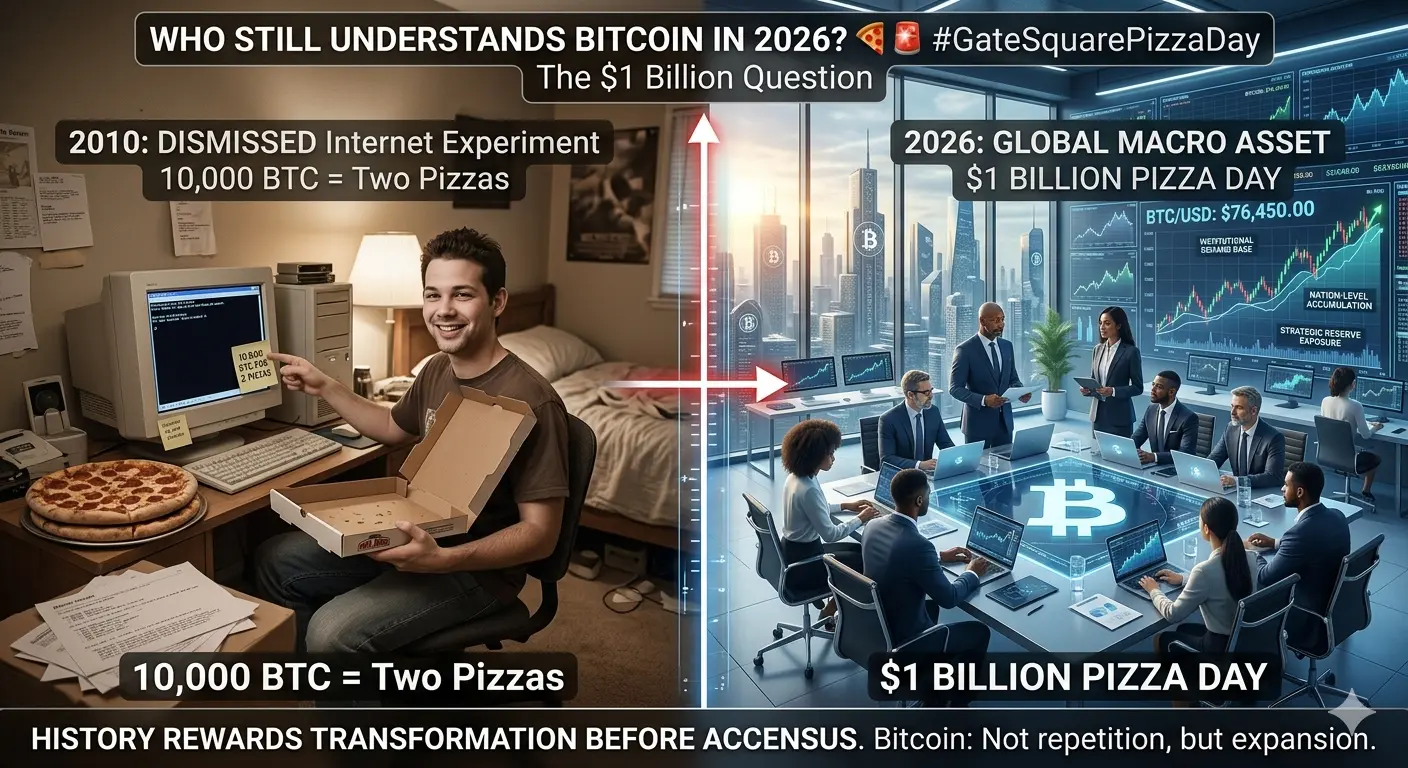
#GateSquarePizzaDay 🍕THE $1 BILLION QUESTION: WHO STILL ACTUALLY UNDERSTANDS BITCOIN IN 2026?
May 23, 2026 is not just another “Bitcoin Pizza Day.” It is a brutal reminder that financial history does not reward those who understand price… it rewards those who understand transformation before it becomes obvious.
In 2010, Bitcoin was dismissed as an internet experiment.
10,000 BTC bought two pizzas.
In 2026, that same experiment is now a global macro asset fighting in the $75K–$77K zone while sovereign funds, hedge funds, institutions, ETFs, and nation-level capital quietly compete for accumula
BTC-0.83%
XAUUSD-0.9%
SoominStar
#GateSquarePizzaDay 🍕THE $1 BILLION QUESTION: WHO STILL ACTUALLY UNDERSTANDS BITCOIN IN 2026?
May 23, 2026 is not just another “Bitcoin Pizza Day.” It is a brutal reminder that financial history does not reward those who understand price… it rewards those who understand transformation before it becomes obvious.
In 2010, Bitcoin was dismissed as an internet experiment.
10,000 BTC bought two pizzas.
In 2026, that same experiment is now a global macro asset fighting in the $75K–$77K zone while sovereign funds, hedge funds, institutions, ETFs, and nation-level capital quietly compete for accumulation.
The irony is extreme:
People still debate pizza.
While institutions debate monetary dominance.
Because the real story was never the pizza transaction.
The real story was the first proof of something the world refused to understand at the time:
Bitcoin can transfer value globally without permission, without banks, without borders, and without central control.
That single idea did not just create a cryptocurrency.
It created a financial paradigm shift that is still unfolding today.
And most people still do not realize how far it has already gone.
---
⚠️ CURRENT MARKET STRUCTURE — MAY 2026
Bitcoin is no longer in its early narrative phase. It is now operating inside a high-stakes liquidity battlefield.
📊 Price compressed around $75K–$77K
📊 Strong institutional demand base forming near $74K–$75K
📊 Resistance cluster near $78K–$78.5K acting as macro trigger zone
📊 Breakout above $78.5K opens acceleration path toward $82K–$85K
📊 ETF inflows remain a structural demand engine
📊 Exchange supply continues declining as long-term holders tighten control
But the most important signal is not on the chart.
It is underneath the chart.
Liquidity behavior is changing permanently.
Bitcoin is being absorbed by entities that do not trade emotionally. They accumulate strategically. They do not chase pumps. They build positions over long cycles. That alone changes every future correction structure.
---
🧠 THE REAL SHIFT NO ONE CAN IGNORE
This is not the same market as 2017 or 2021.
We are now in a phase where:
🏦 Institutions treat Bitcoin as balance sheet collateral
🌍 Governments explore Bitcoin as strategic reserve exposure
🔗 Real-world assets are being tokenized at scale
⚡ Global financial systems are slowly integrating blockchain rails
📈 Liquidity cycles are increasingly macro-driven, not retail-driven
This is no longer “crypto vs finance.”
This is crypto becoming finance infrastructure.
And that transition is why every cycle feels more powerful than the last.
Because each cycle is not repetition.
It is expansion.
---
🚀 ALTCOIN ROTATION PRESSURE BUILDING
Whenever Bitcoin stabilizes after a strong expansion phase, capital does not disappear.
It rotates.
And rotation is already starting to show early signals across sectors:
🚀 AI + blockchain infrastructure convergence
🏦 Real-world asset tokenization narratives
⚡ High-performance Layer-1 ecosystems competing for throughput dominance
🔗 BTCFi innovations expanding Bitcoin utility layers
📊 Derivatives + perpetual ecosystems seeing record participation
But here is the critical point:
This rotation is not retail-driven anymore.
It is liquidity-driven.
And liquidity behaves differently than hype.
It moves strategically, not emotionally.
---
🍕 BITCOIN PIZZA DAY — THE MISUNDERSTOOD LESSON
Everyone repeats the same surface-level story:
“10,000 BTC bought two pizzas.”
But that is not the lesson.
That is just the headline.
The real lessons are far more aggressive and far more uncomfortable:
1️⃣ Early conviction always looks irrational until it becomes obvious
2️⃣ The biggest opportunities are dismissed the hardest at the beginning
3️⃣ Scarcity only matters when global demand finally arrives
4️⃣ Financial revolutions are invisible… until they are irreversible
Back in 2010, Bitcoin was a joke to most people.
Today, it is a multi-trillion narrative being discussed in government meetings.
That is not adoption.
That is evolution.
And evolution does not ask for permission.
---
📉 MARKET PSYCHOLOGY — WHAT MOST TRADERS MISS
Right now, the market is split into two groups:
Group 1: Still thinking in short-term volatility
Group 2: Positioning for long-term structural change
Group 1 sees resistance, support, candles, fear, and greed.
Group 2 sees liquidity cycles, institutional positioning, and macro capital migration.
And the gap between these two groups is where wealth transfer happens.
Because in every major cycle:
The majority reacts…
The minority positions early.
---
🧨 THE REALITY OF THIS CYCLE
Bitcoin is no longer purely speculative.
It is becoming:
• A macro hedge against sovereign debt expansion
• A liquidity absorber in global capital markets
• A digital settlement layer for future financial systems
• A strategic asset class competing with bonds and gold
And that is why volatility will not disappear.
It will intensify.
Because the deeper Bitcoin integrates into global finance, the more sensitive it becomes to macro shifts, liquidity cycles, and institutional positioning.
---
🔮 FUTURE OUTLOOK — WHERE THIS IS HEADING
If historical cycle behavior continues alongside institutional adoption:
📈 Six-figure Bitcoin valuations remain structurally possible
📊 ETF inflows may become long-term price stabilization engines
🌍 Sovereign-level adoption narratives will expand
🔗 Tokenized finance will accelerate capital flow into crypto infrastructure
⚡ Volatility will compress at higher price baselines over time
But the most important shift is psychological:
Bitcoin is no longer being asked:
“Is this real?”
It is now being asked:
“How big can this get?”
That is a completely different stage of adoption.
---
⚠️ FINAL THOUGHT
The biggest mistake in every cycle is the same:
People underestimate transformation while focusing on price.
In 2010, people laughed at Bitcoin because it bought pizza.
In 2026, people debate Bitcoin while it redefines global capital structure.
And in the future, people will likely look back at this phase and realize:
This was not early Bitcoin.
This was mid-transition global finance.
So the real question is not:
“How much is that pizza worth today?”
The real question is:
Who is still ignoring what Bitcoin is becoming right in front of them?
Because history does not wait for understanding.
It only rewards conviction that arrives before consensus.
🍕🚀
#GateSquarePizzaDay #BitcoinPizzaDay #Bitcoin
repost-content-media
  • Reward
  • 3
  • Repost
  • Share
SoominStar:
2026 GOGOGO 👊
View More
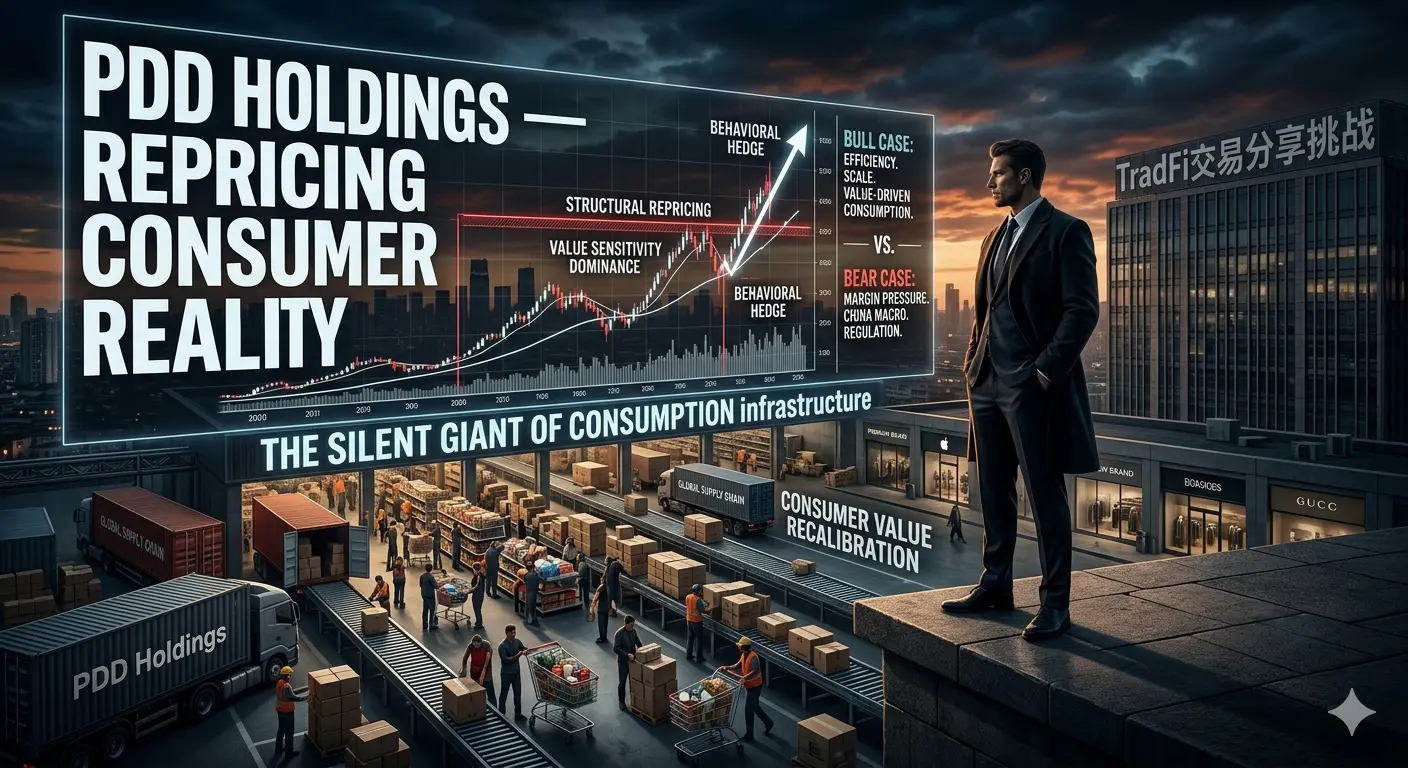
#TradfiTradingChallenge PDD Holdings — The Silent Giant Repricing Consumer Reality
#TradFi交易分享挑战
The market rarely announces revolutions loudly.
It does not ring a bell.
It does not send a warning.
It simply reprices everything in silence.
And right now, PDD Holdings is sitting in exactly that kind of phase where narratives begin shifting faster than fundamentals can react.
For months, PDD was treated as just another China discount e-commerce name.
That framing is now starting to break.
Not because the company suddenly transformed overnight, but because global consumer behavior is shifting un
PDD-3.33%
SoominStar
#TradfiTradingChallenge PDD Holdings — The Silent Giant Repricing Consumer Reality
#TradFi交易分享挑战
The market rarely announces revolutions loudly.
It does not ring a bell.
It does not send a warning.
It simply reprices everything in silence.
And right now, PDD Holdings is sitting in exactly that kind of phase where narratives begin shifting faster than fundamentals can react.
For months, PDD was treated as just another China discount e-commerce name.
That framing is now starting to break.
Not because the company suddenly transformed overnight, but because global consumer behavior is shifting under sustained macro pressure.
---
The Real Engine Behind PDD’s Position
What the market still underestimates is simple.
PDD does not compete on premium branding or luxury positioning.
It competes on price sensitivity dominance.
When inflation pressure remains elevated globally and middle-class consumption shifts toward cheaper baskets, platforms like PDD do not merely survive. They expand structurally.
This is where interpretation splits:
Bull case sees efficiency, scale, and demand expansion.
Bear case sees margin pressure, regulation risk, and macro exposure.
But the uncomfortable truth sits between both views.
PDD is increasingly becoming a behavioral hedge against expensive consumption.
---
Bull vs Bear Structural Divide
Bull narrative:
Large-scale low-cost commerce ecosystem advantage
Strong operational efficiency and logistics execution
Continuous demand from value-driven consumption behavior
Expansion beyond pure discount identity into broader ecosystem relevance
Bull interpretation frames this as next-generation mass consumption infrastructure.
---
Bear narrative:
China macro uncertainty compressing valuation confidence
Margin sustainability questions in competitive environments
Domestic and global platform competition pressure
Regulatory unpredictability as persistent discount factor
Bear interpretation frames this as a rerating risk inside a fragile macro regime.
---
The Variable Market Misprices
One key factor is consistently underestimated.
Consumer down-trading cycles last longer than market optimism cycles.
Once users adapt to lower-cost platforms, behavior rarely reverts quickly, even when macro conditions improve.
That creates a structural tailwind that does not always show up cleanly in short-term earnings reactions.
This is where PDD becomes more interesting again.
Not because it is cheap or expensive, but because it sits at the intersection of macro stress, behavioral economics, and scalable digital commerce.
---
Sentiment Transition Phase
Current sentiment is not stable.
It is transitioning through stages:
Early skepticism still dominates retail perception.
Gradual accumulation appears in value-oriented positioning.
Narrative re-rating phase is not fully priced yet.
PDD appears to be moving between accumulation and early expansion phases.
That is where volatility becomes asymmetrically sensitive.
---
Price Structure Interpretation
From a structural viewpoint, assets like this typically move through three phases:
Accumulation phase with low attention and high uncertainty.
Expansion phase driven by narrative acceleration.
Overreaction phase where sentiment becomes extreme in either direction.
PDD currently shows characteristics of leaving accumulation but not fully confirming expansion.
That explains why price action often feels inconsistent yet directionally biased underneath.
---
Risk Layer
No structural analysis is complete without risk acknowledgment.
China exposure creates macro sensitivity.
Policy changes can trigger rapid repricing.
Global tech sentiment cycles can amplify reversals.
These risks do not disappear. They remain embedded.
---
Forward Scenario Framework
If current consumption trends persist:
PDD strengthens as a dominant value-commerce infrastructure layer.
If macro conditions improve faster than expected:
Capital rotation may shift toward higher-margin tech sectors, slowing relative momentum.
If risk sentiment deteriorates:
PDD can act as both a defensive consumption proxy and a volatility amplifier.
In all scenarios, behavior remains non-linear.
---
Final View
Markets do not always reward the strongest company.
They reward the company most aligned with the current emotional and macro phase of the economy.
At present, global consumption is still in a value recalibration phase rather than premium expansion.
That is where PDD remains structurally relevant.
Not because it is loud.
But because it is aligned with how demand is currently being reshaped.
repost-content-media
  • Reward
  • 3
  • Repost
  • Share
SoominStar:
LFG 🔥
View More
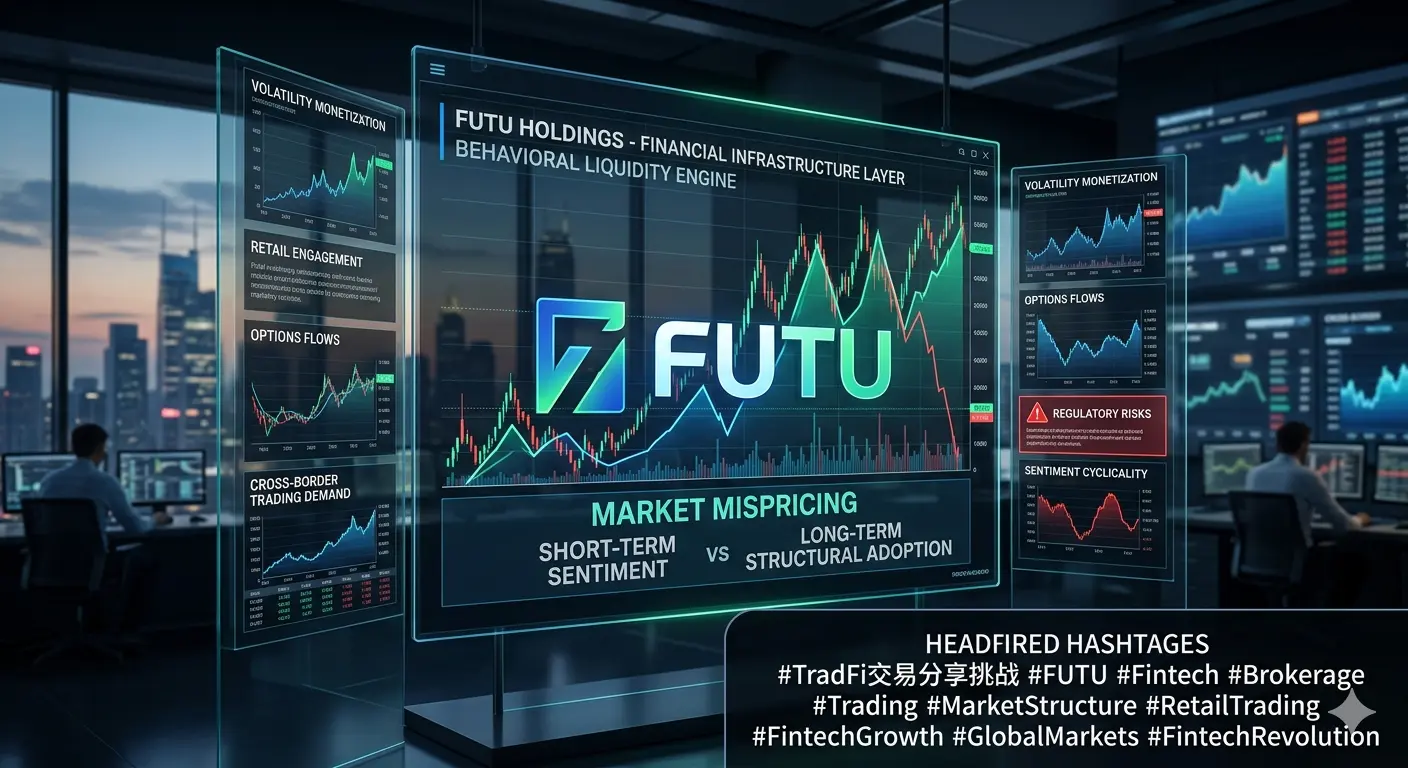
#TradfiTradingChallenge The market consistently misprices financial infrastructure companies because it tends to focus on short-term trading activity, headlines, and sentiment swings rather than long-term structural adoption trends, and Futu Holdings sits directly at that intersection where narrative momentum and underlying fundamentals are constantly in conflict. On the surface, FUTU is simply a digital brokerage platform benefiting from increased retail participation in global equity markets, options flows, and cross-border trading demand. But beneath that surface-level classification lies
SoominStar
#TradfiTradingChallenge The market consistently misprices financial infrastructure companies because it tends to focus on short-term trading activity, headlines, and sentiment swings rather than long-term structural adoption trends, and Futu Holdings sits directly at that intersection where narrative momentum and underlying fundamentals are constantly in conflict. On the surface, FUTU is simply a digital brokerage platform benefiting from increased retail participation in global equity markets, options flows, and cross-border trading demand. But beneath that surface-level classification lies a deeper transformation in how financial access is being distributed, how trading behavior is evolving, and how capital flow dynamics are increasingly being shaped by digital-first ecosystems rather than traditional brokerage institutions.
What makes FUTU particularly important in the current environment is not just its revenue growth or user expansion metrics, but its position within a broader structural shift from legacy brokerage systems toward fully digitized, high-frequency retail engagement platforms. In this new structure, investors are no longer passive allocators waiting for quarterly reports or long-cycle advisory input. Instead, they are continuously active participants reacting in real time to macro data, earnings volatility, geopolitical signals, and cross-asset correlations. This compression of decision-making time has fundamentally changed the nature of retail investing, turning it into a real-time behavioral ecosystem rather than a slow capital deployment process.
In the bullish interpretation, FUTU represents one of the clearest beneficiaries of financial democratization in the digital era. The platform reduces barriers to entry for global stock markets, options trading, margin products, and multi-asset exposure, effectively collapsing the gap between information discovery and trade execution. This structural efficiency creates a powerful feedback loop: more engagement leads to more liquidity, more liquidity improves pricing efficiency and execution quality, and better execution attracts even more users. This is not just product design; it is ecosystem architecture.
From this perspective, FUTU’s revenue model is tightly aligned with trading activity cycles rather than static asset accumulation. Brokerage commissions, financing services, margin utilization, and derivatives exposure all scale with volatility and participation intensity. In high-volatility environments, this creates an accelerated revenue engine where market uncertainty directly translates into platform activity. In other words, volatility is not a risk factor for FUTU in isolation; it is also a primary driver of monetization.
However, the bearish interpretation is equally structured and cannot be dismissed. The same dependence on trading activity that creates upside leverage also introduces significant cyclical risk. Brokerage revenue is highly sensitive to market participation levels, and prolonged periods of low volatility or risk-off sentiment can result in sharp declines in trading volume and engagement. Additionally, regulatory frameworks across Asia and global capital markets remain dynamic, and any tightening in cross-border financial flows, product restrictions, or compliance requirements can directly affect FUTU’s operational flexibility and expansion trajectory.
From a bear standpoint, FUTU is not a stable compounder but rather a leveraged proxy for retail trading sentiment. This means its valuation is heavily dependent on sustained engagement cycles rather than predictable, slow-moving cash flow expansion. In this framing, FUTU behaves more like a sentiment amplifier than a traditional financial institution, which increases both upside potential and downside sensitivity.
The current macro environment makes this dynamic even more relevant. Global markets are not operating in a neutral equilibrium state. Instead, they are shaped by shifting liquidity conditions, interest rate expectations, and ongoing macro uncertainty that periodically triggers spikes in volatility. These volatility clusters tend to attract retail participation, which directly benefits platforms like FUTU. In this sense, volatility itself becomes a monetizable condition, transforming uncertainty into platform activity rather than suppressing it.
This is where FUTU’s positioning becomes structurally interesting. It is less exposed to traditional economic cycles and more exposed to behavioral finance cycles driven by fear, greed, and rapid sentiment rotation. These behavioral cycles tend to move faster and more aggressively than macro fundamentals, which introduces a layer of non-linearity into FUTU’s performance profile. The platform essentially sits at the center of modern retail trading psychology, capturing flows that are driven by emotional and informational acceleration.
Another critical dimension is competitive structure. Unlike legacy financial institutions that rely on slower onboarding processes, geographic constraints, and layered advisory models, FUTU operates as a digital-first brokerage ecosystem with high scalability and rapid user acquisition potential. This allows it to expand across markets with relatively lower friction compared to traditional financial intermediaries. However, this advantage also intensifies competition, as global fintech platforms compete aggressively for similar user segments through pricing strategies, incentives, product innovation, and cross-market expansion.
As a result, FUTU exists in a highly competitive and fast-evolving fintech brokerage landscape where growth is strong but not guaranteed to be linear. The scalability advantage must continuously be defended through innovation, user retention, and ecosystem depth, otherwise competitive pressure can quickly compress margins and market share.
From a structural market perspective, FUTU is currently positioned in a phase where narrative expansion is colliding with valuation sensitivity. On one side, investors recognize the long-term structural trend of retail financialization, digital trading adoption, and increased market accessibility, all of which support a strong bullish thesis. On the other side, fintech and brokerage valuations remain highly sensitive to interest rate cycles, liquidity conditions, and risk appetite in broader equity markets. This creates a tension where operational strength does not always translate into immediate valuation expansion.
Looking forward, the trajectory of FUTU will depend on three key structural variables. First, sustained retail participation levels in global markets. Second, regulatory clarity and stability across its operating jurisdictions. Third, the persistence of volatility cycles that continue to drive trading engagement. If retail participation remains structurally elevated due to macro uncertainty and financial digitization trends, FUTU could continue to scale its ecosystem and deepen monetization layers. If volatility compresses significantly and markets enter prolonged stability phases, revenue growth may normalize and sentiment-driven expansion could slow. If regulatory pressure increases unexpectedly, expansion plans may face friction, temporarily impacting growth expectations.
Ultimately, FUTU is not simply a brokerage company in the traditional sense. It is a behavioral finance infrastructure layer embedded within modern market psychology, where user activity, volatility, and macro sentiment directly translate into economic output. This makes it simultaneously powerful and fragile, depending on the phase of the market cycle. The current environment suggests that markets remain in a transitional state where retail participation is structurally relevant, but sentiment remains highly reactive, keeping FUTU in a constant state of revaluation.
The real question is not whether FUTU can grow in isolation, but whether the global trading ecosystem continues to evolve in a way that sustains high engagement cycles. If it does, FUTU remains one of the most direct beneficiaries of financial digitization and retail empowerment. If it does not, the same structural leverage to sentiment that drives upside can also accelerate downside pressure with equal intensity.
#TradFi交易分享挑战 #FUTU
repost-content-media
  • Reward
  • 3
  • Repost
  • Share
SoominStar:
Diamond Hands 💎
View More
#TradfiTradingChallenge
The market rarely values platform companies for what they actually are in the present. Instead, it constantly misprices them based on outdated categories, short-term earnings noise, and incomplete narratives. Uber is one of those rare cases where the surface-level definition of a “ride-hailing company” is no longer enough to explain what the underlying business has evolved into.
On paper, Uber still looks like a mobility platform. But structurally, it has transformed into a multi-layered logistics and demand orchestration network that sits across urban transportation
SoominStar
#TradfiTradingChallenge
The market rarely values platform companies for what they actually are in the present. Instead, it constantly misprices them based on outdated categories, short-term earnings noise, and incomplete narratives. Uber is one of those rare cases where the surface-level definition of a “ride-hailing company” is no longer enough to explain what the underlying business has evolved into.
On paper, Uber still looks like a mobility platform. But structurally, it has transformed into a multi-layered logistics and demand orchestration network that sits across urban transportation, food delivery, and freight coordination. The deeper shift is not just diversification of revenue streams, but the consolidation of real-time demand matching systems across entirely different physical markets. This is what most of the market continues to underappreciate.
The key misunderstanding is simple: investors still price Uber as a cyclical mobility business rather than a network-driven infrastructure layer. In reality, Uber operates more like a real-time marketplace for physical economy efficiency. It does not own vehicles, it does not control supply in a traditional sense, but it controls coordination — and coordination at scale becomes a form of economic infrastructure.
In the bullish interpretation, Uber represents one of the most successful transitions from high-burn growth narrative to structural profitability narrative in the platform economy. The core thesis is no longer about expansion at any cost, but about monetizing an already deeply embedded global user base. Once network density reaches a certain threshold, the marginal cost of scaling becomes significantly lower, while pricing power and route optimization efficiency improve over time.
Uber’s ride-hailing segment continues to benefit from urbanization trends, declining car ownership incentives in dense cities, and the increasing preference for on-demand mobility over fixed asset ownership. At the same time, Uber Eats has evolved into a parallel demand engine that stabilizes engagement beyond transportation cycles. Freight adds another dimension by connecting enterprise logistics into the same platform logic.
This creates a layered revenue structure where different segments operate on different cycles, reducing overall dependency on a single macro driver. That is a critical structural shift that is often overlooked in traditional valuation models.
However, the bearish perspective is equally important and cannot be ignored. Uber’s profitability narrative is still sensitive to labor cost dynamics, regulatory pressures in different regions, and competition from both local and global mobility platforms. The gig economy model, while scalable, remains structurally exposed to policy shifts, wage inflation pressures, and potential classification changes in worker status across jurisdictions.
Additionally, the mobility sector is inherently sensitive to macroeconomic conditions. During periods of economic slowdown, discretionary ride demand can weaken, while delivery demand may partially offset but not fully neutralize the impact. This creates an uneven balance between resilience and cyclicality that keeps Uber in a constant valuation debate between growth stock and mature cash-flow company.
The more important question, however, is not whether Uber is cyclical or defensive, but whether it is becoming structurally embedded in daily economic activity across global cities. The answer increasingly points toward deeper integration. Uber is no longer an occasional-use app for transportation; in many urban regions, it is becoming a default layer of movement and logistics coordination.
This shift introduces an underappreciated dynamic: network dependency. As more users and drivers interact within the ecosystem, the platform becomes more efficient, wait times reduce, pricing stabilizes, and utilization increases. This self-reinforcing loop strengthens competitive positioning over time and makes displacement increasingly difficult.
From a market structure perspective, Uber currently sits in a transition phase where investor perception is lagging behind operational reality. The market still oscillates between viewing it as a legacy hyper-growth platform and a stabilized profitability story. In reality, it is evolving into a hybrid structure: part infrastructure, part marketplace, and part logistics optimization system.
This transition phase is critical because it defines valuation compression or expansion cycles. When narratives lag structural improvement, multiples remain constrained. When narratives catch up, repricing can occur rapidly and aggressively.
Looking forward, Uber’s trajectory will likely depend on three structural variables. First, sustained demand stability in urban mobility and delivery ecosystems. Second, regulatory clarity around gig economy frameworks across major markets. Third, continued efficiency improvements in matching algorithms, pricing optimization, and route density utilization.
If these factors align positively, Uber strengthens its position as a core global urban infrastructure layer rather than a cyclical consumer platform. If macro conditions deteriorate or regulatory pressure intensifies, growth may stabilize but valuation expansion could remain capped. If competition increases significantly in key regions, margin expansion could slow despite stable demand.
In essence, Uber is no longer just a transportation company. It is a real-time coordination engine for urban economic activity, where value is created through matching efficiency rather than asset ownership. This makes it structurally different from traditional mobility or logistics businesses.
The key misunderstanding in the market is still classification. As long as Uber is treated as a simple ride-hailing business, valuation frameworks will remain incomplete. The real story is not about rides. It is about system-level efficiency in how cities move people, goods, and demand in real time.
The question ahead is not whether Uber grows. It is whether the market finally re-rates it as infrastructure rather than just a consumer platform.
#TradFi交易分享挑战 #UBER
repost-content-media
  • Reward
  • 3
  • Repost
  • Share
SoominStar:
1000x VIbes 🤑
View More