


















#GateSquarePizzaDay 𝐁𝐈𝐓𝐂𝐎𝐈𝐍 𝐏𝐈𝐙𝐙𝐀 𝐃𝐀𝐘 𝟐𝟎𝟐𝟔 — 𝐓𝐇𝐄 𝐃𝐀𝐘 𝐀 𝐒𝐈𝐌𝐏𝐋𝐄 $𝟒𝟏 𝐓𝐑𝐀𝐍𝐒𝐀𝐂𝐓𝐈𝐎𝐍 𝐓𝐑𝐈𝐆𝐆𝐄𝐑𝐄𝐃 𝐎𝐍𝐄 𝐎𝐅 𝐓𝐇𝐄 𝐋𝐀𝐑𝐆𝐄𝐒𝐓 𝐅𝐈𝐍𝐀𝐍𝐂𝐈𝐀𝐋, 𝐓𝐄𝐂𝐇𝐍𝐎𝐋𝐎𝐆𝐈𝐂𝐀𝐋, 𝐀𝐍𝐃 𝐌𝐎𝐍𝐄𝐓𝐀𝐑𝐘 𝐑𝐄𝐕𝐎𝐋𝐔𝐓𝐈𝐎𝐍𝐒 𝐈𝐍 𝐌𝐎𝐃𝐄𝐑𝐍 𝐇𝐈𝐒𝐓𝐎𝐑𝐘
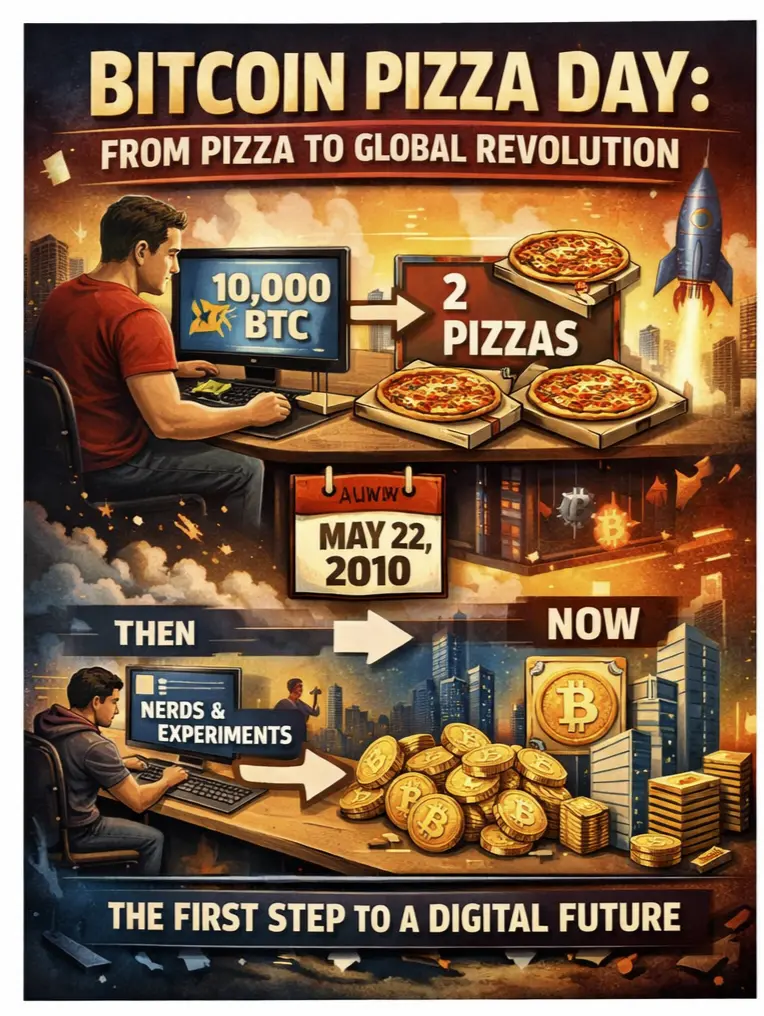
Bitcoin Pizza Day is no longer just a famous crypto meme or a nostalgic internet story remembered by early blockchain communities. It has evolved into a symbolic milestone representing the exact moment decentralized digital currency entered the real economy for the very first time. On May 22, 2010, when Laszlo Hanyecz exchanged 10,000 BTC for two pizzas worth approximately $41, almost nobody could imagine that the transaction would eventually become one of the most iconic moments in global financial history. At that time Bitcoin had no institutional credibility, no regulatory recognition, no ETF ecosystem, no corporate treasury adoption, and virtually no mainstream attention. It was simply an experimental peer-to-peer protocol discussed by programmers and cryptography enthusiasts on obscure internet forums. Yet that single pizza purchase created something extremely important: proof that decentralized digital assets could carry real-world value outside of theoretical code and online discussion.
What makes Pizza Day historically extraordinary is not only the price appreciation of Bitcoin afterward, but the fact that this transaction fundamentally changed how humanity began thinking about money itself. Before Bitcoin, nearly all financial systems depended on centralized authorities, banking intermediaries, payment processors, governments, or trusted third parties to validate transactions and maintain monetary infrastructure. Bitcoin introduced a radically different model — a decentralized network where value could move globally without permission, without borders, and without institutional control. The pizza transaction proved that this new monetary architecture could interact directly with the physical world, transforming Bitcoin from a technological experiment into a functioning economic system. In many ways, those two pizzas became the first commercial proof-of-concept for blockchain-based finance.
𝐅𝐑𝐎𝐌 𝐏𝐈𝐙𝐙𝐀 𝐓𝐎 𝐀 𝐓𝐑𝐈𝐋𝐋𝐈𝐎𝐍-𝐃𝐎𝐋𝐋𝐀𝐑 𝐀𝐒𝐒𝐄𝐓 𝐂𝐋𝐀𝐒𝐒
The growth trajectory of Bitcoin since Pizza Day remains one of the most extraordinary wealth creation events ever recorded in modern finance. From fractions of a cent in 2010 to tens of thousands of dollars per coin in 2026, Bitcoin has transitioned through multiple structural evolutions including:
• experimental internet currency
• retail speculation asset
• mining-driven commodity phase
• institutional investment vehicle
• macro liquidity asset
• digital reserve infrastructure
At current market prices, the 10,000 BTC spent on those pizzas would now be valued at hundreds of millions of dollars, transforming what once appeared to be an insignificant online purchase into arguably the most expensive meal in financial history. However, the real significance is not the “lost fortune” narrative repeated across social media every year. The deeper reality is that without transactions like this, Bitcoin might never have developed enough real-world credibility to evolve into today’s global financial ecosystem. Adoption requires usage. Usage creates trust. Trust creates liquidity. Liquidity creates markets. And markets create entire economic systems.
𝐓𝐇𝐄 𝐇𝐈𝐃𝐃𝐄𝐍 𝐑𝐎𝐋𝐄 𝐎𝐅 𝐋𝐀𝐒𝐙𝐋𝐎 𝐇𝐀𝐍𝐘𝐄𝐂𝐙
Most people only remember Laszlo Hanyecz as “the man who bought pizza with Bitcoin,” but his role in Bitcoin’s early development was far more important than most realize. Beyond Pizza Day itself, Hanyecz was one of the earliest technical contributors helping expand Bitcoin’s infrastructure during its fragile developmental stage. He worked on early software compatibility improvements and became one of the first people to experiment with GPU mining, discovering that graphics cards could dramatically outperform CPUs for Bitcoin mining operations. This innovation transformed Bitcoin mining forever by massively increasing network security and accelerating hash power growth across the ecosystem.
Ironically, the same innovation that strengthened Bitcoin also contributed to concerns around mining centralization. Even Satoshi Nakamoto reportedly expressed concerns regarding GPU mining because it could make mining less accessible for ordinary users. This reveals something important about Bitcoin’s earliest years: the ecosystem was not driven by profit alone. It was shaped by experimentation, philosophical debate, open-source collaboration, and people genuinely trying to build an alternative monetary network outside traditional financial structures.
𝐁𝐈𝐓𝐂𝐎𝐈𝐍 𝐈𝐍 𝟐𝟎𝟐𝟔 — 𝐅𝐑𝐎𝐌 𝐎𝐔𝐓𝐒𝐈𝐃𝐄𝐑 𝐀𝐒𝐒𝐄𝐓 𝐓𝐎 𝐌𝐀𝐂𝐑𝐎 𝐅𝐈𝐍𝐀𝐍𝐂𝐈𝐀𝐋 𝐅𝐎𝐑𝐂𝐄
The Bitcoin market of 2026 looks completely different from the experimental ecosystem of 2010. Today Bitcoin operates inside a global macro environment influenced by:
• institutional ETF flows
• sovereign debt concerns
• global liquidity cycles
• inflation expectations
• interest rate policies
• macroeconomic instability
• AI-integrated financial systems
• tokenized asset infrastructure
Large financial institutions now monitor Bitcoin alongside traditional macro assets such as gold, equities, treasury markets, and commodities. Bitcoin ETFs have introduced mainstream exposure for millions of traditional investors, while corporations and investment funds increasingly view BTC as part of long-term strategic capital allocation frameworks. Instead of being dismissed as internet speculation, Bitcoin is now frequently discussed as:
• digital gold
• decentralized reserve collateral
• macro liquidity indicator
• inflation hedge
• borderless settlement asset
• next-generation financial infrastructure
This transformation represents one of the fastest legitimacy shifts ever experienced by an asset class in financial history.
𝐁𝐈𝐓𝐂𝐎𝐈𝐍’𝐒 𝐂𝐔𝐑𝐑𝐄𝐍𝐓 𝐌𝐀𝐑𝐊𝐄𝐓 𝐒𝐓𝐑𝐔𝐂𝐓𝐔𝐑𝐄
As of Pizza Day 2026, Bitcoin continues trading within a highly volatile but structurally significant macro cycle. Current market conditions are shaped by:
• strong institutional participation
• expanding derivatives liquidity
• ETF capital inflows
• global macro uncertainty
• AI-driven trading systems
• growing stablecoin ecosystems
Key support zones continue forming around major liquidity clusters while resistance remains concentrated near psychologically important institutional levels. Market participants are closely monitoring whether Bitcoin can maintain long-term structural strength despite short-term volatility caused by macroeconomic uncertainty and leveraged market conditions.
At the same time, Bitcoin’s role inside global finance continues expanding because it increasingly acts as a real-time reflection of liquidity conditions across the broader digital asset ecosystem. When liquidity expands, Bitcoin absorbs capital aggressively. When macro fear increases, volatility expands rapidly. This dynamic has transformed BTC into one of the most important macro sentiment indicators inside modern financial markets.
𝐓𝐇𝐄 𝐂𝐎𝐍𝐕𝐄𝐑𝐆𝐄𝐍𝐂𝐄 𝐎𝐅 𝐀𝐈, 𝐁𝐋𝐎𝐂𝐊𝐂𝐇𝐀𝐈𝐍, & 𝐃𝐈𝐆𝐈𝐓𝐀𝐋 𝐅𝐈𝐍𝐀𝐍𝐂𝐄
One of the most important developments of 2026 is the growing convergence between artificial intelligence and blockchain systems. AI is increasingly being integrated into:
• automated trading systems
• blockchain analytics
• liquidity optimization
• smart contract infrastructure
• decentralized applications
• digital identity systems
• tokenized financial models
Bitcoin itself remains at the center of this broader transformation because it represents the foundational reserve asset of the digital economy. Just as gold once anchored traditional monetary systems, Bitcoin is increasingly becoming the liquidity foundation around which modern digital financial infrastructure is being built.
This means Pizza Day is no longer only about celebrating the past.
It is also about recognizing how early experimentation created the foundation for the future global digital economy.
𝐅𝐈𝐍𝐀𝐋 𝐌𝐀𝐑𝐊𝐄𝐓 𝐌𝐄𝐀𝐍𝐈𝐍𝐆
Bitcoin Pizza Day teaches one of the most important lessons in technological history:
Every revolutionary innovation looks small, irrational, and misunderstood before the world fully understands its impact.
In 2010, Bitcoin looked like a niche internet experiment.
In 2026, Bitcoin stands as: • a trillion-dollar financial ecosystem
• a globally recognized digital asset
• a decentralized liquidity network
• an institutional investment category
• a foundational pillar of digital finance
From two pizzas to global financial transformation…
Bitcoin Pizza Day represents the exact moment the future quietly entered the real world.
#CreatorCarnival #ContentMining #TradfiTradingChallenge
Bitcoin Pizza Day is no longer just a famous crypto meme or a nostalgic internet story remembered by early blockchain communities. It has evolved into a symbolic milestone representing the exact moment decentralized digital currency entered the real economy for the very first time. On May 22, 2010, when Laszlo Hanyecz exchanged 10,000 BTC for two pizzas worth approximately $41, almost nobody could imagine that the transaction would eventually become one of the most iconic moments in global financial history. At that time Bitcoin had no institutional credibility, no regulatory recognition, no ETF ecosystem, no corporate treasury adoption, and virtually no mainstream attention. It was simply an experimental peer-to-peer protocol discussed by programmers and cryptography enthusiasts on obscure internet forums. Yet that single pizza purchase created something extremely important: proof that decentralized digital assets could carry real-world value outside of theoretical code and online discussion.
What makes Pizza Day historically extraordinary is not only the price appreciation of Bitcoin afterward, but the fact that this transaction fundamentally changed how humanity began thinking about money itself. Before Bitcoin, nearly all financial systems depended on centralized authorities, banking intermediaries, payment processors, governments, or trusted third parties to validate transactions and maintain monetary infrastructure. Bitcoin introduced a radically different model — a decentralized network where value could move globally without permission, without borders, and without institutional control. The pizza transaction proved that this new monetary architecture could interact directly with the physical world, transforming Bitcoin from a technological experiment into a functioning economic system. In many ways, those two pizzas became the first commercial proof-of-concept for blockchain-based finance.
𝐅𝐑𝐎𝐌 𝐏𝐈𝐙𝐙𝐀 𝐓𝐎 𝐀 𝐓𝐑𝐈𝐋𝐋𝐈𝐎𝐍-𝐃𝐎𝐋𝐋𝐀𝐑 𝐀𝐒𝐒𝐄𝐓 𝐂𝐋𝐀𝐒𝐒
The growth trajectory of Bitcoin since Pizza Day remains one of the most extraordinary wealth creation events ever recorded in modern finance. From fractions of a cent in 2010 to tens of thousands of dollars per coin in 2026, Bitcoin has transitioned through multiple structural evolutions including:
• experimental internet currency
• retail speculation asset
• mining-driven commodity phase
• institutional investment vehicle
• macro liquidity asset
• digital reserve infrastructure
At current market prices, the 10,000 BTC spent on those pizzas would now be valued at hundreds of millions of dollars, transforming what once appeared to be an insignificant online purchase into arguably the most expensive meal in financial history. However, the real significance is not the “lost fortune” narrative repeated across social media every year. The deeper reality is that without transactions like this, Bitcoin might never have developed enough real-world credibility to evolve into today’s global financial ecosystem. Adoption requires usage. Usage creates trust. Trust creates liquidity. Liquidity creates markets. And markets create entire economic systems.
𝐓𝐇𝐄 𝐇𝐈𝐃𝐃𝐄𝐍 𝐑𝐎𝐋𝐄 𝐎𝐅 𝐋𝐀𝐒𝐙𝐋𝐎 𝐇𝐀𝐍𝐘𝐄𝐂𝐙
Most people only remember Laszlo Hanyecz as “the man who bought pizza with Bitcoin,” but his role in Bitcoin’s early development was far more important than most realize. Beyond Pizza Day itself, Hanyecz was one of the earliest technical contributors helping expand Bitcoin’s infrastructure during its fragile developmental stage. He worked on early software compatibility improvements and became one of the first people to experiment with GPU mining, discovering that graphics cards could dramatically outperform CPUs for Bitcoin mining operations. This innovation transformed Bitcoin mining forever by massively increasing network security and accelerating hash power growth across the ecosystem.
Ironically, the same innovation that strengthened Bitcoin also contributed to concerns around mining centralization. Even Satoshi Nakamoto reportedly expressed concerns regarding GPU mining because it could make mining less accessible for ordinary users. This reveals something important about Bitcoin’s earliest years: the ecosystem was not driven by profit alone. It was shaped by experimentation, philosophical debate, open-source collaboration, and people genuinely trying to build an alternative monetary network outside traditional financial structures.
𝐁𝐈𝐓𝐂𝐎𝐈𝐍 𝐈𝐍 𝟐𝟎𝟐𝟔 — 𝐅𝐑𝐎𝐌 𝐎𝐔𝐓𝐒𝐈𝐃𝐄𝐑 𝐀𝐒𝐒𝐄𝐓 𝐓𝐎 𝐌𝐀𝐂𝐑𝐎 𝐅𝐈𝐍𝐀𝐍𝐂𝐈𝐀𝐋 𝐅𝐎𝐑𝐂𝐄
The Bitcoin market of 2026 looks completely different from the experimental ecosystem of 2010. Today Bitcoin operates inside a global macro environment influenced by:
• institutional ETF flows
• sovereign debt concerns
• global liquidity cycles
• inflation expectations
• interest rate policies
• macroeconomic instability
• AI-integrated financial systems
• tokenized asset infrastructure
Large financial institutions now monitor Bitcoin alongside traditional macro assets such as gold, equities, treasury markets, and commodities. Bitcoin ETFs have introduced mainstream exposure for millions of traditional investors, while corporations and investment funds increasingly view BTC as part of long-term strategic capital allocation frameworks. Instead of being dismissed as internet speculation, Bitcoin is now frequently discussed as:
• digital gold
• decentralized reserve collateral
• macro liquidity indicator
• inflation hedge
• borderless settlement asset
• next-generation financial infrastructure
This transformation represents one of the fastest legitimacy shifts ever experienced by an asset class in financial history.
𝐁𝐈𝐓𝐂𝐎𝐈𝐍’𝐒 𝐂𝐔𝐑𝐑𝐄𝐍𝐓 𝐌𝐀𝐑𝐊𝐄𝐓 𝐒𝐓𝐑𝐔𝐂𝐓𝐔𝐑𝐄
As of Pizza Day 2026, Bitcoin continues trading within a highly volatile but structurally significant macro cycle. Current market conditions are shaped by:
• strong institutional participation
• expanding derivatives liquidity
• ETF capital inflows
• global macro uncertainty
• AI-driven trading systems
• growing stablecoin ecosystems
Key support zones continue forming around major liquidity clusters while resistance remains concentrated near psychologically important institutional levels. Market participants are closely monitoring whether Bitcoin can maintain long-term structural strength despite short-term volatility caused by macroeconomic uncertainty and leveraged market conditions.
At the same time, Bitcoin’s role inside global finance continues expanding because it increasingly acts as a real-time reflection of liquidity conditions across the broader digital asset ecosystem. When liquidity expands, Bitcoin absorbs capital aggressively. When macro fear increases, volatility expands rapidly. This dynamic has transformed BTC into one of the most important macro sentiment indicators inside modern financial markets.
𝐓𝐇𝐄 𝐂𝐎𝐍𝐕𝐄𝐑𝐆𝐄𝐍𝐂𝐄 𝐎𝐅 𝐀𝐈, 𝐁𝐋𝐎𝐂𝐊𝐂𝐇𝐀𝐈𝐍, & 𝐃𝐈𝐆𝐈𝐓𝐀𝐋 𝐅𝐈𝐍𝐀𝐍𝐂𝐄
One of the most important developments of 2026 is the growing convergence between artificial intelligence and blockchain systems. AI is increasingly being integrated into:
• automated trading systems
• blockchain analytics
• liquidity optimization
• smart contract infrastructure
• decentralized applications
• digital identity systems
• tokenized financial models
Bitcoin itself remains at the center of this broader transformation because it represents the foundational reserve asset of the digital economy. Just as gold once anchored traditional monetary systems, Bitcoin is increasingly becoming the liquidity foundation around which modern digital financial infrastructure is being built.
This means Pizza Day is no longer only about celebrating the past.
It is also about recognizing how early experimentation created the foundation for the future global digital economy.
𝐅𝐈𝐍𝐀𝐋 𝐌𝐀𝐑𝐊𝐄𝐓 𝐌𝐄𝐀𝐍𝐈𝐍𝐆
Bitcoin Pizza Day teaches one of the most important lessons in technological history:
Every revolutionary innovation looks small, irrational, and misunderstood before the world fully understands its impact.
In 2010, Bitcoin looked like a niche internet experiment.
In 2026, Bitcoin stands as: • a trillion-dollar financial ecosystem
• a globally recognized digital asset
• a decentralized liquidity network
• an institutional investment category
• a foundational pillar of digital finance
From two pizzas to global financial transformation…
Bitcoin Pizza Day represents the exact moment the future quietly entered the real world.
#CreatorCarnival #ContentMining #TradfiTradingChallenge