Cardano has become the second-largest Layer 1 blockchain network by validator count, according to data shared by Token Terminal and highlighted by Cardano community member Mintern. The proof-of-stake blockchain now operates with nearly 2,900 validators, reinforcing its position as one of the most decentralized blockchain ecosystems. Cardano has surpassed several prominent Layer 1 projects in active validator numbers, including Algorand, Solana, Polkadot, and Near Protocol.
Validator Comparison Across Layer 1 Networks
According to Token Terminal data cited in the source, Ethereum continues to dominate the sector with approximately 895,200 validators. Cardano’s validator count of nearly 2,900 places it ahead of competing networks: Algorand operates with around 1,600 validators, Solana has roughly 775, Polkadot maintains approximately 600, and Near Protocol has 472 validators.
Within proof-of-stake blockchain systems, validators play a critical role in transaction verification, consensus maintenance, and overall network security. A broader validator base is often viewed as an important indicator of decentralization because it distributes operational control across a larger number of participants rather than concentrating influence among a limited group of entities.
Decentralization as Competitive Advantage
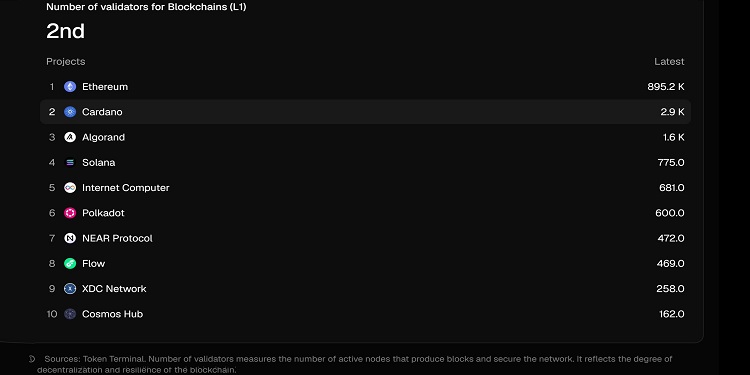
Cardano’s expanding validator structure has strengthened arguments from supporters who consider decentralization a defining advantage within the blockchain sector. Industry participants frequently regard validator distribution as a core measure of a network’s resilience, censorship resistance, and long-term sustainability.
Staking provider Everstake responded to criticism often directed at Cardano regarding transaction speed and ecosystem growth, arguing that the network’s expanding validator structure demonstrates a highly decentralized foundation capable of supporting future blockchain adoption. Everstake emphasized that maintaining a blockchain network supported by nearly 3,000 validators requires extensive participation and commitment from the community.
Everstake suggested that such a decentralized structure could position Cardano favorably as Web3 adoption accelerates globally. The company indicated that widespread validator participation creates the type of infrastructure necessary for sustainable decentralized applications and blockchain services. As institutional and retail interest in decentralized finance and Web3 technologies continues to grow, networks with strong decentralization metrics are increasingly being viewed as better equipped to support large-scale activity.
Layer 1 Competition and Validator Participation
Cardano’s ranking highlights the growing competition among Layer 1 blockchain ecosystems seeking to attract developers, validators, and users. Validator participation has become an increasingly important metric as blockchain networks attempt to balance scalability, security, and decentralization.
Although Ethereum continues to maintain a dominant lead in validator numbers, Cardano’s position above several major competitors demonstrates the network’s ability to sustain a broad base of independent operators. This development reinforces Cardano’s standing as one of the crypto industry’s most decentralized proof-of-stake blockchain networks.
Disclaimer: The information on this page may come from third parties and does not represent the views or opinions of Gate. The content displayed on this page is for reference only and does not constitute any financial, investment, or legal advice. Gate does not guarantee the accuracy or completeness of the information and shall not be liable for any losses arising from the use of this information. Virtual asset investments carry high risks and are subject to significant price volatility. You may lose all of your invested principal. Please fully understand the relevant risks and make prudent decisions based on your own financial situation and risk tolerance. For details, please refer to
Disclaimer.
Related Articles
DOGE Price Faces Bearish Wedge Despite Fresh ETF Demand
Key Insights
Dogecoin ETFs recorded more than $600,000 in inflows during May 5 and 6 despite declining prices and weakening technical momentum across markets
A rising wedge pattern on the four-hour chart signaled growing bearish pressure, with Dogecoin risking a decline toward $0.103 this we
CryptoNewsLand24m ago
x402 Protocol Q1 Payments Exceed $100M, 90% of On-Chain AI Agent Stablecoin Trades on Base
According to ChainCatcher, Base's x402 protocol payments totaled more than $100 million in Q1 2026. Over 90% of on-chain AI agent stablecoin transactions occurred on the Base network.
GateNews4h ago
Judge Clears $71M ETH Transfer From Arbitrum to Aave, But North Korea Creditors Retain Legal Claim
According to The Block, on Friday (May 9), Judge Margaret Garnett of the U.S. District Court for the Southern District of New York modified a restraining notice that had locked 30,766 ETH (~$71 million) inside Arbitrum DAO since May 1. The modification permits an onchain governance vote to
GateNews6h ago
Retail Bitcoin Holders Accumulate 23,074 BTC in 30 Days; Whales Add 140,699 BTC Near $66K
According to BlockBeats, on May 10, addresses holding less than 1 BTC increased their balances by 23,074 BTC over the past 30 days, with notable accumulation occurring near $66,000, $70,000, and $80,000, according to analyst Murphy. Meanwhile, whales holding more than 10,000 BTC added 140,699 BTC ne
GateNews7h ago
U.S. Spot Bitcoin ETFs Record Six Consecutive Weeks of Net Inflows Totaling $3.4B, Longest Streak Since August 2025
According to Cointelegraph, U.S. spot Bitcoin ETFs recorded six consecutive weeks of net inflows totaling $3.4 billion from early April through this week, marking the longest consecutive streak since August 2025. Inflows peaked at $996 million during the week of April 17, with the most recent week s
GateNews9h ago
Ethereum's DeFi Market Share Falls to 54%, Down from 63.5% in Early 2025
According to CryptoSlate data via DefiLlama, Ethereum's share of DeFi total value locked (TVL) has fallen to 54% as of May 10, marking a one-year low and down from 63.5% at the start of 2025. Ethereum's DeFi TVL stands at approximately $45.4 billion, maintaining a significant lead, though
GateNews9h ago


