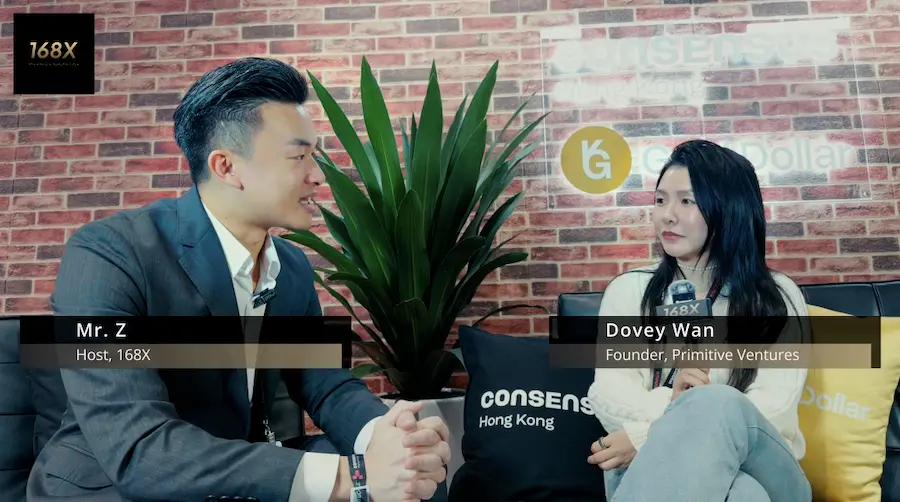
Host: Mr. Z, 168X
Guest: Dovey Wan, Founder of Primitive Ventures
“Bitcoin can no longer keep up with ARKK — AI is draining global liquidity, and the crypto market hasn’t even reached true dead silence yet.” In an exclusive interview on the East-West Capital Dialogue program “168X,” Primitive Ventures founder Dovey Wan offers an in-depth analysis from her extensive practical experience across China and U.S. tech and finance circles. She discusses how AI is disrupting the global liquidity landscape, the survival crisis of white-collar workers, and the philosophy of “dullness” in the crypto bear market.
With a background in technology, Dovey Wan holds a master’s degree in Information Systems from Carnegie Mellon University. She previously served as Managing Director at DHVC, leading early investments in blockchain infrastructure projects such as Dfinity, Cosmos, StarkWare, and dozens more. In 2018, she founded Primitive Ventures, a fully self-funded fund that does not accept external LPs, focusing on investing in crypto-native innovators and supporting independent Bitcoin Core developers during harsh winters. Today, Primitive Ventures’ portfolio includes over 50 projects across DeFi, zero-knowledge proofs, Bitcoin Layer 2, AI infrastructure, and other cutting-edge fields.
The Great Liquidity Split: When Bitcoin Can No Longer Keep Up with ARKK
“In 2024, I kept saying on Twitter that the liquidity supply chain of crypto itself has undergone a significant structural change,” Dovey states plainly.
She uses the relationship between Bitcoin and ARKK (ARK Innovation ETF) as an example—
Before the GPT era, ARKK and Bitcoin moved in highly similar patterns: both are fundamentally “valuation expansion without value expansion” assets driven purely by liquidity.
But after the GPT moment, AI growth stocks began generating real earnings and cash flow. After the DeepSeek phase, the valuation logic of AI growth stocks became increasingly clear.
By mid-2025, a key divergence appeared: Bitcoin could no longer keep pace with ARKK’s gains. This indicates a rotation in liquidity—funds are shifting from purely valuation-expansion assets to AI growth stocks that can be priced based on real cash flows.
Dovey points out that because of this, Primitive Ventures started tracking core supply chain companies like TSMC and SK Hynix early on.
Additionally, she observes a meaningful trend: U.S. stocks are becoming “crypto-like.”
Retail-driven, highly leveraged traders, extreme volatility. Recent flash crashes in silver and gold exhibit characteristics similar to crypto markets. “Many models used by traditional institutions are no longer very effective,” she says frankly. “The profile of traders is also changing.”
Behind this, there’s a deeper driving force: white-collar workers displaced from traditional jobs by AI are collectively flooding into trading markets.
White-collar Workers Are Like Horses in a Carriage: A Five-year Countdown to AI’s Doomsday
Dovey shares a startling statistic: In the first half of 2025, New York City added only 1,000 new jobs.
“Financial folks are all unemployed,” she bluntly states. “Junior lawyers are unemployed too. What can these people do? They have financial literacy, access to various financial tools, and know-how—so they’ve basically all become basement traders.”
This trend echoes her article during the GameStop event—when financial populism and cultural currents combine, the structure of market participants will fundamentally change.
Dovey predicts that AI will become a new ideology. She has seen her friend’s three-year-old child start chatting with AI daily as soon as they learn to speak, because parents can’t satisfy the child’s endless curiosity.
“The world will become very strange in the future, but many people are unprepared for it.”
What worries her more is a deeper structural fracture: in the past, economic models assumed that high economic growth would be accompanied by job growth. The Federal Reserve’s dual mandate of “maximum employment and price stability” is based on this assumption.
But AI may soon break this equation, leading humanity into a world of “super-fast growth + super-high unemployment.”
“People often compare AI replacing textile factory girls to the steam engine,” Dovey says, “but I think it’s more like horses pulling carriages. When cheaper horsepower appears, capital will naturally choose the lower-cost option.”
Her specific prediction: Within five years, major Silicon Valley companies will no longer need “specialized engineers”; accounting, Big Four auditing, and many document-intensive service jobs will also be replaced by AI within five years.
Even if these companies delay layoffs due to management inertia or social responsibility, once operational costs threaten their ecosystem, layoffs will become unavoidable. Overall, within about ten years, the entire societal operation mode will be radically reshaped by AI productivity.
She cites a vivid example: after Elon Musk took over Twitter and carried out mass layoffs, Twitter actually became more efficient. She believes Google could cut a third of its engineers and still operate smoothly.
“For every individual, how to resist AI and maintain immunity against it will be the most important challenge in the next decade,” Dovey concludes.
TSMC Geopolitical Chess: How the “Beautiful Girl” Protects Herself Between Two Big Brothers
Another thought-provoking topic in the interview is Dovey’s deep analysis of TSMC’s geopolitical strategy. Primitive Ventures has not only invested in TSMC stock but has also spent two or three years systematically studying the company.
“We like TSMC the most, not only because it is a monopoly in wafer manufacturing but also because its founder, Morris Chang, is extremely wise and has a very good succession plan,” Dovey says. She even traveled to Taiwan to buy a second volume of Morris Chang’s autobiography, believing it contains a wealth of wisdom on management and succession.
She analyzes the core paradox TSMC faces: if the Arizona factory advances to 3nm quickly, TSMC risks being “stripped of its foundation”—the U.S. could use TSMC as a bargaining chip in negotiations with China. Once U.S. domestic capacity matures, TSMC’s strategic value as Taiwan’s “National Fortress” will significantly diminish.
Therefore, TSMC has chosen to upgrade with Japan, moving from 6nm to 3nm. This is a very clever strategic move. On one hand, it prevents the U.S. from undermining it; on the other hand, due to professional ethics and bureaucratic delays, U.S. progress is inherently slow. Both publicly and privately, TSMC needs to ensure an alternative path.
Dovey uses a vivid metaphor to describe Taiwan’s situation: “Taiwan is like a very beautiful girl, caught between two jealous brothers.” She believes that while these two giants compete for her, the “girl” should aggressively strengthen her fundamentals—using insights learned from her “brothers” to develop her own business. That way, even if the brothers stop fighting over her in the future, she can still thrive.
She extends this logic to a broader macro framework: Taiwan’s past reliance on military defense is shifting, as AI and computing power are becoming new forms of national defense assets.
NVIDIA’s overseas headquarters in Taipei, Jensen Huang’s and Morris Chang’s father-son-like succession, and Japan’s new Prime Minister Sanae Takaichi’s push for manufacturing return—all these moves are reshaping the geopolitical landscape of the global semiconductor supply chain.
The Silence Hasn’t Arrived: SpaceX Blood Draws, Dullness, and Bear Market Survival Rules
Discussing market outlook, Dovey references her well-known article “Who Is Paying for the Bull Market,” brought up by host Mr. Z. Her assessment of current crypto market pessimism is calm and sharp.
“Emotions will definitely go lower, prices will go lower. A real bear market should be very quiet, with a sense of dead silence,” she says. “But now, every day there’s new drama, new fights. We are far from that dead silence.”
She highlights a major liquidity risk event in 2026: SpaceX’s IPO. Reports suggest SpaceX plans to go public around mid-2026 with an estimated valuation of about $1.5 trillion and a fundraising scale of up to $50 billion. If it happens, it will be the largest IPO in human history.
“Just the IPO alone could raise $1.5 trillion,” Dovey analyzes. SpaceX’s investors have held their positions for a long time and need to cash out; combined with its complex share structure after merging with xAI, this will be a “large retail blood draw event” across private and public markets, causing a huge liquidity shock to the entire risk asset market.
She also notes that the market is already becoming extremely cautious: good earnings reports trigger profit-taking, with giants like Microsoft fluctuating 15% up or down—“like meme stocks.”
Extreme volatility is changing the market ecosystem. 2026 will not be an easy year.
For different types of traders, Dovey offers contrasting advice:
If you’re a volatility harvesting trader, 2026 will be a “golden year”—quant firms like QRT and HRT are making big profits. But if you’re a directional, subjective trader, you should be very cautious.
As a long-term asset allocator like Primitive Ventures, she chooses to maintain “dullness”: keeping enough cash reserves, remaining relatively insensitive to short-term fluctuations, and patiently waiting before the dead silence truly arrives.


