A Rapidly Changing Market Is Redefining the Role of Investment Tools
The pace of the crypto market has evolved far beyond the days of buying and waiting patiently. As volatility cycles shorten and price reversals occur more frequently, successful investing relies less on holding assets for long periods and more on the ability to swiftly adjust positions and manage risk in real time.
In this environment, ETFs have taken on a new role. No longer just a component of long-term allocation, they are increasingly viewed as strategic tools for engaging directly with the market’s rhythm. Leveraged ETFs, in particular, have become a renewed focus for traders seeking agility in this changing landscape.
A Strategic Option Between Spot and Futures
Spot and futures trading each have distinct characteristics for most market participants:
- Spot trading: Straightforward operation and transparent risk, but limited capital efficiency.
- Futures trading: Flexible leverage, but requires handling margin, forced liquidation, and constant risk management pressure.
Leveraged ETFs fill the gap between these two. They offer a trading experience similar to spot, while amplifying the impact of price fluctuations on capital. This enables traders to execute leveraged strategies without directly entering the futures market.
Gate Leveraged ETF Token Design Logic
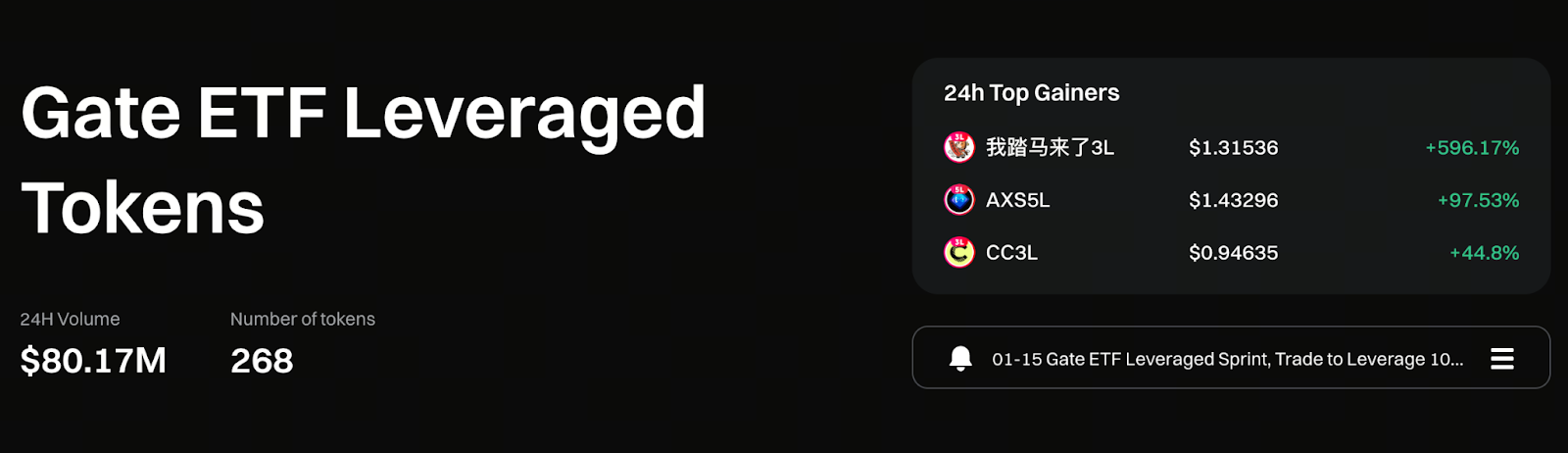
Gate leveraged ETF tokens are built on perpetual contracts to establish leveraged positions at the underlying level. All contract-related details are fully automated by the system.
For users, this means:
- No manual calculations for margin or maintenance ratios
- No pressure from real-time forced liquidation
- No need to manage funding rate changes
- No decisions required on when to adjust leverage ratios
Trading is simplified to buying and selling, with the leverage effect seamlessly integrated into the product structure.
Start trading Gate ETF leveraged tokens: https://www.gate.com/leveraged-etf
Rebalancing Mechanism for Controlled Leverage
Leveraged ETFs are not simple multipliers. To prevent actual risk exposure from drifting away from the target leverage as markets fluctuate, the system regularly rebalances the underlying contract positions. This process is invisible to users but is essential for stable product performance.
As a result, the actual returns of leveraged ETFs do not equal the underlying asset’s movement times the leverage multiple. Instead, performance is shaped by the market’s path and volatility structure. This makes leveraged ETFs better suited for tactical strategies rather than long-term passive holding.
Amplifying Market Moves Beyond Futures Trading
For many traders, the real challenge isn’t leverage itself—it’s the constant stress of forced liquidation and margin calls in futures trading. Leveraged ETFs do not eliminate market risk; instead, they convert risk into price fluctuations directly reflected in the token’s net asset value. With this design, short-term market reversals won’t trigger forced exits, allowing for smoother strategy execution and easier psychological management.
Maximizing Capital Efficiency in Trending Markets
When markets move decisively, leveraged ETFs can multiply price movements, delivering higher capital efficiency over the same period. Combined with the rebalancing mechanism, strong trends may produce a compounding effect.
For many traders, leveraged ETFs are often regarded as:
- A transitional tool before committing to full leverage strategies
- A practical module for stress-testing strategies
- A flexible choice between spot and futures
Structural Limitations You Must Understand
Leveraged ETFs are not all-purpose tools. In sideways or choppy markets, the rebalancing mechanism can gradually erode net asset value, causing results to diverge from intuitive expectations.
Other factors influencing performance include:
- Transaction costs during rebalancing
- Magnitude and frequency of market volatility
- The path of price movement
This is why leveraged ETFs are rarely considered long-term portfolio assets.
Management Fee: Role and Purpose
Gate leveraged ETFs charge a daily management fee of approximately 0.1% to support ongoing product operations, including:
- Opening and closing costs for perpetual contracts
- Funding rate expenses
- Position adjustments and hedging
- Trading losses during rebalancing
These fees are not additional surcharges—they are essential to ensure the long-term stability of leveraged ETFs.
When Do Leveraged ETFs Add Value?
Leveraged ETFs are designed as tools for executing strategies, not passive investments. They are most effective when:
- You have a clear view of market direction
- Your entry and exit plans are well-defined
- Your strategy can withstand short-term price swings
Only with a full understanding of their structure, costs, and limitations can leveraged ETFs truly improve capital efficiency.
Summary
Gate leveraged ETFs do not make trading easier—they make strategy execution more direct. They amplify market moves and the impact of every decision. For traders who actively manage risk and can keep pace with the market, leveraged ETFs serve as an effective bridge between spot trading and leveraged strategies. However, overlooking their structural features and cost implications can result in taking on more risk than anticipated.







