As the DeFi lending market continues to evolve, lending protocols have become foundational infrastructure for on-chain capital movement and return distribution. Users can earn interest by depositing assets or unlock liquidity by borrowing against collateral, thereby optimizing capital efficiency. This approach not only boosts asset utilization but also serves as the core mechanism for return generation across many DeFi protocols.
Within the Spark Protocol, SparkLend functions as the primary lending module. By offering a lending marketplace for stablecoins, SparkLend enables users to earn returns while maintaining liquidity and drives the internal capital cycle of the Sky ecosystem.
What Is SparkLend?
As the decentralized lending marketplace within the Spark Protocol, SparkLend allows users to deposit assets to earn returns, while others can borrow funds by providing collateral. Both sides are automatically matched via a liquidity pool, with borrowing interest serving as the return source for depositors.
This model eliminates the manual matching process required in traditional finance. Users simply deposit assets into the liquidity pool, and the protocol automatically calculates borrowing rates and matches borrowers and lenders based on market demand. With this mechanism, SparkLend delivers on-chain lending services without centralized intermediaries.
For the Sky ecosystem, SparkLend is critical because it creates return opportunities for stablecoins, enabling funds to circulate continuously and generate returns, thus enhancing overall capital efficiency.
How Does SparkLend’s Lending Mechanism Work?
SparkLend operates on a “deposit—borrow—interest distribution” cycle.
First, users deposit stablecoins or other supported assets into SparkLend’s liquidity pool, supplying liquidity for potential borrowers. In return, depositors earn interest. Borrowers can then obtain funds from the pool by offering collateral, and the interest they pay is distributed to liquidity providers.
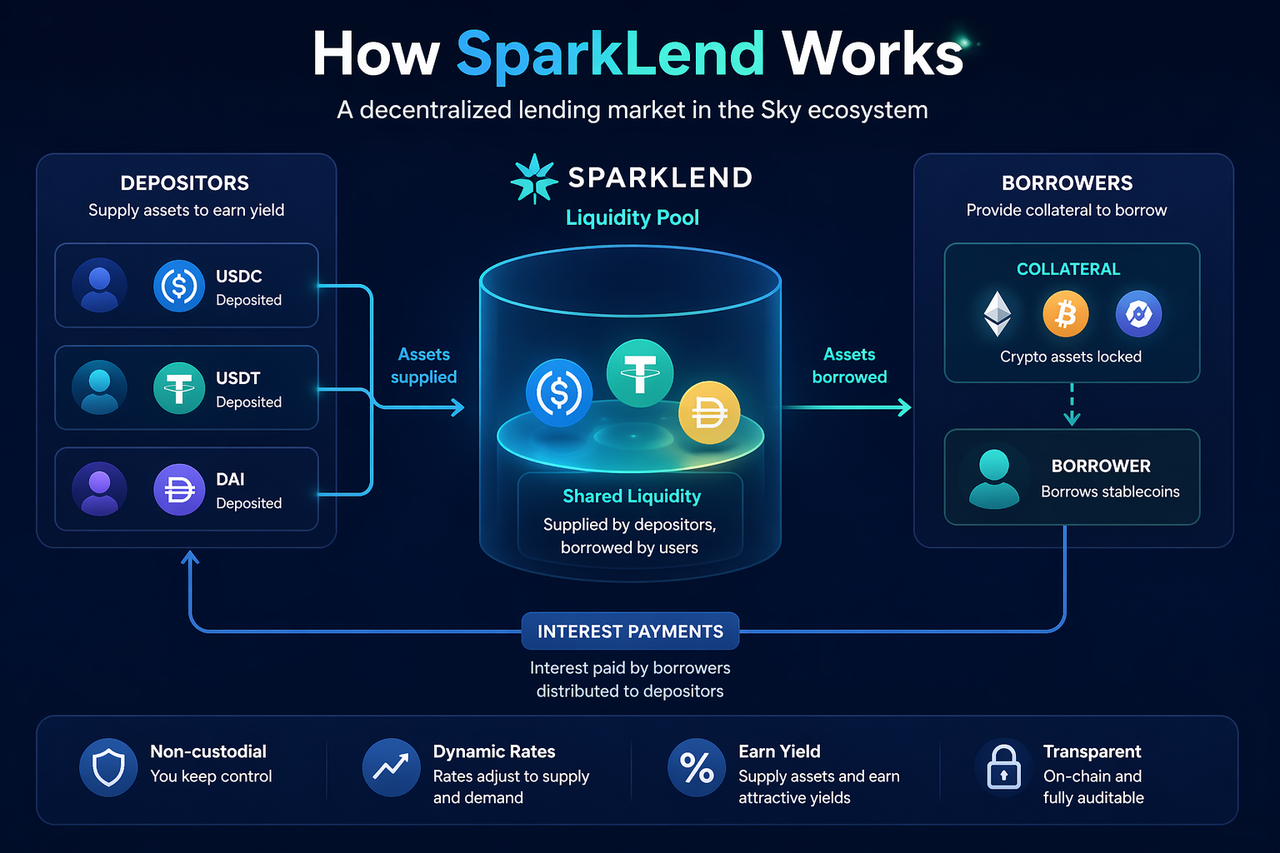
The process works as follows:
Users deposit assets into the pool; the protocol makes these assets available to borrowers; borrowers pay borrowing costs; and depositors earn returns from the interest. The protocol collects a portion of the fees as income.
This model’s advantage is that it allows idle assets to continuously generate returns while providing liquidity to users with borrowing needs, resulting in efficient capital allocation.
What Are SparkLend’s Sources of Return?
SparkLend’s primary source of return is the interest paid by borrowers. When borrowing demand rises, borrowing rates increase and so do deposit returns; when demand falls, yields decrease. This return mechanism is algorithmically adjusted to maintain supply-demand equilibrium.
Beyond borrowing interest, the protocol also earns from the interest rate spread—meaning the rate paid by borrowers exceeds the rate received by depositors, with the difference forming part of the protocol’s revenue. This structure provides returns for users and sustained income for the protocol itself.
For the Sky ecosystem, this means SparkLend not only expands user earning opportunities but also diversifies protocol revenue, supporting governance and long-term ecosystem growth.
How Does SparkLend Regulate Supply and Demand with Its Interest Rate Model?
SparkLend’s interest rates are not fixed—they’re dynamically adjusted based on market utilization rates. When most assets in the pool are borrowed, the protocol raises borrowing rates to incentivize more deposits and curb excessive borrowing. When there’s excess idle liquidity, borrowing rates decrease to stimulate demand.
This dynamic interest rate model automatically balances supply and demand, ensuring healthy protocol liquidity. It reduces idle capital and prevents liquidity crunches, resulting in a more stable lending marketplace.
For users, this means yields fluctuate with market demand rather than remaining fixed. This market-driven structure is a key feature of SparkLend’s return model.
Why Is SparkLend Important to the Sky Ecosystem?
SparkLend’s significance lies in its ability to generate returns for stablecoins within the Sky ecosystem. Previously, stablecoins primarily served payment and value storage roles, but through SparkLend, stablecoins can participate in lending markets and earn interest—maximizing capital utilization.
This earning scenario increases user willingness to hold stablecoins and encourages capital flow within the ecosystem. As more funds are deposited into SparkLend, the Sky ecosystem’s total value locked (TVL) rises, protocol revenue grows, and the sustainability of governance is strengthened.
Ultimately, SparkLend is the core infrastructure underpinning Spark’s return loop and a key driver of capital movement within the Sky ecosystem.
What Are the Potential Risks of SparkLend?
While SparkLend offers earning opportunities, lending protocols inherently carry risks. The primary risks include Smart Contract vulnerabilities that could impact asset security. Additionally, if collateral asset prices fluctuate sharply, borrowers may be subject to liquidation risk.
Yield levels also fluctuate with market demand and are not fixed or guaranteed. When borrowing demand falls, deposit returns may decrease. Users should fully understand these risks and allocate assets according to their own risk tolerance before using SparkLend.
Summary
SparkLend is the Spark Protocol’s core lending module, connecting depositors and borrowers to provide stablecoin returns and on-chain liquidity. It uses a dynamic interest rate model to balance supply and demand, enabling efficient capital flows and generating returns for depositors from borrowing interest.
For the Sky ecosystem, SparkLend not only boosts stablecoin capital efficiency but also establishes protocol revenue and a sustainable return loop—serving as essential infrastructure for ecosystem growth. As demand for stablecoin yields increases, SparkLend’s role in the Sky ecosystem is likely to expand further.
FAQs
Where do SparkLend’s returns come from?
SparkLend’s returns primarily come from interest paid by borrowers, with the protocol dynamically adjusting yield levels through its interest rate model.
Are SparkLend’s interest rates fixed?
No. SparkLend’s interest rates are dynamically adjusted based on market utilization to balance borrowing supply and demand.
Why is SparkLend important?
SparkLend creates earning opportunities for stablecoins in the Sky ecosystem, increases capital utilization, and provides a continuous revenue stream for the protocol.
What risks does SparkLend face?
SparkLend faces Smart Contract risk, liquidation risk, and yield volatility risk. Users should carefully assess these risks before participating.







