HB 1042 Approved by Both Chambers
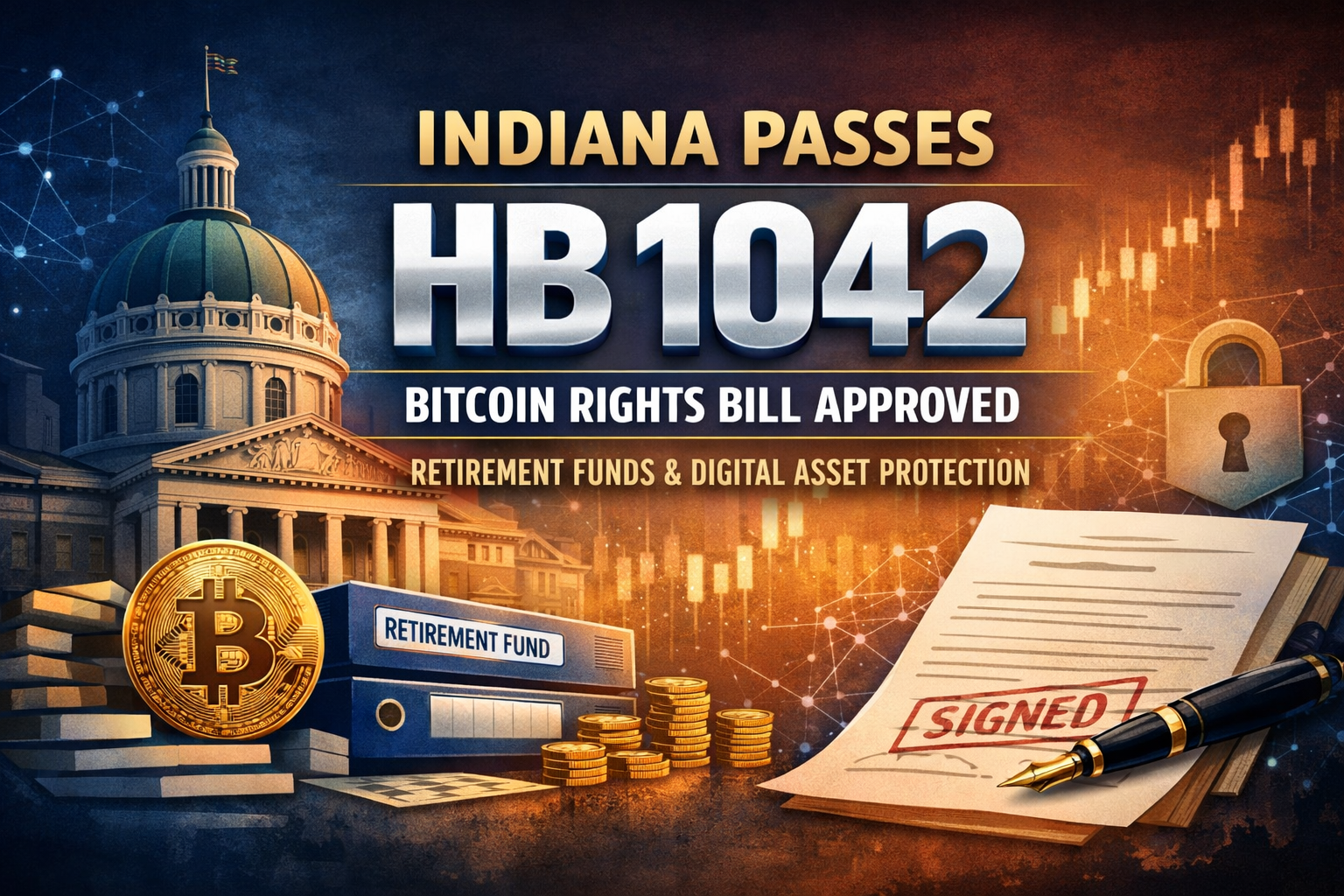
Public records show that the Indiana General Assembly has officially passed HB 1042. After the House accepted the Senate’s amendments, the bill completed the legislative process and now awaits Governor Mike Braun’s final signature. If signed into law, it will take effect on July 1, 2026.
At this stage, the bill has entered the final phase of administrative confirmation, and political risk is now significantly reduced.
Key Provisions Explained: Pension Allocation and Digital Asset Rights Protection
HB 1042 centers on two primary areas:
1. Public Pension Funds May Offer Crypto Asset Investment Options
The bill allows certain major public pension and savings plans to provide crypto asset investment options. This is not a mandate, but rather:
- Permits digital asset products within a compliant framework
- Enables potential indirect participation via funds, ETFs, or regulated vehicles
- Brings crypto assets into the scope of long-term asset allocation discussions
Pension systems are typically risk-averse and subject to strict approvals, so this provision carries strong symbolic weight.
2. Explicit Protection of Individual Digital Asset Access Rights
The bill also underscores the legal right of individuals to access digital assets, including:
- Lawful ownership
- Self-directed control
- Protection from unreasonable restrictions on use
In the US, provisions like these fall under “Bitcoin rights” legislation—focused on defining rights boundaries, not deregulation.
Why Now? Accelerating Divergence in State-Level Regulation
In recent years, the US federal government has remained divided on digital asset regulation. At the state level, however, two clear paths have emerged:
- Strict regulation and risk control
- Innovation-first with parallel rights protection
Indiana’s passage of HB 1042 aligns with the second approach. State legislation often serves as a model—once a state finalizes and successfully implements a framework, others may follow. This “horizontal diffusion” is a defining feature of US policy evolution.
Market Structure Impact: Marginal Institutional Recognition Shift
From a market perspective, state-level legislation rarely drives prices higher in the short term. Its structural significance, however, plays out on three fronts:
First, it strengthens perceptions of asset legitimacy. Including pensions in the conversation fundamentally boosts the institutional standing of this asset class.
Second, it opens a potential channel for long-term capital inflows. Even with minimal initial allocation, the symbolic impact outweighs the scale.
Third, it weakens the “high-risk speculation” label. When public systems are permitted to access digital assets, the risk narrative begins to shift.
These policies reinforce the long-term narrative rather than drive short-term price action.
Public Opinion and Controversy: Institutional Breakthrough or Political Gesture?
Supporters argue:
- This is a major step toward integrating digital assets into the traditional financial system
- The state is creating space for innovation
- Pension allocation options have expanded
Opponents raise concerns:
- Public funds may face excessive volatility risk
- Crypto asset valuation models remain contentious
- Potential for symbolic political gestures
It’s important to note: the bill only “provides options”—it does not mandate allocations or set specific investment ratios. Implementation will depend on future rulemaking.
Three Possible Paths After Implementation
Scenario 1: Symbolic Implementation
Pensions conduct only small-scale pilots, with limited market impact. Institutional significance outweighs capital scale.
Scenario 2: Gradual Expansion
If operations remain stable, allocation ratios may rise year by year, other states may follow, and a state-level diffusion effect may emerge.
Scenario 3: Increased Regulatory Friction
If the federal government introduces stricter rules, state policies may face coordination and adjustment pressures.
Summary
Indiana’s passage of HB 1042 is not an immediate catalyst for price movement, but it marks a trend: digital assets are moving from “regulatory conflict” to “institutional integration.”
As pension systems start to consider crypto allocations and state laws clarify individual digital asset rights, the industry narrative is undergoing a structural shift. The key question is not short-term volatility, but whether this state-level institutional diffusion will persist.







