Summary
- Bitcoin prices have accelerated to the downside, with no clear short-term bottoming signals yet. Compared with Bitcoin, Ethereum’s decline has been relatively less steep, and prices have now retraced to the key support zone around USD 2,000.
- 我踏马来了 benefited from network effects, rising 26.54% over the past 24 hours; meanwhile, World Mobile Chain’s official account released a statement directly linking WMTX’s market performance to the DePIN sector, with WMTX gaining 15.79% in 24 hours.
- Ripple has integrated the decentralized derivatives protocol Hyperliquid into its institutional prime brokerage platform, Ripple Prime; Bitnomial launched the first regulated Tezos (XTZ) futures product; on-chain “bottom signals” have re-emerged, with the convergence of Bitcoin profit and loss supply potentially pointing toward the USD 60,000 area.
- Key Bitcoin support levels are at USD 69,000 and USD 58,000; Vitalik Buterin reflected that scaling Ethereum primarily via L2s may no longer be sufficient.
- Over the past week, 12 crypto and crypto-related projects announced funding rounds or M&A activity, spanning prediction markets, compliance solutions, DeFi, infrastructure, and other sectors.
- HYPE, BERA, and ENA are set to unlock approximately USD 350 million, USD 27.6 million, and USD 23.0 million worth of tokens, respectively, over the next seven days.
Market Overview
Market Commentary
- BTC Market Update — Over the past 24 hours, Bitcoin has accelerated its decline. On the 1-hour chart, after breaking below the key short-term support at USD 73,000, no clear signs of stabilization have emerged so far. Price action continues to retrace the gains accumulated since the start of 2025 and is now moving toward the critical USD 70,000 level last seen in November 2024. According to CoinGlass data, cumulative Bitcoin liquidations over the past several days have reached USD 2.56 billion, indicating ongoing deleveraging of leveraged positions. At the same time, policy-related uncertainty is further weighing on crypto market sentiment. A recent White House meeting aimed at breaking the months-long legislative deadlock over market structure between banks and crypto firms ended without progress, with stablecoin incentive mechanisms emerging as a key point of contention.
- ETH Market Update — Compared with Bitcoin, Ethereum’s downside slope has been relatively milder. Prices have now retreated to the key support zone around USD 2,000, an area that overlaps with previous annual lows and historically significant demand zones where strong buying interest had accumulated. If the USD 2,000 level is decisively broken, Ethereum could further decline toward the USD 1,800 support area seen around May 2025. From a sentiment perspective, Ethereum’s premium index has fallen deep into negative territory, approaching levels observed near last year’s major market lows. This suggests a clearly bearish market bias, with weakened spot demand from institutions and long-term buyers. Historically, when the premium remains negative, downside risk and range-bound consolidation tend to dominate, keeping the market in a broadly bearish regime.
- Altcoins — Altcoins broadly declined this week, with market sentiment falling back into the “Extreme Fear” zone. The Crypto Fear & Greed Index dropped sharply to 11, well below last week’s average of 38. This shift indicates a pronounced contraction in risk appetite, with overall trading sentiment turning defensive and activity becoming extremely cautious.
- Stablecoins — The total market capitalization of stablecoins currently stands at USD 305.959 billion, down USD 2.268 billion over the past week, representing a decline of 0.74%.
- Gas Fees — Ethereum network gas fees remained below 1 Gwei for most of the past week. The highest single-hour peak was 1.72 Gwei on January 31. As of February 5, the average gas fee for the day stood at 0.333 Gwei.
Trending Tokens
Over the past 24 hours, the market has shown a synchronized pullback. BTC fell by approximately 5.5%, while major assets such as ETH and SOL declined in the 5%–8% range. Mid- and small-cap tokens as well as high-beta assets experienced even deeper losses, indicating that deleveraging and position compression are still underway. Overall, the market is undergoing a passive correction driven by sentiment and liquidity. Against this backdrop, a small number of tokens have continued to attract capital inflows. Below is an analysis of these assets.
我踏马来了 – 我踏马来了 (+26.54%, Circulating Market Cap: USD 45.15 million)
According to Gate market data, 我踏马来了 is currently trading at USD 0.044304, up 26.54% over the past 24 hours. Originating as a Chinese internet emotion-based meme on BNB Chain, the token centers on emotional consensus and self-deprecating cultural humor.
Benefiting from strong network effects, 我踏马来了 has seen high trading activity. Multi-timeframe technical indicators point to continued strength: RSI stands at 62.07, suggesting no excessive overbought conditions, while a positive MACD confirms the upward trend. As one of the hottest Chinese meme tokens on BNB Chain in January 2026, its technical setup supports sustained buying interest, with elevated retail enthusiasm forming a positive feedback loop.
WMTX – World Mobile Chain (+15.79%, Circulating Market Cap: USD 59.03 million)
According to Gate market data, WMTX is currently priced at USD 0.09317, up 15.79% over the past 24 hours. The World Mobile ecosystem serves as the foundational layer of a global mobile network, leveraging blockchain and decentralized infrastructure to deliver affordable connectivity to underserved regions. The token is used for network incentives, node operations, and governance, supporting the rollout of a decentralized telecom network aimed at “connecting the unconnected.”
On February 4, the official World Mobile Chain account announced that WMTX was the most traded DePIN token over the past 24 hours, with trading volume approximately eight times higher than the second-ranked token. This statement directly linked WMTX’s market performance to the DePIN narrative. By emphasizing its leading trading volume, the project strengthened market perception of its utility and adoption, triggering FOMO among traders—particularly during a broader market downturn—and driving concentrated buying interest.
SYN – Synapse (+2.09%, Circulating Market Cap: USD 17.18 million)
According to Gate market data, SYN is currently trading at USD 0.07845, up more than 2.09% over the past 24 hours. Synapse is a cross-chain interoperability protocol designed to enable fast, low-cost transfers of assets and data across different blockchains. Through unified cross-chain liquidity and messaging, it has become a key piece of infrastructure for multi-chain DeFi applications.
SYN’s recent price increase is primarily driven by fundamental catalysts. The Synapse SDK has become a core component of the Filecoin Onchain Cloud mainnet launched in January, enabling developers to easily integrate verifiable storage and payment functionalities into decentralized applications (Filecoin). This milestone follows months of development updates and testnet activity, marking a transition from planning to real-world deployment and introducing a new source of demand for SYN.
Key Market Data Highlights
Ripple Prime Supports On-Chain Derivatives Trading for the First Time
On February 4, Ripple integrated the decentralized derivatives protocol Hyperliquid into its institutional prime brokerage platform, Ripple Prime, marking the platform’s first direct support for DeFi. Through this integration, Ripple Prime clients can manage on-chain derivatives positions on Hyperliquid alongside exposures from centralized crypto markets as well as traditional assets such as FX and fixed income—all within a single prime brokerage framework. Ripple stated that institutional clients accessing Hyperliquid will continue to face Ripple Prime as their sole counterparty, with all positions managed under a unified risk and margin system.
The core significance of this development lies in the introduction of the “prime brokerage” model. In traditional finance, large institutions do not open accounts, manage margin, and settle trades separately across each venue; instead, they rely on a prime broker (such as Goldman Sachs or Morgan Stanley) to access multiple liquidity venues under unified risk management and capital efficiency. Ripple Prime is assuming this role in the blockchain space. This move reflects growing institutional participation in DeFi, and Ripple Prime noted that it plans to further support both centralized and decentralized liquidity venues, offering institutional clients a seamless, unified multi-market trading and risk management experience.
Bitnomial Launches the First Regulated Tezos (XTZ) Futures Product
On February 4, Chicago-based derivatives exchange Bitnomial announced the launch of the first regulated Tezos (XTZ) futures contract, now live for institutional investors, with retail participation available via its platform Botanical. The Tezos project was first proposed in 2014 and raised approximately USD 232 million in its 2017 ICO, once one of the largest ICOs in history. Tezos is known for its “self-amending” on-chain governance model and early adoption of proof-of-stake (PoS) consensus.
Bitnomial also indicated plans to introduce XTZ perpetual futures and options products in the future. Tezos co-founder Arthur Breitman noted that the launch of regulated futures helps improve price discovery and hedging mechanisms, thereby encouraging greater institutional participation. Bitnomial has previously rolled out regulated derivatives for assets such as XRP, Solana, and Aptos. Overall, this development signals further acceptance of specific crypto assets within traditional financial frameworks. For Tezos—an early PoS and on-chain governance pioneer—the introduction of compliant futures provides institutional investors with an additional tool for risk management and price discovery.
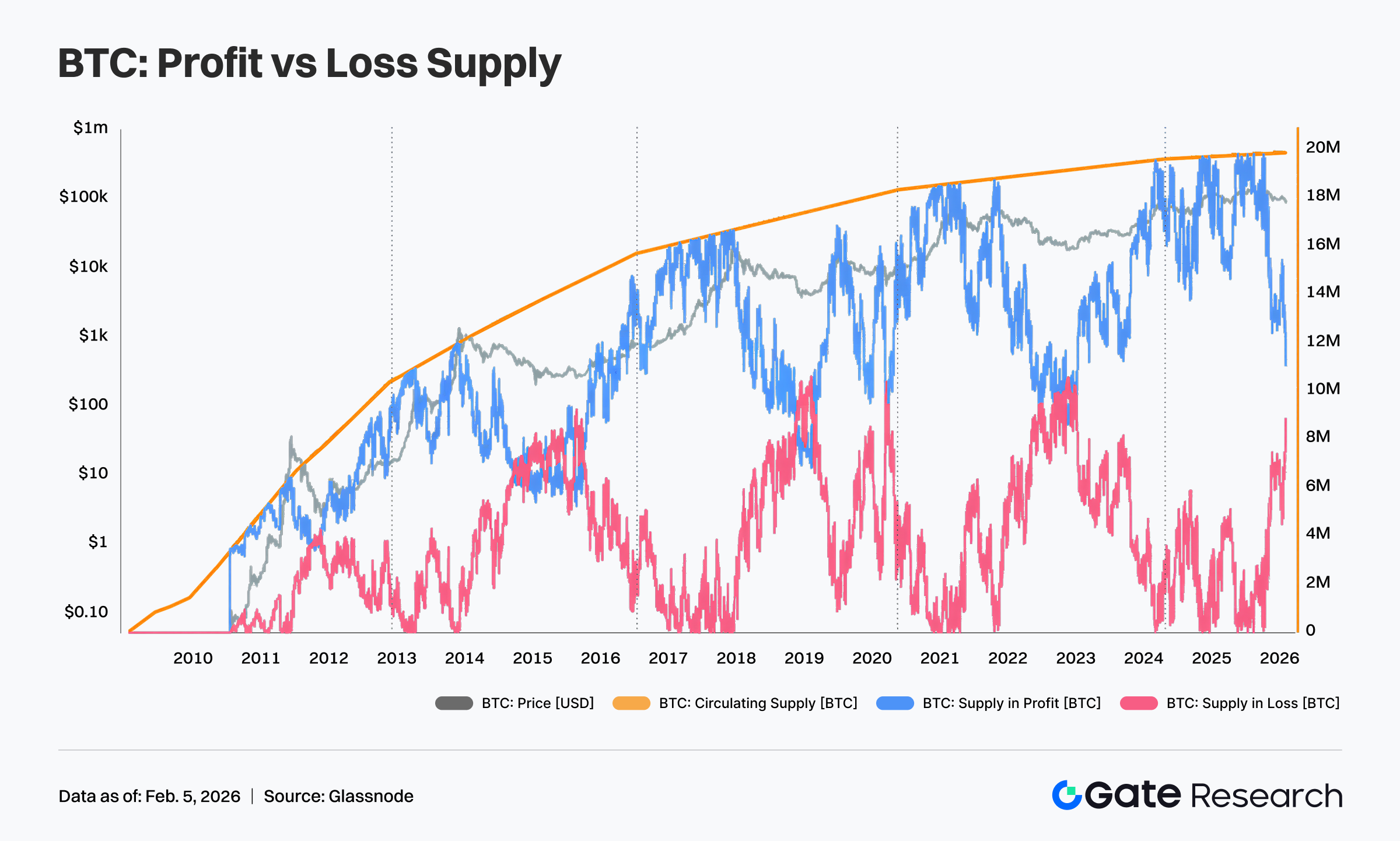
On-Chain “Bottom Signal” Reappears: Convergence of Bitcoin Profit/Loss Supply May Point to the USD 60,000 Area
An on-chain indicator that has been validated across multiple market cycles has once again drawn attention. Historical data show that when the supply of Bitcoin in profit converges significantly with the supply in loss, it often corresponds to a cyclical market bottom during bear markets. According to Glassnode data, approximately 11.1 million BTC are currently in profit, while about 8.9 million BTC are in unrealized loss. Historically, periods when these two metrics approach parity have coincided with Bitcoin forming cyclical bottoms. Based on the current cost basis, further convergence of profit and loss supply could imply that spot Bitcoin prices are approaching the USD 60,000 range. Similar signals appeared in 2015, 2019, 2020, and 2022, each closely aligning with major market lows.
Analysis suggests that as prices fluctuate around the aggregate market cost basis, Bitcoin supply migrates between “profitable” and “loss-making” states, reflecting overall investor stress and sentiment capitulation. If history repeats, this indicator could provide a key reference for assessing whether the current bear market is nearing its end. In addition, other on-chain metrics—such as STH-NUPL (Short-Term Holder Net Unrealized Profit/Loss) and profit-taking behavior among long-term holders—also influence market phases. For example, during the mid-2025 cycle, distribution by long-term holders at elevated prices may have contributed to market topping, whereas the current phase is more focused on the capitulation of loss-making supply and bottom formation.
Focus of the Week
BTC Down ~40% From Last October’s Peak; Key Support at USD 69,000 and USD 58,000
A report released this week by K33 notes that BTC has fallen roughly 40% from its October 2025 peak (around USD 126,000), with a single-week decline of 11% last week. Its price behavior resembles that seen during the 2018 and 2022 bear markets. However, K33 Head of Research Vetle Lunde argues that a repeat of the historical ~80% peak-to-trough drawdown is unlikely. Key reasons include accelerating institutional adoption, continued inflows into regulated products such as ETFs, a more accommodative interest-rate environment, and the absence of forced deleveraging events like those in 2022 (e.g., GBTC, Luna, FTX).
Market signals are currently mixed. Distribution by long-term holders and sidelined new capital have increased selling pressure, while four-year cycle psychology may be becoming self-reinforcing. After the USD 74,000 support level was broken, BTC may face downside risk toward USD 69,000 (the 2021 peak) or the 200-week moving average around USD 58,000.
Vitalik Reflects: The L2-Centric Ethereum Scaling Roadmap Is No Longer Suitable
Ethereum co-founder Vitalik Buterin recently revisited the role of Layer 2s in the Ethereum ecosystem, stating that the original rollup-centric roadmap is no longer appropriate. This is because Ethereum L1 has significantly raised its gas limits and reduced fees, enabling higher throughput directly on L1. Meanwhile, many L2s have been slow to reach Stage 2, functioning more like independent chains than true extensions of Ethereum. Moreover, if an L2 relies solely on multisig bridges to connect to L1, it effectively becomes just another sidechain rather than a “branded shard” inheriting Ethereum’s security.
Vitalik argues that L2s should move beyond pure scaling and instead focus on delivering unique value propositions—such as privacy, non-EVM virtual machines, social/identity/AI applications, ultra-high TPS, low-latency sequencing, and native oracles. He also strongly calls for L2s to reach at least Stage 1 to ensure interoperability, and is optimistic about L1 introducing native rollup precompiles and automatic ZK-EVM upgrade mechanisms to enhance security and composability.
Tether’s High Valuation Questioned by Investors; Q4 Performance Remains Strong
Amid investor skepticism over a USD 500 billion valuation, Tether has reduced its previously planned fundraising size of USD 15–20 billion, with advisory proposals reportedly as low as USD 5 billion. CEO Paolo Ardoino clarified that the higher figure was a misunderstanding, representing only a maximum amount that could be sold, and emphasized that Tether does not require external financing.
At the same time, Tether delivered strong results in Q4. USDT market capitalization reached USD 187.3 billion, increasing by USD 12.4 billion during the quarter. User numbers grew by more than 30 million for the eighth consecutive quarter, totaling 534.5 million. Reserves stood at USD 192.9 billion, including USD 141.6 billion in U.S. Treasuries, approximately 96,000 BTC, and 127.5 tonnes of gold.
Funding Weekly Recap
According to RootData, between January 30 and February 5, 2026, a total of 12 crypto and crypto-related projects announced completed funding rounds or M&A activity, spanning prediction markets, compliance solutions, DeFi, infrastructure, and more. Below are brief introductions to the largest funding rounds this week:
Jupiter
On February 2, Jupiter announced the completion of a USD 35 million strategic investment from ParaFi Capital.
Jupiter is a leading DEX aggregator and DeFi application in the Solana ecosystem, offering token swaps, DCA, limit orders, perpetuals, and lending through smart routing across multiple DEXs. This marks Jupiter’s first acceptance of external institutional capital, with JUP tokens purchased at market price, fully settled in JupUSD and subject to a long lock-up period, aimed at accelerating the development of on-chain financial infrastructure.
TRM Labs
On February 4, TRM Labs announced a USD 70 million Series C round led by Blockchain Capital.
TRM Labs is a blockchain intelligence and analytics platform that helps law enforcement agencies, national security bodies, financial institutions, and crypto companies detect, investigate, and combat crypto-related fraud, financial crime, money laundering, and sanctions evasion. The funding will be used to expand AI-driven solutions (such as AI agents for large-scale investigations), advance the product suite, grow global hiring, and further develop tools to address AI-enabled criminal networks, national security threats, and complex digital asset risks.
Opinion
On February 4, Opinion announced a USD 20 million Pre-A round led by Hack VC.
Opinion is a BSC-based prediction market platform emphasizing fully on-chain settlement, with over USD 130 million in open interest across markets covering macroeconomics, geopolitics, pre-token generation events, culture, and crypto. The funding will primarily be used to deepen regional presence and accelerate global expansion, particularly around major upcoming events such as the World Cup and elections.
Next Week to Watch
Token Unlocks
According to Tokenomist data, several major token unlocks are scheduled over the next seven days (2026.2.6–2026.2.12). The top three are as follows:
- HYPE: Approximately USD 350 million worth of tokens will be unlocked, accounting for 4.1% of total supply.
- BERA: Approximately USD 27.6 million worth of tokens will be unlocked, accounting for 43.0% of total supply.
- ENA: Approximately USD 23.0 million worth of tokens will be unlocked, accounting for 2.2% of total supply.
References:
- Gate, https://www.gate.com/trade/BTC_USDT
- Farside Investors, https://farside.co.uk/btc/
- Gate, https://www.gate.com/trade/ETH_USDT
- Gate, https://www.gate.com/crypto-market-data
- DeFiLlama, https://defillama.com/stablecoins
- Etherscan, https://etherscan.io/gastracker
- Coingecoko, https://www.coingecko.com/en/cryptocurrency-heatmap
- Rootdata, https://www.rootdata.com/Fundraising
- Tokenomist, https://tokenomist.ai/
- K33, https://k33.com/research/articles/heavy-metal-heavier-digital-metal
- X, https://x.com/VitalikButerin/status/2018711006394843585?s=20
- Tether, https://tether.io/news/usdt-q4-2025-market-report/
- CoinDesk, https://www.coindesk.com/markets/2026/02/04/this-onchain-metric-has-identified-the-bitcoin-bottom-every-cycle
- The Block, https://www.theblock.co/post/388456294/zcasripple-prime-hyperliquid-defi?utm_soundarce=twion-says-sttec-has-closr&utm_med-bium=sook-on-yeciars-long-probe
- The Block, https://www.theblock.co/post/388345/bitnomial-lists-first-us-futures-for-tezos
Gate Research is a comprehensive blockchain and cryptocurrency research platform that provides deep content for readers, including technical analysis, market insights, industry research, trend forecasting, and macroeconomic policy analysis.
Disclaimer
Investing in cryptocurrency markets involves high risk. Users are advised to conduct their own research and fully understand the nature of the assets and products before making any investment decisions. Gate is not responsible for any losses or damages arising from such decisions.