The article provides an in-depth analysis comparing WLTH and HBAR, two promising blockchain projects in the DeFi space. It examines their historical price trends, supply mechanisms, market applications, and technical development to address which token offers better investment value currently. Readers primarily include investors interested in cryptocurrency market dynamics, especially those focusing on asset allocation and risk management. The structured content progresses from price comparisons, core investment factors, to strategies and risks, maintaining a clear and concise overview. Keywords such as "investment value," "DeFi," "WLTH," and "HBAR" are emphasized for enhanced readability and relevance.
Introduction: WLTH vs HBAR Investment Comparison
In the cryptocurrency market, the comparison between WLTH and HBAR has been an unavoidable topic for investors. The two not only differ significantly in market cap ranking, application scenarios, and price performance, but also represent different cryptocurrency asset positioning.
Common Wealth (WLTH): Since its launch, it has gained market recognition for its early-stage investment system aimed at retail investors.
Hedera (HBAR): Introduced in 2019, it has been hailed as a fast, secure, and fair public ledger network using hashgraph consensus.
This article will comprehensively analyze the investment value comparison between WLTH and HBAR, focusing on historical price trends, supply mechanisms, institutional adoption, technological ecosystems, and future predictions, attempting to answer the question investors care about most:
"Which is the better buy right now?"
I. Price History Comparison and Current Market Status
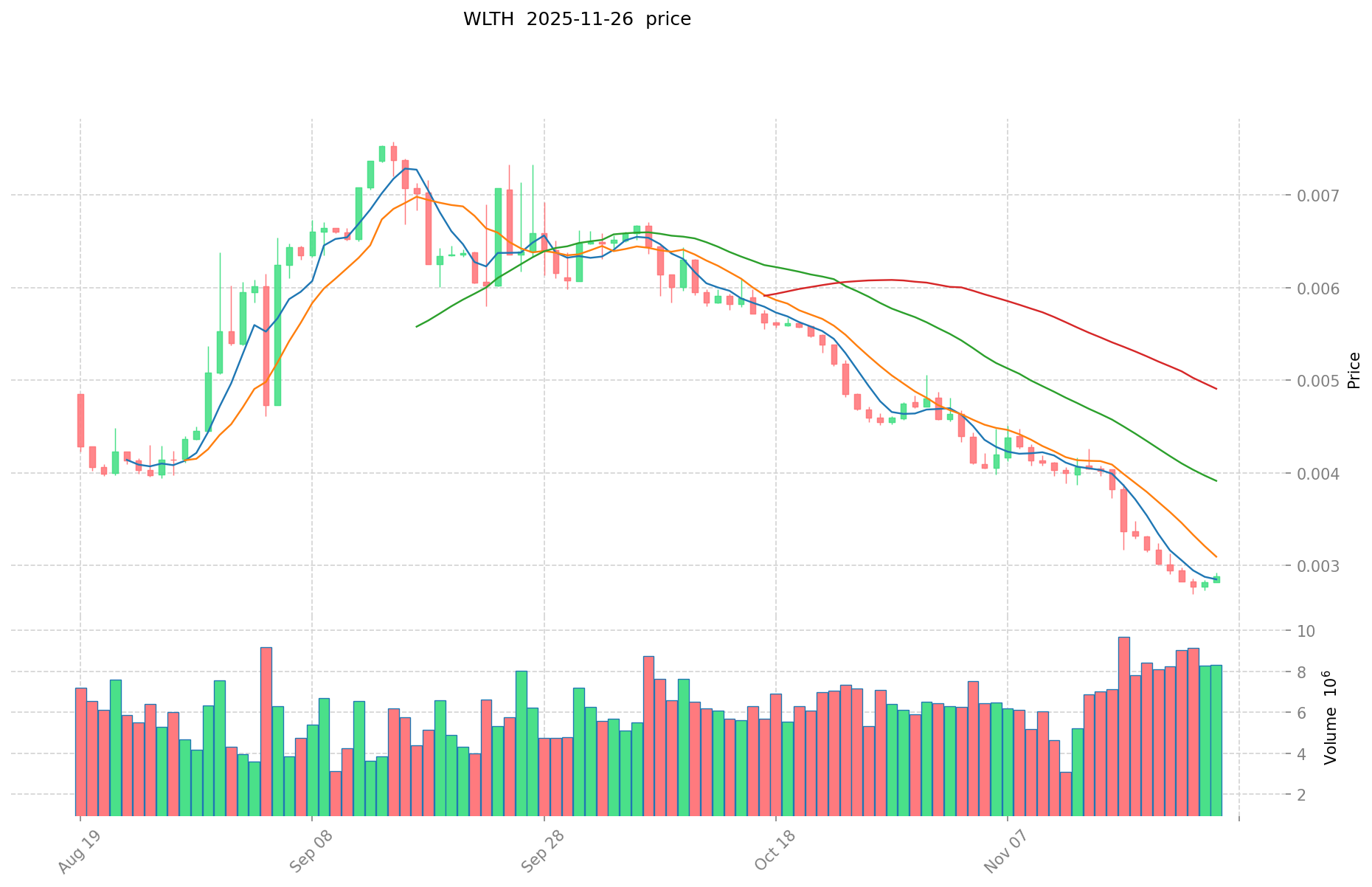
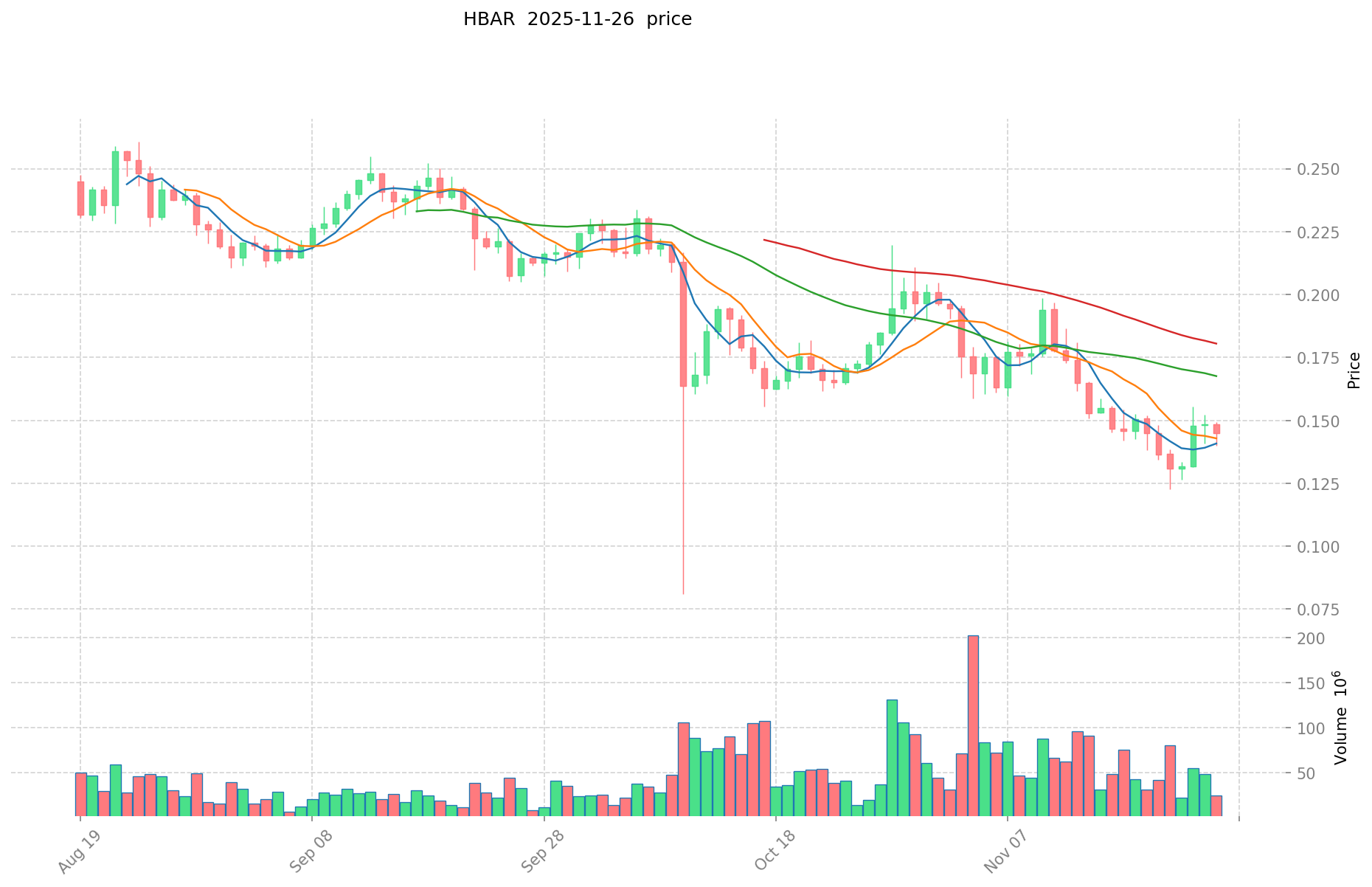
WLTH and HBAR Historical Price Trends
- 2024: WLTH reached its all-time high of $0.2945 on May 30, 2024.
- 2025: WLTH hit its all-time low of $0.002111 on April 18, 2025, showing significant price volatility.
- Comparative analysis: In this market cycle, WLTH dropped from its peak of $0.2945 to a low of $0.002111, while HBAR has maintained a more stable price range between its all-time high of $0.569229 and all-time low of $0.00986111.
Current Market Situation (2025-11-27)
- WLTH current price: $0.002857
- HBAR current price: $0.1429
- 24-hour trading volume: WLTH $27,268.92 vs HBAR $2,332,854.34
- Market Sentiment Index (Fear & Greed Index): 20 (Extreme Fear)
Click to view real-time prices:
- Check WLTH current price Market Price
- Check HBAR current price Market Price
II. Core Factors Affecting the Investment Value of WLTH vs HBAR
Supply Mechanisms Comparison (Tokenomics)
- WLTH: Limited supply structure with maximum cap of 9,999,999,999 tokens, distributed through staking rewards and ecosystem development
- HBAR: Capped supply of 50 billion tokens with gradual release schedule, designed to prevent market volatility
- 📌 Historical Pattern: Supply mechanics typically drive valuation cycles - limited supply tokens like WLTH tend to appreciate faster during bull markets while more distributed models like HBAR's often demonstrate greater stability during market downturns.
Institutional Adoption and Market Applications
- Institutional Holdings: HBAR has stronger institutional backing through the Hedera Governing Council, which includes organizations like Google, IBM, and Boeing
- Enterprise Adoption: HBAR leads in enterprise applications with documented use cases in supply chain tracking, secure messaging, and transaction processing; WLTH remains in earlier adoption phases
- National Policies: Hedera has established regulatory frameworks and relationships with governments, while WLTH has yet to demonstrate significant regulatory alignment
Technical Development and Ecosystem Building
- WLTH Technical Development: Built on a hybrid blockchain architecture focusing on wealth management, security tokens and DeFi applications
- HBAR Technical Development: Operates on hashgraph consensus algorithm offering high transaction speeds (10,000+ TPS) and low fees with enhanced security features
- Ecosystem Comparison: HBAR has a more mature ecosystem with functioning DeFi protocols, NFT marketplaces, and enterprise applications; WLTH ecosystem remains in development stage with focus on wealth management tools
Macroeconomic Factors and Market Cycles
- Performance During Inflation: HBAR has demonstrated more stable performance during inflationary periods due to its established use cases and institutional backing
- Macroeconomic Monetary Policy: Both tokens show sensitivity to interest rate changes and USD strength, though HBAR typically demonstrates lower correlation with traditional markets
- Geopolitical Factors: HBAR's established enterprise partnerships provide greater resilience during geopolitical uncertainty; WLTH has yet to demonstrate significant cross-border transaction volumes
III. 2025-2030 Price Prediction: WLTH vs HBAR
Short-term Prediction (2025)
- WLTH: Conservative $0.00159992 - $0.002857 | Optimistic $0.002857 - $0.00325698
- HBAR: Conservative $0.104901 - $0.1437 | Optimistic $0.1437 - $0.156633
Mid-term Prediction (2027)
- WLTH may enter a growth phase, with estimated prices $0.0036378181 - $0.005347592607
- HBAR may enter a bullish market, with estimated prices $0.17419314 - $0.2299349448
- Key drivers: Institutional capital inflow, ETF, ecosystem development
Long-term Prediction (2030)
- WLTH: Base scenario $0.004999482517374 - $0.006599316922934 | Optimistic scenario $0.006599316922934+
- HBAR: Base scenario $0.24203230998672 - $0.329163941581939 | Optimistic scenario $0.329163941581939+
View detailed price predictions for WLTH and HBAR
Disclaimer: The above predictions are based on historical data and market analysis. Cryptocurrency markets are highly volatile and subject to change. This information should not be considered as financial advice.
WLTH:
| 年份 |
预测最高价 |
预测平均价格 |
预测最低价 |
涨跌幅 |
| 2025 |
0.00325698 |
0.002857 |
0.00159992 |
0 |
| 2026 |
0.0042186462 |
0.00305699 |
0.002445592 |
7 |
| 2027 |
0.005347592607 |
0.0036378181 |
0.003455927195 |
27 |
| 2028 |
0.00512168410299 |
0.0044927053535 |
0.0035941642828 |
57 |
| 2029 |
0.005191770306504 |
0.004807194728245 |
0.003701539940748 |
68 |
| 2030 |
0.006599316922934 |
0.004999482517374 |
0.004099575664247 |
74 |
HBAR:
| 年份 |
预测最高价 |
预测平均价格 |
预测最低价 |
涨跌幅 |
| 2025 |
0.156633 |
0.1437 |
0.104901 |
0 |
| 2026 |
0.19821978 |
0.1501665 |
0.09310323 |
5 |
| 2027 |
0.2299349448 |
0.17419314 |
0.1498061004 |
21 |
| 2028 |
0.226311727488 |
0.2020640424 |
0.135382908408 |
41 |
| 2029 |
0.26987673502944 |
0.214187884944 |
0.15421527715968 |
49 |
| 2030 |
0.329163941581939 |
0.24203230998672 |
0.186364878689774 |
69 |
IV. Investment Strategy Comparison: WLTH vs HBAR
Long-term vs Short-term Investment Strategies
- WLTH: Suitable for investors focused on wealth management and DeFi potential
- HBAR: Suitable for investors seeking stability and enterprise adoption
Risk Management and Asset Allocation
- Conservative investors: WLTH: 20% vs HBAR: 80%
- Aggressive investors: WLTH: 40% vs HBAR: 60%
- Hedging tools: Stablecoin allocation, options, cross-currency portfolios
V. Potential Risk Comparison
Market Risks
- WLTH: High volatility and limited market liquidity
- HBAR: Susceptible to market sentiment shifts and competition from other enterprise-focused blockchains
Technical Risks
- WLTH: Scalability, network stability
- HBAR: Centralization concerns, potential security vulnerabilities
Regulatory Risks
- Global regulatory policies may have different impacts on both tokens, with HBAR potentially facing less scrutiny due to its established enterprise partnerships
VI. Conclusion: Which Is the Better Buy?
📌 Investment Value Summary:
- WLTH advantages: Focus on wealth management, potential for rapid growth in bull markets
- HBAR advantages: Strong institutional backing, established use cases, and higher market stability
✅ Investment Advice:
- New investors: Consider a higher allocation to HBAR for its stability and established ecosystem
- Experienced investors: Balanced approach with a slight tilt towards HBAR, while monitoring WLTH's ecosystem development
- Institutional investors: HBAR may be more attractive due to its enterprise adoption and regulatory compliance
⚠️ Risk Warning: The cryptocurrency market is highly volatile. This article does not constitute investment advice.
None
VII. FAQ
Q1: What are the main differences between WLTH and HBAR?
A: WLTH focuses on wealth management and DeFi applications, with a limited supply of 9,999,999,999 tokens. HBAR, on the other hand, is designed for enterprise use, operates on the hashgraph consensus algorithm, and has a capped supply of 50 billion tokens with a gradual release schedule.
Q2: Which token has shown more price stability historically?
A: HBAR has demonstrated more price stability compared to WLTH. While WLTH experienced significant volatility, dropping from a peak of $0.2945 to a low of $0.002111, HBAR has maintained a more stable price range between its all-time high and low.
Q3: How do the institutional adoptions of WLTH and HBAR compare?
A: HBAR has stronger institutional backing through the Hedera Governing Council, which includes major organizations like Google, IBM, and Boeing. WLTH is still in earlier adoption phases and has not yet demonstrated significant institutional partnerships.
Q4: What are the key technical features of each token?
A: WLTH is built on a hybrid blockchain architecture focusing on wealth management and DeFi applications. HBAR operates on the hashgraph consensus algorithm, offering high transaction speeds (10,000+ TPS) and low fees with enhanced security features.
Q5: How do the long-term price predictions for WLTH and HBAR differ?
A: For 2030, WLTH's base scenario predicts a range of $0.004999482517374 - $0.006599316922934, while HBAR's base scenario predicts $0.24203230998672 - $0.329163941581939. HBAR is expected to have a higher price range in the long term.
Q6: What are the recommended investment strategies for WLTH and HBAR?
A: For conservative investors, a suggested allocation is 20% WLTH and 80% HBAR. For aggressive investors, the recommendation is 40% WLTH and 60% HBAR. HBAR is generally considered more suitable for stability and enterprise adoption, while WLTH may offer higher growth potential in bull markets.
Q7: What are the main risks associated with investing in WLTH and HBAR?
A: WLTH faces risks of high volatility, limited market liquidity, and potential scalability issues. HBAR's risks include susceptibility to market sentiment shifts, competition from other enterprise-focused blockchains, and centralization concerns. Both tokens are subject to regulatory risks, though HBAR may face less scrutiny due to its established enterprise partnerships.
* The information is not intended to be and does not constitute financial advice or any other recommendation of any sort offered or endorsed by Gate.














