Arbitrum is a leading Layer 2 scaling solution for Ethereum launched by Offchain Labs in 2021, utilizing Optimistic Rollup technology to address Ethereum's high transaction costs and network congestion. This comprehensive guide explores Arbitrum's technical architecture, market performance, and ecosystem applications. ARB token holders can participate in governance through the Arbitrum DAO while enjoying reduced gas fees and faster transactions. The guide covers core use cases in DeFi, NFTs, and gaming, current market metrics with 17,428 token holders, and how to acquire and store ARB tokens on Gate.com. Whether you're new to blockchain or experienced, this article provides essential insights into Arbitrum's role in Ethereum scaling and opportunities for community participation and ecosystem engagement.
Arbitrum's Positioning and Significance
In 2021, Offchain Labs launched Arbitrum (ARB), aiming to address Ethereum's scalability challenges, including high transaction costs and network congestion.
As a leading Layer 2 scaling solution utilizing Optimistic Rollup technology, Arbitrum plays a critical role in decentralized finance (DeFi), NFT markets, and Web3 application development.
As of 2026, Arbitrum has established itself as a prominent Layer 2 ecosystem with substantial transaction volume and developer activity, featuring over 17,000 token holders and an active development community.
This article will provide an in-depth analysis of its technical architecture, market performance, and future potential.
Origin and Development History
Birth Background
Arbitrum was created by Offchain Labs in 2021, designed to solve Ethereum's scalability limitations, particularly high gas fees and slow transaction speeds that hindered mainstream adoption.
It emerged during the rapid expansion of DeFi and NFT ecosystems, with the objective of providing developers and users with a faster, more cost-effective alternative while maintaining Ethereum's security guarantees.
Arbitrum's launch brought Ethereum application developers and end users unprecedented possibilities for efficient blockchain interaction.
Major Milestones
- 2021: Mainnet launch (Arbitrum One), achieving significantly reduced transaction costs and increased throughput compared to Ethereum Layer 1.
- 2023: Token launch, with ARB distributed to early users and contributors, establishing decentralized governance mechanisms.
- 2023: Ecosystem expansion, with DeFi protocols and dApps numbers experiencing substantial growth.
- 2024: Price reached notable levels during market activity periods, reflecting growing ecosystem adoption and utility.
With support from Offchain Labs and the Arbitrum Foundation, Arbitrum continues to enhance its technology, security infrastructure, and real-world applications.
How Arbitrum Works?
No Central Control
Arbitrum operates on a decentralized network of computers (nodes) distributed globally, eliminating dependence on banks or government entities.
These nodes collaborate to verify transactions, ensuring system transparency and attack resistance, granting users greater autonomy and enhancing network resilience.
Blockchain Foundation
Arbitrum's architecture leverages Ethereum's blockchain as a secure, immutable digital ledger that records all transactions.
Transactions are grouped into batches and processed off-chain, with periodic commitments posted to Ethereum mainnet through cryptographic proofs.
Anyone can verify transaction records, establishing trust without intermediaries.
Optimistic Rollup technology allows Arbitrum to bundle multiple transactions together, posting only compressed data to Ethereum, which significantly reduces costs while inheriting Ethereum's security.
Ensuring Fairness
Arbitrum utilizes Optimistic Rollup consensus with fraud-proof mechanisms to validate transactions and prevent fraudulent activities like double-spending.
Validators maintain network security by monitoring transaction batches and submitting fraud proofs if invalid transactions are detected, with economic incentives ensuring honest behavior.
Its innovative approach includes a challenge period during which suspicious transactions can be disputed, combined with efficient batch processing that enhances throughput.
Secure Transactions
Arbitrum employs public-private key cryptography to protect transactions:
- Private keys (similar to secret passwords) are used to sign transactions
- Public keys (similar to account numbers) are used to verify ownership
This mechanism ensures fund security while transactions maintain pseudonymous characteristics inherited from Ethereum.
As a Layer 2 solution, Arbitrum benefits from Ethereum's robust security model while providing enhanced scalability for user operations.
Circulation Overview
As of January 14, 2026, Arbitrum's circulating supply stands at 5,719,286,371 ARB tokens, with a total supply of 10,000,000,000 ARB and a maximum supply capped at 10,000,000,000 ARB, establishing a fixed supply model.
The circulating supply represents approximately 57.19% of the total supply, with tokens entering the market through structured distribution mechanisms that influence supply-demand dynamics.
Price Volatility
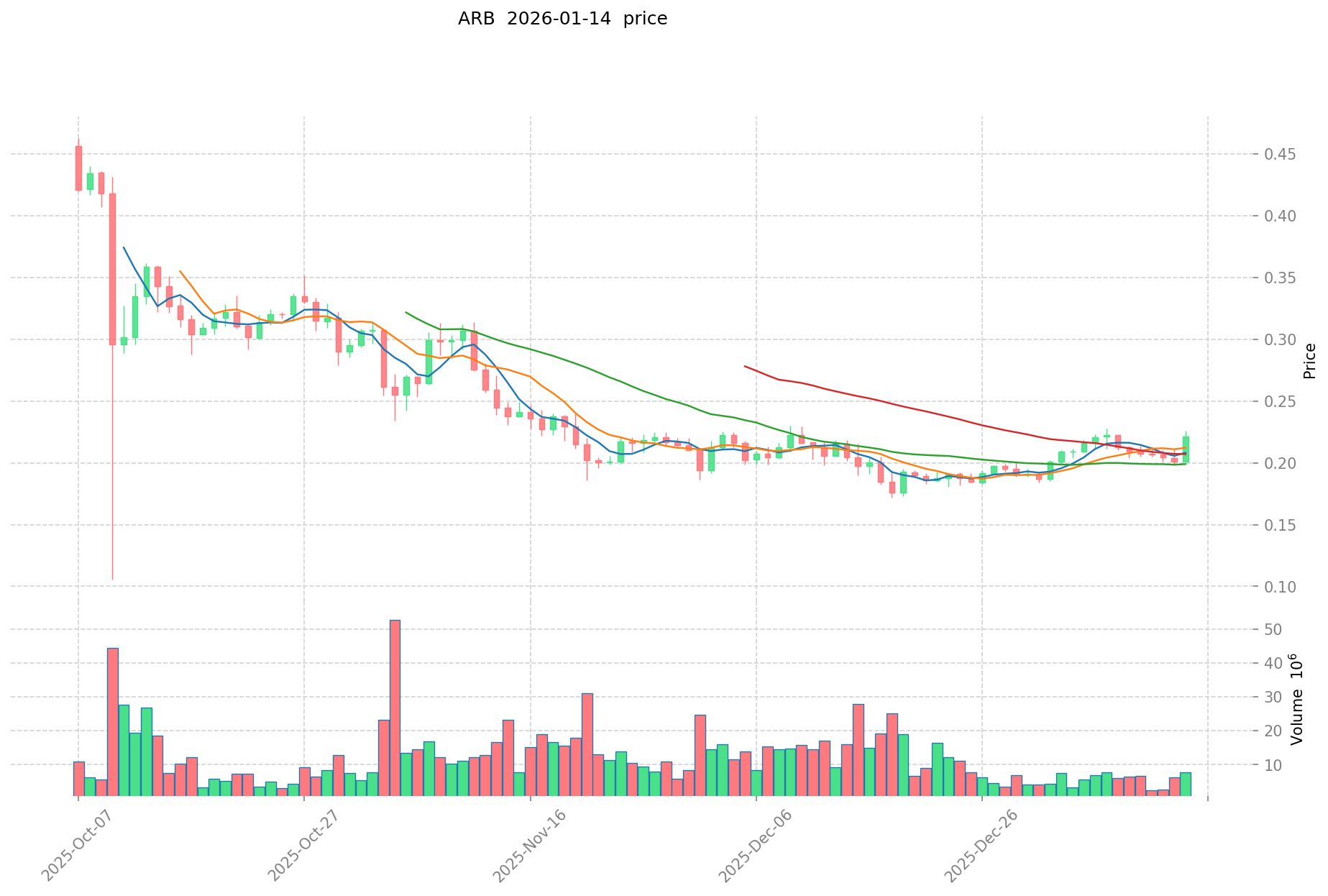
Arbitrum reached a notable price point of $2.39 on January 12, 2024, driven by positive market momentum and increased adoption within the Ethereum scaling ecosystem.
Its lowest recorded price was $0.172637, occurring on December 19, 2025, amid broader market volatility and shifting sentiment in the cryptocurrency sector.
These fluctuations reflect evolving market conditions, adoption trends, and external macroeconomic factors impacting the digital asset space.
Click to view current ARB market price
On-Chain Metrics
- Holder Addresses: 17,428 addresses hold ARB tokens, indicating user participation across the network
- 24-Hour Trading Volume: $1,698,929.41 in trading activity, demonstrating market liquidity
- Market Capitalization: $1,267,393,859.81, representing its position within the cryptocurrency market
Arbitrum Ecosystem Applications and Strategic Partnerships
Core Use Cases
Arbitrum's ecosystem supports a diverse range of applications:
- DeFi: Projects like Uniswap and GMX provide decentralized trading and perpetual contracts, leveraging Arbitrum's low-cost and high-speed transaction capabilities.
- NFT Marketplaces: Platforms built on Arbitrum enable efficient minting and trading of digital collectibles with reduced gas fees.
- Gaming: Blockchain-based games utilize Arbitrum's infrastructure to deliver seamless gaming experiences with faster transaction finality.
Strategic Partnerships
Arbitrum has established collaborations with various technology providers and blockchain projects to enhance its technical capabilities and market reach.
These partnerships contribute to the expansion of Arbitrum's ecosystem and support its ongoing development.
Challenges and Controversies
Arbitrum faces several challenges:
- Technical Considerations: As the ecosystem grows, maintaining optimal network performance and managing increased transaction volumes remain ongoing priorities.
- Regulatory Environment: The evolving regulatory landscape for Layer 2 solutions and blockchain technology requires continuous adaptation.
- Competitive Landscape: The presence of other Layer 2 scaling solutions creates a dynamic and competitive environment.
These factors drive ongoing innovation and community engagement within the Arbitrum ecosystem.
Arbitrum's community demonstrates active participation, with its ecosystem supporting numerous decentralized applications and protocols.
On X platform, discussions related to Arbitrum and the hashtag #Arbitrum generate regular engagement from developers, users, and blockchain enthusiasts.
Major protocol deployments and ecosystem milestones contribute to community discussions.
X platform conversations about Arbitrum reflect diverse perspectives:
- Supporters highlight Arbitrum's scalability improvements, lower transaction costs, and Ethereum security inheritance, viewing it as an important component of Ethereum's scaling roadmap.
- Observers discuss topics such as network adoption metrics, TVL fluctuations, and competitive positioning among Layer 2 solutions.
Market sentiment varies with overall crypto market conditions and ecosystem developments.
Discussion Topics
X users actively discuss Arbitrum's adoption trends, DeFi protocol integrations, and technological developments,
reflecting both its growth potential and the evolving challenges in the Layer 2 ecosystem.
Additional Resources for Arbitrum
- Official Website: Visit Arbitrum Official Website for information about features, use cases, and latest developments.
- Documentation: Technical documentation provides detailed information about Arbitrum's architecture and implementation.
- X Platform: Arbitrum maintains an active presence on X using @arbitrum, sharing updates on technology upgrades, ecosystem developments, and partnership announcements, generating engagement from the community.
Arbitrum Future Roadmap
- Ongoing Development: Continued focus on network optimization and ecosystem expansion, enhancing transaction throughput and user experience
- Ecosystem Goals: Supporting diverse applications across DeFi, gaming, and NFT sectors
- Long-term Vision: Establishing Arbitrum as a key scaling solution within the Ethereum ecosystem
How to Participate in Arbitrum?
- Acquisition: ARB tokens are available on Gate.com and other cryptocurrency platforms
- Storage Solutions: Users can store ARB tokens using Ethereum-compatible wallets such as MetaMask or hardware wallets
- Governance Participation: Token holders can participate in governance decisions through the Arbitrum DAO voting mechanisms
- Ecosystem Building: Developers can access documentation and resources to build applications on Arbitrum
Summary
Arbitrum represents a significant Layer 2 scaling solution for Ethereum, offering reduced transaction costs, faster confirmation times, and maintained security through Ethereum.
Its growing ecosystem, active community, and position in the market make it a notable project in the blockchain space.
While facing competitive pressures and ongoing technical optimization needs, Arbitrum's development trajectory and ecosystem growth demonstrate its role in Ethereum's scaling landscape.
Whether you are new to blockchain or an experienced participant, Arbitrum presents opportunities for engagement and exploration.
FAQ
What is Arbitrum (ARB) and what problem does it solve?
Arbitrum is a Layer 2 scaling solution for Ethereum using optimistic rollup technology. It solves Ethereum's congestion problem by processing transactions off-chain, enabling faster speeds and lower fees while maintaining security through batched confirmations on mainnet.
How can I buy and store ARB tokens?
You can purchase ARB tokens through cryptocurrency exchanges using credit or debit cards. After buying, transfer your tokens to a secure wallet like MetaMask or a hardware wallet for safe storage and full control.
What is the difference between ARB and other Layer 2 solutions like Optimism?
Arbitrum and Optimism both use Optimistic Rollups for Ethereum scaling. Arbitrum offers superior efficiency and maturity with better transaction processing, while Optimism emphasizes simplicity and decentralization. Arbitrum is increasingly favored by large-scale dApps and DeFi protocols.
What are the risks and benefits of investing in ARB?
ARB offers governance participation and layer-2 scaling benefits. Risks include market volatility, regulatory uncertainty, and smart contract vulnerabilities. Long-term potential rewards appeal to those seeking blockchain infrastructure exposure.
How does Arbitrum's technology work and why is it important?
Arbitrum is a Layer 2 scaling solution for Ethereum that uses optimistic rollups to increase transaction throughput and reduce fees while maintaining smart contract compatibility. It's important because it solves Ethereum's scalability challenges, enabling faster and cheaper transactions for users and dApps.
What is the tokenomics and supply of ARB?
ARB has a total supply of 1 billion tokens. It serves as governance token for Arbitrum platform and provides fee discounts. Token distribution includes allocations for developers, ecosystem growth, and community members.
* The information is not intended to be and does not constitute financial advice or any other recommendation of any sort offered or endorsed by Gate.