


April 2, 2026 marked the launch of the world’s first exchange-traded fund focused exclusively on memory chips—Roundhill Memory ETF (ticker: DRAM)—on the Cboe BZX Exchange. Within just two months, the ETF’s price surged from its initial offering of around $28 to above $50, representing a cumulative increase of nearly 150%. Its assets under management (AUM) soared past $10 billion, making it one of the fastest-growing ETFs in history. As of June 2, 2026, DRAM was trading at $68, up 7.6% in the past 24 hours.
This explosive growth isn’t an isolated phenomenon. It reflects the global wave of AI infrastructure expansion manifesting in the capital markets. The memory chips tracked by DRAM are at the heart of the bottleneck in AI computing power expansion.
Why Has an ETF Launched Just Two Months Ago Become the Fastest-Growing Product Globally?
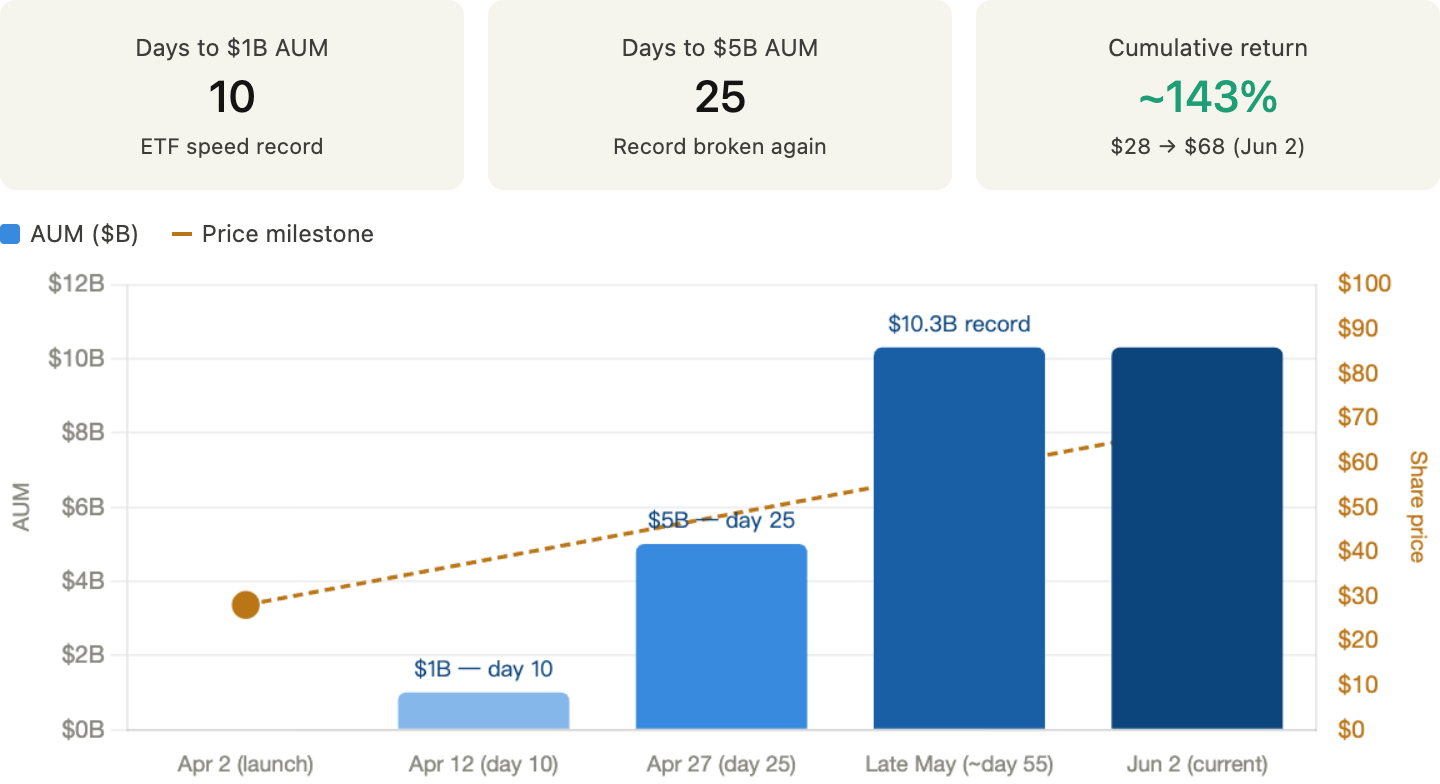
Ten Years’ Progress in Two Months—DRAM ETF Growth Milestones
DRAM achieved asset growth in about two months that would typically take traditional ETFs years to reach. Its explosive momentum wasn’t just driven by price appreciation—from $28 at launch to over $50, which alone is highly attractive—but even more so by the pace of capital inflows, which far exceeded expectations.
According to public data, DRAM surpassed $1 billion in AUM within 10 days of listing and crossed $5 billion in just 25 days. This broke existing records, making it the fastest ETF in history to reach $10 billion in AUM. By the end of May 2026, the fund’s AUM had stabilized around $10.3 billion, with weekly inflows remaining positive.
Such intense investor interest signals market recognition of the "pure memory theme" as a differentiated investment strategy. Unlike traditional semiconductor ETFs like SOXX or SMH, which broadly cover logic chips, equipment manufacturers, and other segments, DRAM strictly limits its investment scope to memory and storage chips, offering a more focused and pure exposure to AI infrastructure.
Why Are Memory Chips the Most Critical Bottleneck in AI Computing Power Expansion?
To understand DRAM’s price performance, you first need to answer a fundamental question: What role do memory chips play in the AI computing ecosystem?
AI computing power depends not only on the continuous evolution of GPUs and other processing chips, but also on the efficiency of data transfer between processors and storage. High Bandwidth Memory (HBM) is a core component of AI accelerator cards, while DRAM and NAND flash support server operations and large-scale data access.
Currently, supply shortages of HBM, DRAM, and NAND flash are expected to persist beyond 2026. The main driver is explosive demand for high-performance memory from AI applications, while supply is constrained by multiple technical bottlenecks that hinder rapid capacity expansion. Specifically, new HBM manufacturing processes result in larger die sizes, reducing the number of chips per wafer and limiting supply flexibility. The adoption of extreme ultraviolet (EUV) lithography in advanced DRAM manufacturing further restricts capacity ramp-up.
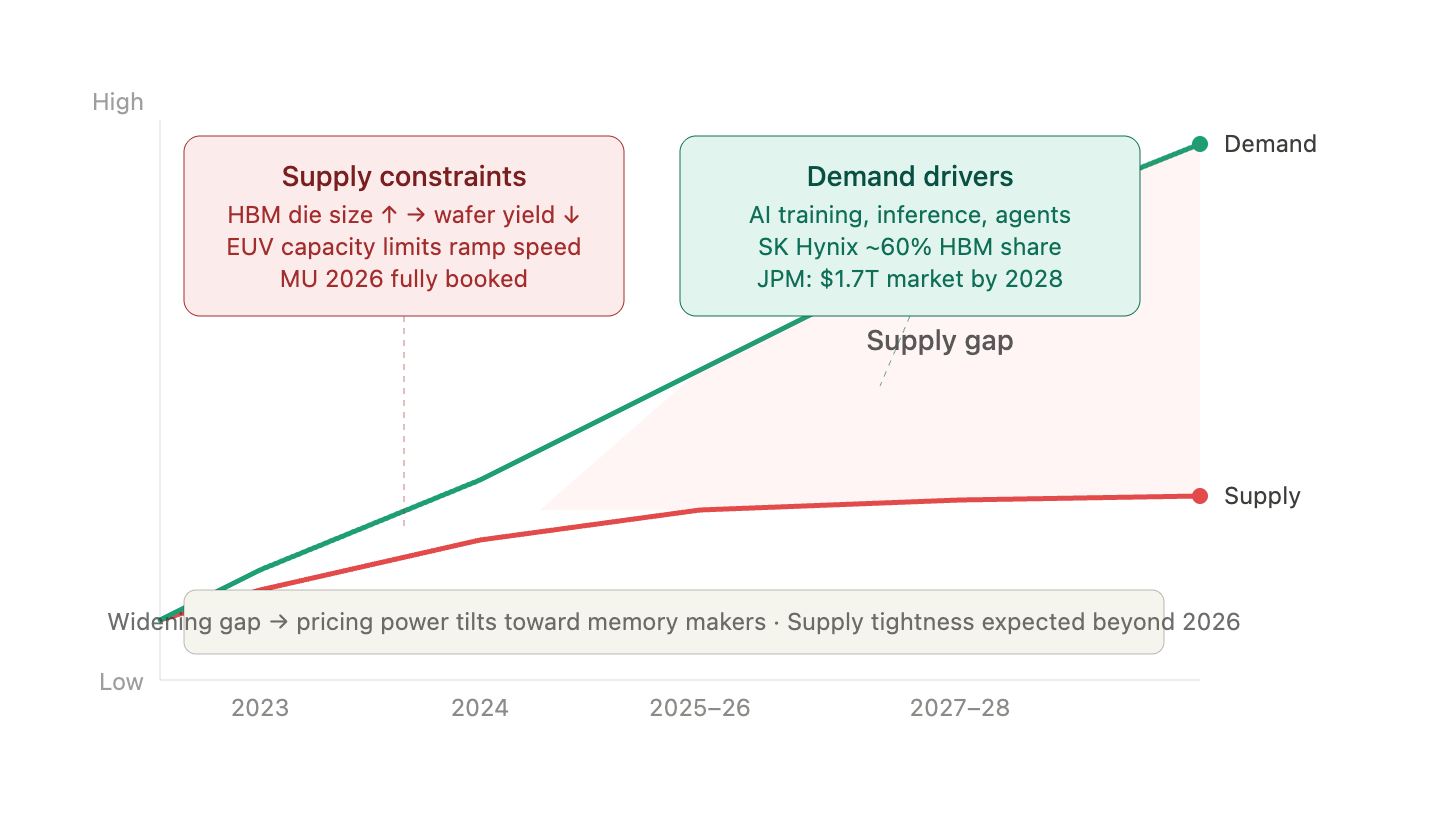
The Achilles’ Heel of AI Computing—Tight Supply and Demand for Memory Chips
While supply remains constrained, demand continues to accelerate. JPMorgan’s latest research report significantly raised its global storage market forecasts for 2026 to 2028, projecting a total market size of $1.7 trillion by 2028. Micron Technology has confirmed that its entire HBM production capacity for 2026 is already fully booked, strengthening its pricing power. SK Hynix holds about 60% market share in HBM, serving as a key pillar in NVIDIA’s AI ecosystem.
DRAM ETF’s Pure Memory Theme: How Concentrated Is Its Portfolio and How Is Risk Distributed?
DRAM’s high concentration isn’t a design flaw—it’s a natural result of its thematic focus. The ETF currently holds 20 constituent securities, with the top three—SK Hynix, Samsung Electronics, and Micron Technology—making up nearly 70% of the portfolio. SK Hynix alone accounts for about 27% to 28% of the fund’s weight.
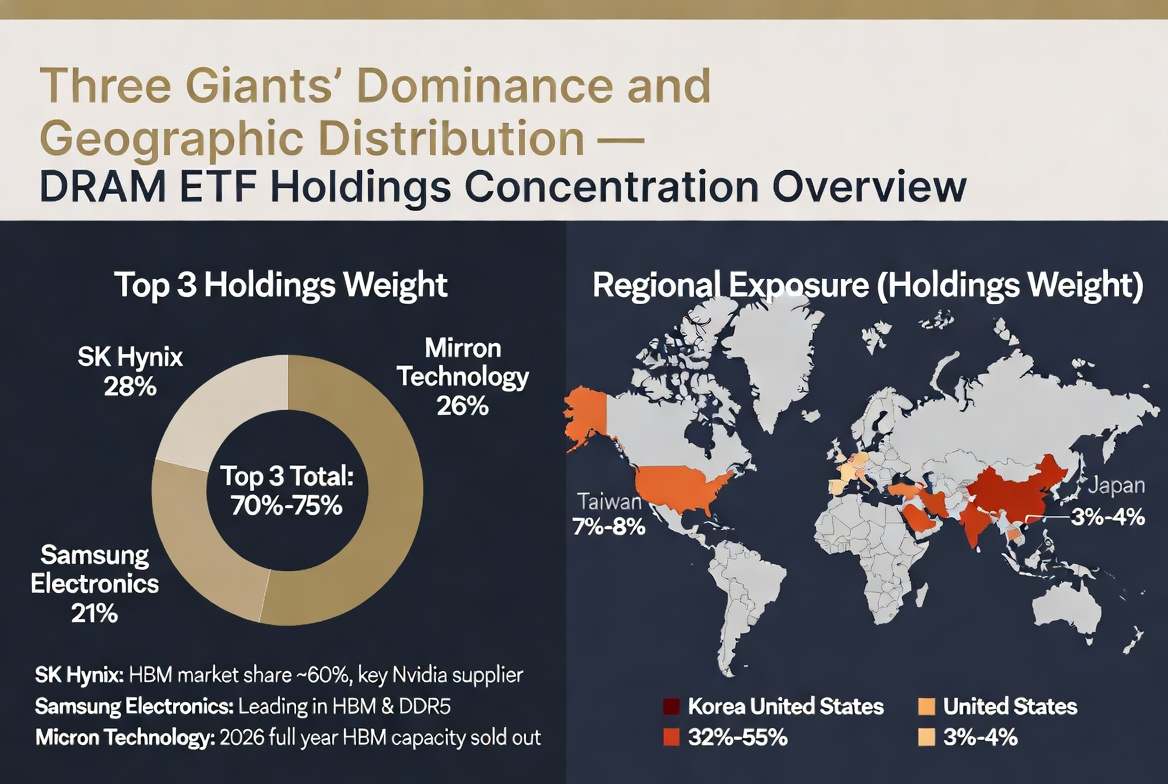
Three Giants and Geographic Distribution—DRAM ETF Portfolio Concentration Overview
South Korean companies represent about 52%–55% of the ETF’s weight (mainly SK Hynix and Samsung Electronics), US companies about 32%–35% (primarily Micron Technology and others), with the remainder spread across Taiwan (about 7%–8%), Japan (about 3%–4%), and other regions. Together, these three regions account for nearly 100%. This geographic concentration mirrors the global distribution of memory chip production: Korean firms dominate HBM and DRAM, US-based Micron is a major player in DRAM and NAND, while Taiwan’s Nanya Technology and Winbond Electronics are included as supplementary holdings.
From HBM to DDR5: How Is the Structure of Memory Demand Evolving?
Over the past two years, market attention has focused mainly on HBM, as it’s a direct companion to AI training chips. However, as AI applications transition from training to inference and the era of AI agents, the structure of memory demand is undergoing profound change.
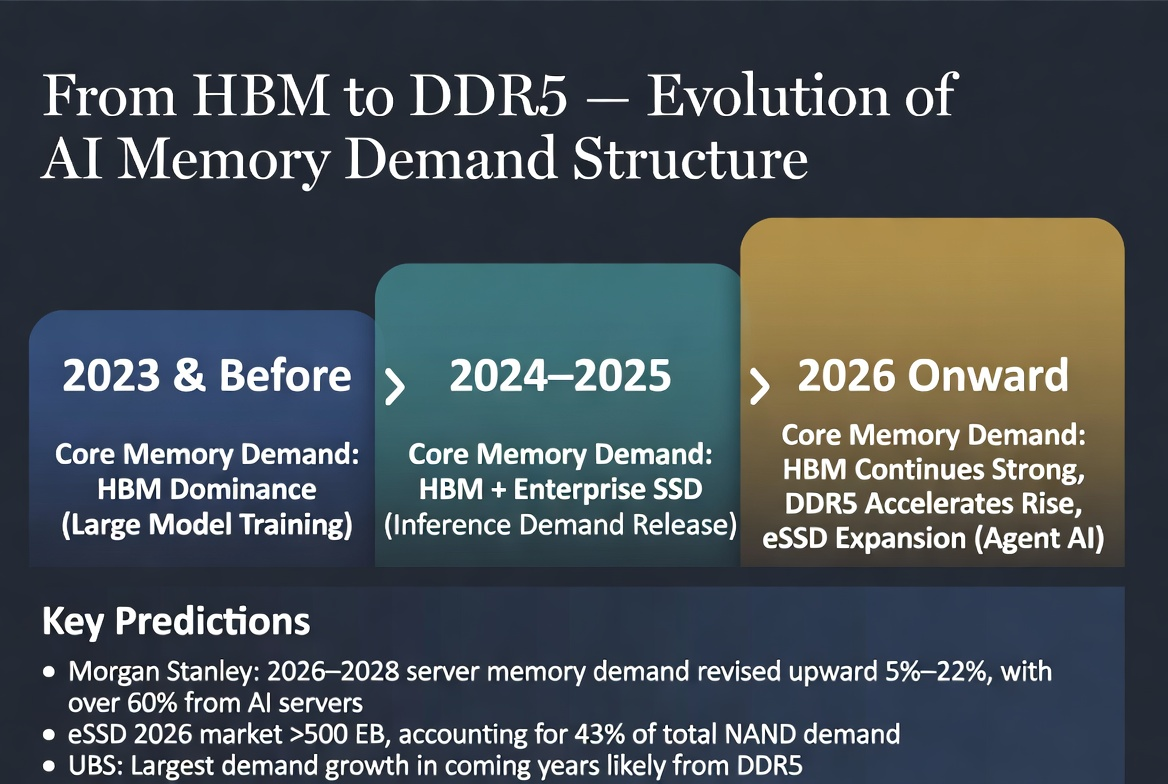
From HBM to DDR5—The Structural Shift in AI Memory Demand
UBS’s latest report highlights that the underlying demand structure in the AI industry is already shifting. Around 2023, large model demand was mainly driven by training. From 2024 to 2025, the focus is moving toward inference. Starting in 2026, the industry is accelerating into the era of AI agents—AI can not only answer questions, but also autonomously plan, execute tasks, and call tools, leading to exponential growth in storage resource consumption.
In this new framework, DDR5’s importance is rising. AI agents require extensive CPU involvement for task orchestration, state management, and tool invocation, and DDR5 is the primary memory supporting CPUs. UBS believes the biggest demand growth in the coming years may come from DDR5 rather than HBM. JPMorgan’s forecasts support this view, raising server memory demand projections for 2026–2028 by 5%–22%, with over 60% of the incremental demand coming from AI servers.
This means the DRAM ETF’s covered categories are shifting from a "single product focus" to "multi-category expansion"—HBM remains strong, DDR5 is accelerating, and enterprise SSDs are rapidly expanding, driven by AI inference demand. JPMorgan expects the eSSD market to exceed 500 EB in 2026, accounting for 43% of total NAND demand.
How Do the Performance Breakouts of the Three Memory Giants Support the ETF’s Portfolio Value?
DRAM’s portfolio continues to attract market attention because its underlying companies have moved beyond traditional "cyclical fluctuations" and entered a growth channel driven by structural demand.
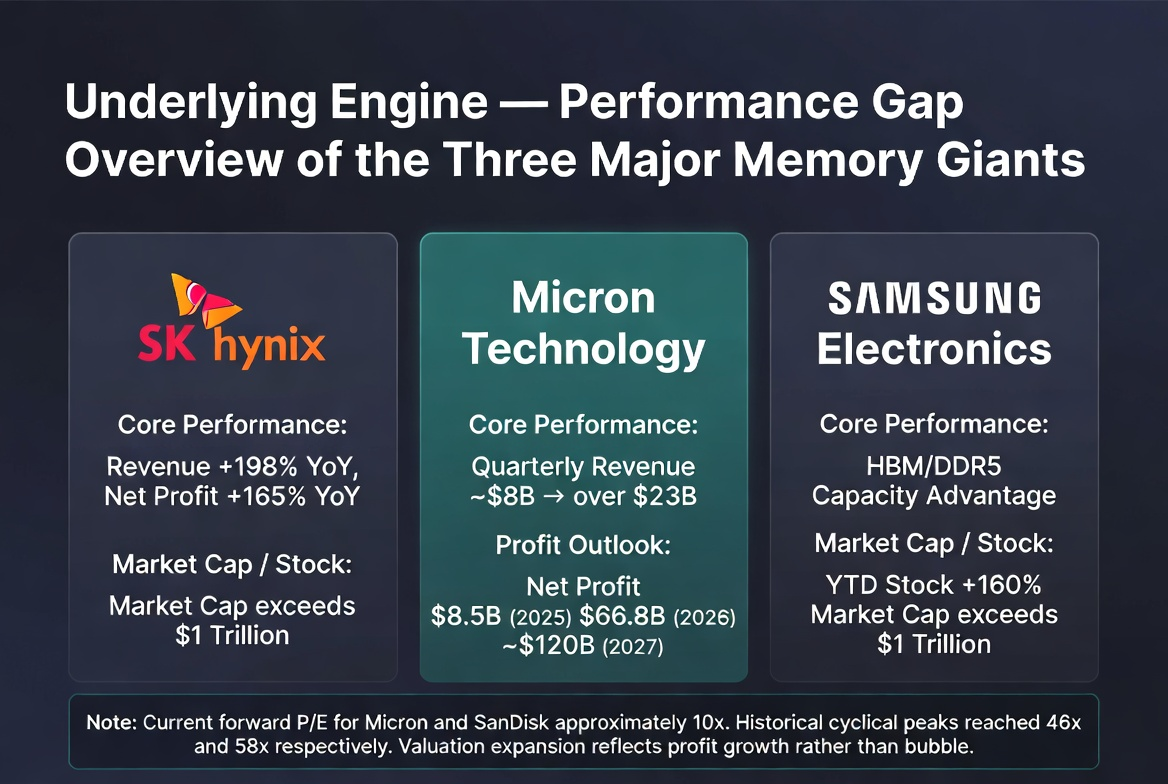
Underlying Engines—Performance Breakouts of the Three Memory Giants
SK Hynix’s latest financial report shows revenue up 198% year-on-year, net profit up 165%, with management raising forward guidance. Micron’s quarterly revenue jumped from about $8 billion a year ago to over $23 billion. Samsung Electronics, leveraging its production advantages in HBM and DDR5, saw its stock price rise more than 160% this year.
Notably, all three companies have surpassed the $1 trillion market cap threshold, becoming the most sought-after AI infrastructure stocks in global capital markets. Bloomberg data shows Micron’s net profit is projected to leap from $8.5 billion in 2025 to $66.8 billion in 2026, and could reach about $120 billion in 2027. If these forecasts materialize, DRAM’s portfolio earnings growth remains highly visible.
From a valuation perspective, market optimism is already well reflected. Micron and SanDisk currently trade at forward P/E ratios of about 10x, but these valuations are based on sustained profit growth. Historically, Micron’s P/E at cyclical peaks reached 46x, and SanDisk’s 58x, indicating that current valuation expansion is more about profit growth expectations than valuation bubbles.
How Can the Supercycle’s Sustainability Be Verified? What Risks Should Investors Watch?
After any asset experiences explosive short-term growth, a fundamental question arises: Can this growth be sustained? For DRAM, three key factors will determine its medium-term trajectory.
Sustainability of capital expenditures. The four major cloud and platform companies—Amazon, Meta, Alphabet, and Microsoft—are expected to spend up to $725 billion on AI infrastructure in 2026. Some are relying on increased debt to support this spending pace. If capital expenditure growth slows, chip company earnings and stock prices will be directly impacted.
Risk of memory pricing cycle inflection. While DRAM and NAND contract prices are currently rising, the memory industry has a strong cyclical nature. TrendForce predicts traditional DRAM contract prices may rise 55%–60% quarter-on-quarter in Q1 2026, underscoring price sensitivity to supply-demand dynamics. If demand growth slows or supply capacity ramps up, high prices could fall, squeezing profits for memory companies highly dependent on pricing leverage.
Double-edged effect of concentrated holdings. About 70% of DRAM’s weight is concentrated in three companies, meaning any negative news from these constituents will significantly impact the ETF’s net asset value. The fund’s heavy reliance on the Korean market also exposes it to currency and policy risks.
JPMorgan’s report acknowledges that storage stocks still trade at discounted earnings valuations, mainly due to market doubts about the sustainability of storage’s value share. However, the firm believes AI has brought a fundamentally new demand structure, making traditional cyclical valuation frameworks obsolete. Ultimately, this is a thesis that requires time to validate: between "structural inflection" and "cyclical peak," the market has yet to reach consensus.
Summary
DRAM’s record-breaking rally is, at its core, a concentrated reflection of the AI infrastructure investment wave in capital markets. The ETF’s differentiated "pure memory" focus and strong performance of its underlying holdings enabled rapid scale expansion in a short period. The structural logic is clear: memory chips are the core bottleneck for AI computing—HBM remains in short supply, DDR5 demand is accelerating, and enterprise SSDs are expanding, together forming a multi-layered demand-driven system.
However, risks remain, including concentration, pricing cycle inflections, and valuation sustainability. The degree of optimism priced in will determine the ETF’s future performance. For market participants, understanding DRAM’s structural logic and cyclical constraints is essential for evaluating this emerging investment tool.
Frequently Asked Questions
What type of fund is the DRAM ETF, and what is its investment theme?
DRAM, issued by Roundhill Investments, is the world’s first actively managed ETF focused exclusively on memory. It was listed on the US Cboe BZX Exchange on April 2, 2026. The fund invests at least 80% of net assets in memory and storage chip companies, with a focus on HBM, DRAM, and NAND flash—differentiating it from broader traditional semiconductor ETFs.
What are DRAM ETF’s main holdings and how concentrated is the portfolio?
DRAM currently holds about 20 constituent securities. The top three holdings are SK Hynix (about 28%), Samsung Electronics (about 21%), and Micron Technology (including both equity and derivatives, totaling about 26%). Together, these three account for approximately 70%–75% of the fund’s weight.
DRAM has gained nearly 150%. What are the main drivers?
The core driver is structural demand for memory chips driven by AI computing expansion. HBM, as a key component for AI accelerator cards, is currently in short supply with limited capacity expansion. As AI applications move from training to inference and AI agents, demand for DDR5 and enterprise SSDs is also accelerating, boosting profit expectations and stock valuations for memory companies.
What risks should investors be aware of when investing in DRAM ETF?
Key risks include: (1) Highly concentrated holdings in three companies—volatility in any constituent will directly affect the ETF’s net asset value; (2) The memory industry is highly cyclical, and contract price inflections may pressure earnings; (3) If AI capital spending slows, demand for memory reliant on high capex may be negatively impacted; (4) The fund’s heavy exposure to the Korean market brings currency and regional policy risks.
What is the ETF’s expense ratio and management approach?
DRAM is an actively managed ETF with an expense ratio of 0.65%. The management team rebalances quarterly, dynamically adjusting portfolio weights based on each company’s market and revenue share in memory and storage, subject to a maximum 25% weight per company.


