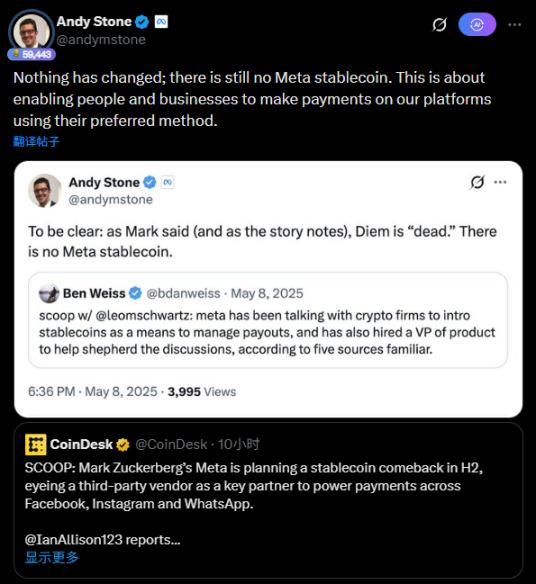
On February 24, CoinDesk reported, citing sources familiar with the matter, that tech giant Meta, under Zuckerberg’s leadership, plans to re-enter the stablecoin sector in the second half of this year. Meta aims to integrate third-party providers to enable stablecoin payments and launch a new wallet. The company has already sent product requirement invitations to third-party firms, with long-standing partner Stripe identified as a potential pilot candidate.
Shortly after, Meta spokesperson Andy Stone posted on Twitter, “Business as usual—there is still no Meta stablecoin. The key point about Meta planning to restart its stablecoin business in the second half of 2026 is to enable individuals and businesses to use their preferred payment methods on Meta’s platforms.”
Dormant Ambitions: The Collapse from Libra to Diem
Reflecting on Meta’s stablecoin journey, the launch of the Libra project in 2019 marked a particularly controversial beginning. At that time, Meta set out to build a global digital currency backed by a basket of fiat currencies and government bonds.
The company aimed to leverage its billions of monthly active users across multiple social platforms to bypass traditional banking systems and enable real-time, peer-to-peer global cross-border payments. However, this ambitious vision immediately faced unified resistance from regulators around the world.
Lawmakers were deeply uneasy about Meta controlling the core of global finance, especially as the company was embroiled in the Cambridge Analytica privacy scandal (in 2018, Facebook was revealed to have allowed the political consulting firm Cambridge Analytica to illegally access the personal data of up to 87 million users). Public trust in Meta’s handling of sensitive financial data hit rock bottom.
Libra head David Marcus and Zuckerberg were both called to testify before the US Congress. Lawmakers even compared Libra’s potential risks to those of 9/11, expressing concerns it could facilitate money laundering and terrorist financing.
Amid intense regulatory scrutiny, the original founding members—including Visa, Mastercard, PayPal, and Stripe—chose to withdraw from the Libra Association to avoid political fallout.
Although Meta later rebranded the project as Diem and attempted to compromise by scaling down and pegging the currency to a single fiat, regulatory pressure persisted. Ultimately, Diem never launched officially in the US and was forced to shut down and sell all assets in early 2022. Core members of the team later split off to launch the Layer 1 blockchain projects Aptos and Sui.
2026’s New Strategy: From “Challenger” to “Gateway”
Compared to the 2019 Libra era, when Meta sought to take on the global financial system directly, Meta’s 2026 approach is more measured and compliance-oriented.
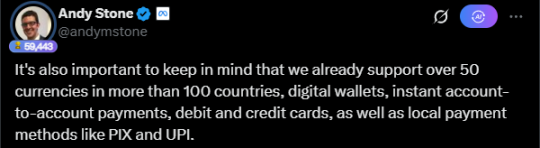
In his response, Meta spokesperson Andy Stone emphasized that Meta now supports over 50 currencies and payment methods across more than 100 countries and regions, aiming to downplay the uniqueness of stablecoins by positioning them as an extension of existing payment infrastructure.
This strategic shift centers on modular integration of external capabilities. Meta’s latest RFP (Request for Proposal) clearly delegates compliance responsibilities to third parties.
Meta’s close partner Stripe (whose CEO Patrick Collison sits on Meta’s board) had already strengthened its stablecoin capabilities by acquiring the stablecoin platform Bridge in October 2024 and the crypto wallet Privy in June 2025.
This compliance-separation model allows Meta to seamlessly embed low-cost, instant settlement capabilities for its more than 3 billion monthly active users, while maintaining a safe legal distance from regulatory pressure.
Regulation and Competition: Dual Barriers Meta Must Overcome
The regulatory landscape has improved significantly since 2019. While challenges remain, US bills such as the GENIUS Act and Clarity Act have established a preliminary legal framework for stablecoin issuers, opening the door to new market entrants.
US regulators are still in the early stages of drafting detailed implementation guidelines. Meta likely recognizes that any overly aggressive move could once again trigger regulatory pushback, making third-party involvement the safest route for now.
On the competitive front, Meta faces an already crowded and mature industry.
Elon Musk’s social platform X continues to advance its “super app” strategy, aiming to integrate payment functions, while Telegram has already gained a lead in crypto payments through the TON ecosystem.
Meanwhile, established crypto giants like Coinbase and Kraken are pushing boundaries, offering complex financial services such as 24/7 tokenized US stock trading.
For Meta, re-entering the stablecoin sector is about more than reducing traditional banking fees—it’s a contest for leadership in social commerce. As Meta aggressively invests in its Llama series of large language models, stablecoin payments are also set to become the financial backbone of its AI strategy.
Statement:
- This article is reprinted from [Foresight News]. Copyright belongs to the original author [Sanqing]. If you have any objections to the reprint, please contact the Gate Learn team, which will address the matter promptly according to relevant procedures.
- Disclaimer: The views and opinions expressed in this article are solely those of the author and do not constitute investment advice.
- Other language versions of this article are translated by the Gate Learn team. Unless Gate is mentioned, do not copy, distribute, or plagiarize these translations.