What Is StrikeBit?

(Source: StrikeBitDeFI)
StrikeBit AI is a modular protocol (Modular Agent Protocol, MAP) purpose-built for AI Agents.
It equips developers with tools to create intelligent agents (AI Agents) and empowers these agents to be upgraded, co-owned, and to generate revenue through on-chain mechanisms.
StrikeBit’s vision is to establish a sustainable AgentFi ecosystem, positioning AI as the central player in the Web3 economy—not just an assistant.
Core Concepts
MAP is the technological foundation of StrikeBit, enabling developers to build multi-layered, interoperable AI Agent systems. Each Primary Agent can create its own Subagents, which handle distinct tasks such as data analysis, interactive communication, and strategy execution.
These agents don’t merely coexist—they learn from one another, share data and logic, and ultimately form an intelligent network capable of self-evolution and autonomous collaboration. MAP’s key features include:
- Modular Logic: Freely add or upgrade functional modules.
- On-chain Ownership: Each Agent exists as an NFT (ERC721 / ERC404), tradable, co-owned, and upgradable.
- Collaborative Networks: Agents inherit logic and share data, forming a self-reinforcing learning network.
MAP establishes StrikeBit as the infrastructure layer for the AI Agent ecosystem.
Decentralized Base for AI Agents
AgentHub is the core platform of the StrikeBit ecosystem, enabling users to create, manage, upgrade, and monetize their AI Agents on-chain. It serves not only as a tool, but as the foundation of the Agent economy. AgentHub’s main features include:
- Agent Deployment and Minting: Users can create new agents using templates and mint programmable NFTs by paying $HUB.
- Agent Migration (Virtuals Integration): Import agents from the Virtuals ecosystem into StrikeBit, enabling on-chain logic and co-ownership.
- Ownership and Identity Layer: Each agent is an independent NFT with traceable identity and collaborative governance.
- Radiant Miner Integration: Agents can connect to Radiant Miner to earn passive $HUB rewards based on usage and interaction.
- Modular Upgrades: Developers can continually add new features via MAP modules, such as trading signals, NFT minting, prediction games, and more.
AgentHub makes true ownership, upgrading, and monetization of AI Agents possible.
StrikeBit’s Gamified Participation Layer
Bolts is a non-transferable points system within the StrikeBit ecosystem, designed to reward genuine participation—not passive mining or mechanical interaction. Users earn Bolts through tasks, interactions, or agent upgrades, unlocking exclusive experiences, privileges, and upgrade permissions. By integrating Bolts, StrikeBit closely links user activity with ecosystem growth, creating a participation system that combines social, economic, and intelligent dynamics.
AI-Driven Mining Economy
StrikeBit introduces Radiant AI Miners—a new concept combining simulated computational power and AI activity in an NFT mining system. Each Miner represents a user’s virtual computational power within the StrikeBit ecosystem, earning simulated rewards based on agent interactions, staking, and upgrades.
This design delivers a mining experience without hardware, allowing AI Agents to become digital workers capable of mining. Radiant AI Miners feature:
- Representation of user ownership within the ecosystem.
- Higher simulated computational power yields more $HUB.
- Upgrade or task completion increases virtual computational power.
- Zero hardware or energy costs—100% virtualized.
Dual Token Model
StrikeBit employs a dual token structure to balance protocol governance and ecosystem liquidity.
$STRIKE — Protocol Core Token
$STRIKE is StrikeBit’s governance and value accrual token, used for system-level decisions, protocol upgrades, and market value capture. Primary uses include:
- Protocol governance and proposal voting
- Native agent deployment and staking ($rSTRIKE)
- Market trading and platform fees
- Treasury and incentive allocation management
$HUB — Ecosystem Utility Token
$HUB is StrikeBit’s utility token, used for AgentHub deployment, Radiant Miner operation, and cross-chain interactions. Main uses include:
- Payment for agent deployment and upgrades
- Simulated computational power increase and yield mining
- NFT module upgrades and fusion
- Cross-chain transactions (StrikeBit ↔ Virtuals)
- Eligibility for airdrops and INO events
Together, these tokens ensure governance stability and ecosystem vitality for StrikeBit, attracting developers, users, and investors to co-create value.
Tokenomics
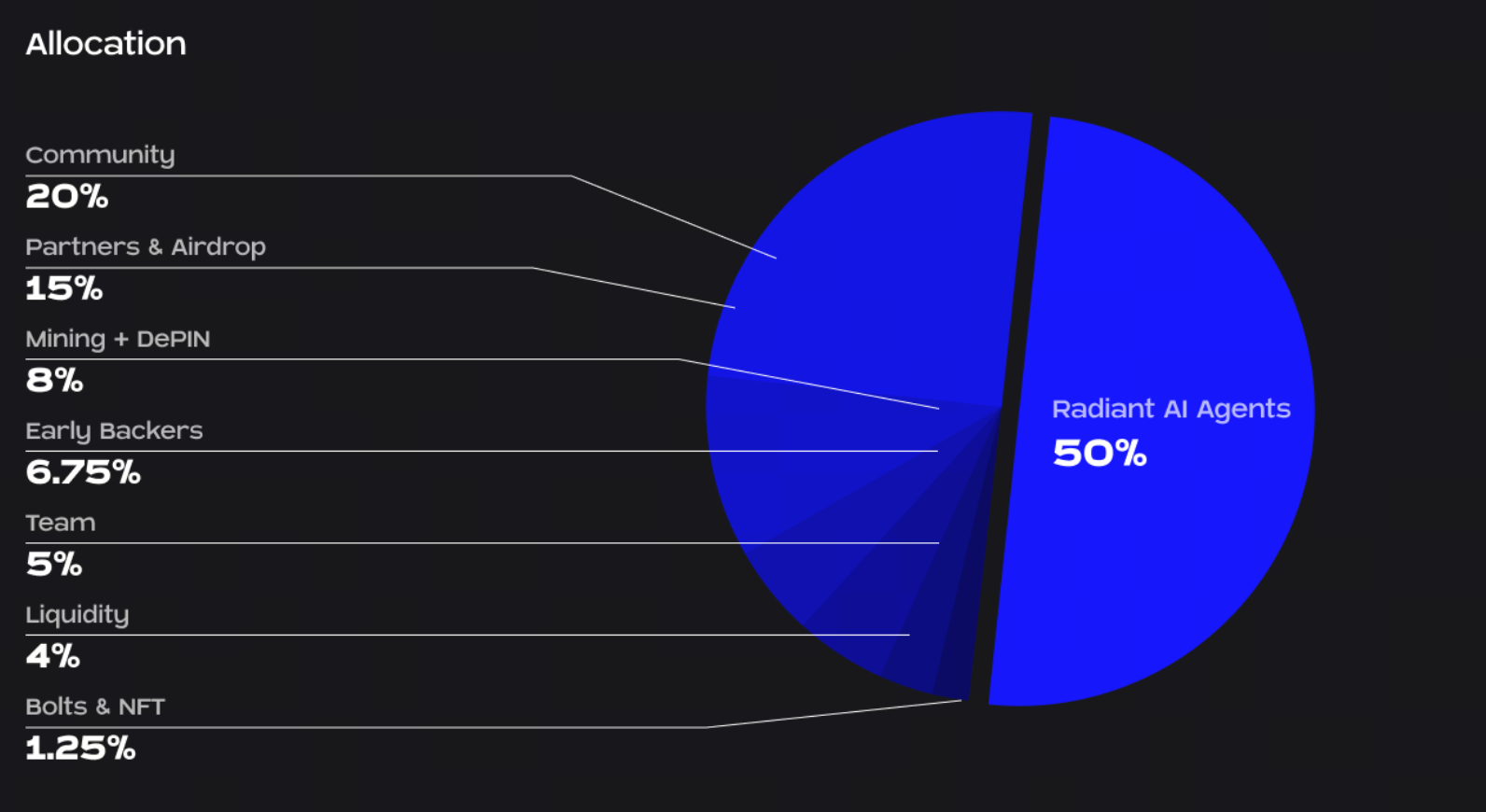
StrikeBit utilizes a balanced allocation model to ensure long-term sustainability and community focus.
- Radiant AI Agents (50%): The largest share supports AI Agent ecosystem development and rewards, driving user engagement and token circulation.
- Community (20%): Dedicated to community activities, incentive programs, and ongoing user support.
- Partners & Airdrop (15%): For partners, ecosystem expansion, and airdrop events to attract new developers and community members.
- Mining + DePIN (8%): Supports Radiant Miners and decentralized AI computing nodes.
- Early Backers (6.75%): Allocated to early investors and strategic funds.
- Team (5%): Incentivizes the core team and long-term contributors.
- Liquidity (4%): Ensures market stability and trading depth.
- Bolts & NFT (1.25%): Rewards user interactions and NFT upgrade-related activities.
(Source: docs.strikebit)
This allocation balances community, technology, capital, and ecosystem growth, building a self-sustaining, scalable token economy for StrikeBit.
To learn more about Web3, click to register: https://www.gate.com/
Summary
StrikeBit AI (STRIKE) is more than just another AI token project—it is the infrastructure layer for the AI Agent economy. Developers can freely build agent systems, users can own, upgrade, and mine, and the entire Web3 ecosystem enters a new era of AI-driven co-creation and shared value.







