What Is Naoris Protocol?

Beginner
Quick Reads
Last Updated 2026-04-03 15:56:23
Reading Time: 1m
This article provides an overview of the Naoris Protocol’s fundamental concepts, key features, and application scenarios, enabling beginners to quickly understand the advantages of this Post-Quantum self-verifying network security protocol.


Image: https://www.naorisprotocol.com/

In today’s digital age, Naoris Protocol is emerging as a significant protocol in cybersecurity. Naoris Protocol is a post-quantum-capable, self-validating cybersecurity protocol designed to build a decentralized Trust Mesh, restoring network trust between diverse devices and systems.

What is Naoris Protocol?

Naoris Protocol leverages post-quantum cryptography. It employs a custom dPoSec (Decentralized Proof of Security) consensus mechanism and a distributed SWARM AI framework to enable ongoing device-to-device validation and trust transfer. Unlike traditional centralized security systems, it operates as a distributed security network that becomes more robust as the community grows.

Core Technologies and Features

  • Post-Quantum Cryptography: Uses encryption algorithms like Dilithium-5, compliant with NIST, NATO, and ETSI standards, to defend against security resistant to quantum computing threats.
  • dPoSec Consensus: Devices act as nodes, directly validating and reaching consensus to form a self-validating security framework with no single point of failure, greatly enhancing network resilience.
  • Distributed SWARM AI: Decentralized AI nodes work collaboratively to monitor, analyze, and respond to threats, enabling real-time defense and continuous learning.

Real-World Applications

  • Enterprise and Government Security: Naoris Protocol allows organizations to share device security status in real time, facilitating cross-organizational compliance and trust.
  • Web2 & Web3 Integrations: Traditional enterprise systems can incorporate Naoris for strengthened security. Blockchain nodes and smart contracts are scanned and validated in real time, ensuring quantum-resistant security.

$NAORIS Tokenomics Overview

1. Key Use Cases

$NAORIS is the core incentive mechanism driving validation and consensus across the protocol. Devices earn token rewards for performing validation tasks, sharing computing resources, and reporting security status, creating a community-powered contribute-and-earn token economy.

2. Incentive Mechanisms

  • Device Validation Rewards: Devices that successfully participate in validations within the mesh network receive $NAORIS tokens.
  • Node Staking: Running a full validator node requires locking a specific amount of $NAORIS tokens.
  • Governance and Voting: Token holders are entitled to participate in node elections and protocol upgrade votes.
  • Transaction verification and trust mechanism: All trust-based interactions and validations between devices are recorded and secured with tokens, functioning as verifiable proof of trusted operations.

3. Token Lock-Up and Release Model (Tokenomics)
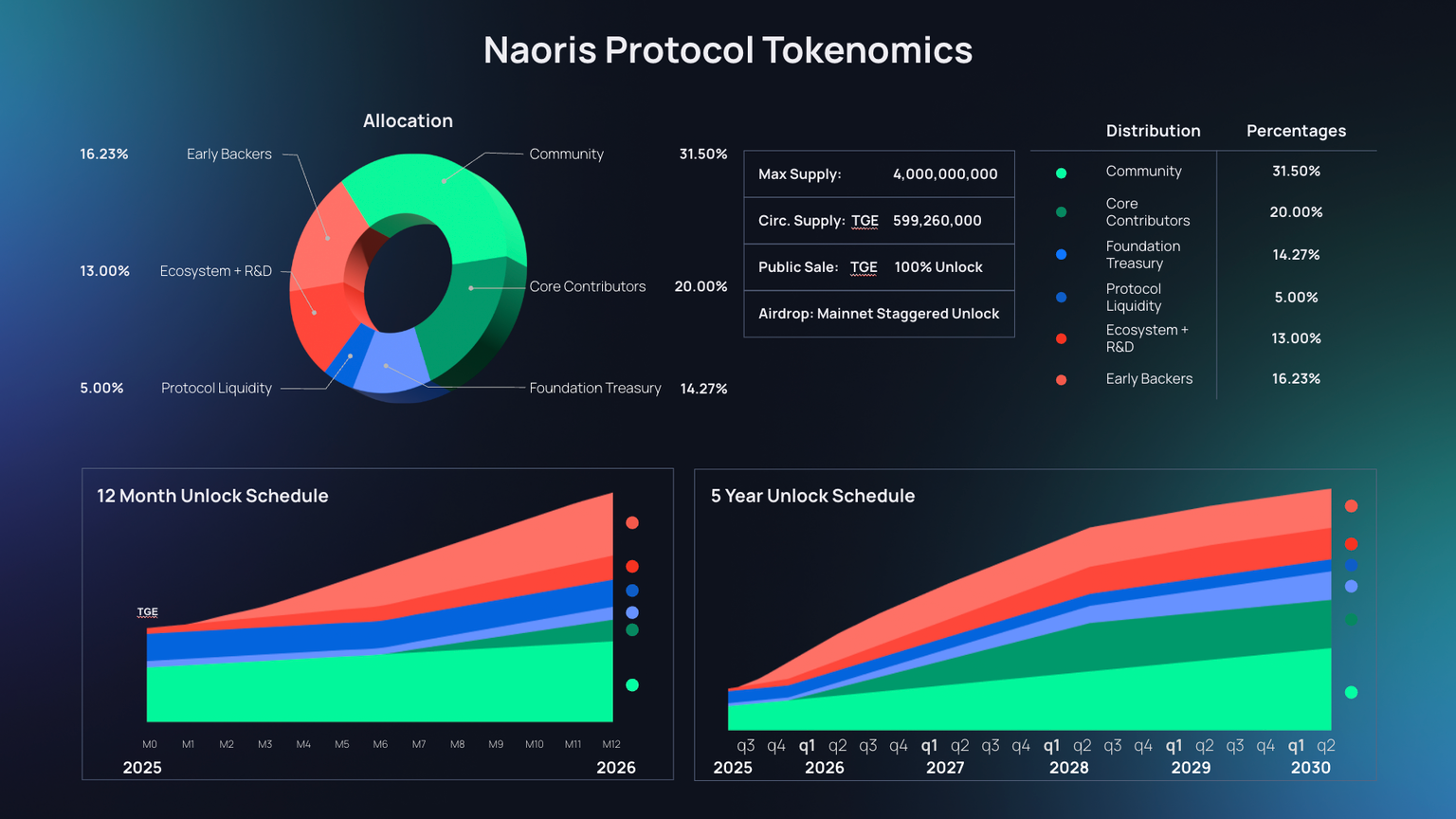

Image: https://knowledgebase.naorisprotocol.com/naoris-protocol/tokenomics/naoris-protocol-tokenomics

According to official documentation, Naoris Protocol has a total supply of 4 billion tokens, allocated as follows:

  • Community Allocation (31.5%) is the largest, serving as a long-term incentive for ecosystem growth.
  • Core Contributors (20%) and Early Supporters (16.23%) are unlocked over time to support long-term collaboration.
  • The protocol distributes other allocations (foundation, R&D, liquidity) linearly over 12 months and 5 years, respectively.

4. Long-Term Value Potential

We expect usage frequency, validation utility, and secure transaction volume of $NAORIS to grow exponentially, powering strong value capture potential.

Why Choose Naoris Protocol?

  1. Quantum-resistant security for the future.
  2. Scalability and resilience from decentralization.
  3. Community-driven incentives: Devices validate and earn $NAORIS, creating a participatory trust ecosystem.
  4. Real-time proof of trust: Every operation, application, and connection is derived from a verifiable state of network security.

Naoris Protocol offers a community-centric approach to network trust and security.

Gate will be the first to launch Naoris Protocol (NAORIS) and open the 276th HODLer Airdrop. A total of 200,000 NAORIS will be distributed. Users only need to hold 1 GT to participate for free, with no lock-up period or deduction of funds. The event ends on 2025 July 31 at 18:00 (UTC+8). All tokens will be released in a single, 100% unlocked distribution. NAORIS spot trading begins that same day at 20:00 (UTC+8), with the initial trading pair NAORIS/USDT.

Author: Max
Disclaimer
* The information is not intended to be and does not constitute financial advice or any other recommendation of any sort offered or endorsed by Gate.
* This article may not be reproduced, transmitted or copied without referencing Gate. Contravention is an infringement of Copyright Act and may be subject to legal action.

Related Articles

What is Fartcoin? All You Need to Know About FARTCOIN
Intermediate

What is Fartcoin? All You Need to Know About FARTCOIN

Fartcoin (FARTCOIN) is a representative meme coin within the Solana ecosystem based on an AI-driven narrative. Its core concept originated from an experiment aimed at exploring the "boundaries between AI Agents and humor." More than just a digital asset with social attributes, the project deeply couples absurd humor culture with on-chain financial logic by integrating autonomous AI interaction models.
2026-04-04 22:01:19
Gold Price Forecast for the Next Five Years: 2026–2030 Trend Outlook and Investment Implications, Could It Reach $6,000?
Beginner

Gold Price Forecast for the Next Five Years: 2026–2030 Trend Outlook and Investment Implications, Could It Reach $6,000?

Analyze current gold price trends alongside authoritative five-year forecasts, integrating an evaluation of market risks and opportunities. This gives investors insight into the potential trajectory of gold prices and the main drivers expected to shape the market over the next five years.
2026-03-25 18:13:30
Aster vs Hyperliquid: Which Perp DEX Will Prevail?
Beginner

Aster vs Hyperliquid: Which Perp DEX Will Prevail?

Aster and Hyperliquid are the two representative protocols of the "purpose-built L1 path" within the current decentralized perpetual exchange (Perp DEX) sector. As a pioneer in the field, Hyperliquid has built a deep liquidity moat through its highly mature order book architecture and strong community consensus. Conversely, Aster, as a rising challenger, seeks to leapfrog the competition in high-performance trading through more aggressive multi-chain aggregation logic, private transaction modules, and an underlying execution environment optimized for 2026 market demands.
2026-03-24 11:58:33
AI-Native Settlement Layers: How United Stables Is Building the Next Financial Rail
Beginner

AI-Native Settlement Layers: How United Stables Is Building the Next Financial Rail

Stablecoins were originally designed as dollar substitutes within exchanges, primarily used for asset pricing and trade settlement. As on-chain financial ecosystems have matured, their role has expanded beyond simple payments to include collateral assets, cross-chain liquidity mediums, and unified settlement units. In particular, as AI systems and automated agents begin to participate directly in economic activity, demand has risen sharply for programmable value units capable of instant settlement. This shift is pushing stablecoins toward the role of foundational financial infrastructure.
2026-03-25 03:16:17
2026 Silver Price Forecast: Bull Market Continuation or High-Level Pullback? In-Depth Analysis of Silver Candlestick Chart
Beginner

2026 Silver Price Forecast: Bull Market Continuation or High-Level Pullback? In-Depth Analysis of Silver Candlestick Chart

2026 Silver Price Forecast: Latest Outlook This article integrates current market trends, silver candlestick chart analysis, and momentum factors to assess the potential key support and resistance levels, upside targets, and pullback risks for silver prices. The goal is to help investors make informed, rational decisions.
2026-03-25 16:08:59
ASTER Tokenomics: Buybacks, Burns, and Staking as the Value Foundation of ASTER in 2026
Beginner

ASTER Tokenomics: Buybacks, Burns, and Staking as the Value Foundation of ASTER in 2026

ASTER is the native equity and governance token of the Aster ecosystem, with its core value built upon a radical "Deflationary Engine." Beyond serving as a governance tool, ASTER integrates multiple utilities including staking rewards, trading fee discounts, and liquidity incentives. Through its deep integration with the upcoming dedicated Layer 1 mainnet, it enables direct value capture from protocol cash flow to token holders.
2026-03-25 07:38:07