When it comes to the META token, the main questions revolve around three areas: its role in governance, whether there’s a fixed supply cap, and how minting and Treasury execution are governed by market constraints.
These topics can be understood through six core aspects: governance functions, minting process, supply structure, Treasury management, decision markets, and governance incentives. The Futarchy mechanism is what sets the META token model apart from traditional DAO tokens.
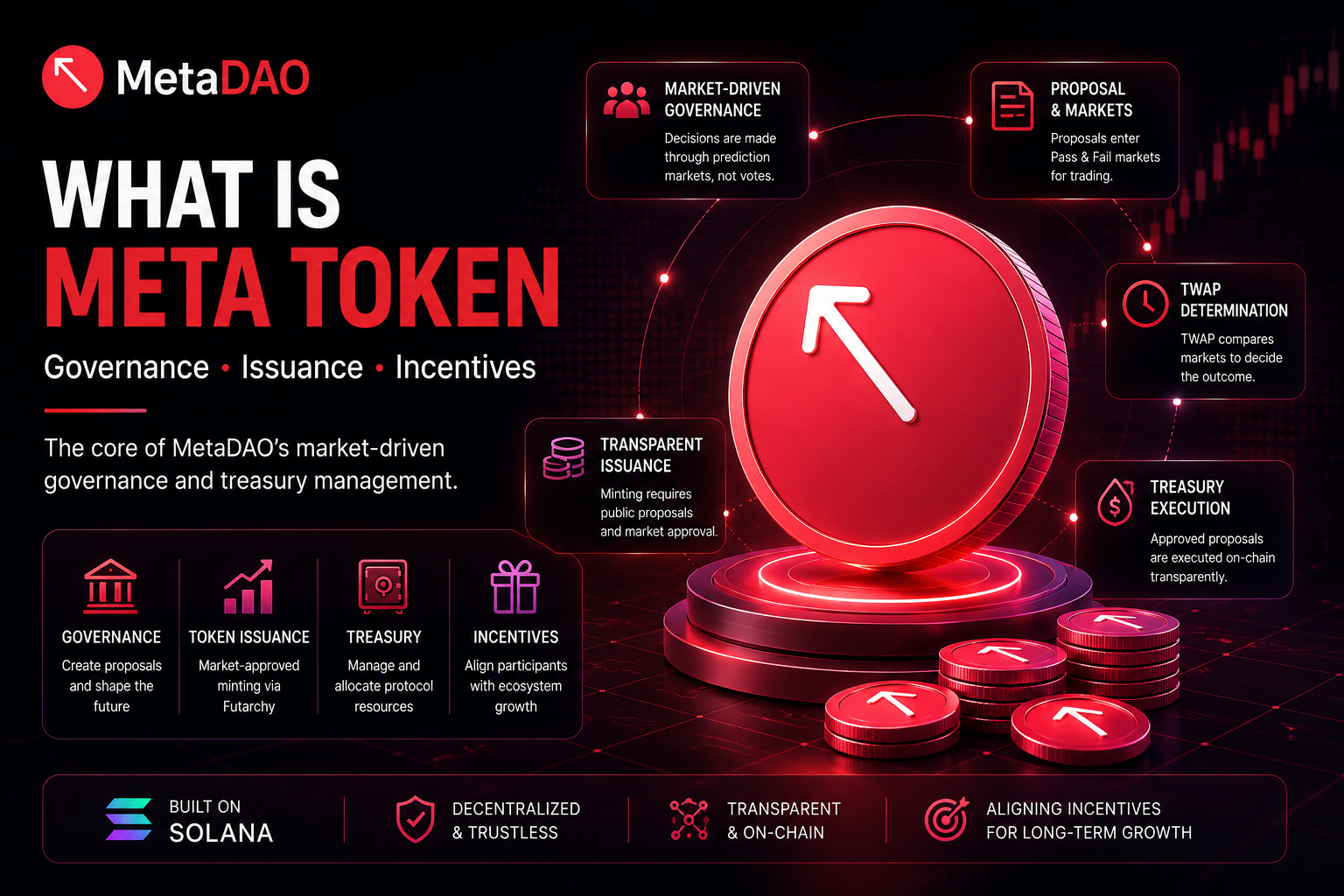
META serves as MetaDAO’s governance and utility token, acting as the core asset that connects decision markets, Treasury management, and protocol control. Official documentation describes META as MetaDAO’s governance and utility token, with its page detailing supply, allocation, and issuance mechanisms.
Unlike typical DAO tokens used solely for voting, META’s structure allows users to create proposals concerning the protocol or Treasury. These proposals then enter staking and decision market phases. The market generates price signals through trading on Proposal Pass and Proposal Fail. Governance actions are executed or rejected based on the market outcome.
This design is significant because META’s governance function is tightly linked to market judgment. META’s value stems not only from voting rights, but also from its roles in Futarchy decision-making, Treasury oversight, and token issuance.
META’s core governance function is to ensure proposals are evaluated through market-driven processes rather than simple token-holder votes. Governance participants must express their views through proposals, staking, and trading.
Specifically, users can create governance proposals related to protocol resources, fund allocation, or token issuance. Each proposal must receive a certain amount of META staking before entering the market trading phase. Traders then buy and sell in conditional markets, signaling their assessment of the proposal’s impact through price. The system determines whether to execute the proposal based on market results.
This mechanism transforms governance participation from a low-cost expression of opinion to an economically meaningful judgment. MetaDAO’s Futarchy governance, as stated in official documents, emphasizes “Vote on values, bet on beliefs”—the community sets goals, while the market determines the path to achieve them.
META’s minting mechanism relies on governance proposals and decision markets, not automatic inflation or discretionary team minting. This process is a market-approved token issuance model.
Practically, anyone can submit a minting proposal specifying the amount, recipient address, and intended use. The proposal must secure 200,000 META staked before entering the conditional market trading phase. The market then enters a three-day trading period, with traders expressing their views in Pass and Fail markets. If the Pass market’s TWAP exceeds the Fail market’s TWAP, tokens are minted and sent to the designated address.
| Process Step |
User Action |
System Action |
Result |
| Create proposal |
Submit minting plan |
Publicly record proposal details |
Specify amount and purpose |
| Stake support |
Stake META |
Check eligibility |
Filter invalid proposals |
| Market trading |
Trade Pass or Fail |
Generate price signals |
Assess minting impact |
| TWAP determination |
Await market results |
Compare average prices |
Decide whether to execute |
| On-chain execution |
View outcome |
Governance program mints tokens |
Complete or reject minting |
This table illustrates that META minting is a transparent, tradable, and verifiable on-chain governance process—not a hidden activity.
META tokens participate in Treasury management primarily through proposals and decision markets that determine fund allocation. Treasury spending authority is governed by the Futarchy framework, not by unilateral team control.
Structurally, users can submit proposals related to Treasury activities, including fund spending, liquidity adjustments, token issuance, or ecosystem support. Proposals then enter the staking phase. Conditional market traders assess whether the proposal will enhance protocol value. If the market outcome is favorable, the governance program executes on-chain actions according to the disclosed terms.
This mechanism shifts Treasury management from “who has voting power” to “does the market approve the use of funds.” Official documentation notes that proposals can address Treasury spending, new token issuance, metadata updates, or liquidity adjustments.
META’s supply structure is characterized by the absence of a token-program-level hard cap, and there is no automatic inflation or hidden minting. Official documentation confirms META lacks a contract-enforced supply limit; minting authority is controlled by the governance program, not manual operators.
Mechanically, META’s initial supply is 10 million tokens, issued through a fair launch. Any subsequent supply increases must be initiated via governance proposals. All minting actions are publicly disclosed and subject to Futarchy market trading. Only when the market determines that minting benefits protocol value are tokens issued.
This supply model means META is not a fixed-supply token, but a governance-constrained issuance asset. It provides flexibility for protocol financing and operations, while requiring effective market mechanisms to prevent unreasonable minting.
META’s governance incentive structure is shaped by three factors: market trading risk, public approval for minting, and Treasury execution based on market judgment. Governance participants must make price-based decisions, not just express preferences through voting.
In the governance process, proposal creators must publicly disclose their plans. Token holders stake META to move proposals into the market phase. Traders bear price risk in Pass and Fail markets. Market results determine proposal execution, impacting Treasury, supply structure, and protocol resource allocation.
This incentive structure is crucial because it shifts governance from “costless expression” to “cost-based judgment.” Incorrect decisions may lead to trading losses, while accurate judgments can yield market returns. META’s governance model prioritizes information discovery and economic accountability over simple token-weighted voting.
Summary
META tokens in MetaDAO serve multiple functions: governance participation, Treasury management, minting control, and market incentives. The core workflow includes proposal creation, META staking, entry into conditional markets, TWAP-based outcome determination, and on-chain execution by the governance program.
Overall, META is not a traditional fixed-supply governance token, but a governance asset integrated with Futarchy decision markets. Changes in supply, fund allocation, and protocol control are all handled through open proposals and market trading.
FAQ
What is the purpose of the META token
META is primarily used for MetaDAO governance, Treasury management, proposal staking, participation in decision markets, and minting control. It is the core functional asset in the Futarchy governance mechanism.
Does META have a fixed total supply
META does not have a contract-enforced hard cap, and there is no automatic inflation. All new issuance must go through open proposals and be approved by the Futarchy decision market.
How is META minting carried out
Minting requires an open proposal, 200,000 META staked, a three-day conditional market trading period, and TWAP-based determination for execution.
How does META participate in Treasury management
Proposals for Treasury spending, liquidity adjustments, or resource allocation must go through the decision market. If the market supports the proposal, the governance program executes on-chain actions based on the disclosed terms.
How does META differ from conventional DAO governance tokens
Conventional DAO tokens are mainly used for voting, while META emphasizes market-based governance. Proposal outcomes are determined by Pass and Fail market prices, and participants must bear trading risk.