As the DeFi narrative enters the critical stage of “On-chain Real-World Assets” in 2026, the importance of Falcon Finance has become increasingly prominent. With the acceleration of global financial asset tokenization, the market urgently needs a tool that can effectively hedge against volatility and capture real value. Boasting a TVL of over $1.9 billion (as of February 2026), the protocol has become a cornerstone of the stablecoin and RWA sectors. It addresses the pain point of single-type collateral and its disconnection from the real economy in traditional DeFi protocols, providing the core driving force for enhancing capital efficiency.
The value of Falcon Finance lies in its underlying adaptability as “Financial Lego.” It marks the transition of digital assets from pure on-chain speculation to deep integration with traditional treasury management. By introducing RWAs into a universal collateral logic, the protocol not only expands the boundaries of decentralized lending and synthetic assets but also provides a standardized paradigm for multi-chain interoperability and compliant asset integration, laying a vital foundation for building a programmable global value transmission network.
The Position of Falcon Finance (FF)
From a positioning perspective, Falcon Finance aims to address three major pain points of early DeFi stablecoin protocols:
- Unsustainable yields, overly reliant on inflationary token incentives
- Collateral overly concentrated in single crypto assets, with highly correlated risk
- Disconnection from real-world assets (RWA), making it difficult to attract institutional and conservative capital
Falcon Finance’s solution is to build a “universal collateral engine” capable of accommodating both crypto assets and RWAs, supporting the entire stablecoin system with structured strategies and compliant RWA yields, and completing a long-term value loop through the FF token.

Source: Falcon Finance
How does Falcon Finance work? USDf synthetic dollar and sUSDf yield certificate design
Falcon Finance’s core products are built around USDf synthetic dollars and sUSDf yield certificates, forming a dual-track design of “stablecoin + yield-bearing certificate.” This approach not only addresses the issue of unsustainable stablecoin yields in DeFi, but also deeply integrates universal collateral and RWA yields to provide users with a full-stack solution from liquidity to long-term returns.
USDf: an overcollateralized synthetic dollar stablecoin
As the foundational stablecoin of Falcon Finance, USDf is minted through an overcollateralization mechanism, combining the robustness of multi-collateral DAI with innovative active yield layer design.
When users deposit assets into the Falcon collateral module, the system displays the amount of USDf that can be minted based on real-time LTV (loan-to-value) ratios. Once minted, these synthetic dollars can circulate freely across the entire DeFi ecosystem, being used for trading on Uniswap, lending on Aave, market making on Curve, or yield farming. Importantly, USDf supports cross-chain transfers, positioning it as an efficient alternative to traditional “on-chain dollars.”
To handle extreme market conditions, the protocol employs diversified multi-asset collateral, conservative LTV parameters, and efficient automated liquidation mechanisms to build a robust risk protection framework, effectively controlling systemic bad debt risk and ensuring USDf’s stable peg.
sUSDf: yield-bearing synthetic dollar certificate
As the “yield-bearing version” of USDf, sUSDf represents users’ direct claim on the protocol’s delta-neutral strategies and RWA yields.
Users simply deposit USDf into designated yield vaults to receive an equivalent amount of sUSDf. As the protocol continuously accumulates delta-neutral arbitrage returns and RWA interest income, the value of sUSDf is reflected on a periodic basis—either through a gradual increase in the sUSDf-to-USDf exchange rate or through a clearly displayed annual percentage yield (APY) in the protocol interface.
The USDf + sUSDf dual-track system perfectly balances “stability” and “yield.” By combining universal collateral with an RWA engine to deliver sustainable returns, it forms Falcon Finance’s core competitive advantage over traditional stablecoin protocols.
Falcon Finance RWA Engine: from stablecoins to real-world assets
The key focus of Falcon’s 2026 roadmap is the RWA Engine, an infrastructure layer designed for institutional asset tokenization:
- Supports tokenization and integration of real-world assets such as government bonds, corporate bonds, gold, and private credit
- Maps off-chain cash flows to on-chain yield certificates through compliant custody and issuance partners
- Allows users to mint USDf using RWAs as collateral, while distributing RWA yields to sUSDf holders and FF stakers according to predefined rules
According to official plans, by 2026 the RWA engine will be “fully deployed,” covering a broad range of assets from bonds and equities to private credit, with the goal of making scenarios such as “a Dubai user collateralizing tokenized gold to instantly obtain synthetic dollar liquidity” a reality.
Falcon Finance team and investors
Falcon Finance’s founders and team originate from DWF Labs, a veteran market maker in the industry that has participated in market making for many mainstream altcoins and well-known meme tokens. As Managing Partner and founding partner of Falcon Finance, Andrei Grachev also serves as an executive at DWF Labs and brings deep experience in Web3 infrastructure. He led the strategic partnership with WLFI, driving Falcon’s transformation from a protocol into a global RWA-DeFi ecosystem, and is a key figure behind the project’s technical execution and institutional expansion.
To date, Falcon Finance has raised a total of USD 20 million in strategic funding, providing strong financial backing for RWA-driven stablecoin infrastructure. On July 30, 2025, World Liberty Financial (WLFI) invested USD 10 million; on October 9 of the same year, Cypher Capital and M2 Capital jointly invested another USD 10 million.
Can Falcon Finance deliver sustainable returns?
The sustainability of sUSDf yields is key to evaluating Falcon Finance’s long-term value. Through a dual-engine model of “on-chain delta-neutral strategies + off-chain real RWA yields,” the protocol provides sUSDf holders with low-volatility, sustainable return sources, completely breaking away from the vicious cycle of “inflationary rewards → yield collapse” seen in traditional DeFi stablecoins.
Falcon’s on-chain delta-neutral strategies are the core pillar of sUSDf’s early-stage yields. These strategies are designed to carefully construct hedged positions that continuously capture structural market returns without taking on significant directional risk.
As the RWA engine gradually comes online, Falcon has begun allocating protocol funds to a range of compliant, high-quality real-world assets, including short-term government bonds, investment-grade corporate bonds, money market instruments, and even structured products such as private credit and supply chain finance.
These assets naturally carry stable interest and coupon income, such as 4–5% annualized yields on short-term U.S. Treasuries, 5–7% credit spreads on investment-grade corporate bonds, and higher-yield components of rigorously vetted private credit. Through smart contracts, the protocol precisely maps these off-chain cash flows on-chain and distributes them to ecosystem participants according to predefined ratios.
FF token explained: value capture and latest market metrics
FF is the governance and value capture token of the Falcon Finance ecosystem, with its intrinsic value closely tied to protocol growth and RWA expansion. Its use cases include:
- Governance voting: protocol parameters, collateral whitelists, RWA strategies, fee models, and other major decisions
- Economic incentives: staking FF to unlock higher yields and more favorable fee structures
- Value capture: sharing a portion of protocol fees and RWA-derived income
FF is currently listed on multiple major centralized and decentralized exchanges.
Industry comparison: Falcon Finance vs Ethena
Finding the right balance between risk, liquidity, and yield sustainability is a challenge all DeFi projects must address.
Ethena is known for its crypto-native hedging strategies. Unlike Ethena, which relies purely on perpetual funding rates, Falcon introduces government bonds and gold as underlying support, giving it stronger resilience during periods of extreme market volatility.
We compare these two protocols across key dimensions such as core product logic, yield sources, and depth of RWA integration:
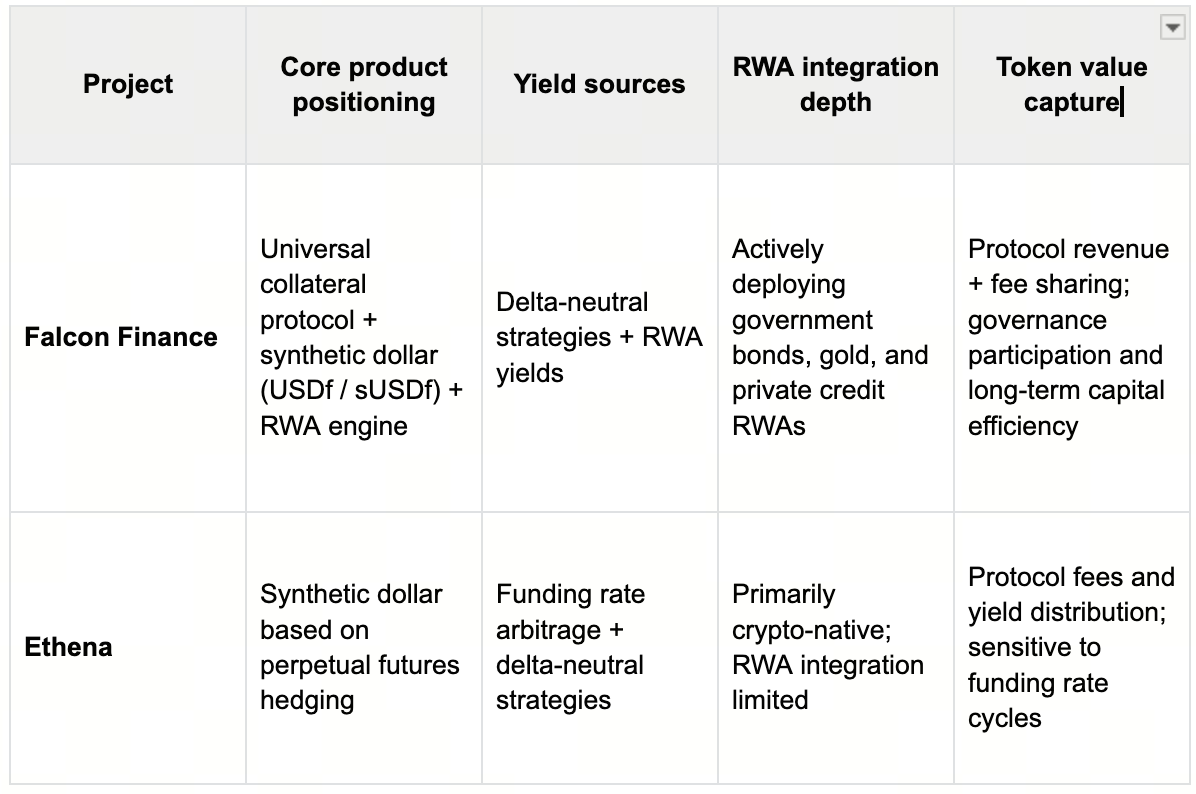
From this comparison, several conclusions can be drawn:
- Falcon emphasizes “protocol-generated yield” (delta-neutral + RWA) distributed to USDf, sUSDf, and FF
- Ethena is more focused on pure crypto-derivatives yields and is sensitive to macro interest rate cycles
How can beginners participate in Falcon Finance?
There are two primary ways to participate in the Falcon Finance ecosystem, corresponding to different needs for “liquidity” and “governance rights.”
As deep users of the protocol, investors can activate asset potential through USDf minting. By depositing stablecoins, major cryptocurrencies (such as BTC and ETH), or tokenized RWA assets (such as government bonds or gold) into Falcon, users can instantly generate synthetic USDf, gaining dollar liquidity without selling their underlying assets.
Further, by depositing USDf into protocol vaults to convert it into sUSDf, users can directly capture compounded returns generated by delta-neutral strategies and the RWA engine, achieving steady asset growth.
For those who are optimistic about Falcon Finance’s long-term potential as RWA infrastructure, investors can also gain deeper exposure by trading and holding the $FF token. FF is currently listed on multiple platforms such as Binance, Bybit, Gate, and decentralized protocols like Uniswap, allowing users to allocate assets based on their investment objectives and market conditions.
Falcon Finance latest developments and 2026 FF value outlook
Falcon Finance has demonstrated strong momentum in early 2026. Key developments include the launch of a Bitcoin yield vault, the establishment of a USD 50 million ecosystem fund, and active exploration in the crypto payment card space.
On January 8, 2026, Falcon Finance launched the groundbreaking Dollar-Yield Bitcoin Vault, an offline Bitcoin vault that allows users to earn 3–5% annualized returns by collateralizing BTC without selling or wrapping it, with yields paid in USDf stablecoins.
On January 23, Falcon partnered with Altery to integrate FCA-regulated payment rails, enabling users to earn yields in sUSDf vaults while making fiat payments via SEPA, SWIFT, or bank cards.
On January 30, Falcon announced the launch of a USD 50 million ecosystem fund focused on supporting teams building yield infrastructure, RWA integrations, and structured products on Ethereum and BNB Chain, further expanding USDf use cases and liquidity.
If Falcon Finance executes its roadmap successfully, the broader ecosystem and the FF token should gain stronger long-term value support.
Final thoughts and Falcon Finance outlook for 2026
Through a multi-layer architecture of “USDf + sUSDf + FF + RWA Engine,” Falcon Finance seeks to upgrade DeFi stablecoins from single-crypto collateral and short-term incentives to a “real-world-yield-driven universal collateral protocol.”
For users looking to participate in the RWA and next-generation stablecoin narrative in 2026, Falcon offers a complete pathway from “low-volatility yield (sUSDf)” to “long-term protocol exposure (FF),” while also carrying multi-dimensional risks related to compliance, strategy execution, and smart contracts.
As Falcon Finance continues to expand the sUSDf ecosystem and the broader RWA trend accelerates, the value of Falcon Finance and FF will be further tested and validated.
Frequently Asked Questions (FAQs)
What is the biggest difference between Falcon Finance and traditional stablecoin protocols?
Falcon does more than issue stablecoins. It builds a universal collateral and yield engine by:
- Supporting multi-asset collateral rather than a single crypto asset
- Combining on-chain delta-neutral strategies with off-chain RWA yields
- Using the FF token for yield distribution and governance
What is the difference between USDf and sUSDf?
- USDf: a synthetic dollar for payments, trading, and collateral use, pegged to USD 1
- sUSDf: a yield-bearing dollar representing strategy and RWA returns, better suited for long-term holding and yield accumulation
What milestones are worth watching for Falcon Finance in 2026?
Key focus areas in 2026 include:
- Whether the RWA engine is fully deployed as planned and introduces more asset types
- Progress on new fiat on-ramps and compliance in key regions (MENA, Hong Kong, Latin America)
- Growth in protocol TVL, USDf circulation, and FF market capitalization