Unlike traditional mutual funds, ETFs use a creation and redemption mechanism managed by Authorized Participants (APs). This allows ETFs to flexibly issue or redeem shares in response to market demand, keeping the ETF’s market price closely tied to its Net Asset Value (NAV). As a result, ETFs generally provide greater liquidity, more transparent pricing, and lower operating costs.
Because of these structural advantages, TradFi ETFs have become some of the most widely used investment tools worldwide. Nicholas Peach, Head of iShares APAC at BlackRock, has noted that global ETF assets under management are projected to reach $30 trillion by 2030, underscoring their strategic significance in today’s investment ecosystem. ETFs let investors efficiently access equities, bonds, commodities, and, more recently, crypto-linked assets, making them a central building block for modern asset allocation.
This article provides a comprehensive look at how ETFs work in traditional finance, explaining their core mechanisms, main types, advantages and risks, and exploring how ETFs bridge traditional finance and the crypto market.
ETF Fundamentals: From Concept to Mechanism
ETF Fundamentals: From Concept to Mechanism
An Exchange-Traded Fund (ETF) is an investment vehicle listed and traded on an exchange, designed to track the overall performance of a specific index, industry sector, commodity, or asset portfolio. ETFs are a popular passive investment product in modern portfolios.
Like regular stocks, ETFs can be bought and sold in real time throughout the trading day. Their underlying assets are a basket of securities closely matching the target index’s components, enabling investors to achieve diversified allocation with a single product.
Compared with mutual funds, ETFs offer four core advantages: 1. Listed exchange trading
2. Basket creation and redemption mechanism
3. Market maker arbitrage mechanism
4. Lower overall expense ratios
These features combine to enhance ETF liquidity, price transparency, and tracking performance.
By investing in ETFs, investors can gain broad market exposure without picking individual stocks, reduce single-stock volatility risk, and build more stable, cost-controlled long-term portfolios.
Operational Overview: A Precision Multi-Party System
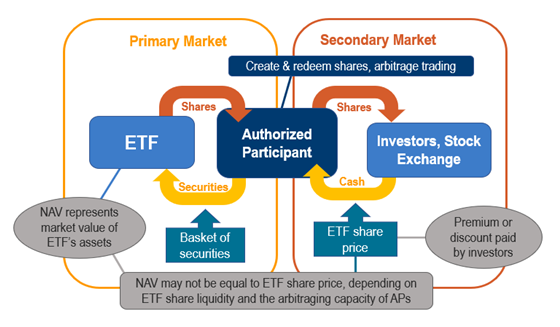
The ETF model is a sophisticated system involving several parties—fund managers, Authorized Participants (APs), investors, and regulators. Fund managers design ETF products, track indices, and adjust holdings to ensure the fund matches the target index. Authorized Participants (APs)—usually large financial institutions—handle primary market creation/redemption and provide secondary market liquidity.
When an investor buys ETF shares, APs deliver a basket of underlying assets to the fund to receive ETF shares; for redemptions, they return ETF shares for the underlying assets—dynamically adjusting supply in the market. This keeps ETF market prices in line with NAV over time, giving investors transparent pricing, flexible trading, and tax efficiency.
This collaborative process means that, compared to mutual funds, ETFs offer lower costs, greater transparency, and better tax efficiency, making them a preferred tool for today’s investors.
Product Landscape: A Toolkit for Diverse Investment Needs
The ETF market offers a broad range of products to meet different investment strategies. By investment target, ETFs fall into equity ETFs, bond ETFs, commodity ETFs, and money market ETFs.
Equity ETFs usually track specific stock indexes or sectors, such as the S&P 500, NASDAQ, or technology-focused ETFs. Bond ETFs invest in fixed income securities like government or corporate bonds, offering stable income. Commodity ETFs cover gold, oil, and other commodities, while money market ETFs focus on short-term cash instruments.
Recently, the rise of crypto assets has brought crypto ETFs into the market. In 2024, for example, the SEC approved spot Bitcoin ETFs—letting investors trade Bitcoin price movements through mainstream brokerage accounts, without managing private keys or wallets.
By investment strategy, ETFs are divided into passive ETFs and active ETFs. Passive ETFs aim to replicate the target index; they do not pick stocks or time the market. Active ETFs rely on managers’ decisions—picking stocks and adjusting allocations—to try to beat the benchmark.
This diversity of types and strategies gives investors flexible, efficient, and customizable tools for everything from long-term investing to short-term trading.
Core Mechanism: The Dynamic Balance of Creation and Redemption
Core Mechanism: The Dynamic Balance of Creation and Redemption
The ETF creation and redemption process is what sets ETFs apart from other products and keeps their price and NAV in sync. Authorized Participants (APs) play the key role, assembling the required ETF basket of securities to keep the fund operating efficiently.
For example, with an ETF tracking the S&P 500, APs buy the S&P 500 stocks in the right weights and deliver them to the ETF provider. The provider then gives the APs the same value in ETF shares, typically in “creation units” of about 50,000 ETF shares each.
When the ETF’s market price is above its NAV, APs can create ETF shares by buying the basket of stocks and selling the ETF in the open market—using arbitrage to bring the price back to fair value. When the market price is below NAV, the redemption process maintains the price/NAV link.
This dynamic creation and redemption mechanism keeps ETF pricing transparent and fair, while providing investors with an efficient, low-cost, and highly liquid investment option.
Key Differences: A Comprehensive ETF vs. Mutual Fund Comparison
ETFs and mutual funds are both fund structures, but they differ significantly in management style, trading mechanism, and fees.
ETFs are mainly passively managed—tracking indexes closely—while mutual funds are actively managed by professional teams seeking to outperform the market with excess returns.
ETFs can be bought and sold throughout the trading day at changing prices, while mutual funds are priced just once daily, based on their NAV. As a result, ETF prices can be more volatile and are better for active traders, while mutual funds’ steadier pricing is easier for beginners to grasp.
ETF fees are typically lower than mutual funds’. The asset-weighted average expense ratio for ETFs is around 0.15%, while active mutual funds are usually more expensive—one key reason many investors prefer ETFs.
This side-by-side view helps investors make informed choices between ETFs and mutual funds based on their own objectives, risk appetite, and trading style.
A Dual Perspective: ETF Investment Advantages and Risks
The core strengths of ETFs are diversification, low cost, and flexibility. Investors can use ETFs to access a wide range of asset classes—including domestic and international equities, bonds, and commodities—for efficient asset allocation.
From a cost perspective, ETFs usually have lower expense ratios. For instance, Schwab ETFs average just 0.04%—far lower than most actively managed mutual funds—saving long-term investors significant costs.
Trading flexibility is another major ETF benefit. Investors can trade ETFs anytime during market hours, like stocks, while mutual funds can only be traded once daily. This makes ETFs more suitable for active or short-term strategies.
Of course, ETFs carry risks. While they reduce single-stock risk, equity ETFs are generally more volatile than bond ETFs. Specialty products like leveraged ETFs and inverse ETFs carry even greater risks and are best suited for experienced investors.
By weighing the pros and cons, investors can match ETFs to their risk preferences and goals for more effective asset allocation.
Beginner’s Guide: A Practical ETF Starter Checklist
If you’re new to ETFs, preparation is key. Start by clarifying your investment objectives and risk tolerance—these will determine which ETF types are best for you.
Open a brokerage account as your first step, then begin trading ETFs. When choosing ETFs, new investors should focus on tracking error, expense ratios, and liquidity, as these impact performance and trading ease.
For risk-averse beginners, a standard cash account (without leverage) is a smart starting point. Those with advanced risk management skills might consider margin accounts for greater flexibility.
Start with broad market index ETFs like the S&P 500 ETF. These offer diversified risk, serve as a foundation for long-term portfolios, and help you learn ETF mechanics and trading practices while building wealth steadily.
By following this checklist, new investors can start their ETF journey in an organized way, minimize risk, and maximize long-term return potential.
Crypto Integration: The New Era of Bitcoin ETFs
BTC ETF
The lines between the crypto market and traditional finance (TradFi) are blurring, and Bitcoin ETFs are a prime example. In 2024, the SEC approved spot Bitcoin ETFs, allowing investors to trade Bitcoin price movements through conventional brokerage accounts—no private key management required—making crypto investing more accessible for traditional investors.
This innovation makes it easier for traditional investors to access crypto markets and brings more institutional capital and liquidity, boosting overall market activity.
On platforms like Gate, this integration goes further. For instance, with trending Chinese meme coins, Gate offers spot trading and leveraged ETF products for leading tokens, supporting 3L/3S long-short trading so users can participate in both rising and falling markets.
These products lower the barrier to entry, enabling users who don’t trade futures to participate easily. As of now, Gate leveraged ETFs cover 258 tokens, giving investors more choices for crypto asset allocation and trading.
With Bitcoin ETFs and leveraged products, investors can access crypto markets safely and flexibly through traditional accounts, achieving low-barrier crypto investing and broader diversification.
Multiple Paths: Achieving Total Asset Allocation with Gate
As the distinction between traditional financial ETFs and crypto assets fades, investors are no longer limited to a single market—they seek cross-market liquidity, diversification, and instant trading. The world’s total financial assets exceed $400 trillion, with equities, FX, and commodities at the forefront. Crypto’s $3 trillion market cap is steadily permeating traditional finance through rapid growth and innovation.
In this total asset allocation trend, the Gate platform provides unique tools for diversifying both traditional and crypto assets within one account.
Gate offers a broad cryptocurrency selection and innovative services like leveraged ETF products, giving investors new ways to participate in traditional and crypto markets.
For those seeking diversification, the Gate platform enables allocation across less-correlated asset types—including crypto assets, equity ETF portfolios, and commodities—for better risk management and optimized returns.
If you want to manage both crypto and traditional assets flexibly on one platform, use the feature comparison below to find the best total allocation tool for your strategy:
| Platform Name |
Core Features |
Main Asset Classes |
Key Advantages |
| Gate TradFi |
Spot and derivatives trading, leveraged ETFs, instant swap services |
Cryptocurrency, leveraged ETF products |
Wide asset coverage, rapid listings, high liquidity |
| Traditional Brokers (e.g., Interactive Brokers) |
Stocks, ETF, options trading |
Global equities, bonds, mutual funds |
Robust regulation, comprehensive offerings, institutional-grade tools |
Conclusion
Since the first U.S. ETF—the SPDR S&P 500 ETF (SPY)—launched in 1993, ETFs have given everyday investors access to diversified assets. Whether you’re tracking major indices like the S&P 500 or entering the crypto world with Bitcoin ETFs, ETFs have made high-barrier assets accessible to all, democratizing investment opportunities.
By mastering ETF mechanics, creation/redemption flows, product types, and ETF vs. mutual fund comparisons, investors can manage risk and returns more effectively. With the Gate platform, you can invest in traditional stocks, bonds, and commodities, as well as diversify with leveraged ETFs and innovative crypto products—such as popular Chinese meme coin leveraged ETFs—all in one account for true total asset allocation.
ETFs offer diversification, low cost, high transparency, and trading flexibility, but also come with specific risks. Whether you’re new to ETFs or a seasoned investor, understanding the core mechanisms, choosing suitable products, weighing pros and cons, and making use of platform tools helps you build efficient, robust, and diversified portfolios for long-term wealth creation in a multi-market world.
Further Reading