The New Era of Crypto Postage: A Complete Guide to Buying Shipping Labels with BTC

Beginner
Quick Reads
Last Updated 2026-03-29 04:08:28
Reading Time: 1m
Effortlessly buy USPS, FedEx, or UPS shipping labels with BTC or other cryptocurrencies—no credit card needed. The process is straightforward and secure. Learn how it works.


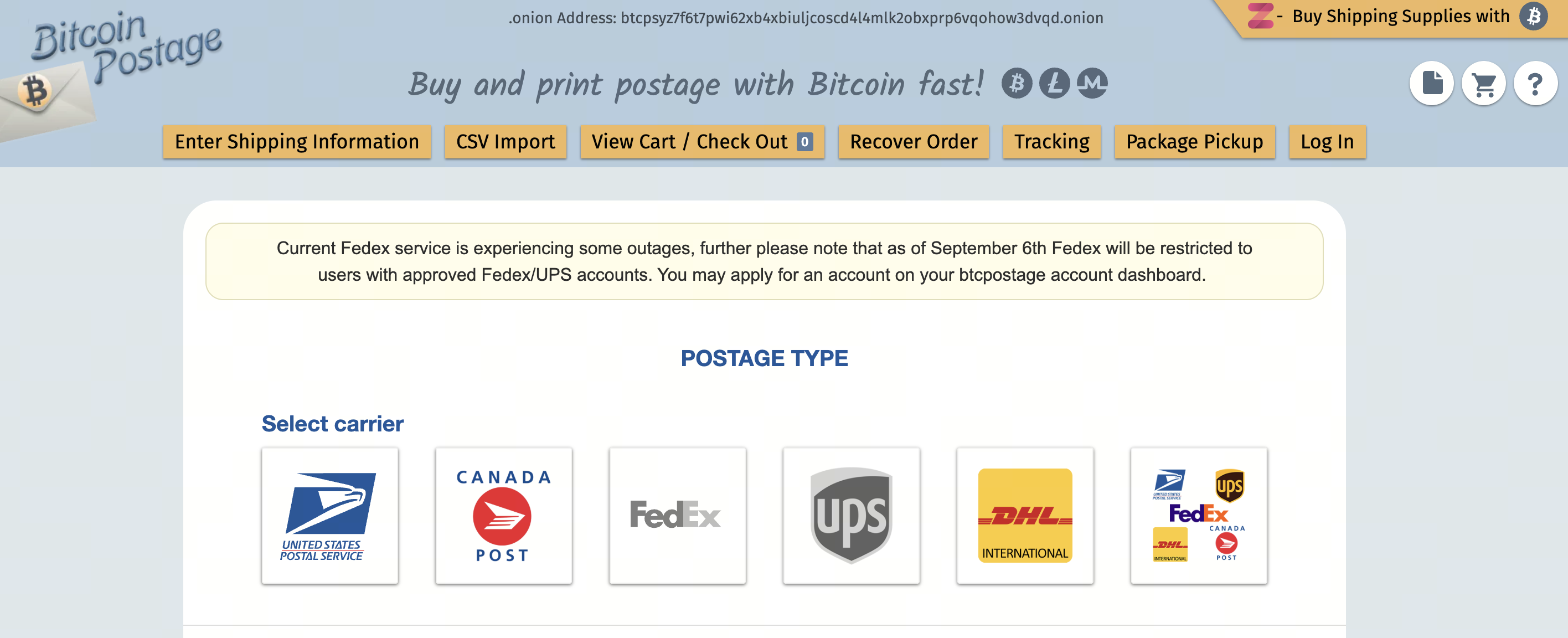
Image: https://btcpostage.com/

1. What Is BTC Postage?

BTC Postage is an innovative service that enables users to purchase shipping labels using cryptocurrencies such as Bitcoin, Litecoin, or Monero. This service supports major carriers, including USPS, FedEx, and UPS. Users do not need to register an account or link a credit card; they can use a crypto wallet to pay and print labels directly.

2. Why Pay for Postage with BTC?

  • Payment Flexibility: Send payments directly from your digital wallet—no banks or third-party processors required.
  • No Added Fees: Postage rates match those of conventional payment methods, with no extra surcharges.
  • Enhanced Privacy: No sensitive financial data is needed, offering greater transaction security.
  • Convenient Operation: Supports individual shipments as well as automated solutions via bulk uploads or e-commerce plugins.

3. How to Use BTC Postage: Step-by-Step Instructions

To use the platform, simply:

  • Select your carrier (USPS, UPS, or FedEx);
  • Enter package weight and dimensions;
  • Provide sender and recipient details;
  • Receive a system-generated postage rate;
  • Pay using BTC, LTC, or other supported cryptocurrencies;
  • Once payment is complete, download and print your electronic shipping label.

Labels can be printed multiple times but are valid for one-time use only. E-commerce sellers can also streamline operations by importing orders in bulk via CSV files.

4. International Shipping and Customs Declaration Details

For international shipments, users must specify package contents and declared value; the system automatically generates a customs declaration form. Select the item type (gift, merchandise, documents, etc.) to help ensure smooth customs clearance.

5. Cost Comparison With Traditional Payment Methods

BTC Postage rates are virtually identical to conventional payment options, with no additional service fees. The main advantage is greater payment freedom for cryptocurrency users—ideal for those lacking an international credit card or who prioritize privacy.

6. Other Market Services and Comparative Advantages

Several other crypto postage platforms provide similar features, focusing variously on lower pricing or broader coin support. BTC Postage stands out for its streamlined workflow and intuitive interface, making it particularly accessible for first-time users.

7. Key Considerations and Tips for Using BTC Postage

  • Monitor Coin Price Volatility: To lock in your rate, pay promptly after generating your order.
  • Enter Accurate Package Weight: Underestimating weight can lead to returns or additional fees.
  • Pay Within the Designated Window: Payment periods are limited; expired orders may need to be regenerated.
  • Add Tracking: For an extra fee, obtain a tracking number to help both sender and recipient monitor shipment status easily.
Author: Max
Disclaimer
* The information is not intended to be and does not constitute financial advice or any other recommendation of any sort offered or endorsed by Gate.
* This article may not be reproduced, transmitted or copied without referencing Gate. Contravention is an infringement of Copyright Act and may be subject to legal action.

Related Articles

AI-Native Settlement Layers: How United Stables Is Building the Next Financial Rail
Beginner

AI-Native Settlement Layers: How United Stables Is Building the Next Financial Rail

Stablecoins were originally designed as dollar substitutes within exchanges, primarily used for asset pricing and trade settlement. As on-chain financial ecosystems have matured, their role has expanded beyond simple payments to include collateral assets, cross-chain liquidity mediums, and unified settlement units. In particular, as AI systems and automated agents begin to participate directly in economic activity, demand has risen sharply for programmable value units capable of instant settlement. This shift is pushing stablecoins toward the role of foundational financial infrastructure.
2026-03-25 03:16:17
The ve(3,3) Flywheel Explained: How AERO Tokenomics Powers Aerodrome’s DeFi Economy
Beginner

The ve(3,3) Flywheel Explained: How AERO Tokenomics Powers Aerodrome’s DeFi Economy

In the competition for DeFi liquidity, high-inflation mining alone is no longer enough to build lasting advantages. Aerodrome applies the ve(3,3) economic model to redesign token emissions, voting mechanisms, and revenue distribution, creating a liquidity flywheel centered on governance and cash flow. This article examines AERO tokenomics, the veAERO locking mechanism, and protocol revenue models to explain how Aerodrome builds a sustainable DeFi economic system.
2026-03-25 06:41:58
Aerodrome Tokenomics: How ve(3,3) Powers Base's Most Profitable DEX
Beginner

Aerodrome Tokenomics: How ve(3,3) Powers Base's Most Profitable DEX

AERO is the native token of Aerodrome Finance, a core decentralized exchange and liquidity protocol in the Base ecosystem. It is primarily used for liquidity incentives and ecosystem operations. veAERO is a governance NFT that users receive by locking AERO, representing both voting power and the right to share protocol revenue. Through a dual track structure of AERO as a utility token and veAERO as a governance credential, Aerodrome separates liquidity usage value from long term governance power, allowing participants to act as liquidity providers, governance decision makers, and revenue sharers within the same system.
2026-03-25 06:40:31
DePIN Identity Network and Real World Applications: How Humanity Protocol Brings on-chain Identity Into the Physical World
Beginner

DePIN Identity Network and Real World Applications: How Humanity Protocol Brings on-chain Identity Into the Physical World

Most Web3 identity systems remain confined to on-chain environments and struggle to achieve meaningful adoption in real world settings. Through a DePIN architecture and physical verification hardware, Humanity Protocol aims to bring decentralized identity into access control systems, hospitality, public services, and offline events, allowing on-chain identity to function not just as a digital credential, but as foundational infrastructure for real world access.
2026-03-25 07:40:53
How is the price of PAXG determined? Pegging mechanism, trading depth, and influencing factors
Beginner

How is the price of PAXG determined? Pegging mechanism, trading depth, and influencing factors

PAXG (Pax Gold) is a tokenized asset backed by physical gold reserves, launched by fintech firm Paxos and issued as an ERC-20 token on the Ethereum blockchain. The core concept is to digitally represent real-world gold assets, allowing investors to hold and trade gold via the blockchain network. Because each PAXG token corresponds to a specific quantity of physical gold, its price is theoretically expected to closely track the global gold market.
2026-03-24 19:11:40
How Does PAXG Work? In-Depth Overview of the Physical Gold Tokenization Mechanism
Beginner

How Does PAXG Work? In-Depth Overview of the Physical Gold Tokenization Mechanism

PAXG (Pax Gold) is a tokenized asset backed by physical gold, issued by the fintech company Paxos and traded on the Ethereum blockchain as an ERC-20 token. The core concept is to tokenize physical gold on-chain, with each PAXG token representing ownership of a certain amount of gold. This structure enables investors to hold and trade gold in the form of a digital asset.
2026-03-24 19:12:51





