SEC Trading and Markets Division Clarifies Custody Standards for Crypto Asset Securities

Beginner
Quick Reads
Last Updated 2026-03-26 19:57:33
Reading Time: 1m
The SEC's Division of Trading and Markets has recently provided clarification on the "physical possession or control" requirement for crypto asset securities as stipulated in Rule 15c3-3 of the Securities Exchange Act.

Statement Background and Scope
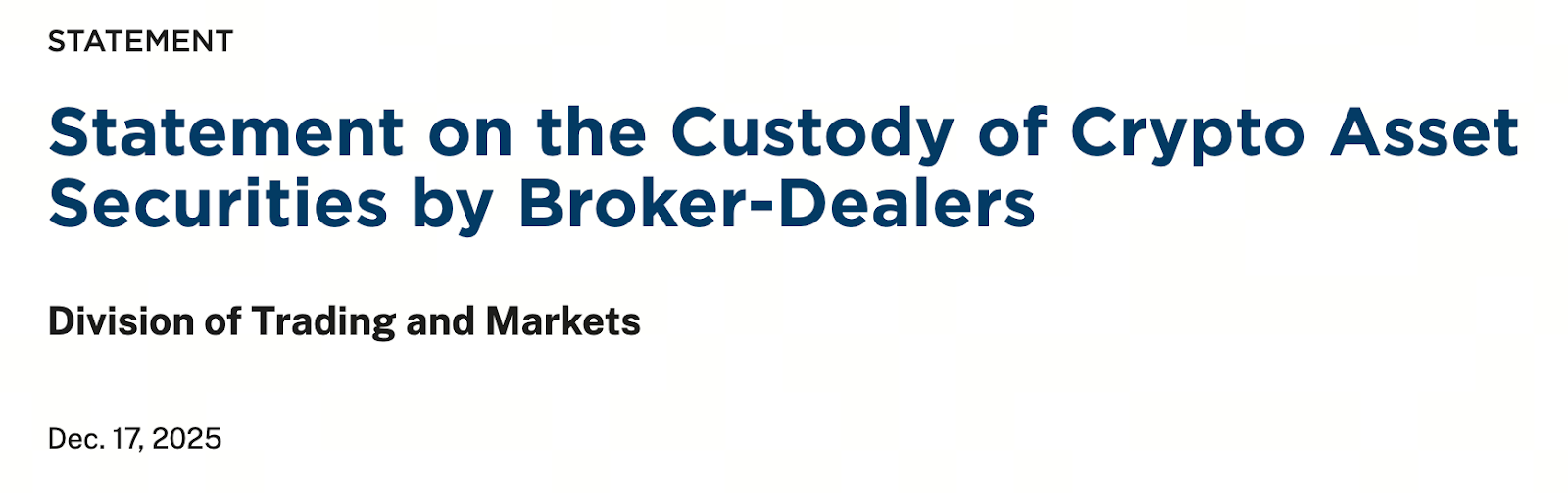

(Source: U.S. Securities and Exchange Commission)

The SEC’s Division of Trading and Markets issued this statement to clarify how Rule 15c3-3(b)(1) applies to crypto asset securities. This guidance is directed at all broker-dealers holding crypto asset securities for clients, including those also engaged in traditional securities business. It is important to emphasize that this statement reflects only the staff’s views; it is not an official rule or guidance and does not alter existing legal obligations. Instead, it serves as a transitional statement as regulators continue to evaluate related issues.

Core Requirements for Physical Possession under Rule 15c3-3

Under Rule 15c3-3, broker-dealers must promptly obtain and continuously maintain physical possession or control over customers’ “fully paid securities” and “excess margin securities.” This statement from the Division of Trading and Markets focuses solely on the criteria for “physical possession” and does not address other financial responsibility or compliance requirements. Provided certain conditions are met and proper measures are taken, regulators will not object to a broker-dealer regarding itself as having physical possession of clients’ crypto asset securities.

Direct Access and Transfer Capability for Crypto Assets

If a broker-dealer chooses to self-custody clients’ crypto asset securities, it must be able to directly access these assets and have the technical capability to transfer them on the relevant distributed ledger. This means the broker-dealer must have actual control over the asset’s technology and transfer mechanisms, not simply rely on third parties.

Risk Assessment Mechanisms for Distributed Ledger Technology

Before taking on custody of crypto asset securities, broker-dealers must develop and implement written policies and procedures to assess the distributed ledger technology and its network used by the asset, and must review these assessments regularly.

Evaluations must address system performance, scalability, security, governance structure, and the impact of protocol updates, hard forks, or other technical changes. The goal is to identify significant technical or operational risks that could affect the broker-dealer’s ability to hold the assets and to implement effective risk controls.

Do Not Treat as Held When Major Issues Exist

If a broker-dealer is aware of significant security flaws or operational issues in the technology or network supporting a crypto asset, or if these present material risks to its business, the asset should not be considered as held by the broker-dealer. This determination is focused on risks directly tied to custody, not market volatility or reputational factors.

Private Key Security and Access Controls

Broker-dealers must establish internal controls that meet industry best practices to prevent theft, loss, or unauthorized use of private keys. Policies and controls must ensure that, except for the broker-dealer itself, no third party—including clients or affiliates—can transfer crypto assets without authorization.

Asset Protection and Contingency Planning for Emergencies

Broker-dealers must have clear contingency plans for scenarios such as blockchain failures, 51% attacks, hard forks, or airdrops to ensure the security and accessibility of crypto asset securities during unexpected events.

These arrangements must also provide for compliance with legal asset freezes or transfers and enable the smooth transfer of assets to a qualified receiver if the broker-dealer ceases operations, enters liquidation, or bankruptcy proceedings.

Statement Nature and Compliance Reminder

The Division of Trading and Markets emphasizes that this statement does not create new legal obligations and does not replace existing broker-dealer duties regarding investment advice, suitability, or best interest standards. All related assessments and actions must still comply with other applicable regulations.

To learn more about Web3, click to register: https://www.gate.com/

Summary

This statement from the SEC’s Division of Trading and Markets does not introduce a new regulatory framework for crypto asset securities. Instead, it clarifies under what conditions broker-dealers may be considered to have physical possession of crypto asset securities in terms of technology, risk management, and operations under the existing Rule 15c3-3. For the market, this shows regulators are seeking a practical path for compliant custody of crypto asset securities without amending current rules, while sending a clear signal that compliance is achievable, though subject to strict standards.

Author: Allen
Disclaimer
* The information is not intended to be and does not constitute financial advice or any other recommendation of any sort offered or endorsed by Gate.
* This article may not be reproduced, transmitted or copied without referencing Gate. Contravention is an infringement of Copyright Act and may be subject to legal action.

Related Articles

AI-Native Settlement Layers: How United Stables Is Building the Next Financial Rail
Beginner

AI-Native Settlement Layers: How United Stables Is Building the Next Financial Rail

Stablecoins were originally designed as dollar substitutes within exchanges, primarily used for asset pricing and trade settlement. As on-chain financial ecosystems have matured, their role has expanded beyond simple payments to include collateral assets, cross-chain liquidity mediums, and unified settlement units. In particular, as AI systems and automated agents begin to participate directly in economic activity, demand has risen sharply for programmable value units capable of instant settlement. This shift is pushing stablecoins toward the role of foundational financial infrastructure.
2026-03-25 03:16:17
DePIN Identity Network and Real World Applications: How Humanity Protocol Brings on-chain Identity Into the Physical World
Beginner

DePIN Identity Network and Real World Applications: How Humanity Protocol Brings on-chain Identity Into the Physical World

Most Web3 identity systems remain confined to on-chain environments and struggle to achieve meaningful adoption in real world settings. Through a DePIN architecture and physical verification hardware, Humanity Protocol aims to bring decentralized identity into access control systems, hospitality, public services, and offline events, allowing on-chain identity to function not just as a digital credential, but as foundational infrastructure for real world access.
2026-03-25 07:40:53
Gold Price Forecast for the Next Five Years: 2026–2030 Trend Outlook and Investment Implications, Could It Reach $6,000?
Beginner

Gold Price Forecast for the Next Five Years: 2026–2030 Trend Outlook and Investment Implications, Could It Reach $6,000?

Analyze current gold price trends alongside authoritative five-year forecasts, integrating an evaluation of market risks and opportunities. This gives investors insight into the potential trajectory of gold prices and the main drivers expected to shape the market over the next five years.
2026-03-25 18:13:30
Aster vs Hyperliquid: Which Perp DEX Will Prevail?
Beginner

Aster vs Hyperliquid: Which Perp DEX Will Prevail?

Aster and Hyperliquid are the two representative protocols of the "purpose-built L1 path" within the current decentralized perpetual exchange (Perp DEX) sector. As a pioneer in the field, Hyperliquid has built a deep liquidity moat through its highly mature order book architecture and strong community consensus. Conversely, Aster, as a rising challenger, seeks to leapfrog the competition in high-performance trading through more aggressive multi-chain aggregation logic, private transaction modules, and an underlying execution environment optimized for 2026 market demands.
2026-03-24 11:58:33
Aerodrome Tokenomics: How ve(3,3) Powers Base's Most Profitable DEX
Beginner

Aerodrome Tokenomics: How ve(3,3) Powers Base's Most Profitable DEX

AERO is the native token of Aerodrome Finance, a core decentralized exchange and liquidity protocol in the Base ecosystem. It is primarily used for liquidity incentives and ecosystem operations. veAERO is a governance NFT that users receive by locking AERO, representing both voting power and the right to share protocol revenue. Through a dual track structure of AERO as a utility token and veAERO as a governance credential, Aerodrome separates liquidity usage value from long term governance power, allowing participants to act as liquidity providers, governance decision makers, and revenue sharers within the same system.
2026-03-25 06:40:31
The ve(3,3) Flywheel Explained: How AERO Tokenomics Powers Aerodrome’s DeFi Economy
Beginner

The ve(3,3) Flywheel Explained: How AERO Tokenomics Powers Aerodrome’s DeFi Economy

In the competition for DeFi liquidity, high-inflation mining alone is no longer enough to build lasting advantages. Aerodrome applies the ve(3,3) economic model to redesign token emissions, voting mechanisms, and revenue distribution, creating a liquidity flywheel centered on governance and cash flow. This article examines AERO tokenomics, the veAERO locking mechanism, and protocol revenue models to explain how Aerodrome builds a sustainable DeFi economic system.
2026-03-25 06:41:58





