Kalshi: The U.S. Predictions Exchange Turning Real-World Events Into Tradable Markets

Beginner
Quick Reads
Last Updated 2026-03-27 15:08:07
Reading Time: 1m
Kalshi is the first regulated centralized prediction market in the United States to offer order matching for event-based contracts. Users can trade directly in US dollars on events with definitive outcomes. Examples include policy approvals, temperature outcomes, or corporate mergers occurring.

Kalshi’s Market Logic
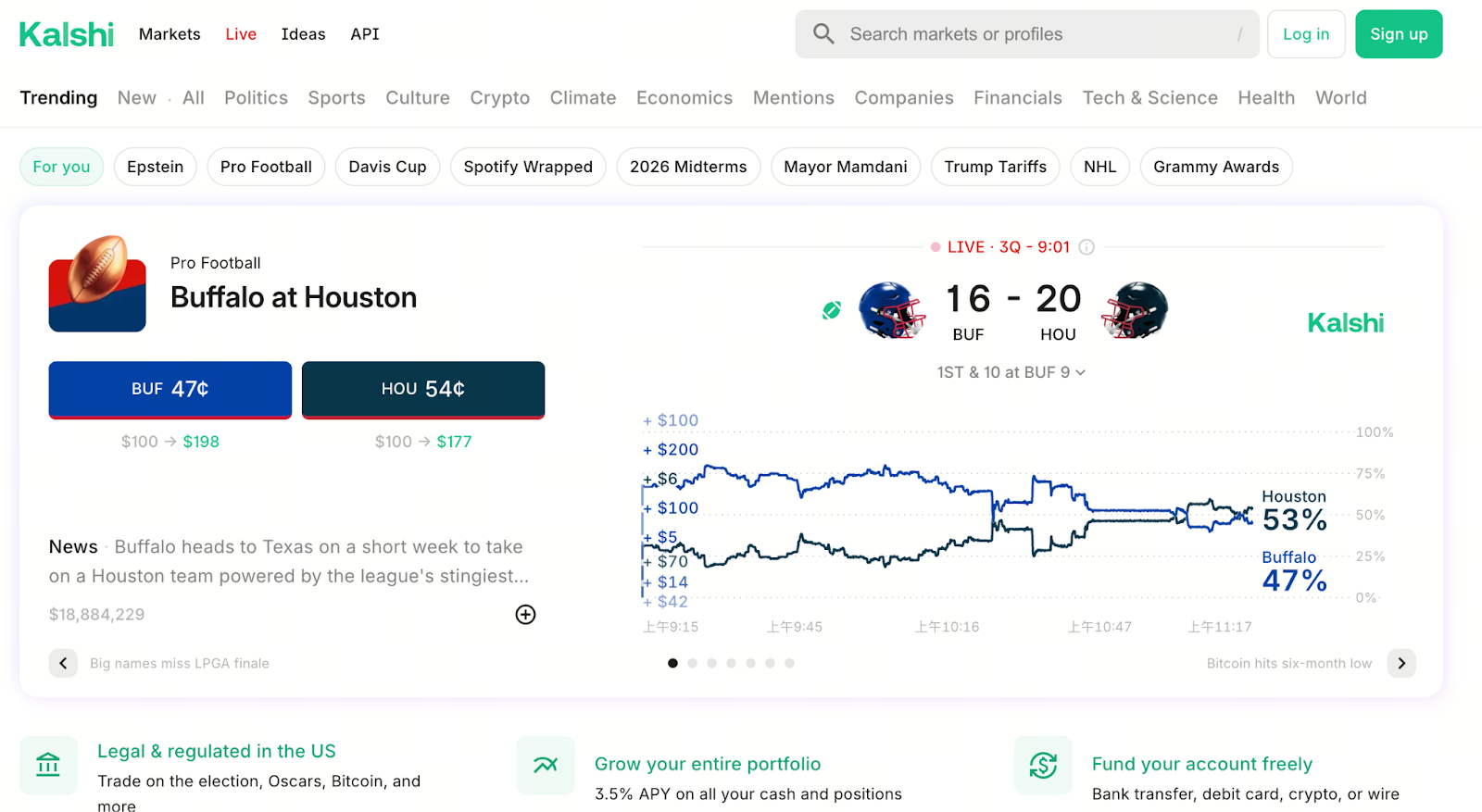

(Source: Kalshi)

In the United States, Kalshi is redefining how events are valued through an innovative approach. The company has established a centralized prediction market platform where anyone can take positions based on their analysis of real-world occurrences, turning the future into a tradable asset. The platform covers a diverse range of topics:

  • Whether the temperature exceeds a specific threshold.
  • Whether economic policies will be enacted.
  • Whether corporations will undergo significant changes.
  • And even trending events in the entertainment industry.

Kalshi may design any event with a clearly defined, objectively verifiable outcome as a tradable contract market.

Founding Team Background

Both of Kalshi’s founders, Tarek Mansour and Luana Lopes Lara, come from the hedge fund trading sector. They met at MIT, where they studied computer science and mathematics. This expertise enables them to apply data analysis, modeling, and risk management principles to market design. This establishes Kalshi’s professional foundation.

Core Principles of Event Contracts

Each Kalshi market operates on a straightforward, precise principle: event outcome → Yes or No → price reflects market expectations. The price of each contract captures participants’ real-time assessments, aggregating collective intelligence into a quantifiable result. This event prediction financial model transforms market prices into a valuable information resource.

For example:

If the “Yes” contract price for a policy passing is 0.67, the market consensus is a 67% probability that the event will happen.

Financial-Grade Architecture

Kalshi’s operations do not resemble gambling as it is commonly perceived; instead, the platform adopts mechanisms consistent with traditional financial markets:

  • Order book system with bidding and matching functionality
  • USD as the primary trading currency
  • Comprehensive clearing procedures and adherence to a regulatory framework

These mechanisms ensure transparent pricing and clear fund flows. Every transaction is settled under established protocols, positioning Kalshi as one of the few fully compliant, institutional platforms in the U.S. for event-driven market trading.

Significant Capital Inflows

Kalshi’s recent fundraising has renewed interest in prediction markets. According to multiple reports:

  • The latest round raised $1 billion, pushing its valuation past $11 billion
  • Less than two months prior, Kalshi completed a $300 million round, with a valuation of $5 billion

This rapid growth is uncommon in the startup sector. It highlights strong investor confidence in prediction markets.

Lead investors include Sequoia Capital and CapitalG, while other notable investors include Andreessen Horowitz, Paradigm, Anthos Capital, and Neo. These firms have deep roots in technology and finance, and their participation signals a shift: event-based markets are evolving from niche concepts into mainstream financial instruments.

Legal and Regulatory Challenges

Prediction markets have always been subject to debate, sitting at the intersection of financial instruments and gaming. They routinely face regulatory and legal scrutiny. However, Kalshi’s model has received endorsements from major institutions. By using USD, implementing an order book system, and following regulatory compliance protocols, Kalshi positions itself as more closely aligned with financial markets than with gambling products.

If you want to explore more Web3 content, register here: https://www.gate.com/

Conclusion

By offering a structured, regulated platform, Kalshi empowers users to transform, quantify, and trade on their outlooks on future events. It is not simply about betting on outcomes; it is a new way to understand collective market expectations. With substantial capital, regulatory alignment, and a professional team, Kalshi is shaping a new mainstream market for event-based trading.

Disclaimer
* The information is not intended to be and does not constitute financial advice or any other recommendation of any sort offered or endorsed by Gate.
* This article may not be reproduced, transmitted or copied without referencing Gate. Contravention is an infringement of Copyright Act and may be subject to legal action.

Related Articles

AI-Native Settlement Layers: How United Stables Is Building the Next Financial Rail
Beginner

AI-Native Settlement Layers: How United Stables Is Building the Next Financial Rail

Stablecoins were originally designed as dollar substitutes within exchanges, primarily used for asset pricing and trade settlement. As on-chain financial ecosystems have matured, their role has expanded beyond simple payments to include collateral assets, cross-chain liquidity mediums, and unified settlement units. In particular, as AI systems and automated agents begin to participate directly in economic activity, demand has risen sharply for programmable value units capable of instant settlement. This shift is pushing stablecoins toward the role of foundational financial infrastructure.
2026-03-25 03:16:17
DePIN Identity Network and Real World Applications: How Humanity Protocol Brings on-chain Identity Into the Physical World
Beginner

DePIN Identity Network and Real World Applications: How Humanity Protocol Brings on-chain Identity Into the Physical World

Most Web3 identity systems remain confined to on-chain environments and struggle to achieve meaningful adoption in real world settings. Through a DePIN architecture and physical verification hardware, Humanity Protocol aims to bring decentralized identity into access control systems, hospitality, public services, and offline events, allowing on-chain identity to function not just as a digital credential, but as foundational infrastructure for real world access.
2026-03-25 07:40:53
Gold Price Forecast for the Next Five Years: 2026–2030 Trend Outlook and Investment Implications, Could It Reach $6,000?
Beginner

Gold Price Forecast for the Next Five Years: 2026–2030 Trend Outlook and Investment Implications, Could It Reach $6,000?

Analyze current gold price trends alongside authoritative five-year forecasts, integrating an evaluation of market risks and opportunities. This gives investors insight into the potential trajectory of gold prices and the main drivers expected to shape the market over the next five years.
2026-03-25 18:13:30
Aster vs Hyperliquid: Which Perp DEX Will Prevail?
Beginner

Aster vs Hyperliquid: Which Perp DEX Will Prevail?

Aster and Hyperliquid are the two representative protocols of the "purpose-built L1 path" within the current decentralized perpetual exchange (Perp DEX) sector. As a pioneer in the field, Hyperliquid has built a deep liquidity moat through its highly mature order book architecture and strong community consensus. Conversely, Aster, as a rising challenger, seeks to leapfrog the competition in high-performance trading through more aggressive multi-chain aggregation logic, private transaction modules, and an underlying execution environment optimized for 2026 market demands.
2026-03-24 11:58:33
Aerodrome Tokenomics: How ve(3,3) Powers Base's Most Profitable DEX
Beginner

Aerodrome Tokenomics: How ve(3,3) Powers Base's Most Profitable DEX

AERO is the native token of Aerodrome Finance, a core decentralized exchange and liquidity protocol in the Base ecosystem. It is primarily used for liquidity incentives and ecosystem operations. veAERO is a governance NFT that users receive by locking AERO, representing both voting power and the right to share protocol revenue. Through a dual track structure of AERO as a utility token and veAERO as a governance credential, Aerodrome separates liquidity usage value from long term governance power, allowing participants to act as liquidity providers, governance decision makers, and revenue sharers within the same system.
2026-03-25 06:40:31
The ve(3,3) Flywheel Explained: How AERO Tokenomics Powers Aerodrome’s DeFi Economy
Beginner

The ve(3,3) Flywheel Explained: How AERO Tokenomics Powers Aerodrome’s DeFi Economy

In the competition for DeFi liquidity, high-inflation mining alone is no longer enough to build lasting advantages. Aerodrome applies the ve(3,3) economic model to redesign token emissions, voting mechanisms, and revenue distribution, creating a liquidity flywheel centered on governance and cash flow. This article examines AERO tokenomics, the veAERO locking mechanism, and protocol revenue models to explain how Aerodrome builds a sustainable DeFi economic system.
2026-03-25 06:41:58





