Amid the rapid growth of the Solana DeFi ecosystem, liquidity has become a critical factor in determining protocol stability and trading efficiency. Traditional liquidity protocols typically rely on fixed distribution models, which lead to underutilized capital. Meteora addresses these challenges by implementing dynamic liquidity management and flexible return mechanisms, establishing a new foundational layer for liquidity infrastructure.
From a broader digital assets perspective, Meteora is not just a liquidity protocol—it is evolving into a core component that connects trading, token issuance, and return management. Centered around the Meteora Dynamic Liquidity Pool Mechanism and its positioning as Solana's liquidity infrastructure, the Meteora ecosystem is expanding into a comprehensive suite of liquidity products.
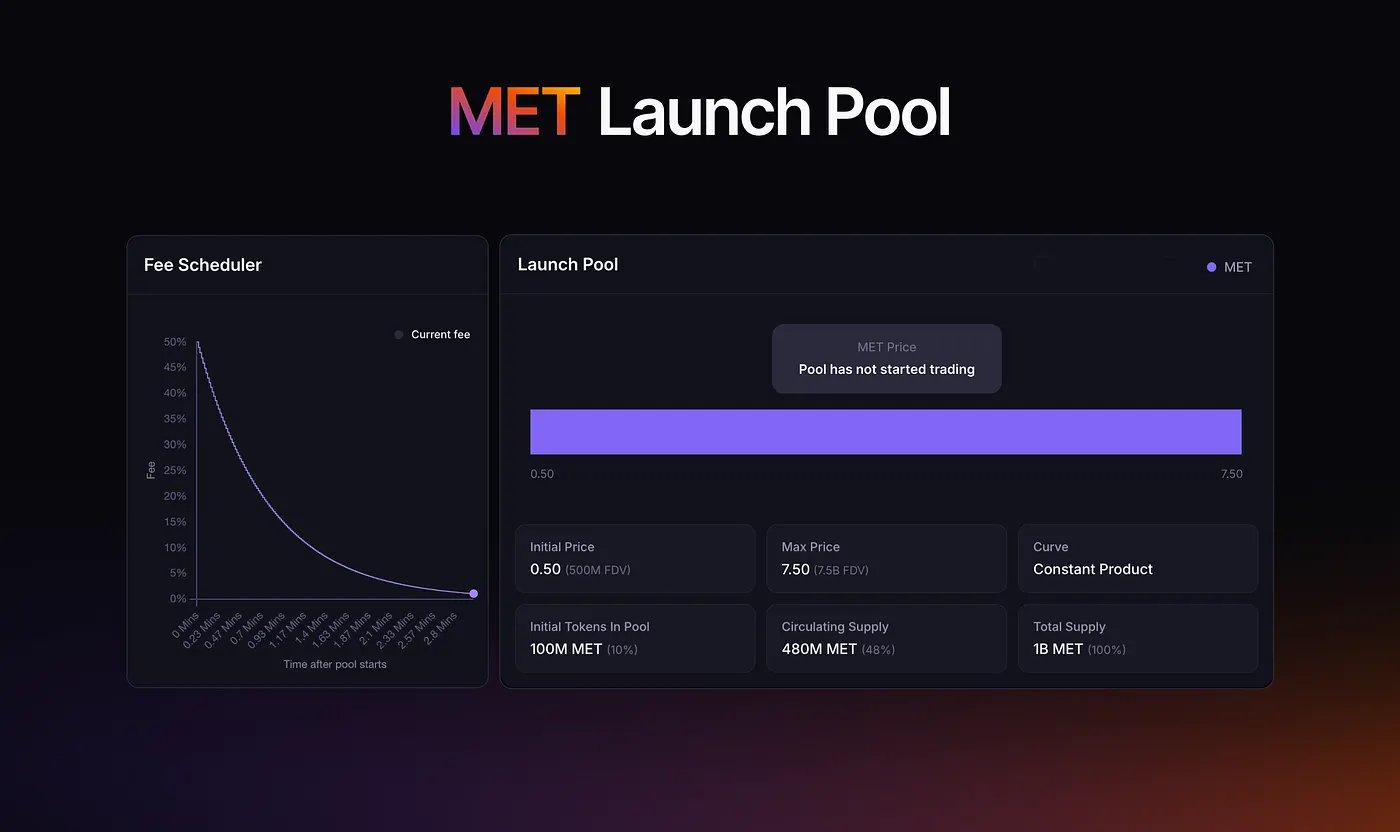
Source: meteora.ag
Meteora (MET): Project Background and Origins
As the DeFi ecosystem matures, liquidity has become the backbone of blockchain-based financial systems. Whether for decentralized exchanges, stablecoin protocols, or new token launches, liquidity pools serve as essential infrastructure. Meteora was created to address the inefficiencies of traditional liquidity models, specifically the issue of low capital efficiency.
In DeFi's early days, liquidity pools often used the constant product model. While straightforward, this approach left much of the capital idle, especially within narrow price ranges, resulting in reduced overall returns. As the DeFi market has grown, optimizing liquidity has become a primary focus.
Meteora introduced the concept of "dynamic liquidity pools," enabling funds to automatically redistribute in response to market demand. This innovation sets Meteora apart from traditional models and underpins the DLMM (Dynamic Liquidity Market Maker) mechanism.
With the expansion of the Solana ecosystem and the proliferation of new projects and tokens, the need for liquidity bootstrapping has surged. By building out liquidity infrastructure, Meteora offers a token liquidity bootstrapping mechanism for new projects, further solidifying its ecosystem role.
Meteora's Role in the Solana DeFi Ecosystem
Within Solana DeFi, Meteora is positioned as a liquidity infrastructure layer—not just a single trading protocol. Its core function is to deliver liquidity support across multiple protocols and applications, thereby improving overall market efficiency.
While Solana hosts numerous trading protocols and return platforms, each typically requires its own liquidity. Meteora's shared liquidity pools and dynamic adjustment mechanisms reduce fragmentation and maximize capital utilization.
This architecture makes Meteora a vital connector for DeFi applications. For example:
-
New projects can launch liquidity through Meteora
-
DeFi protocols can access deeper markets via Meteora
-
Users can participate in return strategies through Meteora
As this model evolves, Meteora’s role as Solana’s liquidity layer becomes increasingly pronounced, and its ecosystem partnership structure continues to grow.
Why Meteora Is Considered a Liquidity Optimization Protocol
Meteora earns its reputation as a liquidity optimization protocol thanks to its dynamic liquidity distribution and return optimization design.
Whereas traditional pools spread funds evenly across the price range, Meteora dynamically concentrates liquidity in active trading zones. This approach boosts capital utilization and reduces idle funds.
Meteora also features a dynamic fee mechanism, adjusting trading fees in line with market volatility. This enables liquidity providers to capture higher returns during periods of heightened volatility.
At the heart of this system is the Dynamic Liquidity Market Maker (DLMM) model, one of Meteora’s core innovations. Additionally, the dynamic fee mechanism and yield optimization strategies make liquidity provision more adaptable and efficient.
These features set Meteora apart from conventional AMM models.
How Meteora Differs from Traditional AMM Liquidity Protocols
Meteora’s primary distinction from traditional Automated Market Makers (AMMs) lies in its approach to liquidity management.
Traditional AMMs maintain fixed capital distribution, but Meteora employs dynamic liquidity distribution. This shift directly impacts capital efficiency and return structures.
Moreover, while standard AMMs focus mainly on trading, Meteora emphasizes both liquidity management and return optimization. In essence, Meteora is not just a trading platform—it is also a liquidity management solution.
| Comparison Dimension |
Traditional AMM Liquidity Protocol |
Meteora Liquidity Protocol |
Key Advantage (Meteora) |
| Liquidity Management |
Fixed Liquidity Distribution |
Dynamic Liquidity Distribution |
Higher capital utilization, real-time market adjustment |
| Capital Efficiency |
Lower, funds often idle or underused |
Higher, dynamic adjustment greatly enhances efficiency |
Minimizes capital waste, improves overall return % |
| Core Function |
Primarily trading |
Dual focus: trading and liquidity management |
Upgrades from trading platform to liquidity optimization platform |
| Fee Mechanism |
Fixed trading fees |
Dynamic trading fees |
Intelligently adapts to market volatility, more flexible |
| Yield Optimization |
Basic returns from trading fees |
Advanced yield optimization mechanisms |
Delivers higher compound returns and risk management for LPs |
| Overall Positioning |
Basic trading infrastructure |
Advanced liquidity and yield optimization protocol |
Creates a differentiated edge in the Solana ecosystem |
Meteora introduces key innovations:
These features give Meteora a unique edge within Solana and drive the evolution of Solana’s liquidity protocols.
Meteora's Core Products and Functional Structure
Meteora delivers a suite of liquidity products as part of its core offering, including:
DLMM (Dynamic Liquidity Market Maker)
DLMM is among Meteora’s flagship products, enabling liquidity providers to adjust fund allocation based on market volatility while supporting dynamic fee structures.
This model allows providers to select different volatility strategies, enhancing return efficiency—a central element of the Meteora Dynamic Liquidity Pool Mechanism.
DAMM v1 / DAMM v2
DAMM represents Meteora’s dynamic automated market maker models:
These options cater to a range of liquidity providers and establish a multi-layered liquidity structure.
Dynamic Bonding Curve (DBC)
DBC empowers project teams to launch tokens using a dynamic price curve, migrating to a liquidity pool once specific conditions are met.
This mechanism supports:
-
Token launches
-
Liquidity creation
-
Market formation
This structure reinforces the Meteora token launch ecosystem.
Meteora’s Role and Impact in the Solana Ecosystem
As Solana DeFi expands, Meteora’s influence grows. Its primary impacts include:
First, Meteora supplies liquidity infrastructure, simplifying market launches for new projects. Second, it enhances capital utilization, increasing trading efficiency.
Meteora also supports stablecoin liquidity and cross-asset trading, further strengthening Solana’s competitiveness.
With this foundation, Meteora’s role in the Solana DeFi ecosystem continues to expand, making it a critical part of the liquidity layer.
Meteora’s Development Roadmap and Ecosystem Expansion
As DeFi evolves, Meteora’s features are continuously expanding. For example:
Meteora has also introduced:
-
Alpha Vault
-
Stake2Earn
-
Dynamic Vault
These innovations further broaden its liquidity ecosystem and drive the expansion of Meteora’s liquidity infrastructure.
As more projects integrate, Meteora’s ecosystem is steadily maturing into a comprehensive system.
Summary
Meteora is a liquidity optimization protocol within the Solana ecosystem. By leveraging dynamic liquidity pools and yield optimization mechanisms, it maximizes capital efficiency and supports the growth of DeFi. As the ecosystem expands, Meteora is emerging as a foundational layer of liquidity infrastructure.
FAQ
What is Meteora (MET)?
Meteora is a liquidity optimization protocol built on Solana, offering dynamic liquidity pools and yield optimization mechanisms.
How does Meteora differ from traditional AMMs?
Meteora employs a dynamic liquidity model, while traditional AMMs use fixed liquidity distribution.
What are Meteora’s core products?
The core products include DLMM, DAMM v1/v2, and Dynamic Bonding Curve.
What role does Meteora play in the Solana ecosystem?
Meteora provides liquidity infrastructure and supports the development of DeFi applications.
Is Meteora a decentralized exchange?
Meteora functions more as liquidity infrastructure rather than a traditional DEX.