Summary
- Bitcoin reclaimed the $65,000 level, with the long/short ratio rising to a four-week high. Ethereum stabilized and rebounded from the $1,734–$1,800 support zone, climbing back above $2,000.
- Driven by expectations of a Gate listing, CRYPTOBURG surged 253.78% in 24 hours. MBX spot trading volume jumped over 1,125%, with the token gaining 36.44%.
- NVIDIA reported 73% Q4 revenue growth, while Jensen Huang raised the company’s $500 billion revenue outlook. Meanwhile, short positions increased, and Bitcoin exchange funding rates turned negative again in February.
- ZachXBT’s teaser of a major on-chain investigation sparked speculation over alleged insider trading at a crypto giant. An Ethereum Foundation researcher also proposed a draft roadmap featuring seven forks.
- Over the past week, eight crypto and crypto-related projects announced completed financings or M&A deals, spanning trading terminals, AI, and stablecoin payments.
- SUI, JUP, and GRASS are set to unlock approximately $41.99M, $40.61M, and $11.40M worth of tokens, respectively, over the next seven days.
Market Overview
Market Commentary
- BTC Market Update — Following Trump’s remarks, Bitcoin reclaimed the $65,000 level, while the long/short ratio climbed to a four-week high. This rally resonated with the rebound in equities. However, the bounce still lacks strong follow-through momentum. Historical patterns suggest that rapidly rising FOMO sentiment often coincides with short-term peaks. The current surge in optimism overlaps with notable technical resistance in the $66,000–$68,500 range, which may become a key zone for renewed selling pressure. On the 4-hour timeframe, Bitcoin has broken below the price compression structure formed since February, with downside momentum clearly released, further confirming that bears remain dominant. Without a decisive breakout, BTC is likely to trade sideways between the $60,000 demand zone and the $70,000 upper boundary in the near term.
- ETH Market Update — From a daily structure perspective, Ethereum stabilized and rebounded from the $1,734–$1,800 support zone, reclaiming the $2,000 level. Nevertheless, the broader trend remains within a descending channel. Repeated rejection near overhead resistance indicates that no substantive trend reversal has occurred yet. This phase can be viewed as a consolidation with relatively balanced bullish and bearish forces. Immediate resistance lies in the $2,050–$2,100 range, followed by the recent range high around $2,149–$2,150. Downside risks persist. Should the rebound lose momentum and price weaken again, a daily close below $1,800 could trigger a retest of the lower boundary near $1,750, with potential extension toward the $1,670–$1,700 support region.
- Altcoins — Macro factors and improving market sentiment have lifted risk appetite. Following Bitcoin’s initial rebound, capital has begun rotating into altcoins. The Crypto Fear & Greed Index has risen to 16, though overall sentiment remains in the “Extreme Fear” zone.
- Stablecoins — The total stablecoin market capitalization currently stands at $309.679 billion, increasing by $1.795 billion over the past week, a gain of 0.58%.
- Gas Fees — Ethereum network gas fees remained below 1 Gwei for most of the past week. The highest single-hour peak on February 25 was 0.161 Gwei. As of February 26, the daily average gas fee stands at 0.145 Gwei.
Trending Tokens
Over the past 24 hours, the crypto market has shown broadly strong performance, with risk appetite rebounding. The current rally appears to be driven more by market sentiment and trading activity rather than by a meaningful influx of new capital. Among major assets, ETH (+6.00%) and SOL (+6.43%) led the gains and stood out. In the altcoin segment, CRYPTOBURG, POWER, and MBX delivered notable moves. A detailed analysis follows.
CRYPTOBURG – Crypto Burger (+253.78%, Circulating Market Cap: $375M)
According to Gate market data, CRYPTOBURG is currently priced at $17.689, surging over 253.78% in the past 24 hours. Crypto Burger represents a rare blend of “cultural phenomenon + infrastructure” within the Bitcoin ecosystem. Originating from the real-world cultural narrative of “buying a burger with Bitcoin,” it has evolved from the top-ranked Runes meme token on Odin.fun into a Bitcoin-based smart execution and payment layer. Its core technical innovation lies in a “state anchoring + external execution” architecture, enabling BTC and Runes assets to achieve automated cross-chain payments and settlement without altering Bitcoin’s security model. The price surge has been largely fueled by expectations of exchange listings. The launch of spot trading on Gate significantly improved liquidity and market visibility. Meanwhile, the introduction of the HODLer Airdrop strengthened holding incentives and short-term demand, encouraging early positioning. The combined effects of listing anticipation and airdrop incentives amplified trading activity and bullish sentiment.
MBX – Marblex (+36.44%, Circulating Market Cap: $16.94M)
According to Gate market data, MBX is currently trading at $0.06291, rising more than 36.44% over the past 24 hours. Marblex (MBX) is a blockchain-based gaming service company focused on delivering AAA-quality games and building a high-quality blockchain gaming ecosystem. The platform offers services including a crypto wallet, decentralized exchange, token investment plans, and an NFT marketplace. Recently, MBX spot trading volume spiked by over 1,125%, reaching $5.19M, signaling strong speculative buying pressure. Social metrics indicate MBX repeatedly ranked among the top gainers on certain exchanges. As the rally appears to be driven primarily by trading momentum and capital flows rather than fundamental developments, the token may face rapid downside risk if volume declines.
POWER – Power Protocol (+32.92%, Circulating Market Cap: $187M)
According to Gate market data, POWER is currently priced at $0.8980, gaining 32.92% in the past 24 hours. Power Protocol functions as an incentive layer designed to connect mainstream applications to Web3 by converting user behavior and application revenue into on-chain rewards. The protocol transforms user participation into tangible economic value, providing millions of Web2 users with their first meaningful on-chain experiences across gaming, consumer apps, and creator platforms. The rally coincided with speculative discussions on social media, including an unverified post questioning whether Ronin had announced plans to “flip $Power in the first week of March.” Another post listed POWER among tokens expected to benefit from an upcoming altcoin season. Such unconfirmed narratives likely triggered FOMO-driven buying rather than fundamentals-based investment.
Key Market Data Highlights
NVIDIA Q4 Revenue Surges 73%, Jensen Huang Raises $500 Billion Revenue Outlook
On February 26, NVIDIA released its earnings report. For the fourth quarter of fiscal year 2026 (ended January 31, 2026), NVIDIA’s revenue increased 73% year-over-year to $68.127 billion. The growth rate significantly exceeded the previous quarter’s 62% and surpassed NVIDIA’s own midpoint guidance of $65 billion. The data center segment—contributing over 90% of total revenue—also reached a new single-quarter revenue record, beating analyst expectations by more than 3%. For the full fiscal year, NVIDIA achieved a record-high annual revenue of $215.938 billion, representing a 65% year-over-year increase.
Profitability in Q4 remained robust. On a non-GAAP basis, adjusted earnings per share (EPS) rose more than 80% year-over-year, exceeding analyst estimates by approximately 5.9%. Gross margin climbed above expectations to 75.2%, marking a one-and-a-half-year high.
Even more encouraging for investors, NVIDIA’s guidance for the first quarter of fiscal year 2027 also came in stronger than expected. Revenue is projected to hit another record high, with the midpoint of guidance standing 7.1% above the analyst consensus and even 4% higher than buy-side optimistic forecasts. Year-over-year growth is expected to accelerate to nearly 77%. This strong earnings report underscores that high-end computing power is likely to remain a scarce strategic resource for a prolonged period, reinforcing the fundamental thesis behind projects integrating blockchain and AI.
Short Positions Rise as Bitcoin Exchange Funding Rates Turn Negative Again in February
Following the recent wave of sell-offs, funding rates across exchanges have turned negative, reflecting an increase in short positions and a shift toward cautious market sentiment. During the price plunge, the spike in negative funding rates indicated that a large number of short sellers entered the market as BTC approached the $60,000 region. Historically, if prices stabilize and rebound, persistently negative funding conditions can trigger a short squeeze.
Notably, Coinglass data shows that total liquidations on February 25 reached $698 million, of which $588.6 million were short liquidations. This marks the first time in the past one and a half months that short liquidations exceeded long liquidations, with the previous occurrence on January 13.
Current funding conditions appear only mildly negative rather than extremely so. This suggests that although bearish sentiment has intensified, the market is not yet near capitulation. Prices hovering near support levels, combined with sub-neutral funding rates, indicate a fragile equilibrium. If Bitcoin stabilizes above $60,000, elevated short positioning could fuel a relief rebound. Conversely, renewed downside pressure may push funding rates deeper into negative territory, reinforcing bearish momentum.
High-Frequency Trading Giant Jane Street Accused of Insider Trading
Jane Street is facing serious legal pressure following allegations that a current employee used non-public information obtained from a former internship to execute trades. The transaction reportedly helped the firm avoid losses amounting to hundreds of millions of dollars while triggering a chain reaction that led to sharp declines in certain asset prices.
According to the lawsuit, Jane Street allegedly leveraged non-public communication channels with Terra insiders to gain advance knowledge of TerraUSD (UST) liquidity withdrawal plans. Before these developments became public, Jane Street withdrew $85 million worth of UST from the Curve 3pool—the largest single transaction in the pool’s history. Plaintiffs claim that this action accelerated the stablecoin’s depeg and the collapse of the broader ecosystem.
The central issue of the lawsuit is not that Jane Street used automated algorithms to anticipate market movements, but rather that it allegedly traded based on specific internal plans obtained through non-public channels. Legally, such conduct is framed closer to insider trading than conventional high-frequency arbitrage.
This case could have broader implications beyond historical events, potentially prompting a reassessment of how regulators define access to non-public or “private-channel” information. Should the court determine that these actions constitute insider trading, it may establish a stricter regulatory precedent for market participants going forward.
Focus of the Week
ZachXBT Teases Explosive On-Chain Investigation, Insider Trading Allegations Shake Crypto
Renowned on-chain sleuth ZachXBT announced that he will release a major investigative report on February 26, targeting one of the most profitable firms in the crypto industry. The report is expected to accuse multiple employees of long-term insider trading through the abuse of internal data. The teaser quickly ignited Crypto Twitter (CT) and triggered a surge of speculative activity. On Polymarket, a prediction market tied to the investigation saw trading volumes jump to tens of millions of dollars, with bets centered on high-revenue Solana ecosystem projects such as Meteora and Axiom. Related tokens experienced sharp price volatility amid widespread FUD and speculative sentiment.
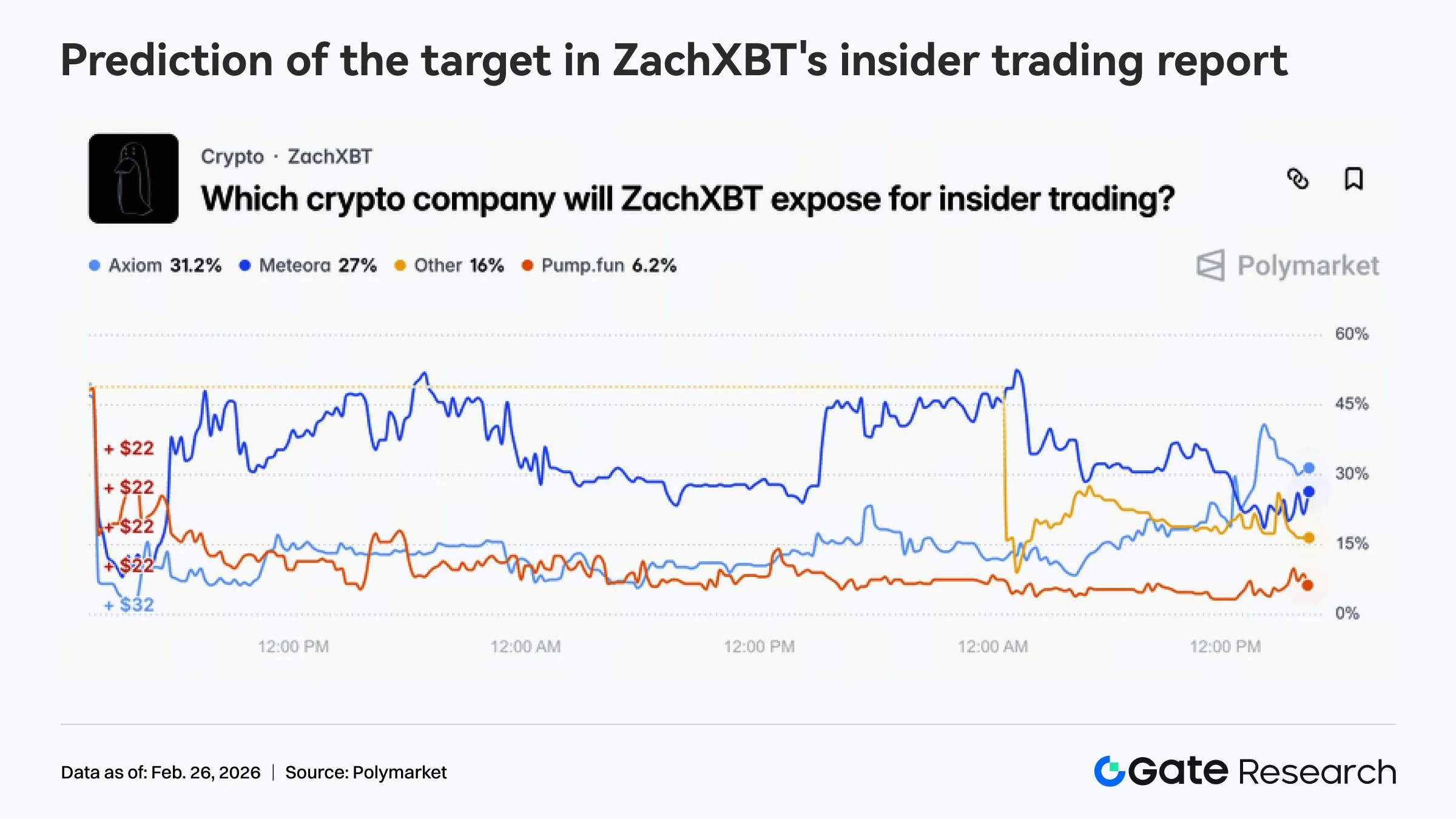
ZachXBT later acknowledged that information had “inevitably leaked” due to the need to interview multiple sources. He also expressed surprise at the teaser’s unexpected virality, noting that previous investigation previews had never sparked such large-scale prediction market activity. With February 26 marking the official release date, the crypto industry is now anxiously awaiting full details. The event has already intensified debates around insider trading, transparency, and regulatory oversight, emerging as one of the most explosive developments of early 2026.
Ethereum Foundation Researcher Proposes “Strawmap” Roadmap Featuring Seven Forks
Ethereum Foundation researcher Justin Drake introduced a draft Ethereum L1 protocol roadmap titled Strawmap, outlining a potential upgrade trajectory for the Ethereum mainnet over the coming years. The roadmap is not an official forecast or binding plan, but rather an acceleration-focused coordination framework. It envisions seven forks between now and the end of 2029, roughly one hard fork every six months. The naming scheme continues Ethereum’s galaxy-themed tradition, with upcoming forks tentatively labeled Glamsterdam, Hegotá, followed by placeholder names such as I and J. Strawmap highlights five core “North Star” objectives:
- A faster L1 achieving near-instant finality
- A “gigagas” L1 enabled by zkEVM and real-time proving, targeting 1 gigagas/sec (~10k TPS)
- Ultra-high-throughput L2s via data availability sampling, targeting 1 GB/sec (~10M TPS)
- Quantum-resistant cryptography
- Native privacy support, including shielded ETH transfers
Circle Earnings Beat Expectations, USDC Growth Accelerates
Circle, the issuer of USDC and the world’s second-largest stablecoin provider, reported strong Q4 and full-year 2025 financial results, exceeding market expectations and lifting its stock (CRCL). Key highlights include:
- USDC circulation reached $75.3 billion by the end of 2025, a 72% year-over-year increase, alongside rising market share among fiat-backed stablecoins
- Q4 on-chain transaction volume surged to $11.9 trillion, up 247% YoY, signaling explosive growth in institutional, enterprise, and payment-related usage
- Total Q4 revenue and reserve income reached $770 million, up 77% YoY
- Net income totaled $133 million
Circle emphasized that USDC is increasingly positioning itself as core infrastructure for internet-native finance. The company continues advancing the Circle Payments Network and the Arc public testnet, framing its strategy around enabling frictionless cross-border payments and powering the emerging AI agent economy.
Funding Weekly Recap
According to RootData, between February 20 and February 26, 2026, a total of eight crypto and crypto-related projects announced completed financings or M&A transactions, spanning multiple sectors including trading terminals, AI, and stablecoin payments. Below is a brief overview of the week’s leading deals by funding size:
Rhythmic
On February 20, Rhythmic announced the completion of a $4 million seed round led by Dragonfly. Rhythmic is an embedded finance infrastructure platform focused on helping consumer-facing brands and internet companies seamlessly integrate financial services into their products. Its offerings include balance storage, payments, co-branded Visa cards, and rewards systems.
Based
On February 23, Based announced the completion of an $11.5 million Series A round backed by Pantera Capital. Based is an omnichannel crypto trading and consumer platform built primarily on high-performance infrastructure such as Hyperliquid. It enables users to seamlessly conduct spot and perpetual futures trading. The platform integrates DeFi trading, infrastructure support, and crypto payment functions into a unified interface, delivering aggregated liquidity, deep execution quality, and a mobile-first user experience.
Finrob
On February 25, finrob announced the completion of a $390,000 seed round backed by Maven 11. Finrob is an AI-native research platform designed for financial and cryptocurrency markets. Through a single conversational interface, users can access real-time on-chain analytics, market intelligence, and in-depth research reports without writing code. Its underlying AI stack is powered by advanced large models, including Claude, GPT-5.2, and Gemini 3.1.
Next Week to Watch
Token Unlocks
According to Tokenomist data, the market is set to see several notable token unlocks over the next seven days (Feb 27, 2026 – Mar 4, 2026). The top three unlock events are as follows:
- SUI will unlock tokens worth approximately $41.99 million, representing 1.1% of the total supply.
- JUP will unlock tokens worth approximately $40.61 million, accounting for 7.8% of the total supply.
- GRASS will unlock tokens worth approximately $11.40 million, equivalent to 11.7% of the total supply.
References:
- Gate, https://www.gate.com/trade/BTC_USDT
- Farside Investors, https://farside.co.uk/btc/
- Gate, https://www.gate.com/trade/ETH_USDT
- Gate, https://www.gate.com/crypto-market-data
- DeFiLlama, https://defillama.com/stablecoins
- Etherscan, https://etherscan.io/gastracker
- Coingecoko, https://www.coingecko.com/en/cryptocurrency-heatmap
- Rootdata, https://www.rootdata.com/Fundraising
- Tokenomist, https://tokenomist.ai/
- EF protocol, https://strawmap.org/
- Circle, https://s206.q4cdn.com/265218871/files/doc_earnings/2025/q4/earnings-result/4Q25-Earnings-Release.pdf
- Wallstreet, https://wallstreetcn.com/articles/3766200#from=ios?ivk=1
- CoinDesk, https://www.coindesk.com/markets/2026/02/24/jane-street-faces-claims-of-insider-trading-that-sped-up-terraform-s-2022-collapse-ft
- CryptoQuant, https://cryptoquant.com/insights/quicktake
Gate Research is a comprehensive blockchain and cryptocurrency research platform that provides deep content for readers, including technical analysis, market insights, industry research, trend forecasting, and macroeconomic policy analysis.
Disclaimer
Investing in cryptocurrency markets involves high risk. Users are advised to conduct their own research and fully understand the nature of the assets and products before making any investment decisions. Gate is not responsible for any losses or damages arising from such decisions.