I. Why Understanding Contract Types Matters More Than Simply Opening Positions
Many newcomers to contract trading focus solely on leverage and market direction, often overlooking a critical question: What type of contract are you actually trading? Each contract type has its own rules and position management logic. Without a clear understanding of the product structure, you lack the foundation for effective risk management.
Gate offers two primary contract types:
- Perpetual Contracts
- Delivery Contracts
While their interfaces may look similar, their core mechanisms differ significantly.
II. What Is a Perpetual Contract?
The defining feature of a perpetual contract is the absence of an expiration date. As long as your account margin remains sufficient, you can hold your position indefinitely. To keep prices aligned with the spot market, Gate perpetual contracts use a funding rate mechanism to balance long and short positions.
Perpetual contracts are best suited for:
- Short-term trading
- Swing trading
- High-frequency strategies
However, it’s important to consider the impact of funding rates on long-term positions.
III. What Is a Delivery Contract?
The main distinction between delivery and perpetual contracts is the presence of a set expiration date. When the contract expires, the system automatically settles the position at the settlement price. Delivery contracts do not require a funding rate mechanism, as prices naturally converge with spot prices. On Gate, delivery contracts typically include:
- Weekly
- Bi-weekly
- Quarterly
- Perpetual Quarterly
Delivery contracts are more suitable for:
- Medium- and long-term trend analysis
- Hedging
- Structured trading strategies
IV. Gate Platform Contract Product Structure
On the Gate contract interface, users can switch between different contract types as needed.
The platform offers several advantages:
- Clear product categorization
- Transparent margin requirements
- Explicit risk alerts
This structure helps beginners make informed choices after understanding the rules.
V. Key Differences Between Perpetual and Delivery Contracts
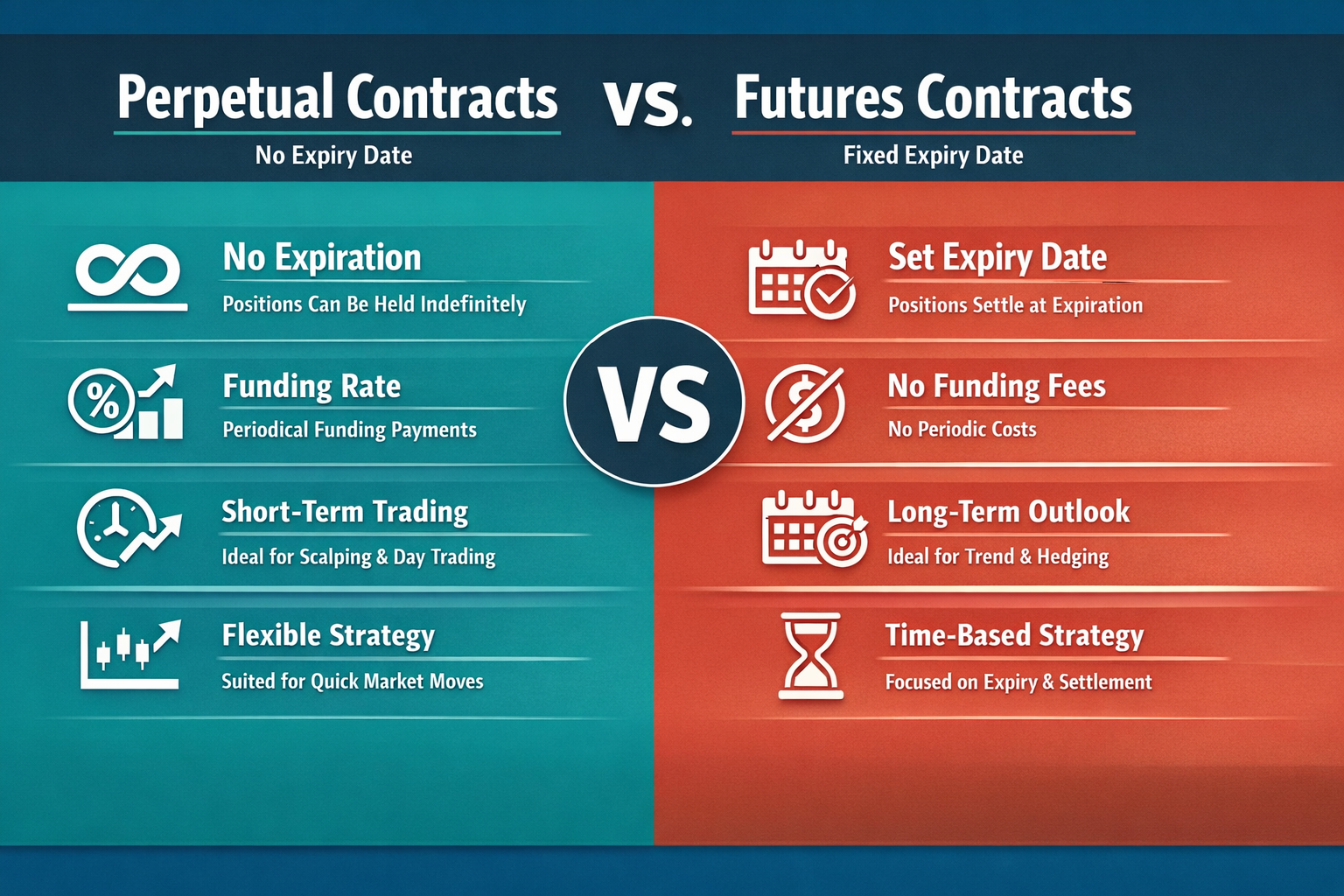
They differ across several key dimensions:
- Expiration — Perpetual contracts do not expire; delivery contracts have a set expiration
- Funding rate — Required for perpetual contracts; not applicable to delivery contracts
- Position cost structure — Perpetual contracts require attention to funding rates; delivery contracts focus on time value
- Applicable strategies — Perpetual contracts favor flexible trading; delivery contracts are suited for structured trading
Understanding these differences helps prevent confusion between the two product types.
VI. How Beginners Should Choose a Contract Type
If you are new to Gate’s contract trading, consider the following:
- For short-term trading practice, choose perpetual contracts
- For trend analysis, try delivery contracts
- If you don’t plan to hold positions long-term, funding rate impact is minimal
- If you plan to hold positions long-term, carefully compare the cost structures
Contract trading is not just about market direction—it’s about understanding the rules. Learning the product structure before selecting a contract type is the first step toward avoiding systematic mistakes.