What Is the FBTC Spot Bitcoin ETF?
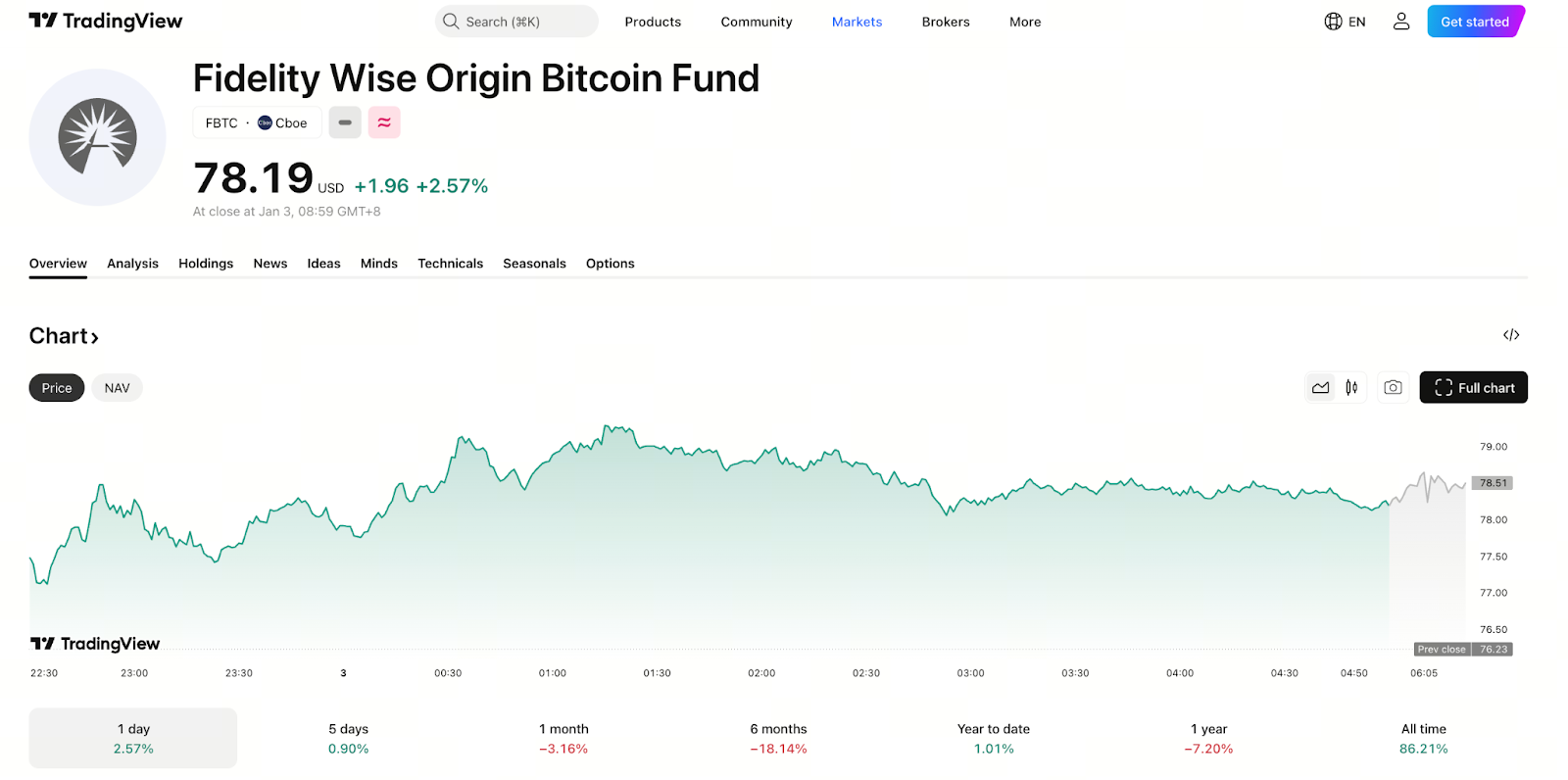
Source: https://www.tradingview.com/symbols/CBOE-FBTC/
The FBTC (Fidelity Wise Origin Bitcoin Fund) is a spot Bitcoin ETF introduced by Fidelity. It enables investors to gain exposure to Bitcoin without directly managing wallets or digital asset private keys, making it possible to access the Bitcoin market through traditional brokerage accounts. After securing approval in the US financial markets, FBTC operates with a structure similar to stock ETFs, allowing trading during standard market hours.
As a leading example of spot Bitcoin ETFs, FBTC—like similar products such as IBIT—holds actual Bitcoin rather than Bitcoin futures contracts. This means its net asset value (NAV) is closely tied to the real-time price of BTC, positioning FBTC as a core instrument in the eyes of market participants.
Recent Capital Flows and Price Impact
Spot Bitcoin ETFs have recently seen frequent capital flows, drawing significant market attention. Data shows that on certain trading days, Bitcoin ETFs—including FBTC—have posted substantial net outflows. For instance, on one trading day, US spot Bitcoin ETFs registered net outflows totaling $938 million, with FBTC accounting for one of the largest single-day outflows at approximately $345 million—one of the most significant movements in its history.
Conversely, there have been periods where net inflows have rebounded. As of early 2026, spot Bitcoin ETFs recorded daily net inflows of $471 million, with FBTC contributing about $88 million. This reflects that, following short-term market volatility, institutional capital continues to re-enter the market.
These capital flows have a direct impact on FBTC’s price. Typically, inflows help support ETF prices, while significant net outflows can increase selling pressure. When Bitcoin’s price is especially volatile, FBTC’s price often amplifies BTC’s price swings.
FBTC’s Correlation with the Broader Bitcoin Market
Because FBTC holds actual Bitcoin, its price movement is tightly correlated with BTC’s performance. When Bitcoin undergoes sharp price swings, FBTC’s market performance typically magnifies these moves. Market analyses indicate that during risk events, a drop in Bitcoin prices often triggers ETF net outflows and downward price pressure; the reverse also holds true.
Market data shows that on multiple trading days, net outflows from spot Bitcoin ETFs coincide with declines in BTC’s price, with FBTC frequently among those experiencing the largest outflows.
Nonetheless, during phases of capital inflow, FBTC once again attracts institutional attention. For example, as Bitcoin’s market dominance rises and risk appetite returns, FBTC’s net inflow figures signal renewed institutional participation.
Institutional Participation Drives Market Sentiment
Institutional interest in spot Bitcoin ETFs has continued to grow in recent years. Major financial institutions, including Bank of America, now permit their wealth management advisors to recommend various spot Bitcoin ETFs—including FBTC—as part of client asset allocation strategies.
This institutional engagement is highly significant: it not only drives larger capital inflows but also boosts the credibility of Bitcoin-related ETFs, further integrating this asset class with traditional finance.
At the same time, volatile capital flows highlight the agility of institutional money. During periods of sharp price swings, some capital exits quickly to manage risk, while during recoveries or rallies, institutional funds may flow back in. This rapid capital rotation is a key driver of FBTC’s resonance with the broader market.
Risk Warnings and Key Investor Considerations
While FBTC offers a convenient and regulated avenue for Bitcoin investment, investors must be aware of several core risks:
- Price Volatility: FBTC is highly correlated with BTC. When Bitcoin prices swing sharply, FBTC’s NAV can also fluctuate significantly.
- Liquidity Risk: Large, rapid capital outflows may intensify price pressure in the short term.
- Regulatory and Macroeconomic Factors: Shifts in regulatory policy or macroeconomic conditions can affect both Bitcoin and ETF price trends.
As a result, investors should evaluate their risk tolerance, asset allocation needs, and long-term objectives when considering FBTC, and avoid overexposure to highly volatile assets.
Summary and Outlook
Overall, the FBTC spot Bitcoin ETF serves as a vital bridge between Bitcoin and traditional financial markets. Its performance is shaped not only by BTC’s price but also by capital flows, institutional participation, and broader market sentiment. Although capital flows remain volatile, the long-term trend shows continued institutional interest.
Looking forward, as crypto asset regulations become clearer and market infrastructure matures, FBTC will remain a key entry point for Bitcoin investment. Investors, however, should approach market volatility rationally and avoid chasing momentum or panic selling.