1. Introduction: Bitcoin and the Return of the “One Million Dollar” Narrative
Recently, Coinbase CEO Brian Armstrong once again publicly expressed his strong optimism about Bitcoin’s long-term price potential—he believes Bitcoin (BTC) could reach $1 million by 2030.
This outlook quickly sparked intense debate across both the crypto industry and mainstream investment communities. For an asset class famous for its volatility, a million-dollar target signals exceptional confidence in long-term value but inevitably brings significant controversy as well.
Notably, this is not Armstrong’s first time making such a prediction. However, with current shifts in market structure, greater institutional participation, and a changing global regulatory landscape, his forecast has returned to the center of market attention.
2. Armstrong’s Key Perspectives and Statement Context
During his speech at the 2026 World Economic Forum in Davos, Armstrong highlighted that while short-term price swings are unavoidable, Bitcoin’s value remains solid over the long term as a scarce, digitally native asset.
He also stressed that policy should promote financial innovation and fair competition, rather than protecting the traditional banking system through regulatory design. In the long run, this approach to regulation will support the healthy development of the crypto asset market.
In a subsequent podcast, Armstrong further explained his bullish stance, arguing that Bitcoin could benefit from several key trends:
- The potential for the US government to establish strategic Bitcoin reserves
- Increasing clarity in crypto regulatory frameworks
- Ongoing institutional capital inflows through compliant channels
Because Armstrong rarely names specific price targets, his public reference to the “one million dollar” range is viewed by the market as a particularly strong signal.
3. Current Bitcoin Price and Market Conditions
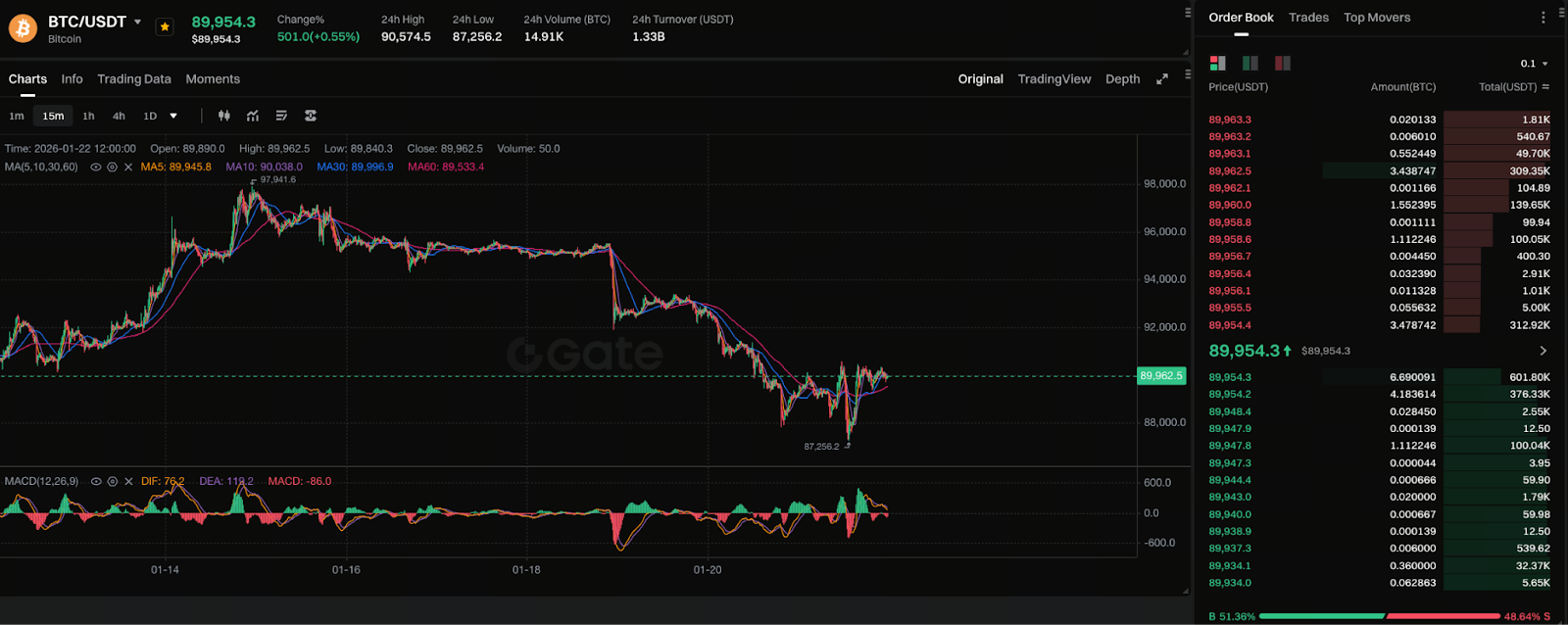
According to the latest market data, Bitcoin has recently traded around $90,000, briefly setting new all-time highs above $124,000.
Still, compared to the $1 million long-term target, today’s price remains far off. If Armstrong’s prediction proves accurate, Bitcoin would require multiple rounds of revaluation over the next several years.
At the same time, volatility remains elevated, and short-term price action continues to be driven by factors such as:
- Macroeconomic cycles and liquidity shifts
- Monetary policy expectations
- Regulatory developments and policy signals across major jurisdictions
4. Core Logic Behind the Million-Dollar Forecast
The main rationale supporting Armstrong’s forecast can be summarized as follows:
First, scarcity and monetary characteristics: Bitcoin’s total supply is permanently capped at 21 million, and this absolute scarcity is seen as a fundamental anchor for its long-term value.
Second, persistent institutional inflows: Through spot Bitcoin ETFs and other compliant instruments, a growing number of institutional investors can access the market with minimal friction, creating structural capital inflows.
Third, global demand shifts: In some emerging markets and high-inflation environments, Bitcoin is increasingly viewed as a cross-border store of value and alternative safe haven, with its use cases steadily expanding.
Fourth, improving policy and regulatory environment: Progress on stablecoin legislation and greater regulatory transparency help reduce compliance costs and increase the willingness of both enterprises and individuals to hold and use crypto assets.
As these factors converge, the market has seen the emergence of multiple long-term price models—some even more aggressive than Armstrong’s forecast.
5. Market Skepticism and Key Risk Factors
Alongside optimism, the market also includes many cautious and skeptical voices, focused on several main points:
- Timeframe and growth magnitude: From current levels, Bitcoin would need to rise 8–10x to reach the million-dollar mark—a highly aggressive assumption for any mature asset.
- Macroeconomic and regulatory uncertainty: Should major economies adopt stricter regulatory stances, the pace of institutional inflows could slow considerably.
- Technological and market competition: Growth in other crypto assets, Layer 2 solutions, and new financial infrastructure could divert demand away from Bitcoin.
- Long-term technical risks: While still in early stages, developments in frontier technologies like quantum computing could, in theory, challenge existing crypto security mechanisms.
As a result, any long-term price forecast should be viewed as a scenario analysis—not a predetermined outcome.
6. Investor Takeaways for Medium- and Long-Term Trends
When assessing long-term targets like these, investors should focus on the following principles:
- Rely on diverse sources of information, not just a single viewpoint
- Monitor on-chain data, market structure, and policy evolution as key fundamentals
- Implement robust risk management, including prudent position sizing and contingency plans for extreme volatility
- Clearly distinguish between long-term trends and short-term price moves
7. Conclusion: Balancing Imagination and Uncertainty with Rationality
Brian Armstrong’s forecast of Bitcoin reaching $1 million by 2030 presents a bold and imaginative long-term vision for the market. Yet, this outlook comes with significant uncertainties across macroeconomic, policy, technological, and market structural dimensions.
Regardless of whether this milestone is ultimately reached, understanding the underlying logic and risks remains highly relevant for investors. Deep research, independent judgment, and risk awareness continue to be essential foundations for participating in the crypto market.







