Image: https://bittensor.com/about
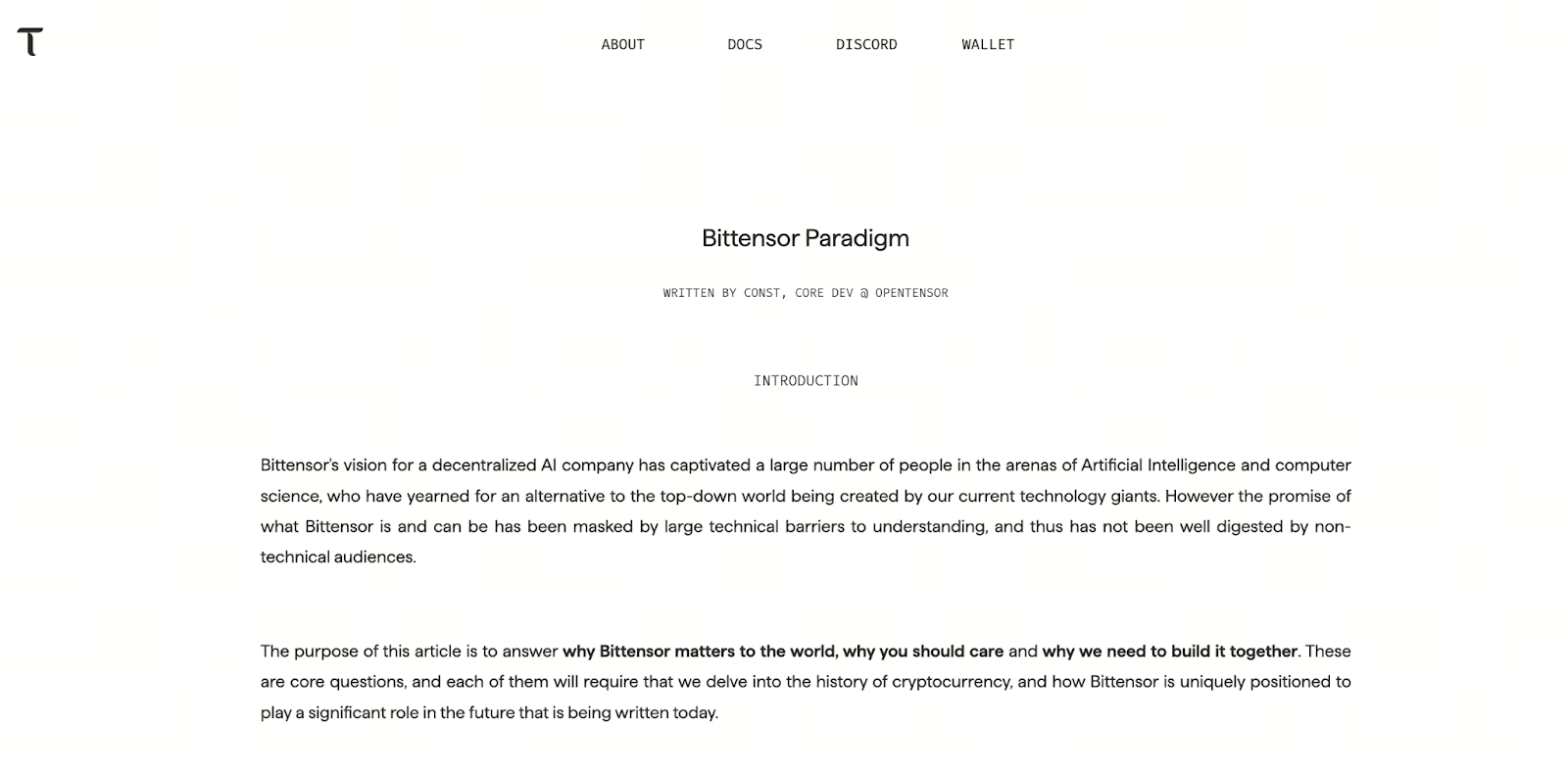
As artificial intelligence continues to transform the global landscape, leading tech companies are fortifying their advantages in computing power, talent, and data, driving AI development toward greater centralization. This concentrated structure, however, brings concerns about limited innovation and uneven allocation of intelligent resources. In response, Bittensor introduces a new paradigm for the industry—making AI a shared, collaborative public network, collectively built and governed by its participants.
Bittensor’s Core Role: A Decentralized AI Collaboration Network
Bittensor is an open-source protocol and a decentralized machine learning network built on blockchain technology. Its mission is to enable any node worldwide to participate in model training, provide data or computing services, and earn TAO tokens based on the “information value” they contribute.
In essence:
- The more valuable a node’s contribution—such as high-quality model outputs, advanced inference, or unique data—the greater its rewards.
- A stronger, more intelligent network increases underlying demand for TAO.
- Intelligence itself becomes a tradable asset, no longer monopolized by centralized corporations.
This approach is reminiscent of a transformative moment in AI—each node contributes computation and intelligence, and every participant shares in the resulting value growth.
Industry leaders recognize Bittensor as foundational infrastructure for the open-source AI economy, thanks to this open, collaborative model.
2025 Year-End Halving: TAO’s Deflationary Inflection Point
Bittensor’s first halving will occur in December 2025, reducing daily TAO issuance from 7,200 to 3,600 tokens—a 50% cut.
This mechanism is as pivotal as Bitcoin’s halving:
- Slower supply growth increases scarcity.
- Continued network activity drives higher TAO demand.
- Ongoing institutional accumulation strengthens expectations of a deflationary trend.
For a token with genuine network utility, when supply halves and demand rises, a price adjustment cycle often occurs.
This dynamic is why TAO is attracting growing interest from institutions, exchanges, and analysts throughout 2025.
Recent Price Performance: Institutional Backing and Enhanced Liquidity

Image: https://www.gate.com/trade/TAO_USDT
As of December 4, 2025, TAO trades at approximately $299. Technical analysis suggests that if TAO breaks through key resistance levels, it could see a short-term upside of 20% to 30%. However, such projections should be weighed against broader macroeconomic conditions.
Three Core Drivers: Institutional Involvement, Subnet Ecosystem, and AI Industry Momentum
1. Expansion of Institutional Holdings
Since early this year, multiple institutions have publicly increased their TAO holdings and committed to long-term lockups. For an early-stage AI project, institutional involvement typically signals:
- Confidence in the project’s long-term prospects.
- Strategic positioning in a scarce asset ahead of broader adoption.
These moves have positively impacted TAO’s price and market liquidity.
2. Accelerating Subnet Ecosystem Growth
Bittensor’s architecture features multiple “subnets,” each specializing in a specific AI capability, such as:
- Natural language processing
- Multimodal training
- Search and retrieval
- Enhanced inference
- Dataset development
- Model fine-tuning
As the number of subnets grows, the overall value of the Bittensor network rises. Increased utility drives greater TAO demand and fuels long-term ecosystem growth.
3. Rapid Advancement of the AI Sector
The AI market remains in a strong growth phase in 2025. From large model competitions to real-world deployments and surging infrastructure needs, the industry is expanding rapidly.
Within this environment:
- Decentralization
- Collaboration
- Open-source intelligence
- Incentive-driven network construction
These focal points are driving industry change, and Bittensor is leading these trends.
Risk Factors: Halving Does Not Guarantee a Bull Market—Caution Remains Essential
While the medium- and long-term outlook is strong, TAO faces several notable risks:
- Macroeconomic headwinds: Federal Reserve policy and global liquidity tightening could pressure the broader crypto market.
- Demand shortfalls: Slower subnet expansion or lagging real-world AI adoption could weaken TAO’s value proposition.
- Heightened price volatility: Reduced TAO supply may amplify short-term price swings, especially during the halving event.
- Technical execution risk: The challenges of decentralized AI remain significant. If the infrastructure fails to support large-scale AI collaboration, market valuations may be reassessed.
Investors should maintain risk awareness during upward trends and avoid making impulsive investment decisions based solely on price movements.
Conclusion: With Halving Approaching, Bittensor Stands at a Critical Juncture
As the year-end halving approaches in 2025, Bittensor is entering a pivotal phase in terms of supply, demand, institutional participation, and technological ecosystem. If subnet expansion continues and AI momentum remains strong, Bittensor could become a central narrative in the crypto market in 2026.
For investors and industry researchers with higher risk tolerance, this is an opportunity that merits close attention. Still, prudent strategies call for diversification, position management, and ongoing monitoring of the project’s real-world progress.







