Bitcoin Rebounds Strongly to $87,000: Bull Market Return or Just a Short Break?

Beginner
Quick Reads
Last Updated 2026-03-27 10:45:02
Reading Time: 1m
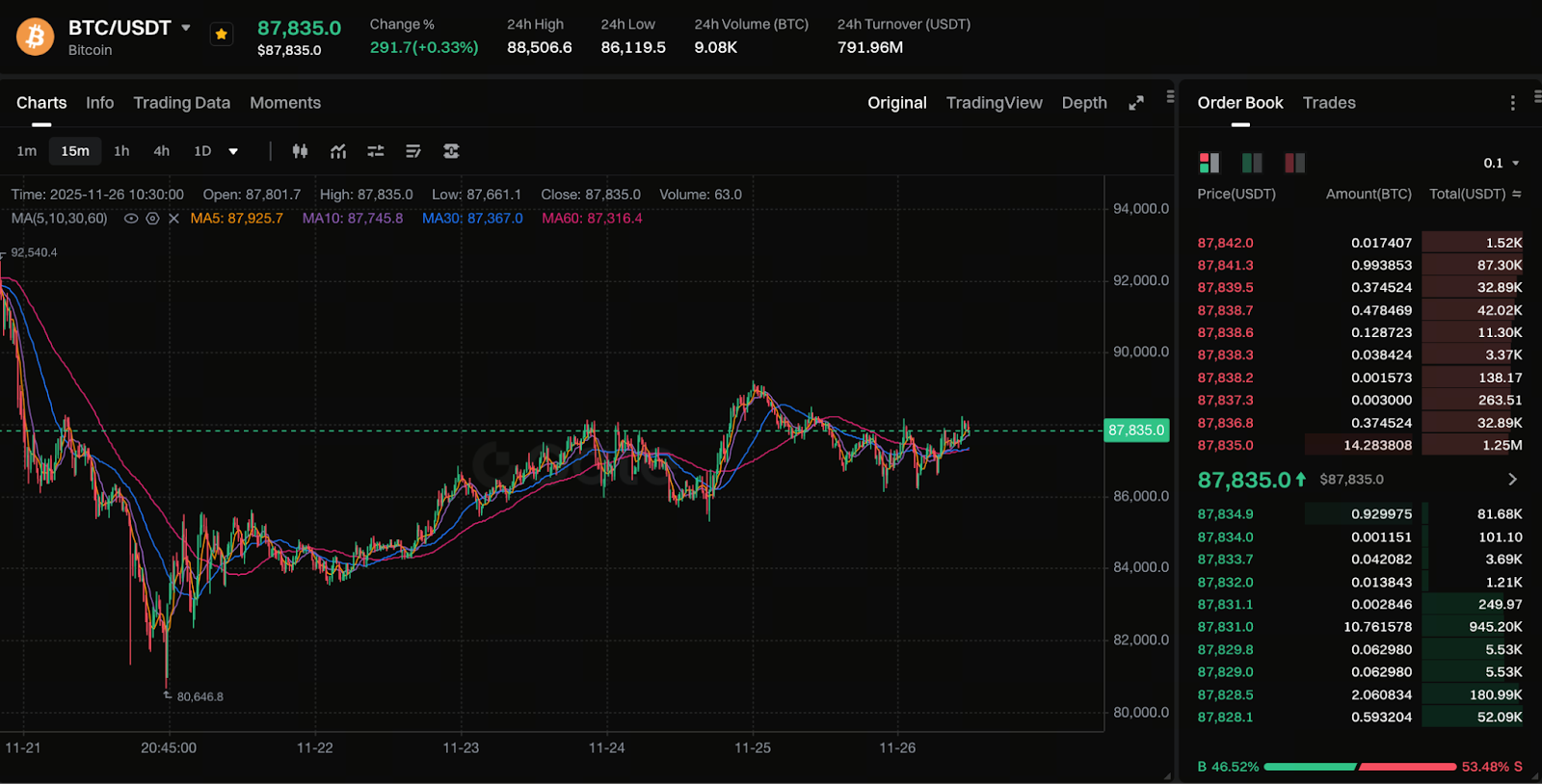
Bitcoin has recently surged from the $82,000 support level to nearly $87,000, drawing renewed market attention as investors look toward the next potential rally. This could signal the start of a new bull market, or it might be a false breakout in a highly volatile environment.


Image: https://www.gate.com/trade/BTC_USDT

Bitcoin has recently seen dramatic price swings. After a sharp drop to around $82,000, the market quickly stabilized and rebounded, with prices now approaching $87,000. This strong recovery has significantly improved market sentiment, which had turned cautious during the previous correction. Investor expectations for future price action have also strengthened.

Market Review: Robust Recovery from the $82,000 Low

During this correction, Bitcoin experienced a steady decline, repeatedly testing the key support zone between $82,000 and $83,000. Institutions regard this range as a short-term defensive point, and several on-chain metrics identify it as a cost concentration zone. Once the price stabilized here, buying pressure surged, driving BTC to rebound and break through the $87,000 mark.

This price action has restored confidence in the market’s medium-term structure. Exchange flow data shows that short-term selling pressure eased considerably after reaching key support. Institutional buying off-exchange has risen, and increased holdings by long-term investors are also evident. Short-term panic in the market has greatly subsided, as confirmed by sentiment indicators.

Core Drivers of the Rebound: Technical Stability and Inflows of Capital

Bitcoin’s rapid short-term rebound is driven by several key factors:

1. Strong Performance at Key Support Levels

The $82,000–$83,000 range is widely regarded by institutions as a robust short-term support zone. When prices stabilized in this area and trading volumes increased, technical signals were reinforced, attracting additional inflows of capital. On-chain data also indicates that long-term holders did not significantly reduce their positions near this level, reflecting strong market acceptance.

2. Short Covering Effect Fuels Price Upside

Recently, funding rates briefly turned negative, and a rapid decline led to a build-up of high-leverage short positions. As prices stabilized, these shorts faced forced stop-loss orders, which drove prices higher. Analysts note that in such conditions, short covering often accelerates rebounds, resulting in swift price rallies.

3. Improved Market Sentiment and Renewed Confidence

Bitcoin’s rebound from key support has led investor sentiment indices to recover. The stability of medium- and long-term holders provided solid price support. Capital flow indicators show that large-scale funds have returned to the spot market, signaling increased investor confidence in future trends.

Key Levels to Watch: $90,000 Resistance and Support Zone Strength

Following the rapid rebound, several price levels remain critical:

1. $90,000 as the Primary Short-Term Resistance

If Bitcoin breaks and holds above $90,000, it could unlock further upside potential, with the price possibly moving toward previous highs or new targets. A breakout typically requires a significant increase in trading volume, making sustained inflows of capital essential.

2. $82,000–$83,000 Remains the Core Market Support

If momentum fades and prices fall below this range, it could trigger another correction or a move toward lower support levels. Given the market is still in a consolidation phase, breaking support would increase short-term volatility and impact investor risk appetite.

Overall, while the current outlook is optimistic, prices remain range-bound. It is important to watch for signs of a breakout.

Risk Factors: Macroeconomic Environment, Liquidity, and Capital Flows

Despite the short-term recovery, three key risks remain:

1. Macroeconomic Uncertainty

Global markets face ongoing uncertainties around interest rate policy, liquidity shifts, and geopolitical factors. Rising macro pressures could weigh on Bitcoin prices.

2. Market Liquidity Has Yet to Fully Recover

While the rebound has brought some inflows of capital back, overall liquidity remains below previous peak levels. Without sustained inflows of capital, moving above $90,000 will remain challenging.

3. Major Capital Flows Require Further Monitoring

On-chain data shows some large addresses increasing their holdings, but a clear trend has yet to emerge. Whale activity may still drive short-term market swings.

Investor Mindset and Strategic Recommendations

For medium- and long-term investors, the recent rebound provides initial confirmation of a market bottom, which helps stabilize confidence. Short-term traders should exercise caution, as rapid price movements increase volatility.

To manage risk, investors should consider:

  • Setting clear stop-loss orders and target levels
  • Allocating positions prudently and avoiding excessive leverage
  • Monitoring key support and resistance levels
  • Using macro and on-chain indicators for comprehensive risk assessment

At this stage, Bitcoin may continue to follow a “rebound–correction–rebound” structural pattern. Maintaining patience and disciplined risk management is more important than chasing rallies or panic selling.

Author: Max
Disclaimer
* The information is not intended to be and does not constitute financial advice or any other recommendation of any sort offered or endorsed by Gate.
* This article may not be reproduced, transmitted or copied without referencing Gate. Contravention is an infringement of Copyright Act and may be subject to legal action.

Related Articles

AI-Native Settlement Layers: How United Stables Is Building the Next Financial Rail
Beginner

AI-Native Settlement Layers: How United Stables Is Building the Next Financial Rail

Stablecoins were originally designed as dollar substitutes within exchanges, primarily used for asset pricing and trade settlement. As on-chain financial ecosystems have matured, their role has expanded beyond simple payments to include collateral assets, cross-chain liquidity mediums, and unified settlement units. In particular, as AI systems and automated agents begin to participate directly in economic activity, demand has risen sharply for programmable value units capable of instant settlement. This shift is pushing stablecoins toward the role of foundational financial infrastructure.
2026-03-25 03:16:17
The ve(3,3) Flywheel Explained: How AERO Tokenomics Powers Aerodrome’s DeFi Economy
Beginner

The ve(3,3) Flywheel Explained: How AERO Tokenomics Powers Aerodrome’s DeFi Economy

In the competition for DeFi liquidity, high-inflation mining alone is no longer enough to build lasting advantages. Aerodrome applies the ve(3,3) economic model to redesign token emissions, voting mechanisms, and revenue distribution, creating a liquidity flywheel centered on governance and cash flow. This article examines AERO tokenomics, the veAERO locking mechanism, and protocol revenue models to explain how Aerodrome builds a sustainable DeFi economic system.
2026-03-25 06:41:58
Aerodrome Tokenomics: How ve(3,3) Powers Base's Most Profitable DEX
Beginner

Aerodrome Tokenomics: How ve(3,3) Powers Base's Most Profitable DEX

AERO is the native token of Aerodrome Finance, a core decentralized exchange and liquidity protocol in the Base ecosystem. It is primarily used for liquidity incentives and ecosystem operations. veAERO is a governance NFT that users receive by locking AERO, representing both voting power and the right to share protocol revenue. Through a dual track structure of AERO as a utility token and veAERO as a governance credential, Aerodrome separates liquidity usage value from long term governance power, allowing participants to act as liquidity providers, governance decision makers, and revenue sharers within the same system.
2026-03-25 06:40:31
How Does PAXG Work? In-Depth Overview of the Physical Gold Tokenization Mechanism
Beginner

How Does PAXG Work? In-Depth Overview of the Physical Gold Tokenization Mechanism

PAXG (Pax Gold) is a tokenized asset backed by physical gold, issued by the fintech company Paxos and traded on the Ethereum blockchain as an ERC-20 token. The core concept is to tokenize physical gold on-chain, with each PAXG token representing ownership of a certain amount of gold. This structure enables investors to hold and trade gold in the form of a digital asset.
2026-03-24 19:12:51
How is the price of PAXG determined? Pegging mechanism, trading depth, and influencing factors
Beginner

How is the price of PAXG determined? Pegging mechanism, trading depth, and influencing factors

PAXG (Pax Gold) is a tokenized asset backed by physical gold reserves, launched by fintech firm Paxos and issued as an ERC-20 token on the Ethereum blockchain. The core concept is to digitally represent real-world gold assets, allowing investors to hold and trade gold via the blockchain network. Because each PAXG token corresponds to a specific quantity of physical gold, its price is theoretically expected to closely track the global gold market.
2026-03-24 19:11:40
DePIN Identity Network and Real World Applications: How Humanity Protocol Brings on-chain Identity Into the Physical World
Beginner

DePIN Identity Network and Real World Applications: How Humanity Protocol Brings on-chain Identity Into the Physical World

Most Web3 identity systems remain confined to on-chain environments and struggle to achieve meaningful adoption in real world settings. Through a DePIN architecture and physical verification hardware, Humanity Protocol aims to bring decentralized identity into access control systems, hospitality, public services, and offline events, allowing on-chain identity to function not just as a digital credential, but as foundational infrastructure for real world access.
2026-03-25 07:40:53





