Bitcoin Price Prediction: Demand Weakens, Could Drop to $56,000 with Over 50% Loss

Last Updated 2026-03-26 17:56:35
Reading Time: 1m
Bitcoin’s demand growth has recently decelerated, and major institutions have begun to reduce their positions, pushing the market into a bear cycle. Analysts warn that the price may retreat to $70,000 in the short term and could potentially drop to $56,000 over the long term, with downside risk exceeding 50%.

Bitcoin Enters Bear Market

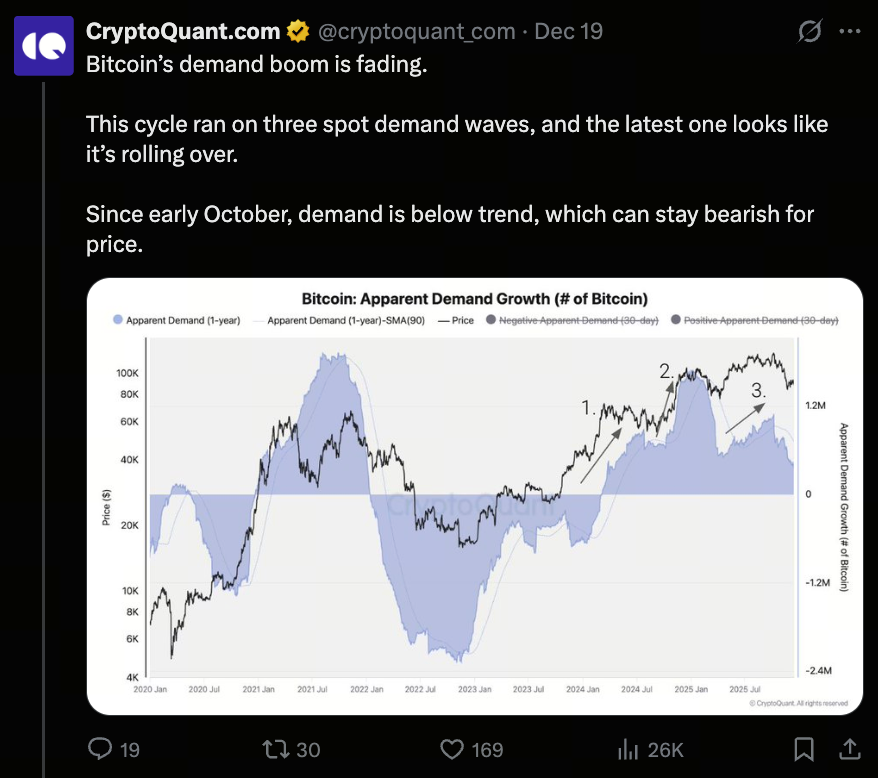
Blockchain analytics firm CryptoQuant reported Thursday that Bitcoin demand is falling, with major investors steadily reducing their positions. The market has now entered a bear phase. Their analysis suggests prices could drop further to $70,000, and in the long term, may reach as low as $56,000.

(Source: cryptoquant_com)

CryptoQuant highlighted that since 2023, Bitcoin has seen three major demand surges: the launch of US spot Bitcoin ETFs, the US presidential election, and increased purchases by corporate treasury departments. As demand growth slows, the key drivers that previously supported price momentum have faded away.

ETF and Large Holder Positions Turn Cautious

Institutional demand is cooling, drawing further attention. In Q4 2025, US spot Bitcoin ETFs shifted to net selling, reducing their Bitcoin holdings by about 24,000 coins. Wallets holding 100 to 1,000 Bitcoins—including ETF and corporate treasury wallets—also show slower accumulation. The last time this pattern emerged was just before the 2022 bear market.

Risk appetite in the derivatives market is also declining. Funding rates for perpetual contracts have dropped to their lowest levels since December 2023, signaling that traders are less willing to maintain long positions— a trend commonly seen in bear markets.

Technical Support

Bitcoin’s price has fallen below its 365-day moving average, a technical threshold that typically marks the shift between bull and bear markets. CryptoQuant notes that Bitcoin’s four-year cycle is primarily driven by demand shifts rather than halving events. Although the outlook remains bearish, this correction may be relatively moderate. Historically, Bitcoin bear market lows often align with the realized price, which is currently around $56,000—about a 55% drop from the recent all-time high. Medium-term support sits near $70,000, providing a degree of market stability.

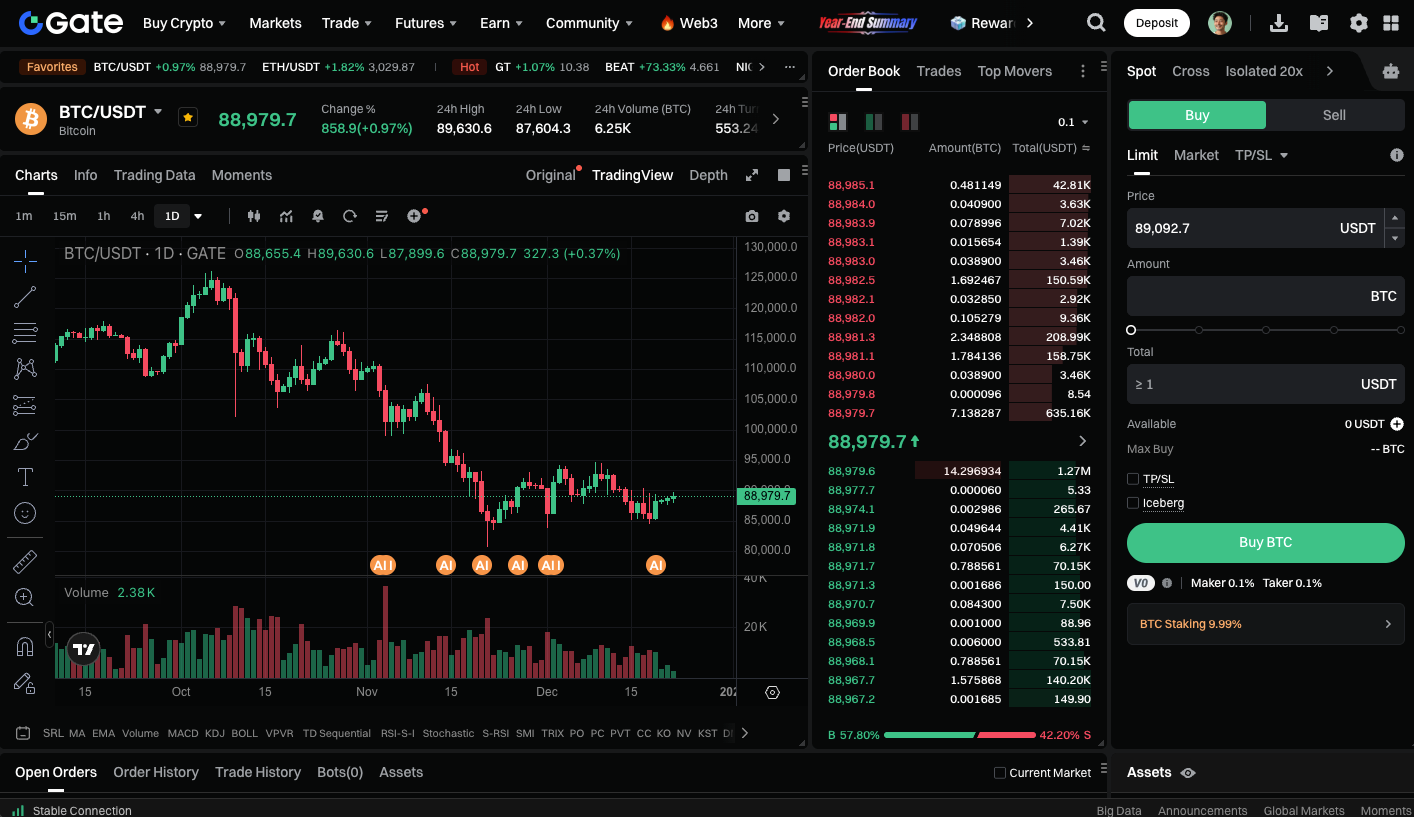
Start trading BTC spot now: https://www.gate.com/trade/BTC_USDT
Summary

Overall, Bitcoin faces mounting pressure from both weakening demand and institutional selling, leading to a cautious market sentiment in the near term. Technical analysis points to medium-term support at $70,000 and a potential long-term bottom around $56,000. For investors, while downside risks persist, this pullback could set the stage for the next bull market and present opportunities for strategic positioning.

Author: Allen
Disclaimer
* The information is not intended to be and does not constitute financial advice or any other recommendation of any sort offered or endorsed by Gate.
* This article may not be reproduced, transmitted or copied without referencing Gate. Contravention is an infringement of Copyright Act and may be subject to legal action.

Related Articles

AI-Native Settlement Layers: How United Stables Is Building the Next Financial Rail
Beginner

AI-Native Settlement Layers: How United Stables Is Building the Next Financial Rail

Stablecoins were originally designed as dollar substitutes within exchanges, primarily used for asset pricing and trade settlement. As on-chain financial ecosystems have matured, their role has expanded beyond simple payments to include collateral assets, cross-chain liquidity mediums, and unified settlement units. In particular, as AI systems and automated agents begin to participate directly in economic activity, demand has risen sharply for programmable value units capable of instant settlement. This shift is pushing stablecoins toward the role of foundational financial infrastructure.
2026-03-25 03:16:17
The ve(3,3) Flywheel Explained: How AERO Tokenomics Powers Aerodrome’s DeFi Economy
Beginner

The ve(3,3) Flywheel Explained: How AERO Tokenomics Powers Aerodrome’s DeFi Economy

In the competition for DeFi liquidity, high-inflation mining alone is no longer enough to build lasting advantages. Aerodrome applies the ve(3,3) economic model to redesign token emissions, voting mechanisms, and revenue distribution, creating a liquidity flywheel centered on governance and cash flow. This article examines AERO tokenomics, the veAERO locking mechanism, and protocol revenue models to explain how Aerodrome builds a sustainable DeFi economic system.
2026-03-25 06:41:58
Aerodrome Tokenomics: How ve(3,3) Powers Base's Most Profitable DEX
Beginner

Aerodrome Tokenomics: How ve(3,3) Powers Base's Most Profitable DEX

AERO is the native token of Aerodrome Finance, a core decentralized exchange and liquidity protocol in the Base ecosystem. It is primarily used for liquidity incentives and ecosystem operations. veAERO is a governance NFT that users receive by locking AERO, representing both voting power and the right to share protocol revenue. Through a dual track structure of AERO as a utility token and veAERO as a governance credential, Aerodrome separates liquidity usage value from long term governance power, allowing participants to act as liquidity providers, governance decision makers, and revenue sharers within the same system.
2026-03-25 06:40:31
DePIN Identity Network and Real World Applications: How Humanity Protocol Brings on-chain Identity Into the Physical World
Beginner

DePIN Identity Network and Real World Applications: How Humanity Protocol Brings on-chain Identity Into the Physical World

Most Web3 identity systems remain confined to on-chain environments and struggle to achieve meaningful adoption in real world settings. Through a DePIN architecture and physical verification hardware, Humanity Protocol aims to bring decentralized identity into access control systems, hospitality, public services, and offline events, allowing on-chain identity to function not just as a digital credential, but as foundational infrastructure for real world access.
2026-03-25 07:40:53
How is the price of PAXG determined? Pegging mechanism, trading depth, and influencing factors
Beginner

How is the price of PAXG determined? Pegging mechanism, trading depth, and influencing factors

PAXG (Pax Gold) is a tokenized asset backed by physical gold reserves, launched by fintech firm Paxos and issued as an ERC-20 token on the Ethereum blockchain. The core concept is to digitally represent real-world gold assets, allowing investors to hold and trade gold via the blockchain network. Because each PAXG token corresponds to a specific quantity of physical gold, its price is theoretically expected to closely track the global gold market.
2026-03-24 19:11:40
Aster vs Hyperliquid: Which Perp DEX Will Prevail?
Beginner

Aster vs Hyperliquid: Which Perp DEX Will Prevail?

Aster and Hyperliquid are the two representative protocols of the "purpose-built L1 path" within the current decentralized perpetual exchange (Perp DEX) sector. As a pioneer in the field, Hyperliquid has built a deep liquidity moat through its highly mature order book architecture and strong community consensus. Conversely, Aster, as a rising challenger, seeks to leapfrog the competition in high-performance trading through more aggressive multi-chain aggregation logic, private transaction modules, and an underlying execution environment optimized for 2026 market demands.
2026-03-24 11:58:33





