Bitcoin Depot Mandates ID for Every ATM Transaction Amid Legal and Fraud Scrutiny

Last Updated 2026-03-25 02:09:45
Reading Time: 1m
Bitcoin Depot, one of North America's largest crypto ATM providers, has announced that all future ATM transactions will require identity verification. This move is regarded as an enhanced effort to reinforce compliance and anti-fraud protocols following lawsuits from several state attorneys general and persistent fraud-related concerns.

Comprehensive Identity Verification for Every Transaction

Comprehensive Identity Verification for Every Transaction
(Source: CoinDesk)

Atlanta-based Bitcoin Depot announced that users will now need to complete identity verification for every transaction conducted via its cryptocurrency ATMs.

The company reported that this measure began phased rollout earlier this month. Unlike the previous policy in October 2023—which required only new users to submit identification on their first transaction—the new approach extends verification to every transaction.

CEO Scott Buchanan stated that real-time and ongoing identity checks help detect abnormal patterns missed during initial registration, further enhancing fraud prevention and user security.

Targeting Account Sharing and Fraud

Targeting Account Sharing and Fraud
(Source: Bitcoin_Depot)

Bitcoin Depot explained that mandatory verification for each transaction is designed to address the following risks:

  • Account sharing
  • Identity theft
  • Account takeover

The company emphasized that this policy is part of its compliance upgrade, with the goal of reducing fraud and illegal activity via ATMs.

Bitcoin Depot currently operates about 8,800 ATMs across North America, focusing on enabling cash purchases of Bitcoin. These devices, however, have also become targets for fraud schemes, particularly those aimed at older adults.

Multiple State Attorneys General File Lawsuits, Heightening Legal Pressure

Earlier this month, Massachusetts Attorney General Andrea Campbell filed suit against Bitcoin Depot, alleging the company knowingly allowed its ATMs to be used for scams while weakening safeguards and misleading investors. The complaint notes that prior to the October 2023 policy change, purchasing small amounts of Bitcoin required only a phone number.

Last year, the Iowa Attorney General also sued the company, alleging it charged hidden markup fees. The Massachusetts suit goes further, seeking a court order to force the company to change its business model, including:

  • Prohibiting transactions over $10,000 unless additional risk screening is conducted
  • Establishing a refund mechanism for fraud victims

Fraud Issues Continue to Escalate

FBI data projects that losses to crypto ATM scams in the US could reach $333 million in 2025. Most schemes target seniors, using pretexts like government assistance or tech support to direct victims to deposit funds into crypto ATMs. Because blockchain transactions are irreversible, recovering those funds is nearly impossible.

In 2024, losses in Arizona exceeded $177 million, prompting a warning from the state attorney general. The AARP also reported that 14 states have enacted laws targeting crypto ATMs, with states like California and Texas imposing strict transaction caps.

Company Stock Price and Market Response

Under mounting regulatory and legal pressure, Bitcoin Depot’s stock price had fallen about 6.77% to $5.37 as of press time. Over the past six months, the stock has declined roughly 80%.
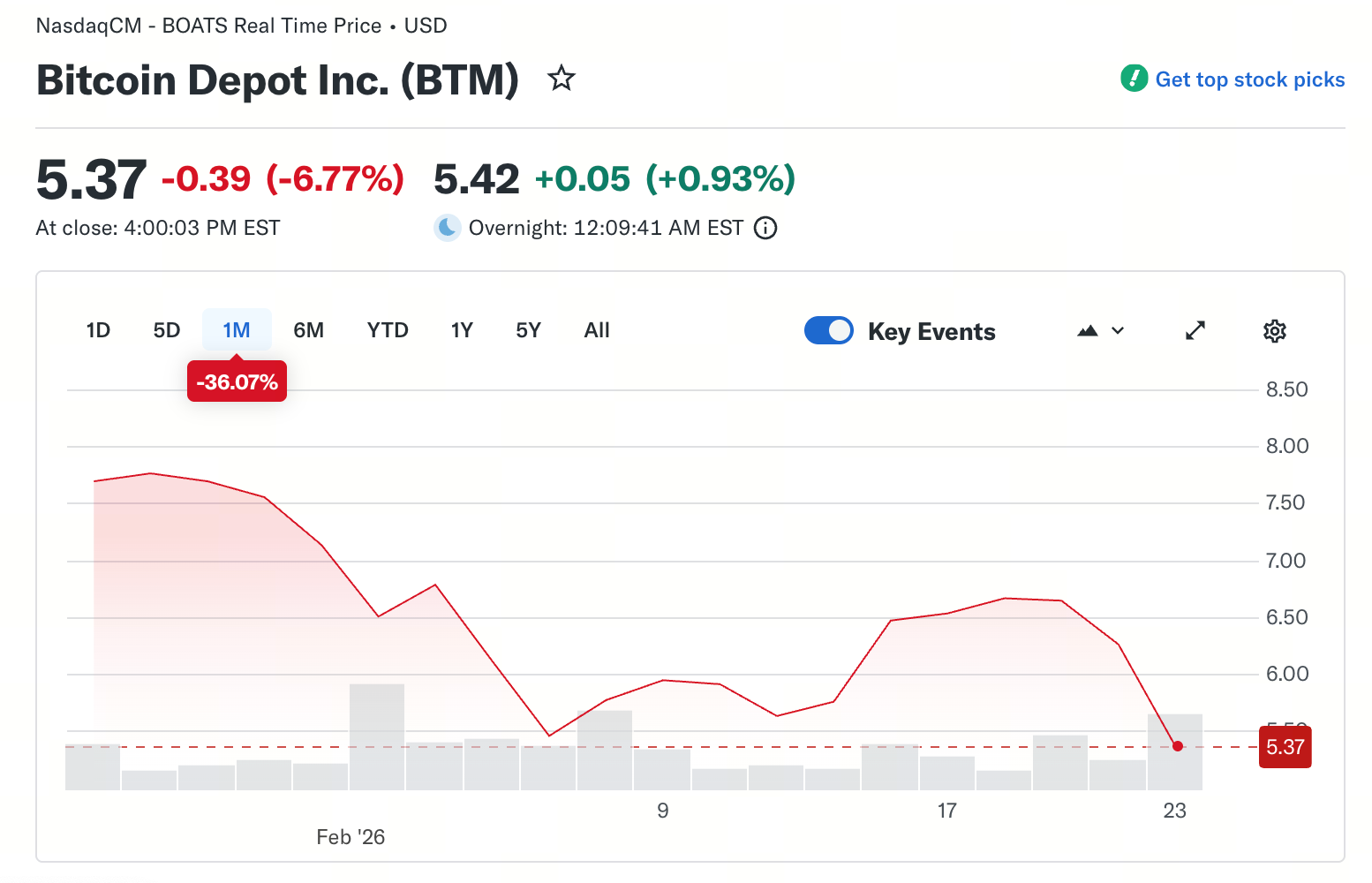
Company Stock Price and Market Response
(Source: finance.yahoo)

Despite these challenges, the company stated it will continue to cooperate with law enforcement in tracking down fraud. However, enforcement actions have sometimes been controversial—for example, in Texas, officers forcibly damaged ATMs in attempts to recover funds.

Prior Legal Cases and Settlements

In 2024, the Iowa Supreme Court ruled that Bitcoin Depot could retain ATM deposits tied to fraud, as users must declare ownership of a Bitcoin wallet before transacting. Last month, however, the company reached a $1.9 million settlement with the Maine Bureau of Consumer Credit Protection and agreed to refund fraud victims.

Summary

With state regulators increasing oversight of crypto ATMs, Bitcoin Depot is responding to public concerns by implementing comprehensive identity verification. Whether these measures will effectively reduce fraud and restore market confidence remains to be seen, but one thing is clear: the crypto ATM industry is entering a new era of stricter compliance.

Author: Allen
Disclaimer
* The information is not intended to be and does not constitute financial advice or any other recommendation of any sort offered or endorsed by Gate.
* This article may not be reproduced, transmitted or copied without referencing Gate. Contravention is an infringement of Copyright Act and may be subject to legal action.

Related Articles

AI-Native Settlement Layers: How United Stables Is Building the Next Financial Rail
Beginner

AI-Native Settlement Layers: How United Stables Is Building the Next Financial Rail

Stablecoins were originally designed as dollar substitutes within exchanges, primarily used for asset pricing and trade settlement. As on-chain financial ecosystems have matured, their role has expanded beyond simple payments to include collateral assets, cross-chain liquidity mediums, and unified settlement units. In particular, as AI systems and automated agents begin to participate directly in economic activity, demand has risen sharply for programmable value units capable of instant settlement. This shift is pushing stablecoins toward the role of foundational financial infrastructure.
2026-03-25 03:16:17
The ve(3,3) Flywheel Explained: How AERO Tokenomics Powers Aerodrome’s DeFi Economy
Beginner

The ve(3,3) Flywheel Explained: How AERO Tokenomics Powers Aerodrome’s DeFi Economy

In the competition for DeFi liquidity, high-inflation mining alone is no longer enough to build lasting advantages. Aerodrome applies the ve(3,3) economic model to redesign token emissions, voting mechanisms, and revenue distribution, creating a liquidity flywheel centered on governance and cash flow. This article examines AERO tokenomics, the veAERO locking mechanism, and protocol revenue models to explain how Aerodrome builds a sustainable DeFi economic system.
2026-03-25 06:41:58
Aerodrome Tokenomics: How ve(3,3) Powers Base's Most Profitable DEX
Beginner

Aerodrome Tokenomics: How ve(3,3) Powers Base's Most Profitable DEX

AERO is the native token of Aerodrome Finance, a core decentralized exchange and liquidity protocol in the Base ecosystem. It is primarily used for liquidity incentives and ecosystem operations. veAERO is a governance NFT that users receive by locking AERO, representing both voting power and the right to share protocol revenue. Through a dual track structure of AERO as a utility token and veAERO as a governance credential, Aerodrome separates liquidity usage value from long term governance power, allowing participants to act as liquidity providers, governance decision makers, and revenue sharers within the same system.
2026-03-25 06:40:31
DePIN Identity Network and Real World Applications: How Humanity Protocol Brings on-chain Identity Into the Physical World
Beginner

DePIN Identity Network and Real World Applications: How Humanity Protocol Brings on-chain Identity Into the Physical World

Most Web3 identity systems remain confined to on-chain environments and struggle to achieve meaningful adoption in real world settings. Through a DePIN architecture and physical verification hardware, Humanity Protocol aims to bring decentralized identity into access control systems, hospitality, public services, and offline events, allowing on-chain identity to function not just as a digital credential, but as foundational infrastructure for real world access.
2026-03-25 07:40:53
How is the price of PAXG determined? Pegging mechanism, trading depth, and influencing factors
Beginner

How is the price of PAXG determined? Pegging mechanism, trading depth, and influencing factors

PAXG (Pax Gold) is a tokenized asset backed by physical gold reserves, launched by fintech firm Paxos and issued as an ERC-20 token on the Ethereum blockchain. The core concept is to digitally represent real-world gold assets, allowing investors to hold and trade gold via the blockchain network. Because each PAXG token corresponds to a specific quantity of physical gold, its price is theoretically expected to closely track the global gold market.
2026-03-24 19:11:40
How Does PAXG Work? In-Depth Overview of the Physical Gold Tokenization Mechanism
Beginner

How Does PAXG Work? In-Depth Overview of the Physical Gold Tokenization Mechanism

PAXG (Pax Gold) is a tokenized asset backed by physical gold, issued by the fintech company Paxos and traded on the Ethereum blockchain as an ERC-20 token. The core concept is to tokenize physical gold on-chain, with each PAXG token representing ownership of a certain amount of gold. This structure enables investors to hold and trade gold in the form of a digital asset.
2026-03-24 19:12:51





