XRP Price Prediction: XRP Struggles Below $3 With Potential Drop to $2.83 as Cloud Mining Gains Attention

Last Updated 2026-03-29 11:03:16
Reading Time: 1m
On-chain data indicates that major holders are persistently selling their holdings, thereby limiting price recovery. Meanwhile, retail investors remain optimistic about XRP's long-term prospects.

Foreword

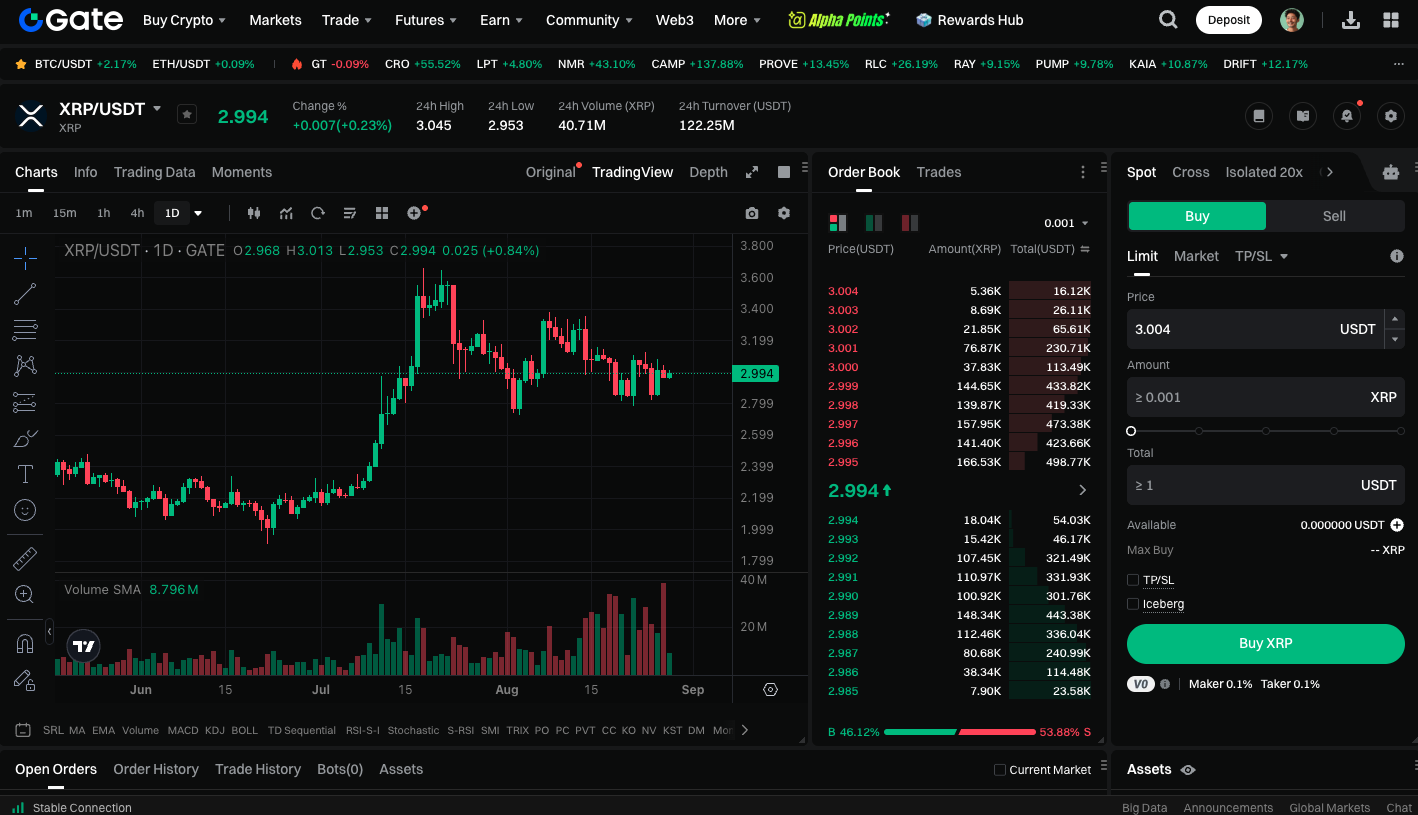
Recently, after reaching a record high of $3.65, XRP lost momentum and dipped below $3 within just a few weeks, shaking overall market sentiment. While the price made multiple attempts to break through resistance at $3.3 and $3.1, it ultimately failed to hold above either level. Should XRP remain unable to break out, it may see a short-term pullback to $2.83. Market analyst Ali Martinez has identified this level as a critical support target.

Investor Behavior and Market Contradictions

On-chain data reveals that major holders have continued offloading their positions, widely seen as a primary factor restraining any price rebound. Over the past year, XRP has posted remarkable gains, prompting some institutions and large investors to take profits at higher prices. This activity has intensified overall market uncertainty. In contrast, retail investors have shown a starkly different outlook, broadly confident in XRP’s significant potential for cross-border payments and financial use cases, and viewing it as a worthwhile asset for mid- to long-term holding. Meanwhile, professional traders and institutions remain much more cautious. Some commentators even suggest that XRP is the most disliked cryptocurrency among institutional investors.

Cloud Mining Applications Draw Attention

Despite ongoing price pressures, the market is seeing new developments. Siton Mining has introduced an XRP cloud mining application leveraging blockchain and green energy, enabling users to mine XRP from their mobile devices. This approach not only lowers hardware and maintenance costs but also achieves eco-friendly mining by utilizing distributed data centers and clean energy. Key features of the application include:

  • Daily earnings: Mining rewards are settled automatically every day, allowing users to withdraw or reinvest at any time.
  • Diverse contract selections: Options from short-term trials to long-term plans to meet varying investment needs.
  • Fund security: Multi-layer encryption and ongoing risk monitoring ensure the safety of user assets.
  • Global service: Coverage in over 180 countries with 24/7 multilingual customer support.
  • Settlement in US dollars: All mining rewards are converted to US dollars, effectively reducing exposure to token price volatility.

This innovative service drives increased participation from retail and small-to-medium investors and expands real-world use cases for XRP.

Start trading XRP spot today: https://www.gate.com/trade/XRP_USDT
Conclusion

XRP continues to face resistance within the $3.1 - $3.3 range, and a failure to break through could see a short-term decline to $2.83. However, with the rollout of cloud mining and similar applications, XRP’s ecosystem is steadily expanding, potentially laying the groundwork for stronger long-term value.

Author: Allen
Disclaimer
* The information is not intended to be and does not constitute financial advice or any other recommendation of any sort offered or endorsed by Gate.
* This article may not be reproduced, transmitted or copied without referencing Gate. Contravention is an infringement of Copyright Act and may be subject to legal action.

Related Articles

The ve(3,3) Flywheel Explained: How AERO Tokenomics Powers Aerodrome’s DeFi Economy
Beginner

The ve(3,3) Flywheel Explained: How AERO Tokenomics Powers Aerodrome’s DeFi Economy

In the competition for DeFi liquidity, high-inflation mining alone is no longer enough to build lasting advantages. Aerodrome applies the ve(3,3) economic model to redesign token emissions, voting mechanisms, and revenue distribution, creating a liquidity flywheel centered on governance and cash flow. This article examines AERO tokenomics, the veAERO locking mechanism, and protocol revenue models to explain how Aerodrome builds a sustainable DeFi economic system.
2026-03-25 06:41:58
AI-Native Settlement Layers: How United Stables Is Building the Next Financial Rail
Beginner

AI-Native Settlement Layers: How United Stables Is Building the Next Financial Rail

Stablecoins were originally designed as dollar substitutes within exchanges, primarily used for asset pricing and trade settlement. As on-chain financial ecosystems have matured, their role has expanded beyond simple payments to include collateral assets, cross-chain liquidity mediums, and unified settlement units. In particular, as AI systems and automated agents begin to participate directly in economic activity, demand has risen sharply for programmable value units capable of instant settlement. This shift is pushing stablecoins toward the role of foundational financial infrastructure.
2026-03-25 03:16:17
Aerodrome Tokenomics: How ve(3,3) Powers Base's Most Profitable DEX
Beginner

Aerodrome Tokenomics: How ve(3,3) Powers Base's Most Profitable DEX

AERO is the native token of Aerodrome Finance, a core decentralized exchange and liquidity protocol in the Base ecosystem. It is primarily used for liquidity incentives and ecosystem operations. veAERO is a governance NFT that users receive by locking AERO, representing both voting power and the right to share protocol revenue. Through a dual track structure of AERO as a utility token and veAERO as a governance credential, Aerodrome separates liquidity usage value from long term governance power, allowing participants to act as liquidity providers, governance decision makers, and revenue sharers within the same system.
2026-03-25 06:40:31
How Does PAXG Work? In-Depth Overview of the Physical Gold Tokenization Mechanism
Beginner

How Does PAXG Work? In-Depth Overview of the Physical Gold Tokenization Mechanism

PAXG (Pax Gold) is a tokenized asset backed by physical gold, issued by the fintech company Paxos and traded on the Ethereum blockchain as an ERC-20 token. The core concept is to tokenize physical gold on-chain, with each PAXG token representing ownership of a certain amount of gold. This structure enables investors to hold and trade gold in the form of a digital asset.
2026-03-24 19:12:51
How is the price of PAXG determined? Pegging mechanism, trading depth, and influencing factors
Beginner

How is the price of PAXG determined? Pegging mechanism, trading depth, and influencing factors

PAXG (Pax Gold) is a tokenized asset backed by physical gold reserves, launched by fintech firm Paxos and issued as an ERC-20 token on the Ethereum blockchain. The core concept is to digitally represent real-world gold assets, allowing investors to hold and trade gold via the blockchain network. Because each PAXG token corresponds to a specific quantity of physical gold, its price is theoretically expected to closely track the global gold market.
2026-03-24 19:11:40
DePIN Identity Network and Real World Applications: How Humanity Protocol Brings on-chain Identity Into the Physical World
Beginner

DePIN Identity Network and Real World Applications: How Humanity Protocol Brings on-chain Identity Into the Physical World

Most Web3 identity systems remain confined to on-chain environments and struggle to achieve meaningful adoption in real world settings. Through a DePIN architecture and physical verification hardware, Humanity Protocol aims to bring decentralized identity into access control systems, hospitality, public services, and offline events, allowing on-chain identity to function not just as a digital credential, but as foundational infrastructure for real world access.
2026-03-25 07:40:53





