XRP Amid Market Correction
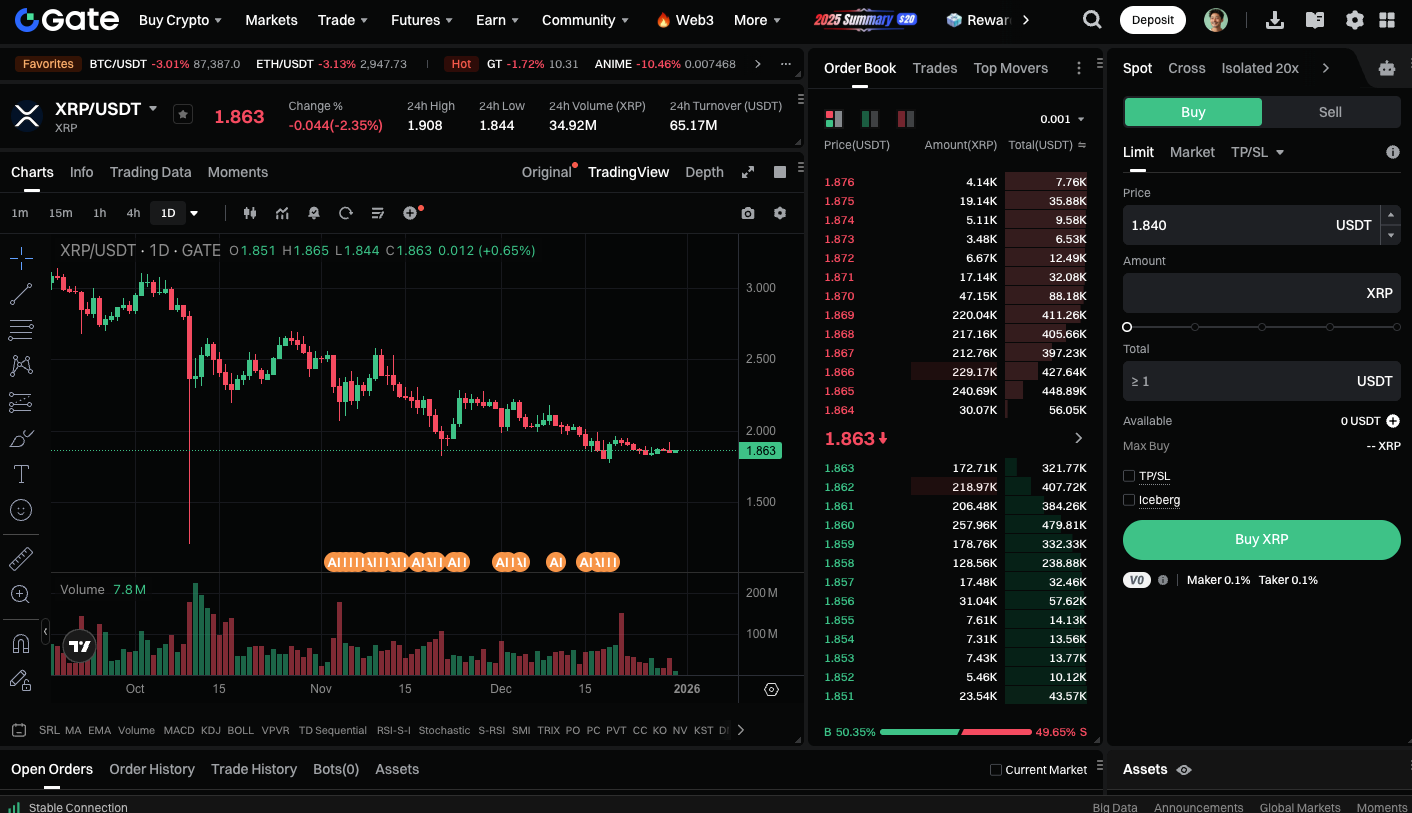
Since the overall crypto market entered a correction phase in October, XRP fell below the $2 threshold, cooling market sentiment. Despite this, XRP remains among the top five cryptocurrencies by market cap. Its short-term performance, however, is under significant pressure, with the price nearly 50% off its all-time high from July.
Market analyst Sam Daodu contends that recent price weakness does not indicate the end of XRP’s trend. Instead, several structural shifts are underway that could create a new path for XRP to reach $5 before 2026.
Key Drivers of XRP Price Movement
1. BlackRock XRP ETF Potential
Daodu first identifies the potential launch of an XRP ETF led by traditional financial giant BlackRock as a core variable. Since mid-November 2025, spot XRP ETFs have seen over $1 billion in cumulative inflows.
If BlackRock formally enters the market, new capital inflows could exceed $2 billion. This would not only reshape XRP’s capital structure but could also make it one of the few crypto assets in the US market deeply integrated with highly regulated financial products, further strengthening its valuation narrative.
2. Japanese Market and RLUSD Stablecoin Strategy
The second key driver is the strategic role of the Japanese market. Ripple is partnering with SBI Holdings to launch the RLUSD USD stablecoin in Japan in Q1 2026, pending regulatory approval.
Once RLUSD goes live on the XRP Ledger (XRPL), XRP’s utility as a bridge asset for cross-asset and cross-stablecoin transactions will increase. While the impact may not be immediate, over the long term, this development will support XRP’s push toward the $5 mark.
3. On-Chain Demand from Asset Tokenization
On the application side, Daodu highlights the significance of asset tokenization. Ripple is expanding its partnership with Archax, aiming to tokenize hundreds of millions of dollars in equities, bonds, and funds and onboard them to the XRP Ledger by mid-2026.
If XRPL captures 5% to 10% of the tokenized settlement market, the resulting on-chain transaction volume and liquidity demand will materially alter XRP’s supply-demand dynamics, providing a stronger fundamental base for price support.
4. Rotation to Risk Assets in a Rate-Cut Environment
Macroeconomic policy remains a critical factor. Markets widely anticipate that the US Federal Reserve may begin a rate-cut cycle, which would compress returns on cash and short-term bonds, driving capital back toward risk assets with growth and liquidity potential.
In this environment, XRP—with its institutional narrative, real-world applications, and regulatory progress—could become a prime beneficiary as capital is reallocated.
5. Declining Exchange Supply and Shifting Token Distribution
The final key indicator comes from on-chain data. Over the past two months, more than 1.35 billion XRP have been withdrawn from exchanges, with balances dropping from around 3.95 billion to roughly 2.6 billion XRP—over 1 billion of which moved in just three weeks. These large-scale withdrawals typically signal a shift toward long-term holding rather than short-term trading. If this trend persists, falling circulating supply will amplify price elasticity as demand returns.
Start trading XRP spot now: https://www.gate.com/trade/XRP_USDT
Summary
Daodu stresses that for XRP to reach $5 in 2026, it will take more than a single positive catalyst or a short-lived sentiment surge. Instead, it requires a confluence of ETF inflows, institutional adoption, macroeconomic conditions, and on-chain supply-demand shifts. As these factors gradually align, the medium- and long-term outlook for XRP remains compelling. However, whether this narrative translates into price momentum will ultimately depend on market execution and the test of time.







