Real Challenges Facing BTC Holders
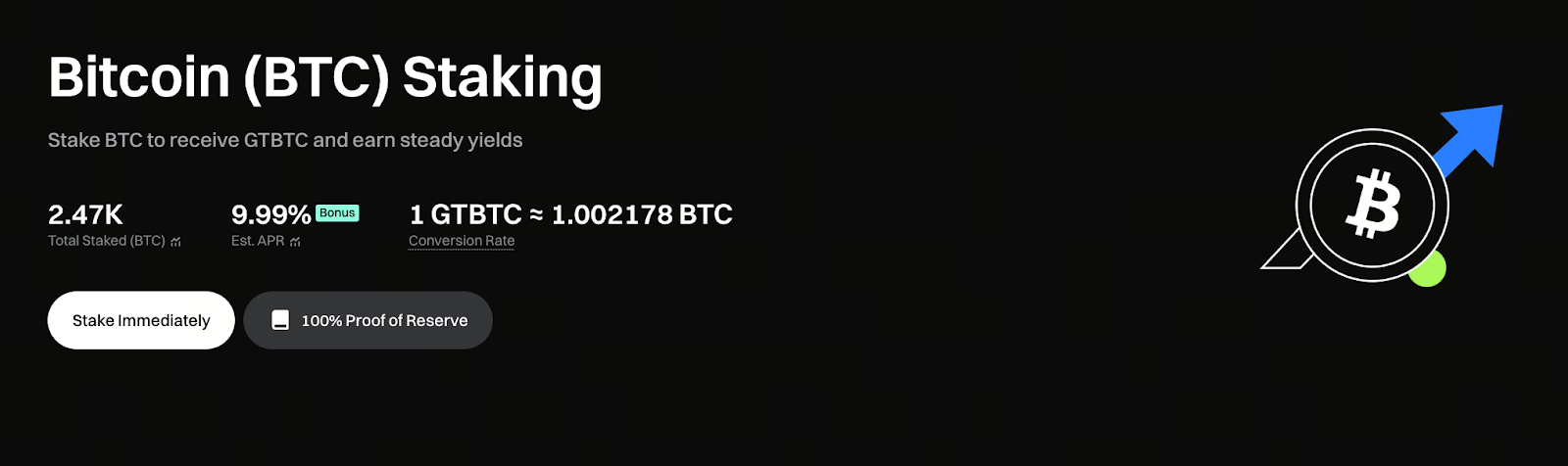
Source: https://www.gate.com/staking/BTC
Bitcoin has long been viewed primarily as a store of value. In most cases, BTC returns rely on price appreciation, and during periods of volatility or correction, the asset itself generates no cash flow.
As the market matures, more users are asking a critical question: Can BTC still deliver stable returns without high-frequency trading or excessive leverage?
GTBTC was developed to meet this emerging demand.
GTBTC: Design Philosophy and Core Logic
GTBTC is a yield-bearing wrapped BTC asset introduced by Gate, fully backed by the platform’s BTC reserves and issued as an on-chain token. The core idea is not to “create a new asset,” but to standardize and package the results of BTC participating in yield strategies within the Gate ecosystem.
When users stake BTC through Gate’s on-chain Earn platform, they receive GTBTC as a proof of ownership, maintaining their original BTC exposure.
How GTBTC Delivers Yield
Unlike traditional “daily payout” models, GTBTC uses a net asset value (NAV) accumulation approach. Yield generated from BTC staking is not distributed separately, but is continuously reflected in GTBTC’s value.
The current reference annualized yield for BTC staking is about 9.99%, with actual returns dynamically adjusted based on market conditions and participation levels. This method lowers the operational burden of managing returns and aligns with long-term holding strategies.
GTBTC’s Role in the Gate Ecosystem
Within Gate’s asset ecosystem, GTBTC is neither a simple lock-up certificate nor a high-risk derivative. Instead, it serves as a “functional BTC,” preserving native BTC attributes while adding a yield component.
Users can redeem GTBTC for BTC at any time or include it as a yield-generating element in their asset allocation to enhance overall portfolio efficiency.
What Asset Strategies Fit GTBTC?
GTBTC is best suited for users seeking stable, balanced portfolios:
- Those confident in BTC’s long-term value but not interested in short-term trading
- Those aiming to reduce idle assets during market fluctuations
- Those who prefer automated yield and low-maintenance holding options
For these users, GTBTC offers a way to make BTC work more efficiently, rather than replacing BTC itself.
Conclusion
As the crypto market matures, asset utilization is evolving. The introduction of GTBTC marks a shift in perspective: focusing not only on price movements, but on enabling core assets to generate ongoing value while being held.
For long-term BTC holders, this approach may ultimately matter more than short-term gains.







